Chemical Changes and Chemical Reactions
Squeeze lemon juice into milk and the milk curdles. Leave an iron tool out in damp air and it rusts. Burn firewood and you are left with ash. Keep milk warm overnight with a spoonful of old curd and it becomes curd. Each of these is a chemical change. In every one, the starting substance is used up and a new substance with quite different properties appears. Curdled milk neither looks nor tastes like fresh milk, and ash can never be turned back into wood.
What really happens inside a chemical change is that atoms are rearranged. Sometimes the atoms of two substances join to make one new substance. Sometimes one substance breaks apart into two or more simpler substances. Sometimes two substances swap atoms with each other. This joining, breaking apart or swapping of atoms is what we call a chemical reaction.
Chemical reaction: the process in which the atoms of substances combine, exchange places or break apart during a chemical change, so that new substances are formed.
The three examples below show one reaction of each kind:
- Combination: hydrogen gas + oxygen gas → water. Atoms of hydrogen and oxygen join together to make water.
- Decomposition: calcium carbonate → calcium oxide + carbon dioxide. A single substance breaks apart into two new substances.
- Exchange: magnesium + hydrochloric acid → magnesium chloride + hydrogen gas. Magnesium takes the place of the hydrogen in the acid, and the hydrogen escapes as a gas.
Reactants and Products
When charcoal burns, the carbon in it reacts with oxygen from the air and carbon dioxide gas is formed. We write this briefly as: carbon + oxygen → carbon dioxide. Carbon and oxygen are the substances that take part and get used up, so they are the reactants. Carbon dioxide is what the reaction makes, so it is the product.
Reactants: the substances that take part in a chemical reaction and are changed by it.
Products: the new substances obtained as the result of a chemical reaction.
Sodium metal and chlorine gas combine to form sodium chloride, the common salt we eat. Sodium and chlorine are the reactants and sodium chloride is the product. The table below separates the two parts for a few reactions:
| Reaction | Reactants | Products |
| Burning charcoal | carbon, oxygen | carbon dioxide |
| Making salt | sodium, chlorine | sodium chloride |
| Zinc in acid | zinc, hydrochloric acid | zinc chloride, hydrogen gas |
The arrow (→) is not an equals sign. Read it as "gives" or "forms". Reactants always go on the left of the arrow and products on the right. Swapping the two sides describes a completely different reaction.
Writing a Reaction as an Equation
Put a little dilute hydrochloric acid in a test tube and drop in a small piece of zinc. Tiny bubbles start rising from the surface of the zinc, and the zinc slowly gets smaller. Zinc chloride and hydrogen gas are being formed, and the bubbles are the hydrogen.
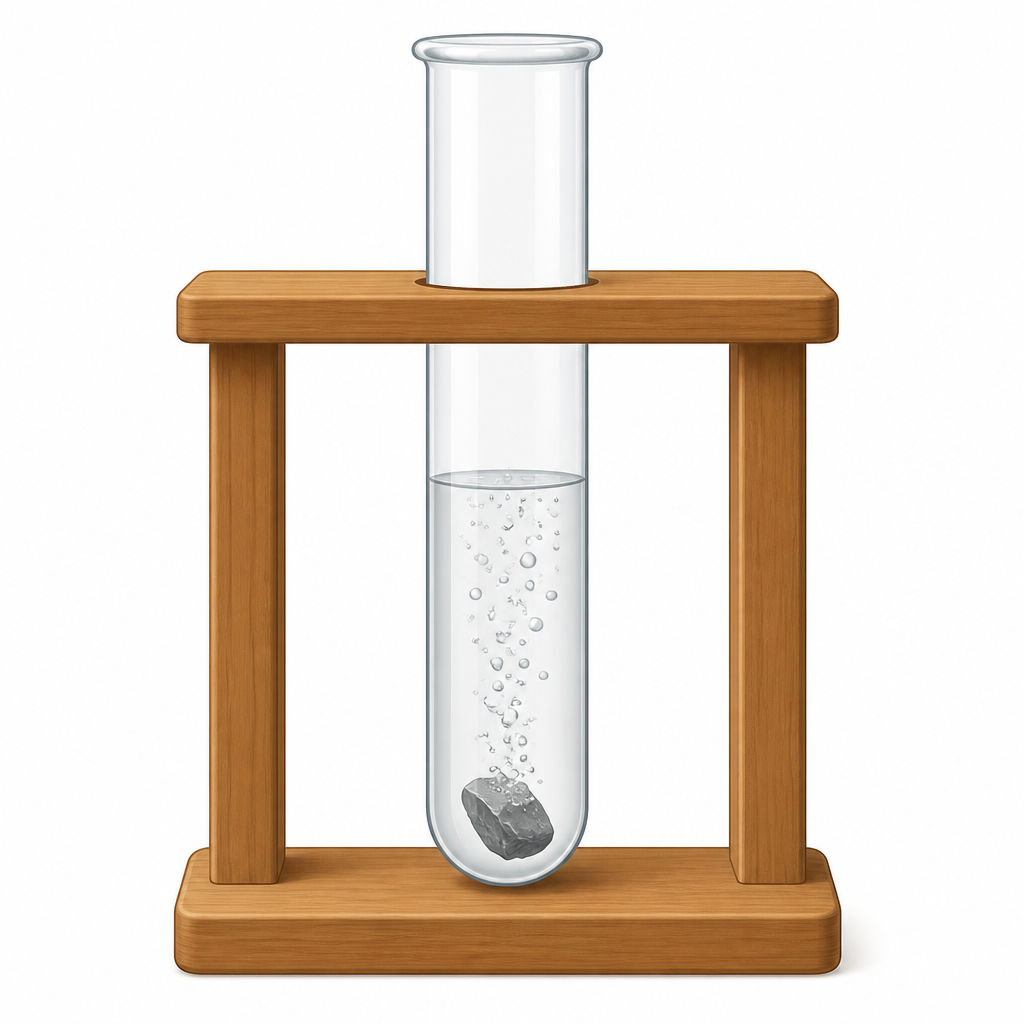
Even dilute acid must not touch your skin, eyes or clothes. Never point the mouth of the test tube towards anyone. The hydrogen given off catches fire easily, so keep flames and lit matches away.
Writing this out as a full sentence every time would be slow. So it is written in short form: zinc + hydrochloric acid → zinc chloride + hydrogen gas. Using symbols for the elements and formulas for the compounds makes it shorter still:
\[ \mathrm{Zn + 2HCl \rightarrow ZnCl_2 + H_2} \]
Writing of this kind is called a chemical equation. Zinc and hydrochloric acid are the reactants, so they sit to the left of the arrow. Zinc chloride and hydrogen are the products, so they sit to the right. When a side has more than one substance, a + sign separates them.
Chemical equation: a way of representing a chemical reaction by writing its reactants and products in words or in formulas, with the reactants on the left of an arrow and the products on the right.
A chemical equation can be written in two ways: in words, or in formulas.
Word Equations
Limestone is made of calcium carbonate. When it is heated strongly it breaks down into calcium oxide, known as quicklime, and carbon dioxide gas. Using only the names of the substances, this reaction is written as: calcium carbonate → calcium oxide + carbon dioxide.
There are no symbols or formulas here, only names. An equation like this tells you which substances react and what they form, but it tells you nothing about how many atoms each substance contains.
Word equation: a chemical equation in which the reactants and products are written using their names.
Formula Equations
Writing the same limestone reaction with symbols and formulas instead of names gives the line below. The word heat written above the arrow shows that the reaction needs heat to happen:
\[ \mathrm{CaCO_3} \xrightarrow{\text{heat}} \mathrm{CaO + CO_2} \]
Here \( \mathrm{CaCO_3} \) is the formula of calcium carbonate, \( \mathrm{CaO} \) is calcium oxide and \( \mathrm{CO_2} \) is carbon dioxide. A formula equation shows more than the names. It shows which elements each substance is made of and how many atoms of each it contains. Because scientists everywhere use the same symbols, it is also a language that everyone can read.
Formula equation: a chemical equation in which the reactants and products are written using the symbols of elements and the formulas of compounds.
| Feature | Word equation | Formula equation |
| Written with | names of substances | symbols and formulas |
| Example | hydrogen + oxygen → water | \( \mathrm{H_2 + O_2 \rightarrow H_2O} \) |
| Shows number of atoms? | no | yes |
| Can be checked for balance? | no | yes |
Counting Atoms in an Equation
Because a formula equation shows atoms, you can count the atoms of each element on both sides. Two numbers have to be read. The small number written low on the right of a symbol is the subscript. It tells how many atoms of that element are in one molecule, so \( \mathrm{O_2} \) has 2 oxygen atoms, and no number means 1. The large number written in front of a whole formula is the coefficient. It tells how many of those molecules there are. So \( \mathrm{2HCl} \) means two HCl molecules, which hold 2 hydrogen atoms and 2 chlorine atoms.
Coefficient: the number written in front of a formula in a chemical equation. It tells how many molecules of that substance there are, and every atom in the formula is multiplied by it.
As an example, count the oxygen atoms in \( \mathrm{2KClO_3 \rightarrow 2KCl + 3O_2} \).
Step 1: The equation is:
\[ \mathrm{2KClO_3 \rightarrow 2KCl + 3O_2} \]
Step 2: Counting oxygen on the left. One \( \mathrm{KClO_3} \) has 3 oxygen atoms and the coefficient is 2, so multiplying:
\[ 2 \times 3 = 6 \]
Step 3: Counting oxygen on the right. \( \mathrm{KCl} \) has no oxygen. \( \mathrm{3O_2} \) is three molecules with 2 atoms each, so multiplying:
\[ 3 \times 2 = 6 \]
Step 4: Counting potassium and chlorine. Both sides have the coefficient 2 and each formula has 1 atom of these elements, so on each side:
\[ 2 \times 1 = 2 \]
Step 5: Conclusion. Oxygen is 6 and 6, potassium is 2 and 2, and chlorine is 2 and 2, so every element has the same number of atoms on both sides.
Unbalanced Chemical Equations
Now count the atoms of each element on the left and right of three equations. The first is \( \mathrm{Zn + HCl \rightarrow ZnCl_2 + H_2} \):
| Element | Atoms in reactants | Atoms in products |
| Zinc | 1 | 1 |
| Hydrogen | 1 | 2 |
| Chlorine | 1 | 2 |
Zinc matches, but hydrogen and chlorine do not. The second equation is \( \mathrm{Mg + O_2 \rightarrow MgO} \):
| Element | Atoms in reactants | Atoms in products |
| Magnesium | 1 | 1 |
| Oxygen | 2 | 1 |
Magnesium matches but oxygen does not. The third equation is \( \mathrm{KClO_3 \rightarrow KCl + O_2} \):
| Element | Atoms in reactants | Atoms in products |
| Potassium | 1 | 1 |
| Chlorine | 1 | 1 |
| Oxygen | 3 | 2 |
Potassium and chlorine match but oxygen does not. In all three equations at least one element has a different number of atoms on the two sides, so all three are unbalanced. An unbalanced equation makes it look as if atoms appeared from nowhere or vanished during the reaction, which never happens. So an unbalanced equation has to be balanced.
Unbalanced chemical equation: a chemical equation in which the number of atoms of at least one element in the reactants is not equal to the number of atoms of that element in the products.
Balanced Chemical Equations
Here are the same three reactions written with suitable coefficients in front of the formulas. Count again. The first: \( \mathrm{Zn + 2HCl \rightarrow ZnCl_2 + H_2} \)
| Element | Atoms in reactants | Atoms in products |
| Zinc | 1 | 1 |
| Hydrogen | 2 | 2 |
| Chlorine | 2 | 2 |
Zinc, hydrogen and chlorine now all match. The second: \( \mathrm{2Mg + O_2 \rightarrow 2MgO} \)
| Element | Atoms in reactants | Atoms in products |
| Magnesium | 2 | 2 |
| Oxygen | 2 | 2 |
Magnesium and oxygen both match. The third: \( \mathrm{2KClO_3 \rightarrow 2KCl + 3O_2} \)
| Element | Atoms in reactants | Atoms in products |
| Potassium | 2 | 2 |
| Chlorine | 2 | 2 |
| Oxygen | 6 | 6 |
Potassium, chlorine and oxygen all match, so these three are balanced equations. Look closely and you will see that no small number inside any formula was changed. \( \mathrm{HCl} \) is still \( \mathrm{HCl} \). The only thing that changed is the coefficient in front of each formula.
Balanced chemical equation: a chemical equation in which the number of atoms of every element in the reactants is equal to the number of atoms of that element in the products.
In a reaction, atoms are never created and never lost. They are only rearranged. That is why a correct chemical equation is always a balanced one.
State Symbols
When you write a balanced equation, you should also show the physical state of each reactant and product. A letter in brackets is written after each formula:
- (s): the substance is a solid.
- (l): the substance is a liquid.
- (g): the substance is a gas.
When a magnesium ribbon burns in air, solid magnesium reacts with oxygen gas to form white solid magnesium oxide:
\[ \mathrm{2Mg(s) + O_2(g) \rightarrow 2MgO(s)} \]
Potassium chlorate is a solid. When it is heated, solid potassium chloride is left behind and oxygen gas is given off:
\[ \mathrm{2KClO_3(s) \rightarrow 2KCl(s) + 3O_2(g)} \]
Hydrogen and oxygen are both gases, and the water they form is a liquid:
\[ \mathrm{2H_2(g) + O_2(g) \rightarrow 2H_2O(l)} \]
State symbols are never counted as atoms. The l in \( \mathrm{H_2O(l)} \) is not an element. It only tells you that the water is a liquid.
The full lesson is waiting for you
The notes are free to read in full. A free account opens the rest of the practice, and tracks your progress and confidence score for every subject. Presentations and videos need approval from Learn Yeti.