Why Astronomy Needs Organizations
The objects that astronomy studies are extremely far away. Even inside our own solar system, Neptune is about 30.2 AU from the Sun. The nearest star to Earth after the Sun, Proxima Centauri, is about 4.2 light years away. Nobody can study things at such distances with the naked eye from a rooftop.
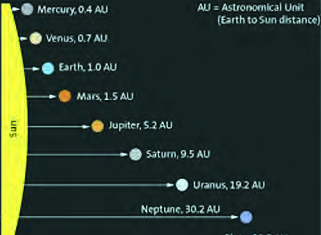
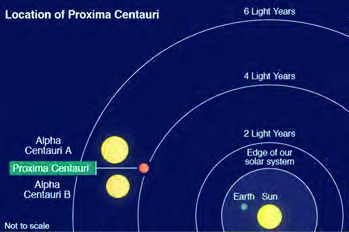
Watching objects this far away takes huge telescopes, powerful rockets, satellites, computers and hundreds of scientists working together. No single person or small group can carry that cost and that workload. So countries set up national bodies, and the world has international organizations. They carry out research, share new findings with everyone, agree on the names and definitions of objects in the sky, and draw young people towards science.
Research in astronomy is large and expensive, so organizations pool their people and money to move it forward.
Nepal Academy of Science and Technology (NAST)
The Nepal Academy of Science and Technology (NAST) is Nepal's autonomous national institution for research in science and technology, set up in 2039 BS to promote science and technology in the country.
An autonomous institution is one that runs by its own rules and makes its own decisions. NAST plans for itself what research to do and how to do it. It is the national body for scientific and technological research in Nepal, and it has four main aims:
- (a) to spread science and technology for the all-round development of the country
- (b) to protect traditional technologies and bring them up to date
- (c) to increase research in science and technology
- (d) to help identify suitable technologies and pass them on to the people who need them
The second aim is easier to picture with the water mill. The water mill built by our ancestors beside hill streams is a traditional technology. Improving it so that it grinds grain and also produces a little electricity keeps the old skill alive while making it modern. NAST encourages exactly this kind of work.
NAST has long carried out discovery, research and promotion in many fields of science and technology. It has now begun work in space research as well, and for this it is setting up the National Space Research Center.
International Astronomical Union (IAU)
The International Astronomical Union (IAU) is a non-governmental international astronomy organization founded in Paris, France, in 1919 to advance education, research and public reach in astronomy through worldwide cooperation.
Being non-governmental, it is not run by the government of any one country. Its members are 12,131 active professional astronomers from more than 100 countries. That is why a decision taken by the IAU counts as the shared decision of astronomers everywhere, not the view of a single nation.
The IAU's main work can be put simply. It arranges scientific meetings and holds an international IAU symposium every year, where astronomers present their new findings. It gives recognition, against set standards, to organizations working in space science around the world. It also defines what kinds of objects exist in the sky and gives those objects their official names.
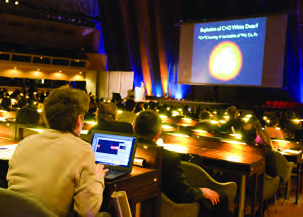
The best known example of the IAU's naming and defining work is Pluto. For many years Pluto was called the ninth planet of the solar system. On 24 August 2006 the IAU agreed a new definition of a planet, and under it Pluto was removed from the list of planets and classed as a dwarf planet. In the same way Ceres, which had been thought of as the largest asteroid, was also classed as a dwarf planet. Since that decision the solar system has only eight planets.
Dwarf planet: a body that orbits the Sun and is massive enough for its own gravity to make it nearly round, but has not cleared other objects out of the region around its orbit.
Do not write Pluto down as the ninth planet. Since 2006 it has been a dwarf planet, and the solar system has only eight planets.
International School for Young Astronomers (ISYA)
The International School for Young Astronomers (ISYA) is a project of the IAU, started in 1967. In it, teachers from many countries run seminars on chosen topics in astronomy. Participants swap experiences and learn how scientists in other countries think about a problem. The aim is to widen the participants' outlook on astronomy.
The IAU runs many other education activities too. Through astronomy it works to spark interest in mathematics and science at school level, and to inspire university graduates towards research. A student who sees the rings of Saturn through a telescope for the first time at a school star watching night may well decide to study physics later. That spark is exactly what these programmes are for.
National Aeronautics and Space Administration (NASA)
NASA is the organization, set up in 1958 under the civilian space programme of the United States of America, that leads space exploration worldwide.
At that time Russia and the USA were competing to get ahead in space science. In the middle of this race NASA started many space research missions. On 20 July 1969 NASA landed Neil Armstrong and Buzz Aldrin on the surface of the Moon, which made NASA the first organization ever to put human beings on the Moon.
NASA launches satellites for space studies, and builds spacecraft and sends them into space. For scientific research and astronomy in space it has launched the International Space Station, which travels round the Earth in an orbit about 354 km high. Astronauts living on board carry out experiments in conditions where gravity is felt very little.
As part of its exploration missions NASA has sent space probes to study the planets, moons, dwarf planets, asteroids and comets of the solar system, and the Sun itself.
Space probe: an uncrewed spacecraft carrying scientific instruments, launched to travel close to an object in space, collect information about it and send that information back to Earth.
The Parker Solar Probe, sent to study the Sun, entered the Sun's corona in December 2021. The corona is the Sun's hot outermost layer. Being inside it has let scientists study the particles and the magnetic field there from very close by.
Searching for Life on Mars
Under its mission to search for life beyond the Earth, NASA has landed robots on the surface of Mars. The Perseverance rover was launched as part of a plan to dig into the Martian surface, collect samples of the material there, and bring those samples back to laboratories on Earth for study. It landed on Mars on 18 February 2021.
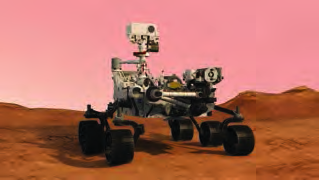
A rover is a robot vehicle that can drive itself across the surface of another world. Even though no person can go there yet, the rover's cameras and instruments send back information about the soil, rocks and air.
Telescopes in Space
The Earth's atmosphere blurs the light arriving from stars and stops some kinds of radiation from reaching the ground at all. So, under its missions to study deep space, NASA has launched telescopes above the atmosphere, into space itself.
The Hubble Space Telescope, launched in 1990, has made it far easier to uncover the strange secrets of the universe. It has sent back sharp pictures of distant galaxies, of the nebulae where stars are born, and of the planets.
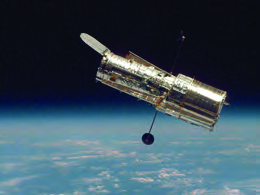
Working together with the European Space Agency and the Canadian Space Agency, NASA built the James Webb Space Telescope, which is more advanced than Hubble. It can detect infrared radiation, the heat radiation our eyes cannot see. By catching this radiation from objects hidden behind dust or lying extremely far away, it can study them. It was launched into space on 25 December 2021 and is bringing new information about many puzzles in astronomy.
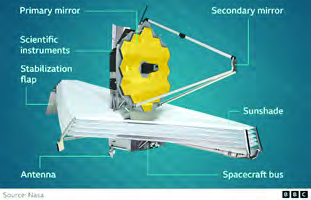
| Telescope | Launched | Built by | Special feature |
| Hubble Space Telescope | 1990 | NASA | Made it easier to uncover strange secrets of the universe |
| James Webb Space Telescope | 25 December 2021 | NASA with the European and Canadian Space Agencies | More advanced than Hubble, detects infrared radiation |
The Principle of Conservation of Energy
Everything on Earth is made of matter that was scattered when the universe was created. All the matter and energy the universe holds today has been there since that beginning. No new matter or energy is added from anywhere. What already exists simply keeps changing its form.
Principle of conservation of energy: energy can neither be created nor destroyed. It can only be changed from one form into another.
Burning firewood shows this clearly. The chemical energy stored in the wood turns into heat and light. The wood itself becomes ash, smoke, carbon dioxide and water vapour. The log seems to vanish, yet its matter and energy have only spread out into the surroundings. Nothing has been destroyed.
Living things follow the same rule. After a person or an animal dies, the body decays into simpler substances. These mix into the soil and air, and plants take them up again. Stars do the same. When a star's life ends, its matter goes back into the universe, and new nebulae and new stars can form from it.
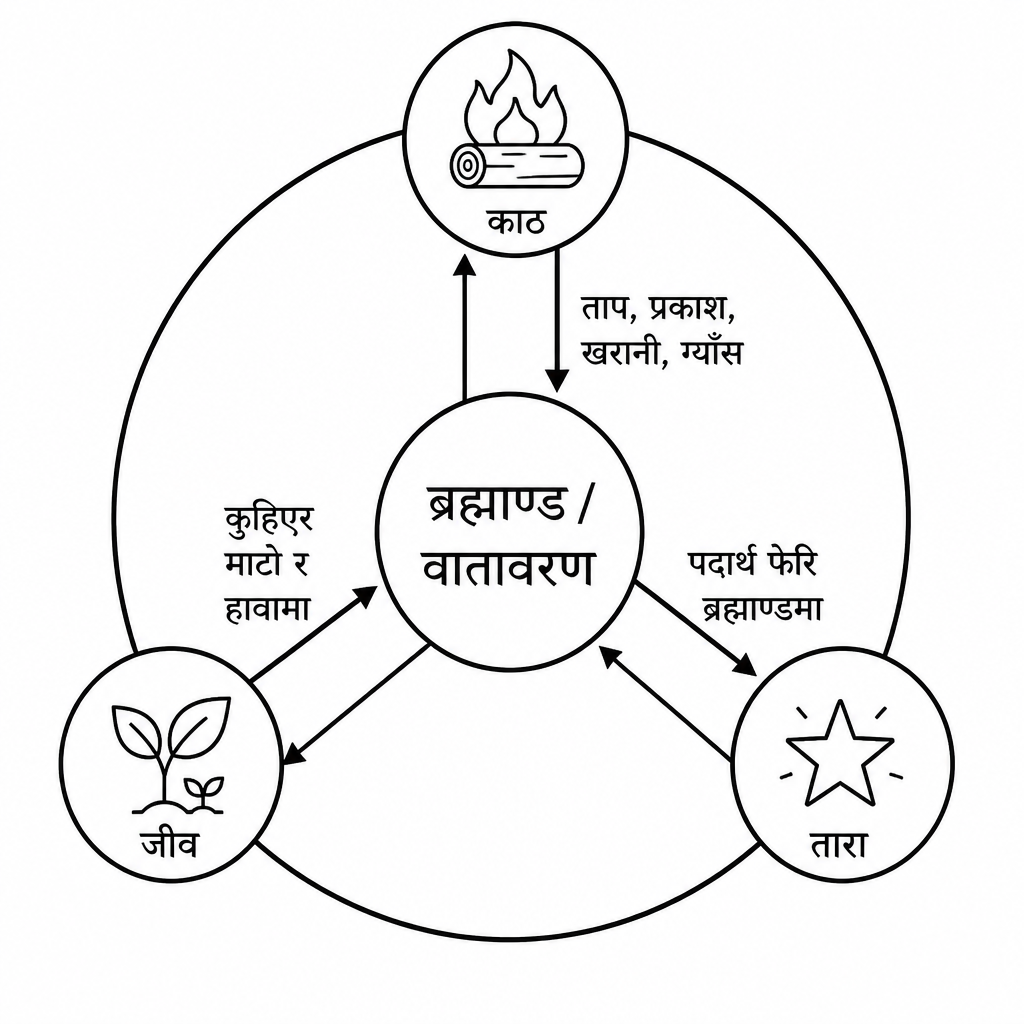
Looking at the life cycles of living things on Earth, the water cycle, the chemical cycles, and the life cycles of stars in space, one conclusion follows: everything in the universe, animals included, has a fixed lifespan. When that life is over, its energy and matter merge back into the universe.
A thing's life comes to an end, but its matter and energy do not. They change form and stay in the universe.
Astronomy and Astrology
Many people in our society treat astronomy and astrology as the same thing, but they are different. Astronomy studies planets, stars and the universe through observation, measurement and testing, and its conclusions can be checked by scientists in any country. Astrology claims to tell a person's fortune and future from the positions of the planets, and these claims have not been proved by the scientific method. NAST, the IAU and NASA are all organizations of astronomy.
| Point | Astronomy | Astrology |
| What it studies | The make-up, motion and distance of objects in space | A person's fortune from the positions of planets |
| Method | Observation, measurement and testing | Traditional calculation and belief |
| Evidence | Others can test and confirm it | Not proved by the scientific method |
The full lesson is waiting for you
The notes are free to read in full. A free account opens the rest of the practice, and tracks your progress and confidence score for every subject. Presentations and videos need approval from Learn Yeti.