The Universe: A Boundless Expanse
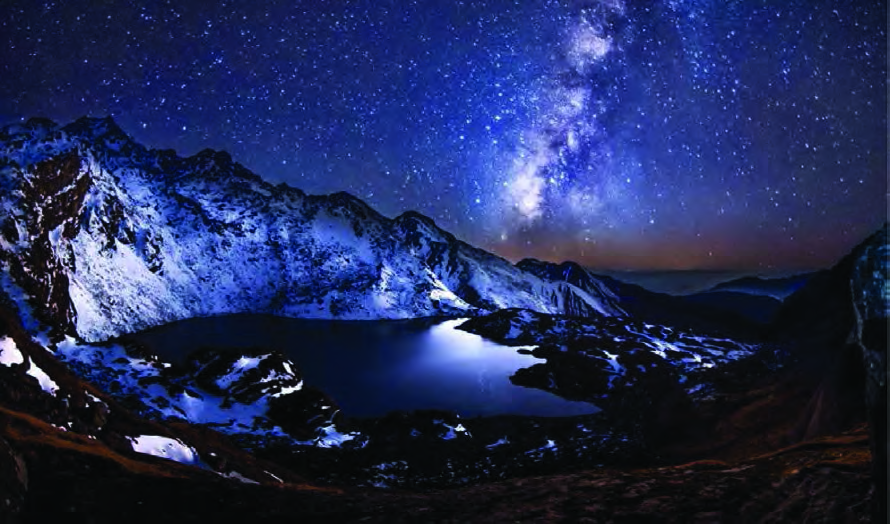
On a clear night, the naked eye can pick out countless stars. All of them belong to our own Milky Way galaxy. Each of those stars produces heat and light in the same way our Sun does, and every one of them has a definite lifespan. With telescopes, astronomers watch events such as stars exploding and stars circling bodies of enormous gravity, and the scientific facts we hold about the universe have been established from the information those observations give us.
The universe is the boundless expanse of space. All matter, all energy and time itself are contained within it.
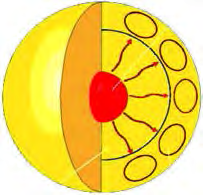
Stars and the Sun's Inner Structure
A star is a celestial body that produces heat and light. That heat and light come from nuclear fusion, in which hydrogen atoms join together to form helium.
The Sun is the star of our solar system. Energy is produced by nuclear fusion in its core, at the very centre. Around the core lies the radiative zone, where that energy travels outward by radiation, and outside it lies the convective zone, where energy is carried by convection. This process runs continuously for as long as hydrogen fuel remains in the core, which is why the Sun sends us heat and light without pause.
The stars of the universe differ widely from one another in size, mass, colour, temperature and age. Our Sun is a yellow star, its surface temperature is 5778 K, and it formed 4.6 billion years ago. Sirius A, seen beside the Orion constellation in the night sky, is the brightest star there, bluish white in colour with a surface temperature of 9940 K. Proxima Centauri is the nearest star to the Sun, sitting 4.2 light years from Earth and glowing a faint red.
A light year is the distance light travels in one year. One light year is equal to \( 9.46 \times 10^{15} \) metres.
Just like living things on Earth, stars have a life cycle. A star is born, it lives for billions of years, and it dies in an explosion. From the particles that explosion scatters, the making of new stars begins again. A star's shape, size, temperature and colour all depend on how it was born and which stage of its life cycle it has reached.
The Birth of a Star
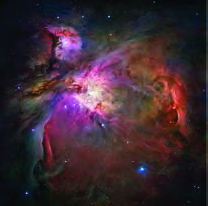
Stars are born inside nebulae. A nebula is a vast cloud of gas and dust particles, made up mainly of hydrogen and helium gas. Those particles of gas and dust were themselves thrown out when other stars exploded. Powerful telescopes let us observe some of the nebulae in the universe, and the Orion nebula, lying beside the Orion constellation, is one of the easiest to see.
A nebula is a vast cloud of dust particles and gas, mainly hydrogen and helium, and it is the place where new stars are born.
Star formation begins when gravity pulls the dust particles and gas of a nebula together, so they contract into a single mass. As the mass attracts still more gas and dust, its size keeps growing. The bigger it grows, the greater the pressure at its centre becomes, and that rising pressure drives the temperature of the core up. This huge mass, built from the joining of dust and gas, is called a protostar. Forming a protostar takes hundreds of thousands of years. As the pressure and temperature climb, nuclear fusion finally begins in the protostar's core, and at that moment a star is born. Nuclear fusion needs a temperature of about \( 10^7 \) K to begin.
A protostar is the huge mass formed when gravity squeezes together the dust and gas of a nebula, before nuclear fusion has begun in its core.
The universe holds many masses of hydrogen and helium, but not every one of them can become a star, because most never reach the minimum temperature and pressure that nuclear fusion demands. In a newly born star, the fusion reactions go on producing heat and light for billions of years.
The Death of a Star
A young star's core holds plenty of hydrogen, and thermonuclear fusion runs in it without pause. As the star ages, the hydrogen of the core is steadily converted into helium, until at last the core's hydrogen runs out. Fusion then enters its next stage, in which helium atoms are converted into carbon, so heavier and heavier atoms build up at the star's centre. But because the amount of fusion happening in the core keeps falling, the star's temperature falls with it, and as the temperature changes, the star's colour changes too.
A star's colour and temperature reveal its age. A newly formed star shines blue, while a star that has reached the last stage of its life glows red. The relation between a star's colour and its temperature is given below:
| Star colour | Temperature |
| Blue | 11,000°C to 25,000°C |
| Yellow | 5,000°C to 6,000°C |
| Orange | 3,500°C to 5,000°C |
| Red | 3,000°C to 3,500°C |
Red Giants, Novae and Supernovae
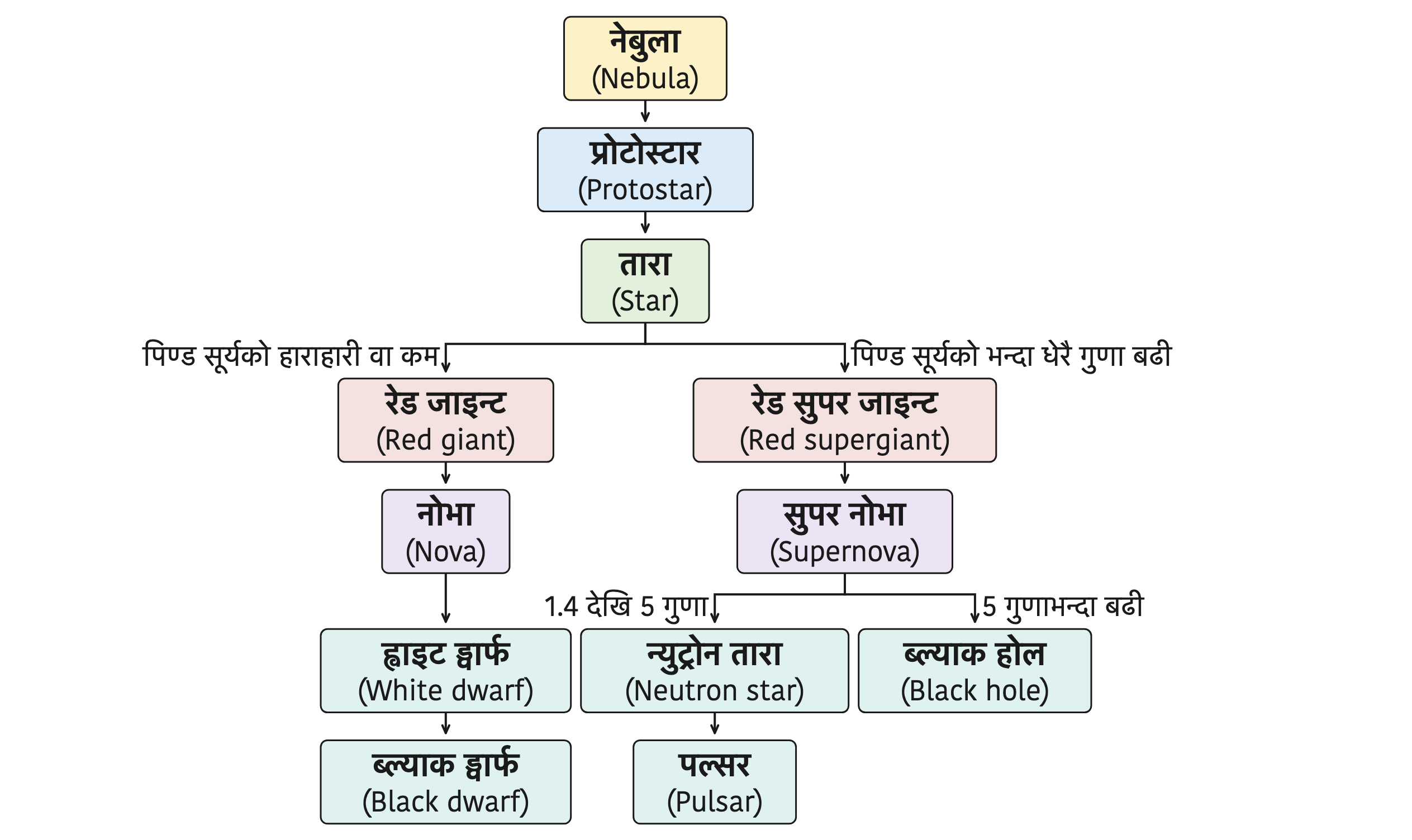
The heat produced in a star's core makes the gas of its outer layers swell outward, so a star's size grows as it ages. Old stars are red in colour and also look enormous, and for that reason they are called red giants. A red giant formed from a very large star is called a red supergiant. Small stars, on the other hand, may never become red giants at all.
In a very old star, the outer gas keeps swelling until a point comes where the core's gravity can no longer hold it, and the outer layer explodes. Such an explosion is called a nova, and a far more powerful one is called a supernova. In the explosion, the gas and dust of the star's outer layers are scattered across the universe. Those particles of gas and dust gather together again and form another nebula. Once the outer layers have blown away, only the star's core is left, and what becomes of it depends on the mass the star began with.
Here the cycle closes: the gas and dust a dying star scatters gather into a new nebula, and inside that nebula new stars are born.
What Remains After the Explosion
The future of the core left behind by the explosion is decided by the star's mass. Four outcomes are possible:
| Star's mass | What forms | Its nature |
| Less than the Sun's | Black dwarf | After a certain time nuclear fusion ends, and it remains as a small mass giving out no light. |
| About equal to the Sun's | White dwarf | Nuclear fusion keeps running in the core for a long time. It is hot but looks dim. |
| 1.4 to 5 times the Sun's | Neutron star | The core is crushed until it becomes a mass made only of neutrons. |
| More than 5 times the Sun's | Black hole | The core shrinks into an extremely small but extremely dense mass, from which not even light can escape. |
A white dwarf is hot, yet it looks dim. Over time it cools further and further, until at last it goes dark and becomes a black dwarf. A neutron star is a mass of neutrons spinning very rapidly, and a neutron star that gives off continuous pulses of X-rays is called a pulsar.
A black hole's gravity is so immense that even light cannot escape from it, so it turns into an invisible body. Even so, scientists have discovered that it keeps emitting X-rays continuously, and it can pull in the bodies around it and absorb them into itself.
A black dwarf and a black hole are not the same thing. A black dwarf is a small dead star that has cooled after its fusion ended, but a black hole is the crushed core of a star more than 5 times the Sun's mass, a body of such immense gravity that not even light can escape it.
The full lesson is waiting for you
The notes are free to read in full. A free account opens the rest of the practice, and tracks your progress and confidence score for every subject. Presentations and videos need approval from Learn Yeti.