How the Universe Began: The Big Bang
Nobody has found solid proof of how the universe began. One thing, however, can actually be measured: the universe is still spreading out. In 1920 the Belgian scientist Georges Lemaitre discovered that our own galaxy, the Milky Way, and many other galaxies are moving away from one another. If every galaxy is drifting apart today, then at some time in the past they must all have been squeezed together in one place. Scientists therefore believe the universe began with the explosion of an extremely compressed mass. That explosion is called the Big Bang. According to this theory, the universe came into existence about 13.8 billion years ago.
Big Bang: the event in which the universe is believed to have begun, with the explosion of an extremely compressed mass, about 13.8 billion years ago.
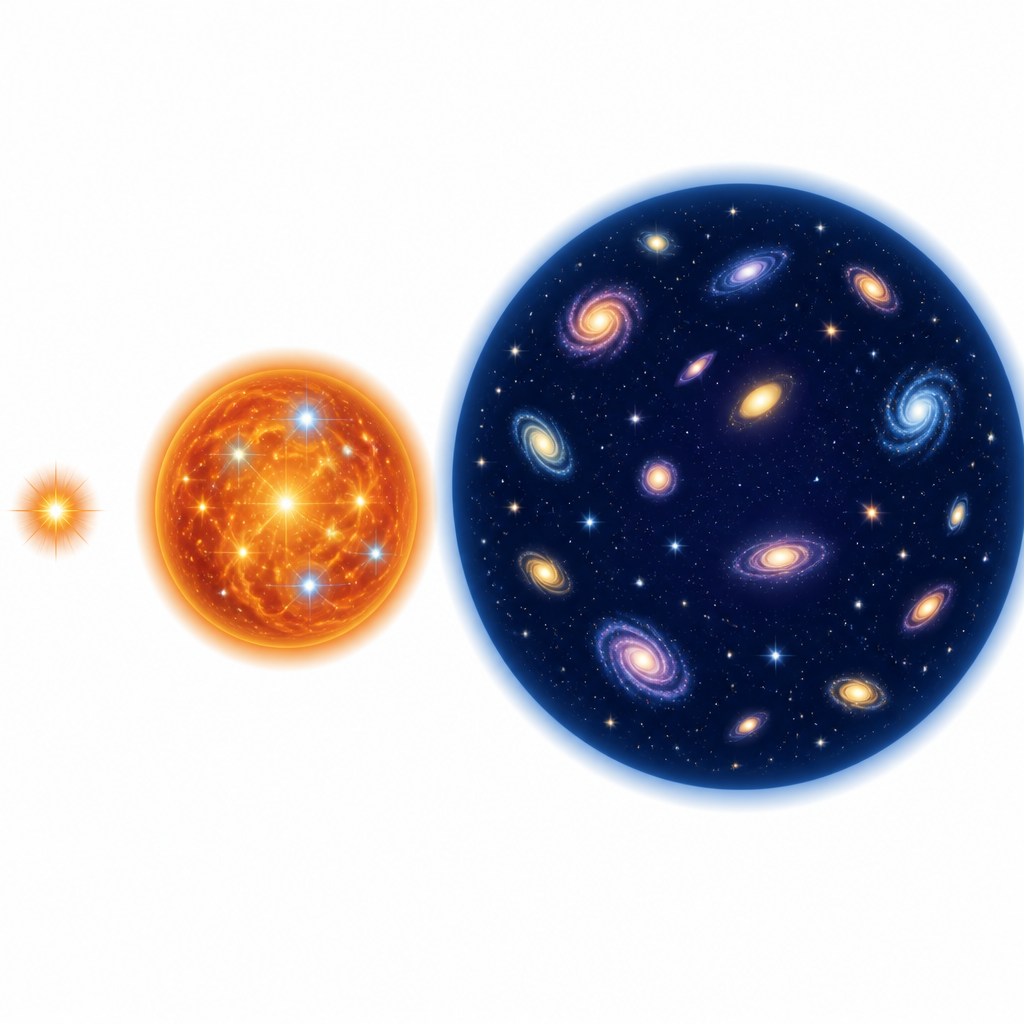
The stars and galaxies we can see make up only a small part of the mass of the universe. The rest is energy and matter that is not easy to observe. This is why we say the universe is made of matter and energy.
Nothing in the Universe Stands Still
No body in the universe is at rest. Every object is moving with respect to some reference point. For example, while the Moon revolves around the Earth, the Earth itself is revolving around the Sun. During that same time the Sun is also revolving around the centre of the Milky Way galaxy. So the very Earth we sit on is taking part in several motions at once. It only feels still to us because we are moving along with it.
Motion is always judged against a reference point. Every body in the universe is moving with respect to some point, so there is no completely motionless object anywhere in the universe.
Galaxies, Our Solar System and Their Ages
The universe holds countless galaxies. The nearest large galaxy to our Milky Way is the Andromeda galaxy, which lies about 2.5 million light years from the Earth. Even within a single galaxy the stars are not all the same age. Some stars are still forming right now while others are already billions of years old.
Our solar system sits near one edge of the Milky Way. It formed about 4.6 billion years ago. The oldest material found on Earth so far is a zircon crystal, whose age has been calculated at about 4.4 billion years. This tells us the Earth itself had formed within a short time of the birth of the solar system.
Astronomers have also discovered planets around other stars that are similar to the Earth in shape and size and that lie in the habitable zone of their star. The planet TOI 700 d, discovered on 5 January 2020, orbits the star TOI 700 in the Dorado constellation. That planet lies 101.4 light years from the Earth. Research into the universe and other fields of science keeps uncovering new information like this every year.
Can Scientific Theories Change?
Cosmology: the branch of science that studies the origin of the universe and how it has developed over time.
As the technology used to study the universe improves, new facts keep coming to light, and some of those facts end up replacing old theories. A famous example concerns our own solar system. Ancient science had established the geocentric theory, which placed the Earth at the centre with everything revolving around it. Modern science replaced it with the heliocentric theory, because the evidence showed that the planets actually revolve around the Sun.
In the same way, the celestial body Pluto was accepted as a planet of the solar system until 2006. In that year scientists prepared a fresh set of criteria for what counts as a planet, and by those criteria Pluto was removed from the list of planets. The very definition of a planet was rewritten on the basis of new evidence, and under the new definition Pluto no longer qualified. Because new studies, discoveries and research go on continuously in every field, science is always in motion, never final.
A scientific theory is not a final truth. When new evidence appears, an old theory can be corrected or replaced. This willingness to change is exactly what makes science trustworthy.
The Future of the Universe: The Big Crunch
Scientists have made several hypotheses about the future of the universe on theoretical grounds. According to one of them, the expansion of the universe will one day stop and the universe will begin to contract. As it shrinks, all its matter will squeeze together into a single point, creating the Big Crunch, and from that point another Big Bang will begin again. This remains a hypothesis for now, not a proven fact.
Units for Measuring Distances Between Celestial Bodies
Could we express the distance between the Earth and the Moon, or between the Sun and the Earth, in the metre and the kilometre we use in daily life? Celestial bodies lie extremely far from one another. Measuring the distances between them with our everyday length units is not practical, because the numbers become so enormous that they are hard even to write down and to understand. For this reason separate units have been defined for celestial distances. The value of each of these units is many times larger than the metre, the standard unit of length.
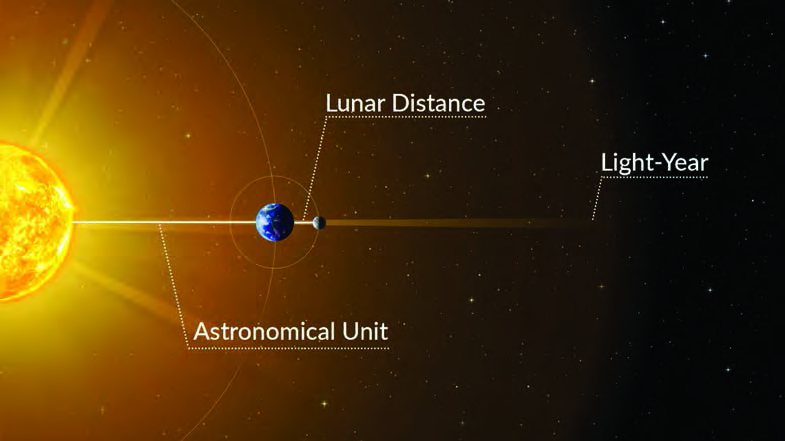
The main units used to measure distances between celestial bodies, their definitions, their symbols and their relation to the metre are given in the table below.
| Unit | Definition | Symbol | Value in metres |
| Astronomical Unit | The average distance between the Sun and the Earth is called one astronomical unit. | AU | \( 1 \, \text{AU} = 1.5 \times 10^{11} \, \text{m} \) |
| Light Year | The distance light travels in one year is called one light year. | lyr | \( 1 \, \text{lyr} = 9.46 \times 10^{15} \, \text{m} \) |
Astronomical Unit: the average distance between the Sun and the Earth. Its symbol is AU, and \( 1 \, \text{AU} = 1.5 \times 10^{11} \, \text{m} \).
Light Year: the distance that light travels in one year. Its symbol is lyr, and \( 1 \, \text{lyr} = 9.46 \times 10^{15} \, \text{m} \).
Using the Astronomical Unit and the Light Year
The astronomical unit is used to measure the distances of planets. For example, the planet Mars lies about 1.5 AU from the Sun, which means one and a half times the average distance between the Sun and the Earth. Stating distances inside the solar system in AU makes them easy to compare: one glance tells you how many times farther from the Sun a planet is than the Earth.
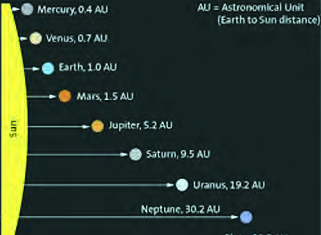
For distances between stars and between galaxies, the light year is used instead. The kilometre is far too small for stellar distances, and a much larger unit is needed, so astronomers use the light year. For example, the nearest star to the Earth after the Sun, Proxima Centauri, lies 4.246 light years away. That means the light leaving that star takes more than four years to reach us.
Although the light year has the word year in it, it is a unit of distance, not of time. One light year is the distance light covers in one year. Writing that the light year measures time is a serious mistake in an exam.
How Many Metres Are in One Light Year?
The speed of light is \( 3 \times 10^{8} \, \text{m/s} \), which means light covers three hundred million metres in every second. A year has 365 days, a day has 24 hours, an hour has 60 minutes and a minute has 60 seconds. Multiplying all of these together by the speed of light gives the distance light travels in one year.
Step 1: Counting the total seconds in one year:
\[ 365 \times 24 \times 60 \times 60 = 31536000 \, \text{s} \]
Step 2: Multiplying by the distance light covers each second, which is \( 3 \times 10^{8} \, \text{m} \):
\[ 31536000 \times 3 \times 10^{8} \, \text{m} \]
Step 3: The product gives the distance light travels in one year:
\[ 1 \text{ light year} = 9.46 \times 10^{15} \, \text{m} \]
The farther the body, the larger the unit: use the AU for distances inside the solar system, and the light year for distances between stars and between galaxies.
The full lesson is waiting for you
The notes are free to read in full. A free account opens the rest of the practice, and tracks your progress and confidence score for every subject. Presentations and videos need approval from Learn Yeti.