Ethics, Norms and Values
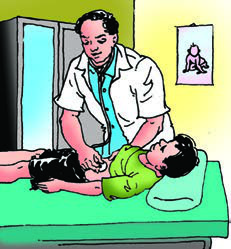
Every profession has its own rules of right behaviour. A doctor must keep a patient's information secret. A pilot must never fly a plane while tired or careless, because hundreds of lives depend on one decision. A singer owes her audience honest, well prepared performances. A teacher must treat every student fairly, whether that student is quick or slow. These unwritten and written rules are what we call professional ethics, norms and values, and people trust a profession only as long as its members follow them.
Ethics are the moral principles that tell a person what is right and what is wrong in their work and in their life. A doctor who refuses to reveal a patient's secrets is following medical ethics.
Norms are the accepted standards of behaviour that a group or a society expects from its members. Arriving on time for duty is a norm in almost every profession.
Values are the beliefs a person or a community holds about what is important in life, such as honesty, hard work and respect for others. Values guide our choices even when nobody is watching.



One value that every profession and every culture shares is owning a mistake. When we break a norm, hurt someone or let someone down, we apologise. Yet the small words we use to apologise do not mean the same thing everywhere in the world, and that surprising fact is where this unit's first reading takes us.
Why "I'm Sorry" Doesn't Always Translate

This essay, written by William Maddux, Peter H. Kim, Tetsushi Okumura and Jeanne Brett, argues that even after decades of business and political cooperation, America and Japan still trip over one seemingly simple idea: the apology. Neither culture fully understands what the other means or expects by it. When Toyota's CEO Akio Toyoda gave effusive apologies in 2010 after widespread reports of malfunctioning Prius accelerators, most Americans were unmoved. Japan, on the other hand, bristled in 2001 when a US submarine commander did not immediately apologise after his submarine collided with and sank a Japanese fishing boat off Hawaii.
The confusion goes far beyond those two countries. Virtually every culture has its own rules about saying sorry. In India, researchers have noted, apologies are far less common than in Japan. In Hong Kong they are so prevalent and ritualised that many people have become inured to them, which means they hardly notice them any more.
The core difference is culpability. Americans see an apology as an admission of wrongdoing, as if the speaker were saying "I am the one who is responsible." Japanese see it as an expression of eagerness to repair a damaged relationship, with no blame necessarily implied. Their apology is heard more like "It is unfortunate that this happened."
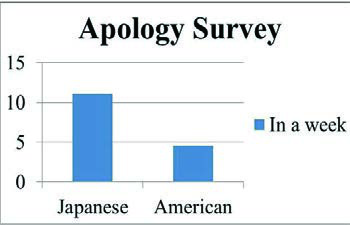
The writers tested this difference in two studies. In the first, a survey of US and Japanese undergraduates, the US students were more likely to say that an apology directly implied guilt. The Japanese students were more likely to apologise even when they were not personally responsible for what had happened, and perhaps for that reason they apologised far more often. They recalled issuing an average of 11.05 apologies in the previous week, while the US students recalled just 4.51.
In the second study, the writers looked at the utility of apologies for repairing trust. Undergraduates from both countries were asked to imagine they were managers, and were shown a video in which an applicant for an accounting job apologised for having deliberately filed an incorrect tax return for a prior client. The Japanese students were more willing than their US counterparts to trust the candidate's assertion that she would not behave that way again, and more willing to offer her the job. The writers believe this is because Americans are inclined to associate apologies with culpability, so to them the apology sounded like a confession of guilt.
Why do Westerners link apologies with blame? The essay connects it to a psychological tendency among Westerners to attribute events to individuals' actions. Japan, like many other East Asian countries, has a more group-oriented culture, so an apology there is about the situation, not the person. Researchers comparing apologies in America and China found the same pattern: US apologies serve to establish personal responsibility, while Chinese ones focus on the larger consequences of the transgression. The essay ends with advice for business leaders. Only with a deep understanding of such differences can executives use the apology as a tool for facilitating negotiations, resolving conflicts and repairing trust. Misunderstandings over apologies are just one part of a broad semantic disconnect between East and West, and managers would do well to tune in to cultural nuances that are easily lost in translation.
Pronouncing Contracted Forms
A contraction is a short form in which two words are joined and one or more letters are replaced by an apostrophe. "I'm" is the contraction of "I am", and "they'll" is the contraction of "they will".
English speakers use contractions constantly in conversation, and each one is pronounced as a single beat, not as two separate words. Practise saying each of these aloud until the two words melt into one sound.
| Contraction | Full form | It rhymes with or sounds like |
| I'm | I am | time |
| you're | you are | your |
| he's | he is or he has | sees |
| she's | she is or she has | keys |
| it's | it is or it has | its |
| we're | we are | here |
| they're | they are | there |
| I've | I have | five |
| I'd | I would or I had | side |
| they'll | they will | tale |
"You're", "they're" and "it's" sound exactly like "your", "their" and "its", but they are different words. The forms with the apostrophe always contain a hidden verb. If you can replace the word with "you are", "they are" or "it is", the apostrophe belongs there.
Apologising and Responding
An apology in English usually has two parts: the sorry itself, and a short reason or promise that shows you mean it. The person who receives the apology also has a job, which is to accept it gracefully. Read how these two short exchanges do both.
Notice the pattern. The speaker names the mistake, apologises clearly, and gives a brief reason without turning it into an excuse. The listener accepts and, where needed, adds a gentle request such as "Be careful". These are the standard structures to build from.
| Apologising | Responding to an apology |
| I'm sorry that ... | That's OK. |
| It's my fault. | It happens. |
| Oops, sorry. | No problem. |
| I should have ... | Don't worry about it. |
| I apologise for ... | I forgive you. |
Match the strength of the apology to the size of the mistake. "Oops, sorry" fits stepping on a toe or bumping into someone in a hurry. "I apologise for keeping your book so long" fits a real inconvenience you caused. For a serious mistake, add what you should have done: "I'm sorry I spilt your drink. I should have watched where I was going." Practise with everyday situations: eating a friend's chocolates, arriving late at school, forgetting to bring a friend's notebook, or tapping the shoulder of a stranger you mistook for your friend.
The Present Continuous Tense
The present continuous tense describes an action that is in progress. It is formed with am, is or are followed by the ing form of the verb: I am standing, she is reading, they are playing.
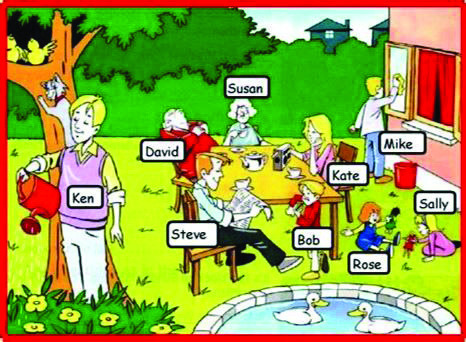
Look at the family in the picture and describe what each person is doing at this very moment. Bob is standing in front of his father, who is reading the newspaper. Susan is listening to her favourite songs. Kate and the girls, Rose and Sally, are playing with their dolls. The grandfather is having a nap. The cat is running after the birds, Ken is watering the flowers and Mike is cleaning the windows. Every one of those verbs wears the same uniform: am, is or are plus ing, because every action is happening as we speak.
The present continuous is used in four main situations.
- For an action happening right now, at the moment of speaking: Be quiet! The baby is sleeping.
- For a temporary action around now, even if it is not happening this second: John is busy. He is working at the moment.
- For a changing situation or trend, often with these days or nowadays: These days most people are writing emails instead of letters.
- For a fixed future arrangement that is already planned: She is travelling to Dhangadhi next weekend.
Keep the simple present for habits and permanent facts, and the contrast becomes easy to hear. She usually drives a taxi, but today she is driving a lorry. I usually do not wear a scarf, but today I am wearing one because it is unusually cold. It rains heavily here in the monsoon season, but look outside, it is raining right now. The words usually, every day and in the monsoon season pull a sentence towards the simple present; the words now, at the moment, these days and tonight pull it towards the continuous.
- Spelling the ing form: most verbs simply add ing, as in play, playing.
- Verbs ending in a silent e drop the e: make, making; drive, driving.
- Short verbs ending in one vowel and one consonant double the consonant: run, running; sit, sitting.
- Verbs ending in ie change ie to y: lie, lying; die, dying.
State verbs such as know, want, like, believe, understand and own are not normally used in the continuous. Say "I know the answer", never "I am knowing the answer". The one that traps everyone is think: "I think it is right" gives an opinion, but "What are you thinking of?" asks about thoughts running through the mind right now, so both exist with different meanings.
Interpreting a Pie Chart
A pie chart shows how one whole is divided into parts. Each slice stands for a share of the total, and all the slices together make one hundred percent. Interpreting a chart means turning those slices into clear English sentences that compare, not just repeat, the numbers. Study these two charts of house ownership in Nepal.
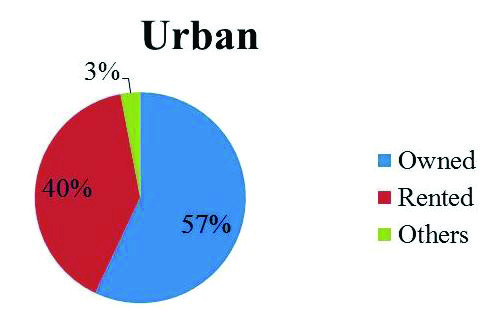
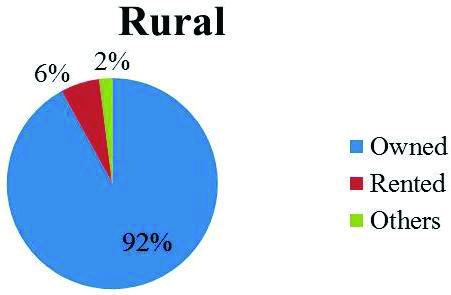
A good interpretation of this pair reads like this. The charts compare home ownership between rural and urban Nepal. In rural areas, 92 percent of families own their houses and only 6 percent rent, while 2 percent neither own nor rent. In towns and cities the picture changes sharply: 57 percent own their houses, but a full 40 percent live in rented houses, which is more than one third of all urban families. So house owners are fewer in towns than in villages, and the share of renting families is more than six times higher in urban areas than in rural ones. Only the small group living outside both owned and rented houses is similar in the two areas.
- Read the title first, so you know what whole the chart is dividing.
- Name the biggest slice and the smallest slice, with their percentages.
- Compare the slices with each other, or compare the same slice across two charts. Use phrases like more than, only, nearly half, six times as much.
- Finish with one sentence of conclusion about what the whole picture shows.
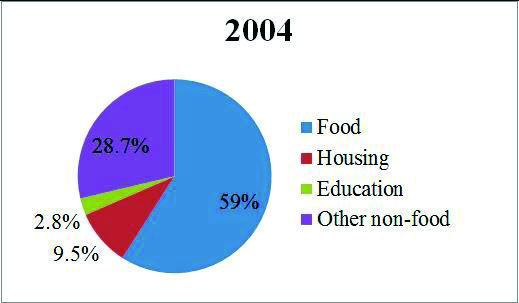
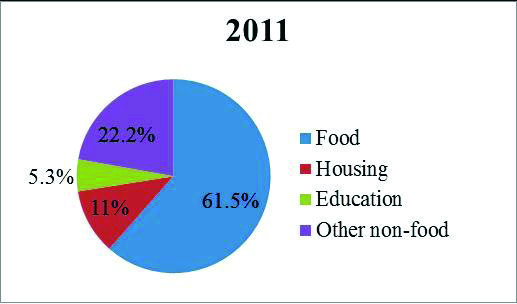
These two charts show household expenditure in Nepal in 2004 and 2011, divided into food, housing, education and other non-food spending. Your task is to write an interpretation that compares the two years: which shares grew, which shrank, and what that says about how Nepali families were living. A full model answer is worked out for you in the examples.
Do not march through every number one by one. An interpretation that lists eight percentages teaches the reader nothing. Group the facts, point out the biggest changes, and always end with what the comparison means.
The JetBlue Apology Letter
Apologising is not only for individuals. When a company lets thousands of customers down, its leader sometimes writes a public apology, and this unit's second reading is a famous real one. Before reading it, think about two statements. Apologising does not always mean you are wrong and the other person is right. And great people apologise when they realise they have made a mistake. The letter tests both ideas.

The letter is addressed to JetBlue customers and signed by David Neeleman, the founder and CEO of JetBlue Airways. It opens with startling directness: "We are sorry and embarrassed. But most of all, we are deeply sorry." He then explains what happened. A severe winter ice storm in the Northeast of the United States caused the worst operational week in JetBlue's seven year history. The storm disrupted the movement of aircraft and, more importantly, the movement of the pilots and inflight crewmembers who depended on those planes to reach the airports where they were scheduled to serve. With the busy President's Day weekend arriving, rebooking opportunities were scarce, and hold times on the telephone line were unacceptably long or not available at all, further hindering the recovery. Customers suffered delays, flight cancellations, lost baggage and other major inconveniences.
What makes the letter a model apology is what comes after the explanation. Neeleman admits the failure hurts because JetBlue was founded on the promise of bringing humanity back to air travel and making flying happier and easier, and the company failed to deliver on that promise. He announces corrective steps: better and timelier information for customers, more tools and resources for crewmembers, and improved procedures for handling operational difficulties. Most importantly, JetBlue published its Customer Bill of Rights, an official commitment describing how the airline will handle operational interruptions in the future, including details of compensation. He closes by admitting that customers deserved better, a lot better, and by asking for the chance to welcome them onboard again.
A strong public apology does five things. It says sorry directly, explains honestly what went wrong, takes responsibility instead of blaming, announces concrete steps to fix the problem, and asks for the chance to rebuild trust.
Listening for Details in an Apology Conversation
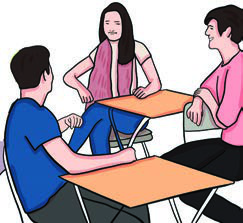
The listening task plays a conversation in which a man meets a woman again and apologises, and your job is to catch specific details from what is said. The book prints the questions but not the script, so everything depends on your ears. Before the audio starts, read all the questions and their answer choices. They tell you exactly what to listen for: where the man first met the woman, what he apologises for, the woman's name, the subject she is majoring in, and the subject the man considers the best at this time. Knowing the targets in advance turns a blur of speech into a treasure hunt.
- Predict first. From the picture and the questions, guess the situation: a friend has forgotten a name and is apologising for it.
- Listen for names, places and subjects. Speakers usually stress exactly these words.
- Do not stop when you miss a word. The next sentence often repeats or explains it.
- On the second listening, check your answers instead of hunting for new ones.
The task ends with a personal question worth thinking about before class: how do you apologise when you forget the name of a friend who is talking to you? A natural answer uses this unit's structures: "I'm so sorry, your face is completely familiar but your name has slipped my mind. Please remind me." Honesty plus a light apology rescues the moment.
Writing Your Own Apology Letter
We all make mistakes, and this unit's final writing task asks you to remember a real mistake you have recently made and write a letter or an email apologising to the person concerned. The JetBlue letter gives you the skeleton; your letter simply wears smaller clothes. Keep the tone sincere and simple, and never let the explanation become an excuse.
- Begin with a greeting and say sorry clearly in the first sentence, naming the mistake.
- Explain briefly and honestly what happened.
- Take responsibility. Write "It was my fault", not "It just happened".
- Say what you will do to fix the damage or to make sure it never happens again.
- Ask for forgiveness or for another chance, and close politely.
Simple, Compound and Complex Sentences
Good apology letters, chart interpretations and essays all depend on controlling sentence structure, so this unit closes with the three basic sentence types. The difference between them lies in how many clauses a sentence carries and how those clauses are joined.
A simple sentence contains a subject and a verb. It expresses a single complete thought that can stand on its own. The bell rang.
A compound sentence has two independent clauses. An independent clause is a part of a sentence that can stand alone because it contains a subject and a verb and expresses a complete thought. Basically, a compound sentence contains two simple sentences, and the independent clauses are joined by a conjunction: for, and, nor, but, or, yet, so. The bell rang, so the students ran to the field.
A complex sentence contains an independent clause and one or more dependent clauses. A dependent clause either lacks a subject or a verb, or has both but does not express a complete thought. A complex sentence always has a subordinator such as as, because, since, after, although, when, or a relative pronoun such as who, that, which. Because the bell rang, the students ran to the field.
| Type | What it contains | Example |
| Simple | One subject and one verb, a single complete thought | The shopkeeper apologised. |
| Compound | Two independent clauses joined by for, and, nor, but, or, yet, so | The shopkeeper apologised, and the customer forgave him. |
| Complex | An independent clause plus a dependent clause with a subordinator or relative pronoun | The customer forgave him because the apology was sincere. |
Project: Ways of Apologising Around You
The unit's project takes the classroom into your home. Collect different ways of apologising and of responding to an apology from your parents, your friends and newspapers. Listen for the exact words people use: an elder brother's quick "my mistake", a formal printed apology from a company in the news, a friend's "oops, sorry". Write each one down, note who said it and how serious the situation was, and display your whole collection on chart paper in your class. When the class compares collections, you will see the essay's lesson living around you: how people say sorry depends on who they are and where they come from.
The full lesson is waiting for you
The notes are free to read in full. A free account opens the rest of the practice, and tracks your progress and confidence score for every subject. Presentations and videos need approval from Learn Yeti.