Four stages in the life of a honey bee
Every honey bee, whether it grows up to be a queen, a worker or a drone, passes through the same four stages: egg, larva, pupa and adult. The stages always come in this order. When the bee is adult, a queen lays new eggs and the cycle starts again. What differs from one kind of bee to another is not the stages themselves but how long each stage lasts.
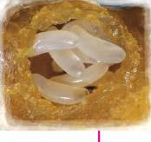
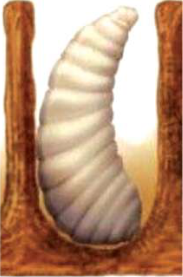
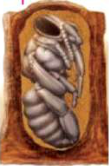
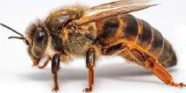
Follow the four pictures in order and the circle closes. The egg hatches into a larva, the larva turns into a pupa, the pupa becomes an adult, and an adult queen lays fresh eggs. Every bee in a hive, from the queen to the smallest worker, began its life as one of those tiny eggs.
Complete metamorphosis
A young honey bee does not look like a small adult. The larva is a soft white grub with no wings, no legs and no sting. To become a flying bee, its body has to be taken apart and built again. Two events inside the larva and the pupa make this possible. First, old tissues are broken down. Then new tissues are formed in their place. These two events carry the bee from egg to larva, from larva to pupa and from pupa to adult.
Histolysis is the breaking down of old tissues in the body of the larva and pupa.
Histogenesis is the formation of new tissues in the larva and pupa.
Complete metamorphosis is the development of an insect through four stages, egg, larva, pupa and adult, in which the young look completely different from the adult. It happens because of histolysis and histogenesis.
Honey bees and butterflies both grow by complete metamorphosis. A cockroach does not: its young already look like small adults without wings.
A new queen and the mating flight
A hive keeps growing. When it holds more worker bees than it needs, the queen leaves with a large group of workers and sets up a new colony somewhere else. Those workers build the new hive.
The old hive is now left without a queen, so the workers who stayed behind make one. They choose a larva that hatched from a fertilised egg and feed it on nothing but royal jelly. Rich food all the way through its growth turns that larva into a queen.
Royal jelly is a highly nutritious food made by a gland in the head of young worker bees. All larvae get it for their first three days, and a future queen gets it throughout her growth.
Once the new queen is adult, she is ready to mate. The events follow each other in this order:
- She leaves the hive on her nuptial flight, usually in the evening.
- A group of drones follows her into the air.
- She mates with many drones during the flight.
- The drones die after mating, because their genital organs are forcibly pulled out during mating.
- The queen keeps the sperms she has received in her spermathecae.
- Two to three days after mating, she starts laying eggs in the brood cells.
One mating flight lasts the queen a long time. The stored sperms are used to fertilise millions of eggs, so she does not have to fly out and mate again every time she lays.
The nuptial flight, or mating flight, is the flight a new adult queen makes out of the hive to mate with drones.
Spermathecae are the structures in the queen's body in which she stores the sperms received from drones.
A brood cell is a wax cell of the honeycomb in which an egg is laid and a young bee grows.
Egg
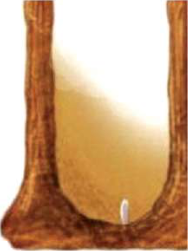
Honey bee eggs are white and elongated, and only 1 mm to 1.5 mm long. The way an egg lies in its cell changes from day to day, so its position tells you how old it is:
- On the first day it stands upright.
- On the second day it leans at a slant.
- On the third day it lies flat.
For every kind of bee, the egg stage lasts three days.
The queen does not lay her eggs just anywhere. She uses three kinds of cells: drone cells to produce drones, queen cells to produce queens and worker cells to produce workers. When conditions are favourable she can lay up to 3,000 eggs in a single day, and the number differs between types of bees.
There are two types of egg, and the type decides whether the bee will be female or male:
| Type of egg | Bees that develop from it | Sex |
| Fertilised egg | Queen and worker | Female |
| Unfertilised egg | Drone | Male |
Parthenogenesis is the development of a new individual from an unfertilised egg. Drones are produced in this way.
Larva
Three days after it is laid, the egg hatches into a larva. The larval stage lasts about 5.5 days for a queen, about 6 days for a worker and about 7 days for a drone. This is the eating stage. The larva feeds all the time and grows fast. Larvae that will become queens and drones are bigger than those that will become workers.
A queen and a worker are both females, and both come from fertilised eggs. So what makes one larva a queen and another a worker? The answer is the food it is given:
- For their first three days, all larvae are fed royal jelly.
- After three days, larvae that will become queens go on receiving royal jelly without a break.
- Larvae that will become workers and drones are switched to beebread.
Beebread, also called honey bread, is a mixture of honey and pollen. Worker and drone larvae are fed on it after their third day.
While it grows, the larva moults five times, shedding its old skin each time it becomes too tight. Because the larvae are given different food, they also take different lengths of time to develop.
A queen does not hatch from a special egg. Queens and workers come from the same kind of fertilised egg. A larva becomes a queen only because it is fed royal jelly for its whole larval life.
Pupa
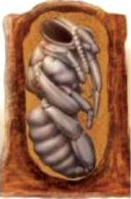
The pupa is the inactive stage of the life cycle. It does not feed and it does not move, and its cell is sealed with a cap of wax. Inside, though, big structural changes are going on. Three pairs of legs, the wings and the mouthparts all develop during this stage.
The pupal stage lasts about 7.5 days for a queen, which is often rounded to 8 days, 12 days for a worker and 14 days for a drone.
Adult
At the end of the pupal stage, after many changes, the pupa has become an adult bee. It is still shut inside its cell, so it uses its mandibles, the biting jaws of its mouth, to chew through the wax cap and climb out. A new worker does not rest after it emerges. It starts helping straight away: caring for the brood cells, feeding larvae and protecting the hive.
How long each bee takes to grow
Add the three growing stages together and you get the time from egg to adult. Each type of bee takes a different time. The numbers are in days:
| Bee | Egg | Larva | Pupa | Total |
| Queen bee | 3 | 5.5 | 7.5 | 16 days |
| Worker bee | 3 | 6 | 12 | 21 days |
| Drone | 3 | 7 | 14 | 24 days |
For a worker, for example, \( 3 + 6 + 12 = 21 \) days. Two things stand out in the table. The egg stage is the same three days for all three bees, so all the differences come in the larva and the pupa. And the queen, fed on royal jelly the whole way, becomes adult fastest, in 16 days, while the drone is slowest, at 24 days.
Division of work by type and age
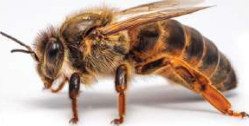
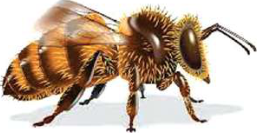
A hive runs smoothly because every bee has its own job. For the queen and the drones, the job stays the same all their lives. For a worker, the job changes with age. A newly emerged worker spends about its first three weeks working inside the hive, and only after that is it sent out to work outside.
| Type | Age | Work |
| Drone | Throughout life | Fertilises the queen and keeps the hive warm |
| Queen bee | Throughout life | Lays eggs and controls the activities of the hive by giving out pheromones |
| Worker | 1 to 3 days | Cleans the hive and clings to the honeycomb to keep the eggs, larvae and pupae warm |
| Worker | 4 to 6 days | Feeds honey bread to the larvae |
| Worker | 7 to 11 days | A royal gland develops in the head, and its royal jelly is fed to the larvae and the queen |
| Worker | 12 to 17 days | Four pairs of wax glands develop, used to build honeycomb and seal the larval cells and honey cells |
| Worker | 18 to 20 days | Sting glands develop, and the worker guards the hive |
| Worker | After 21 days | Collects nectar, pollen, water and other things from outside |
Why does a worker's job change? Because her body changes. At 7 to 11 days a royal gland develops in her head, so that is when she makes royal jelly. At 12 to 17 days four pairs of wax glands develop, so she builds comb and seals cells. At 18 to 20 days her sting glands are ready, so she guards the hive. After 21 days she is fully developed and flies out to collect food.
In a worker bee, the job follows the gland. Each task begins once the body part it needs has developed.
How honey is made
Honey does not come out of any gland in a bee's body. It is made from nectar, the sweet juice of flowers. Worker bees bring back nectar from many different flowers. In the hive, as much water as possible is evaporated from this mixture, both by the natural wind and by the wind the workers make when they flap their wings. What is left behind is thick and sweet. That is honey.
Honey is a thick, sweet mixture of monosaccharide sugars, mainly fructose and glucose, made by evaporating water from the nectar of flowers.
| Constituent | Amount in honey |
| Carbohydrates | 80 to 85 per cent |
| Water | 15 to 17 per cent |
| Protein | 0.3 per cent |
| Amino acids | 0.2 per cent |
| Vitamins and other constituents | Small amounts |
The colour, smell and effectiveness of honey depend on the flowers the nectar was collected from. Honey from a field of mustard in bloom looks, smells and tastes different from honey collected from forest flowers.
Uses of honey bees
Honey bees are useful insects for the whole ecosystem, and for people in particular. Their main benefits are these:
- Their hard work, their division of labour and their strong discipline set an example that encourages good social behaviour in people.
- They produce highly nutritious honey, which is used in Ayurvedic medicine and in sweets, cakes, bread and other foods.
- While sucking nectar from flowers they carry out pollination, so they help farmers grow more crops.
- Beeswax is widely used to make cosmetics such as cream and lipstick, and to make candles.
- Beekeepers who learn how to extract royal jelly from bees can earn a large income.
- Farmers can earn well from apiculture, and this strengthens the economy of the nation.
Apiculture is the rearing of honey bees for honey, wax and other products. It is also called beekeeping or bee farming.
Bees and crops depend on each other. Where bees are taken away, crops such as mustard give a smaller harvest, because fewer of their flowers are pollinated.
The full lesson is waiting for you
The notes are free to read in full. A free account opens the rest of the practice, and tracks your progress and confidence score for every subject. Presentations and videos need approval from Learn Yeti.