Bees in a Mustard Field
In late winter the mustard fields of the Terai turn bright yellow, and the whole field hums. Look closely and the humming turns out to be honey bees. A bee lands on a flower, pushes its head inside, drinks the sweet juice called nectar and flies on to the next flower. After a while the bees start flying off in the same direction. Follow them and you may find their home: a hive hanging from the branch of a tree or tucked under a rock, crowded with thousands of bees. Watch that hive carefully and you will see that the bees are not all alike. A few are large, some are dark and hairy, and most are small and very busy.
This small scene raises good questions. What do bees eat? Are all the bees in one hive the same kind? Why do people build boxes for bees? Do bees help us only by making honey? Each of these has a clear answer once we see how a bee lives and how its body is built.
The Honey Bee: A Social Insect
A honey bee is an insect. It lives freely in a special home that it builds for itself, called a hive. Like crabs, spiders and butterflies, it has jointed legs and a hard outer covering, so it belongs to the phylum Arthropoda.
Social insect: an insect that lives in a large, organised group called a colony, in which the members share the work and depend on one another. Honey bees are social insects.
One hive may hold tens of thousands of bees, yet they do not live as strangers. There is a high level of understanding and discipline among the members of the colony. Every bee has its own job and keeps busy with it all the time, and every member is disciplined and hardworking. This sharing out of jobs is called division of labour, and bees show it to a very high degree.
Division of labour: the dividing of work among the members of a group so that each member does one particular job. In a hive, one kind of bee lays the eggs, another fertilises the queen, and a third does all the other work.
A hive holds three kinds of honey bee: the queen, the drone and the worker. Together they collect pollen and nectar from flowers and make honey from the nectar. Nectar and pollen are the bees' food, and honey is the food they store for later.
A bee colony works like a well-run team: every member is disciplined, hardworking and busy with its own task.
Natural and Artificial Hives
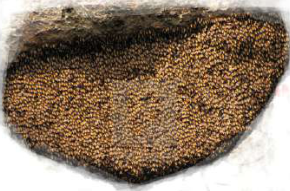
Wild bees build their own hive. They make the comb from wax that comes out of their own bodies and hang it from a tree branch, a cliff or the roof of an old building. Such a hive is a natural hive. When people farm honey bees, they build an artificial hive for them instead: usually a wooden box fitted with frames that can be lifted out. The bees build their comb on these frames, and the farmer can take out one frame to check the bees or collect honey without breaking the whole hive.
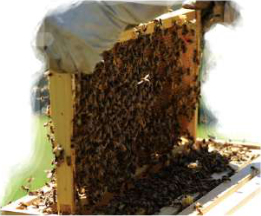
Should people make hives for bees? There are good reasons to. A box hive shelters the colony from rain, wind and enemies. The farmer can take honey without destroying the colony, and the bees can be kept close to the crops that need them. A colony that is well looked after grows stronger year by year.
Beekeeping, Apiculture and Melittology
People have kept bees in traditional ways since ancient times, for example in hollow logs or in holes left in the walls of houses. Since the 20th century, beekeeping has been done not only for honey but also for pollination and for producing wax. As a bee moves from flower to flower for food, it carries pollen with it, and this helps crops such as mustard, apple and pumpkin to set seeds and fruits. Today modern hives are used and beekeeping is run as an agricultural business, because modern hives give more honey. Bees are also studied separately so that they can be farmed well as a business.
Apiculture: the commercial rearing of bees.
Melittology: the science that studies bees, also called apicology. It is a branch of entomology.
Entomology: the science of insects.
So bees help people in more ways than one. They give honey and wax, and by pollinating crops they help farmers get a better harvest.
Body Structure of a Honey Bee
A honey bee is generally 9 mm to 20 mm long. That is from a little under one centimetre up to two centimetres. Like every other insect, its body is divided into three parts: the head, the thorax and the abdomen.
The head carries a pair of compound eyes, a pair of antennae and the mouth parts. The antennae pick up stimuli from the surroundings, such as smell and touch. Each compound eye is built from many tiny units, and each unit looks in a slightly different direction, so the bee can see around itself without turning its head.
Compound eye: an eye made of many small units joined together, which lets an insect see in many directions at once without rotating its head.
The thorax is made of three segments. A pair of legs grows from each segment, so a bee has three pairs of legs, six in all. The legs are jointed, and jointed legs are the reason the bee is placed in the phylum Arthropoda. Two segments of the thorax also carry a pair of wings each, and these wings let the bee fly long distances in search of flowers.
The abdomen has 9 segments, but not all of them can be seen clearly. In adult females 6 segments are prominent, and in adult males 7 segments are prominent. In the bees that have a sting, it lies at the tip of the abdomen, and the bee uses it to defend its colony.
Watch live bees from a distance. Never catch a bee with bare hands and never disturb a hive. A frightened bee stings to protect its colony.
An easy way to hold it: the head senses and feeds, the thorax carries the legs and wings, and the abdomen has 9 segments and the sting.
Three Kinds of Bee in a Hive
Every hive holds three kinds of bee: the queen bee, the drone bee and the worker bee. They differ in size, shape and body parts, and each kind has its own work. The queen and the workers are females; the drones are males.
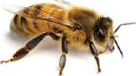
Queen Bee
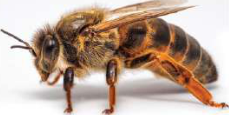
The queen bee is the largest bee in the hive, and her body is long and elongated. Her head is smaller and more rounded than the heads of the other bees. Her proboscis is short and covered with hairs. A sting is present at the end of her abdomen.
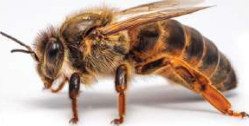
Proboscis: the long, tube-like mouth part an insect uses to suck up liquid food.
Generally there is only one queen in a hive. Her main function is to lay eggs, and all the eggs of the colony come from her. She also controls the activities of all the bees in the hive according to the situation.
The queen's body produces a special scented substance called pheromone. With its help she attracts the males for mating. Pheromones are also used for communication among the bees and for finding the location of the hive.
Pheromone: a special scented substance given off by an animal's body that carries a message to other members of its species. The queen bee uses it to attract drones.
The queen lives the longest of all the bees in the hive, about 2 to 5 years. When the colony needs a new queen, the worker bees feed royal jelly to a larva, and that larva grows into a queen.
Royal jelly: a special rich food made by worker bees; a larva fed on it grows into a queen.
Drone Bee
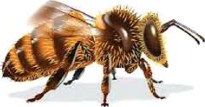
The drone bee is smaller than the queen but larger, more blackish and hairier than the worker. It has no sting, no pollen basket and no wax-producing glands, so it cannot defend the hive, gather pollen or build comb. It is the laziest bee in the hive and is even fed by the worker bees. Its function is to fertilise the queen bee.
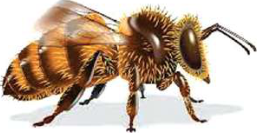
Drones are different even in their cells. They are haploid, with only 16 chromosomes, while the queen and the workers are diploid, with 32 chromosomes. This is because drones develop from unfertilised eggs. That process is called parthenogenesis. A drone survives for only about two months.
Haploid: having a single set of chromosomes in each cell. A drone bee has 16 chromosomes.
Diploid: having two sets of chromosomes in each cell. The queen and worker bees have 32 chromosomes.
Parthenogenesis: the development of a new individual from an unfertilised egg. Drone bees are produced this way.
Do not swap the numbers. 16 chromosomes belongs to the drone, which is haploid. 32 chromosomes belongs to the queen and the workers, which are diploid.
Worker Bee
Worker bees are the smallest bees in the hive, yet they are by far the most numerous: about 20,000 to 80,000 of them can be found in one hive. Their bodies have a special structure suited to work. Their mouth parts are of the chewing and lapping type, so they can chew and shape wax and lap up nectar.
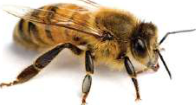
Worker bees are extremely hardworking. Their legs are densely covered with hair, and the legs also carry pollen baskets. As a worker moves over flowers, pollen sticks to the hairs. The bee packs it into the pollen baskets and carries it back to the hive.
Pollen basket: a part of a worker bee's leg in which pollen is collected and carried back to the hive.
Nearly every job in the hive is done by the workers:
- collecting nectar and pollen from flowers
- constructing the hive from wax
- nursing the young bees
- protecting the hive, using the sting when needed
- feeding the drones, and raising a new queen with royal jelly
A worker lives for about 6 weeks to 6 months, far shorter than the queen.
Comparing the Three Kinds of Bee
| Feature | Queen bee | Drone bee | Worker bee |
| Sex | Female | Male | Female |
| Size | Largest, long body | Smaller than the queen, larger than the worker | Smallest |
| Sting | Present | Absent | Present |
| Main work | Lays eggs, controls the hive | Fertilises the queen | Collects nectar and pollen, builds, nurses, protects |
| Chromosomes | 32 (diploid) | 16 (haploid) | 32 (diploid) |
| Number in a hive | Generally one | Far fewer than workers | About 20,000 to 80,000 |
| Life span | About 2 to 5 years | About two months | About 6 weeks to 6 months |
Largest and longest-lived: the queen. Stingless, lazy and haploid: the drone. Smallest, most numerous and hardest working: the worker.
The full lesson is waiting for you
The notes are free to read in full. A free account opens the rest of the practice, and tracks your progress and confidence score for every subject. Presentations and videos need approval from Learn Yeti.