Minerals and the Metals Inside Them
Iron gates, aluminium pots, copper wires and silver jewellery all begin as rock. Only a few metals, such as gold and silver, are unreactive enough to be found in nature as the metal itself. Most metals, including sodium, potassium, calcium and iron, react with oxygen, sulphur, water and other substances. So in nature they are always found joined with other elements, in the form of compounds. These compounds lie in the rocks of the earth's crust.
Mineral: a pure, solid, crystalline compound found naturally in the earth's crust. Almost all minerals are inorganic, and each has a fixed chemical formula.
Most of the earth's crust is made of silicate minerals, and it also holds oxide, sulphide, carbonate, sulphate and phosphate minerals. Hematite and cuprite, for example, are minerals found in different parts of Nepal. A mineral that contains a metal is a possible source of that metal. Whether it is a useful source is a separate question, and the answer to that question is what separates an ore from an ordinary mineral.
What Makes a Mineral an Ore
Minerals do not all contain the same amount of metal. Some are rich in a metal. From these, the metal can be taken out easily and economically, which means without spending much money, fuel or labour. Others contain only a small amount of metal. Getting the metal out of them is so slow and costly that it is not worth doing.
Picture two sacks of rice, both mixed with small stones. In the first sack almost every handful is rice, with a stone here and there. In the second, every handful is mostly stones with a few grains of rice between them. Both sacks contain rice, but only the first is worth the effort of cleaning. A mineral that is rich in a metal is like the first sack, and such a mineral is called an ore of that metal.
Ore: a mineral from which a metal can be extracted in a large amount at a low cost.
Clay shows the difference clearly. Clay contains aluminium, so it is a mineral that holds a metal. Yet aluminium is not taken from clay, because the amount is small and hard to remove. Clay is a mineral, but it is not an ore of aluminium. Bauxite also contains aluminium, in a much larger amount that comes out cheaply, so bauxite is an ore of aluminium. The minerals from which a metal cannot be taken out easily are not ores.
All ores are minerals, but all minerals are not ores. An ore is always a mineral, because it is a natural compound. A mineral becomes an ore only when a metal can be obtained from it in large amounts and at low cost.
Every metal used in daily life is obtained from an ore. A metal usually has several ores, and one of them is its main source. The sections below name the ores of five important metals and pick out the main one for each.
Impurities in an Ore
An ore taken out of a mine does not arrive clean. Along with the useful metal compound, it carries sand, soil, pieces of rock and other unwanted matter. A lot of these impurities are found in every ore obtained from a mine, and the metal can be obtained from the ore only after they have been removed.
Impurities: the unwanted substances, such as sand, soil and rock, that are mixed with an ore when it comes out of a mine.
There is no single way of removing impurities that suits every ore. The method depends on the physical and chemical properties of the substances found in the ore. How heavy a substance is, and whether a magnet attracts it, are physical properties. How a substance reacts with other chemicals is a chemical property. Because each ore is a different mixture, each needs a method matched to what it contains.
Ores of Iron
Iron is the metal used most in buildings, tools and machines. It has five common ores. Each is a different compound of iron, so each has its own chemical formula:
- Hematite \( \mathrm{Fe_2O_3} \)
- Magnetite \( \mathrm{Fe_3O_4} \)
- Siderite \( \mathrm{FeCO_3} \)
- Limonite \( \mathrm{2Fe_2O_3 \cdot 3H_2O} \)
- Iron pyrite \( \mathrm{FeS_2} \)
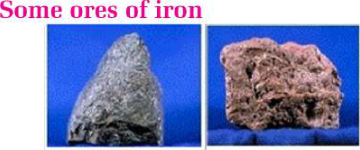
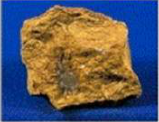
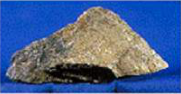
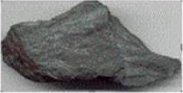
The formulas tell you what kind of compound each ore is. Hematite and magnetite contain only iron and oxygen, so they are oxides. Siderite contains the carbonate group \( \mathrm{CO_3} \), so it is a carbonate. Limonite is an oxide of iron with water joined to it. Iron pyrite contains iron and sulphur, so it is a sulphide.
Chief ore: the ore from which a metal is mainly obtained. It is rich in the metal and is found in large quantities in nature.
Among the ores of iron, hematite is the chief ore. It contains the maximum amount of iron of all of them, about 75%.
Iron pyrite \( \mathrm{FeS_2} \) and copper pyrite \( \mathrm{CuFeS_2} \) sound almost the same. Iron pyrite is an ore of iron. Copper pyrite, also called chalcopyrite, is an ore of copper even though its formula also contains iron. When a list of iron ores says only "pyrite", it means iron pyrite.
Ores of Aluminium
Aluminium is a light metal used for cooking pots, window frames and electric cables. Its ores are:
- Bauxite \( \mathrm{2Al_2O_3 \cdot 2H_2O} \)
- Cryolite \( \mathrm{Na_3AlF_6} \)
- Corundum \( \mathrm{Al_2O_3} \)
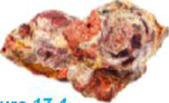
Bauxite is the chief ore of aluminium. It contains about 40 to 60 percent aluminium. Now look at the formula of cryolite. Besides aluminium it contains sodium and fluorine. An ore often holds several elements, and only one of them is the metal we want from it.
Ores of Copper
Copper carries electricity very well, so it is used in wires, motors and utensils. It has four common ores, and two of them are known by two names each:
- Chalcocite or copper glance \( \mathrm{Cu_2S} \)
- Copper pyrite or chalcopyrite \( \mathrm{CuFeS_2} \)
- Cuprite \( \mathrm{Cu_2O} \)
- Malachite \( \mathrm{Cu_2(OH)_2CO_3} \)


Copper pyrite, also called chalcopyrite, is the main ore of copper. It contains about 34.5% copper. Malachite is easy to recognise by its green colour and contains about 57.3% copper. Cuprite is an oxide of copper, and chalcocite is a sulphide of copper.
A higher percentage of metal does not by itself make an ore the chief ore. Malachite holds more copper than chalcopyrite, yet chalcopyrite is the main ore of copper, because it is found in far larger quantities and so most copper is obtained from it.
Ores of Silver
Silver is less reactive than iron or copper, and some silver is found pure in nature. Most silver, however, is obtained from these ores:
- Argentite \( \mathrm{Ag_2S} \)
- Horn silver \( \mathrm{AgCl} \)
- Ruby silver \( \mathrm{Ag_2Sb_2S_3} \)
- Silver copper glance \( \mathrm{Ag(Cu)_2S} \)
Argentite is the chief ore of silver. It consists of about 87% silver. Like chalcocite, argentite is a sulphide, a compound of the metal with sulphur. Horn silver is different: it is silver joined with chlorine.
Gold: A Metal Found Pure
Gold behaves differently from every metal above. It is a non-reactive metal. It does not combine with oxygen, water or sulphur, so it stays as gold for a very long time. That is why gold is found in nature in a pure state. Even the ores of gold contain the gold in pure form, as grains, flakes or small lumps sitting inside the rock, not as a compound.
Pure state: a metal is in a pure state when it is found in nature as the element itself, not combined with other elements in a compound.
Gold is found mainly in rocks and in alluvial soil formed from rocks. Alluvial soil is made when rocks break down and rivers carry the pieces and lay them down along their banks and beds. As gold-bearing rock wears away, its heavy gold grains settle in that river sand and soil.
The less reactive a metal is, the more likely it is to be found in a pure state. Reactive metals such as iron and aluminium are always found in compounds, so they must be extracted from ores. Gold, being non-reactive, is found pure.
Chief Ores at a Glance
This table puts the main source of each metal side by side. Learn each row as one set: the metal, its chief ore, the formula of that ore and the amount of metal it holds.
| Metal | Chief ore | Formula | Metal in the ore (about) |
| Iron | Hematite | \( \mathrm{Fe_2O_3} \) | 75% |
| Aluminium | Bauxite | \( \mathrm{2Al_2O_3 \cdot 2H_2O} \) | 40 to 60% |
| Copper | Copper pyrite (chalcopyrite) | \( \mathrm{CuFeS_2} \) | 34.5% |
| Silver | Argentite | \( \mathrm{Ag_2S} \) | 87% |
| Gold | Found in pure state | Au | Pure metal |
The full lesson is waiting for you
The notes are free to read in full. A free account opens the rest of the practice, and tracks your progress and confidence score for every subject. Presentations and videos need approval from Learn Yeti.