Metals Come Locked Inside Ores
A copper wire, an aluminium pan and a silver ring all look bright and clean, but none of these metals comes out of the ground in that form. In nature most metals are joined with other elements such as oxygen, sulphur or carbon, and the compounds they form are mixed with rock, sand and mud. A rock that holds enough of a metal to be worth extracting is called an ore, and even a rich ore is only partly metal.
Look at these five ores. Each one carries a useful metal, but none of them is the metal itself.
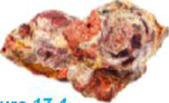


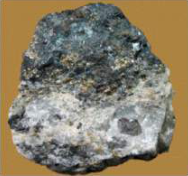
Malachite is a little over half copper and chalcopyrite only about one third. Even argentite, a rich ore, is only about 87% silver. Everything else in these rocks has to be removed, and the metal has to be pulled out of its compound. Gold is the familiar exception. It is a non-reactive metal, so it is found in the pure state in rocks and in alluvial soil formed from rocks, and it does not need most of the steps that follow.
So turning an ore into a pure metal happens in stages, and the very first stage is getting the ore out of the ground.
Mining: Taking Ores Out of the Earth
Mining: the process of extracting useful substances and minerals from the earth's geological surface by digging.
Before any metal can be extracted, its ore has to be dug out of the mine. Mining brings coal, petroleum, gold and the ores of many different metals out of the Earth's crust. Some ores lie near the surface and are dug from open pits. Others lie deep underground and are reached through tunnels. Either way, what comes out is rough lumps of rock with the metal hidden inside. The metal is then extracted from that ore through a series of steps.
What Metallurgy Means
Metallurgy: the science that deals with the properties, production and purification of metals. It also includes the stepwise extraction of metals from their ores.
Generally, five main steps are followed to get a pure metal from its ore. Each step has one job, and each one passes a slightly purer material on to the next.
- Grinding: the ore is crushed into small particles.
- Concentration: earthy impurities are removed, so the percentage of metal in the ore rises.
- Oxidation: the concentrated ore is changed into the metal's oxide by roasting or calcination.
- Reduction: oxygen is removed from the oxide, leaving the metal. Smelting is done at this stage.
- Refining: the last impurities are removed from the metal by methods such as distillation and electro-refining.
Grinding: Crushing the Ore
Grinding: the process of crushing the ores into small particles with the help of the rollers of machines. It is the first step of metal extraction.
A lump of ore fresh from the mine is large and hard, and the metal compound is scattered through it in small grains. While those grains are locked inside a big rock, no method can reach them. Heavy rollers crush the lumps into powder, much as a grinding stone turns grain into flour. Once the ore is powdered, each tiny particle is either mostly ore or mostly waste, and the two can now be separated. Grinding does not change the ore chemically. It only makes the pieces smaller.
Concentration: Removing the Gangue
Gangue: the impurities such as mud, sand and rocks present in a ground or crushed ore.
Concentration: the process of removing impurities from the ores, thereby increasing the percentage of metal in them.
If the gangue is not removed first, the later steps have to heat a great deal of waste and fuel is wasted. The method used depends on how the ore and its impurities differ. Whichever property is different, whether density, magnetism or the way they behave with water, becomes the handle for pulling them apart.
| Method | Property used | How it works | Example |
| Hydraulic or gravity separation | Ore and impurities have different densities | A stream of water washes the lighter sand and earth away while the heavier ore particles settle | Heavy oxide ores such as hematite |
| Magnetic separation | One is magnetic, the other non-magnetic | A magnet or magnetic roller pulls the magnetic part aside | Separating a magnetic iron ore from sand |
| Froth floatation | One is hydrophilic, the other hydrophobic | Hydrophobic particles stick to an oily froth and rise, hydrophilic particles sink | Sulphide ores such as chalcopyrite |
Two words in the table need explaining. A hydrophilic substance is one that water wets easily; the word means water-loving. A hydrophobic substance repels water. In froth floatation the powdered ore is mixed with water and a little oil, and air is blown through it to make froth. Sulphide ore particles are hydrophobic, so they cling to the oily bubbles and rise with the froth, which is skimmed off. The hydrophilic sand and earth soak up water and sink.
Concentration does not produce metal. It only makes the ore richer, so that less waste has to be heated in the steps that follow.
Oxidation: Changing the Ore into an Oxide
It is easier to obtain a metal from its oxide than from its sulphide or carbonate, so the concentrated ore is first changed into the metal oxide. This is done by strong heating, in one of two ways.
Roasting: the process of strongly heating an ore by passing air, or in the presence of oxygen, to change it into its oxide. It is done for non-oxide ores, generally to convert sulphide ores into oxides.
Zinc sulphide (ZnS) is a good example. Heated strongly in a current of air, it turns into zinc oxide (ZnO), and the sulphur leaves as sulphur dioxide gas. The triangle Δ above the arrow means the reaction needs heat:
\[ \mathrm{2ZnS + 3O_2 \xrightarrow{\Delta} 2ZnO + 2SO_2} \]
Chalcopyrite and argentite, seen above, are also sulphide ores, so they too are roasted.
Calcination: the process of strongly heating an ore in the absence of air, without passing oxygen, to change it into its oxide. It is done to convert carbonate ores into oxides.
When calcium carbonate is calcined, it breaks down into calcium oxide and carbon dioxide escapes:
\[ \mathrm{CaCO_3 \xrightarrow{\Delta} CaO + CO_2} \]
Malachite, the green copper ore, is also a carbonate, so it is calcined. Cuprite is already an oxide, so it does not need this step at all.
| Point | Roasting | Calcination |
| Air or oxygen | Passed in | Kept out |
| Kind of ore | Sulphide and other non-oxide ores | Carbonate ores |
| Example | \( \mathrm{ZnS} \) becomes \( \mathrm{ZnO} \) | \( \mathrm{CaCO_3} \) becomes \( \mathrm{CaO} \) |
| Gas given off | Sulphur dioxide | Carbon dioxide |
Both roasting and calcination mean strong heating, so students often mix them up. The difference is the air. Roasting lets air in and suits sulphide ores. Calcination keeps air out and suits carbonate ores.
Reduction: Taking Oxygen Away from the Metal Oxide
Reduction: the process of removing oxygen from a metal oxide.
Reducing agent: a substance that removes oxygen from a metal oxide, such as carbon, carbon monoxide or hydrogen.
Metal oxides such as copper oxide, lead oxide and iron oxide are treated with reducing agents like carbon, carbon monoxide or hydrogen. The reducing agent pulls the oxygen to itself and the metal is left behind. When hydrogen reduces copper oxide, copper and water are formed:
\[ \mathrm{CuO + H_2 \xrightarrow{\Delta} Cu + H_2O} \]
When carbon monoxide reduces iron oxide, iron and carbon dioxide are formed:
\[ \mathrm{Fe_2O_3 + 3CO \xrightarrow{\Delta} 2Fe + 3CO_2} \]
Not every oxide gives up its oxygen equally easily. Zinc oxide can be reduced by carbon only:
\[ \mathrm{ZnO + C \xrightarrow{\Delta} Zn + CO} \]
Silver oxide and mercury oxide are unstable, so heating alone splits them into metal and oxygen. At the other extreme, the oxides of reactive metals such as sodium, potassium, calcium, magnesium and aluminium are very stable. No ordinary reducing agent can take their oxygen, so they can be reduced only by the electrolysis method.
| Metal oxide | How it is reduced |
| Copper oxide, lead oxide, iron oxide | By carbon, carbon monoxide or hydrogen |
| Zinc oxide | By carbon only |
| Silver oxide, mercury oxide | By heating alone, because they are unstable |
| Oxides of sodium, potassium, calcium, magnesium, aluminium | By electrolysis only, because they are very stable |
Smelting
Smelting: the process of heating a metal oxide beyond the melting point of the metal along with a reducing agent, so that the metal separates in molten form.
After oxidation, the metal oxide is heated with a reducing agent such as carbon, coke or hydrogen, at a temperature above the melting point of the metal. Two things happen together. The reducing agent removes the oxygen, and the freed metal melts and collects as a liquid at the bottom of the furnace. The remaining impurities leave as gases or form slag, a light molten waste that floats on top of the metal and is run off separately. So smelting is one way of carrying out reduction, and it belongs to the reduction step.
Refining: Making the Metal Pure
Refining: the process of removing the impurities left in a metal after reduction, to obtain the metal in the pure state.
The metal that comes out of reduction is far purer than the ore, but it may still contain some impurities, such as traces of other metals. For electric wires, jewellery and machines, a metal has to be purer still. Metals are refined through various processes such as distillation and electro-refining, and the method is chosen to suit the metal.
Distillation
Distillation: a method of refining in which the impurities present in a metal are removed by boiling.
It works when either the metal or its impurities change into vapour on heating while the other does not. Mercury is the standard example, because it has a low boiling point and vaporises easily. When impure mercury is heated, the mercury turns to vapour and leaves the solid impurities behind. The vapour is then cooled and condenses back into pure liquid mercury.
Mercury vapour is poisonous to breathe. Never heat mercury in a school laboratory, and never touch spilt mercury with bare hands.
Electro-refining
Electro-refining: a process of refining metals obtained from reduction by using the electrolysis method.
This process is used to obtain metals like iron, silver, copper and gold in the pure state, and the metal it gives is about 99% pure. The electrolysis is carried out in a voltameter, which is a vessel for performing electrolysis. Three things are arranged in it:
- The impure metal is connected to the anode, the positive terminal of the cell.
- A thin plate of the pure metal is connected to the cathode, the negative terminal of the cell.
- A solution of a salt of the metal being refined is used as the electrolyte. For copper, this is copper sulphate solution.
When electricity is passed, copper atoms at the anode lose electrons and go into the solution as copper ions. At the anode:
\[ \mathrm{Cu \rightarrow Cu^{2+} + 2e^-} \]
The copper ions travel through the solution to the cathode, gain electrons there and settle on it as pure copper. At the cathode:
\[ \mathrm{Cu^{2+} + 2e^- \rightarrow Cu} \]
So the impure anode slowly wears away while the pure cathode grows thicker. Impurities that do not dissolve fall to the bottom of the vessel below the anode and collect there as anode mud. Copper purified this way is what electric wires are made from.
Copper sulphate solution is harmful if swallowed and stings the eyes. Never taste it, keep it away from your face, and wash your hands afterwards. Disconnect the battery before touching the plates.
The Whole Journey at a Glance
| Step | What happens | Example |
| Grinding | Rollers crush the ore to powder | Lumps of chalcopyrite become powder |
| Concentration | Gangue is removed and the metal percentage rises | A magnet pulls iron ore out of sand |
| Oxidation | Roasting or calcination changes the ore into an oxide | \( \mathrm{ZnS} \) to \( \mathrm{ZnO} \), \( \mathrm{CaCO_3} \) to \( \mathrm{CaO} \) |
| Reduction and smelting | A reducing agent or electrolysis removes the oxygen | Carbon monoxide turns iron oxide into iron |
| Refining | The last impurities are removed | Mercury by distillation, copper by electro-refining |
Each step depends on the one before it. Unground ore cannot be concentrated, heating ore that still holds its gangue wastes fuel, an ore not yet changed to an oxide does not easily give up its metal to an ordinary reducing agent, and metal from reduction is not fully pure until it is refined. That is why metallurgy is called a stepwise process.
The full lesson is waiting for you
The notes are free to read in full. A free account opens the rest of the practice, and tracks your progress and confidence score for every subject. Presentations and videos need approval from Learn Yeti.