Metals and Non-metals in Everyday Things
Walk into almost any kitchen in Nepal and you will find a copper jug for drinking water, a pressure cooker on the stove, a bucket in the corner and a cup for tea. Out on the street, iron rods stick out of a house that is still being built, and at a wedding people wear gold. We use all of these things every day, but they are not all made of the same kind of matter. The four objects below are made of metals.
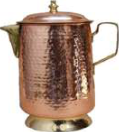
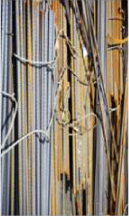
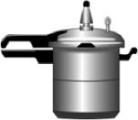
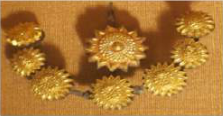
The coins in your pocket are metal too. A plastic bucket and a china tea cup are different. The bucket is made of plastic, which is made from petroleum, and the cup is made of clay that has been shaped and baked. Neither of them shines like metal, neither rings when you tap it, and neither gets too hot to hold the way a steel cup does when you pour in hot tea.
Now the objects can be sorted into two groups. The jug, the rods, the cooker, the coins and the ornaments are metallic. The bucket and the cup are non-metallic. The metal objects share some features: they all shine, they all carry heat, and they can all be beaten or drawn into shape. They differ in which metal they contain: copper in the jug, iron in the rods, aluminium or steel in the cooker, gold in the ornaments. Every one of those metals began as part of a rock in the ground. To understand where metals come from, we first need to sort matter itself.
Pure and Impure Substances
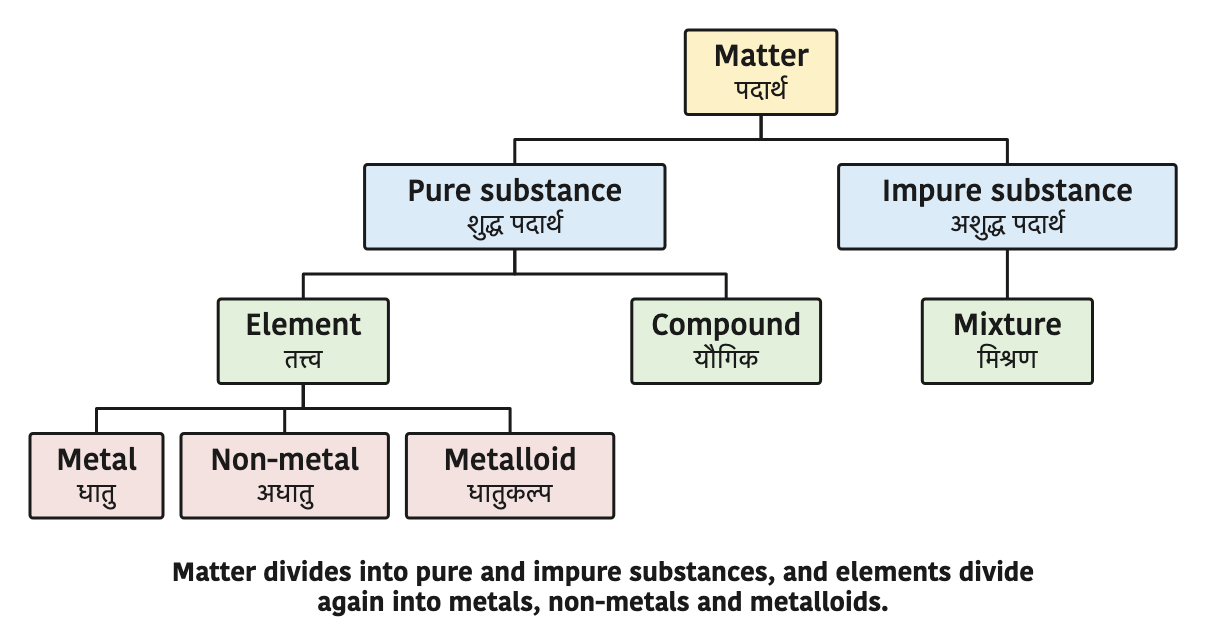
Everything around us is matter. We use many kinds of matter in daily life, and all of it can be placed in two groups: pure substances and impure substances. What separates the two is whether the substance has a fixed makeup.
Pure substance: matter that has a fixed composition and the same properties in every part of it. Elements and compounds are pure substances.
Element: a pure substance made of only one kind of atom, which cannot be broken down into anything simpler by chemical means. Examples are copper, oxygen and carbon.
Compound: a pure substance formed when two or more elements combine chemically in a fixed ratio. Water, \( \mathrm{H_2O} \), and common salt, \( \mathrm{NaCl} \), are compounds.
Mixture: a substance made of two or more substances mixed in any proportion without combining chemically. A mixture is an impure substance. Air, muddy water and brass are mixtures.
| Group | Type | Examples |
| Pure substance | Element | Gold, oxygen |
| Pure substance | Compound | Water, common salt |
| Impure substance | Mixture | Air, muddy water |
Scientists have discovered 118 elements so far. Every substance on Earth, from a gold ring to a grain of sand, is made of these 118 elements, either alone or joined together.
Metals, Non-metals and Metalloids
The 118 elements do not all behave alike. On the basis of their properties, elements are divided into three groups: metals, non-metals and metalloids. Most of the 118 elements in the modern periodic table are metals, some are non-metals, and only a few are metalloids. Their sources, properties and uses were studied in earlier classes, so here is a short picture of each group.
Metal: an element that is usually shiny and solid at room temperature, conducts heat and electricity well, and can be beaten into sheets and drawn into wires. Iron, copper, aluminium, gold and silver are metals.
Non-metal: an element that is usually dull, conducts heat and electricity poorly, and breaks easily if it is a solid. Carbon, sulphur, oxygen and nitrogen are non-metals.
Metalloid: an element that shows some properties of metals and some properties of non-metals. Silicon, boron and arsenic are metalloids.
| Property | Metals | Non-metals | Metalloids |
| Shine | Shiny | Usually dull | Some shine |
| Heat and electricity | Good conductors | Poor conductors | Partly conduct |
| When hammered | Flatten into sheets | Break | Break |
| Examples | Iron, copper | Carbon, sulphur | Silicon, boron |
What Is a Mineral?
The outermost layer of the Earth is called the crust, and it is made of rocks. These rocks are made mainly of metallic and non-metallic matter. Some rocks are made of a single type of mineral, and others are made of two or more types together. The elements and compounds that occur naturally in this way are called minerals. Minerals are the sources of metals.
Mineral: a pure, solid and crystalline compound found naturally in the Earth's crust. Every mineral has a fixed chemical formula. Minerals are the sources of metals.
Almost all minerals share these features:
- They form naturally. People do not make them.
- They are inorganic, which means they are not made by living things.
- They are pure.
- They are solid.
- They are crystalline.
- They have a fixed chemical formula.
Crystalline: describes a substance whose particles are arranged in a regular, repeating pattern, so its pieces have flat faces and sharp edges.
Here are some examples. Hematite is a mineral of iron with the formula \( \mathrm{Fe_2O_3} \). Cuprite is a mineral of copper with the formula \( \mathrm{Cu_2O} \). Limestone is made mostly of calcium carbonate, \( \mathrm{CaCO_3} \). Because the formula is fixed, a piece of hematite from one hill has the same ratio of iron to oxygen as a piece of hematite from a hill far away.
Minerals are the sources of metals. The iron in a building rod was once locked inside a mineral such as hematite.
How Metals Are Found in Nature
Almost all metals, except a few, are found in the Earth's crust as compounds rather than as the pure metal. Whether a metal is found free or combined depends on how reactive it is.
Free state: a metal is found in the free state when it occurs in nature as the pure metal, not joined to any other element.
Combined state: a metal is found in the combined state when it occurs in nature joined with other elements such as oxygen, sulphur or carbon, as a compound.
Non-reactive metals such as gold and silver hardly react with air, water or other substances. They stay as they are for millions of years, so they are found in the pure state. This is why tiny shining grains of gold can be found in river sand. Reactive metals such as sodium, potassium, calcium and iron react easily with the oxygen, water, sulphur and other substances around them. They cannot stay free for long, so they are found as compounds.
| Point | Free state | Combined state |
| Found as | The pure metal | A compound |
| Reactivity | Low | High |
| Examples | Gold, silver | Sodium, potassium, calcium, iron |
Sodium and potassium react violently with water, even with the moisture in air and on skin, so they are stored under kerosene. Never touch them with bare hands.
Because iron is so common in our homes, it is easy to think it is found as pure iron in nature. It is not. Iron is a reactive metal and is obtained from minerals such as hematite. How much we use a metal tells us nothing about the state it is found in.
Minerals in the Earth's Crust
About 90% of the Earth's crust is made of silicate minerals. Silicates contain silicon and oxygen, usually joined with metals such as aluminium, iron, calcium, sodium or potassium. Besides silicates, the crust also holds sulphide, oxide, carbonate, sulphate and phosphate ores. The name of each group tells you which non-metallic part is joined to the metal.
| Group | Joined to the metal | Example |
| Silicate | Silicon and oxygen | Mica, feldspar |
| Sulphide | Sulphur | Galena, \( \mathrm{PbS} \) |
| Oxide | Oxygen | Hematite, \( \mathrm{Fe_2O_3} \) |
| Carbonate | Carbon and oxygen | Limestone, \( \mathrm{CaCO_3} \) |
| Sulphate | Sulphur and oxygen | Gypsum |
| Phosphate | Phosphorus and oxygen | Rock phosphate |
Minerals Found in Nepal
The hills of Nepal hold many minerals. Hematite, cuprite, granite, limestone, talc, red clay and coal are found in different parts of the country. Each has its own use:
- Hematite: a mineral of iron, from which iron is obtained.
- Cuprite: a mineral of copper, from which copper is obtained.
- Granite: a hard stone used for buildings and bridges.
- Limestone: used to make cement and lime.
- Talc: a very soft mineral used to make talcum powder.
- Red clay: used for bricks, tiles and pots.
- Coal: burnt as fuel in brick kilns and factories.
Dang, Salyan, Rolpa, Gulmi, Pyuthan, Lalitpur, Palpa and Nawalparasi are some of the places in Nepal where minerals are found.
Knowing where minerals lie matters, because a mineral is useful only after it has been found, dug out and processed. A country that knows where its hematite and limestone are can produce its own iron and cement instead of buying everything from abroad.
The full lesson is waiting for you
The notes are free to read in full. A free account opens the rest of the practice, and tracks your progress and confidence score for every subject. Presentations and videos need approval from Learn Yeti.