Fast Reactions and Slow Reactions
Every chemical reaction turns reactants into products, but reactions do not all happen at the same speed. Pour dilute hydrochloric acid into sodium hydroxide solution and the acid and the base react almost the moment they meet. A strip of magnesium ribbon held in a flame burns away in a few seconds. An iron gate left out in the rain is very different. It takes weeks or even months before a brown layer of rust covers it. Rusting is also a chemical reaction. It is simply a very slow one.
To compare how fast reactions are, we ask one question: how much of the reactants changes into products in a fixed stretch of time, such as one second or one minute? A reaction that changes a large amount in one second is fast. A reaction that changes only a little in a whole day is slow.
Rate of chemical reaction: the change of reactants into products per unit time in a chemical reaction.
How Reactants Turn into Products Over Time
Concentration means how much of a substance is present in a given volume. Think about the very first instant of a reaction. All the reactants are still there, so the concentration of the reactants is at its maximum. Nothing has been made yet, so the concentration of the product is zero. Once the reaction starts, reactant particles are used up and product particles appear. From then on, the concentration of the reactants keeps going down and the concentration of the products keeps going up, until the reaction is over.
During a chemical reaction, the concentrations of both the reactants and the products change with time. Reactants decrease and products increase.
Watching a Fast Reaction: Lemon Juice and Baking Soda
Lemon juice contains an acid called citric acid. Baking soda is sodium hydrogen carbonate, \( \mathrm{NaHCO_3} \), which is a base. Drop about 1 g of baking soda into about 100 ml of lemon juice and the mixture starts to fizz at once. The bubbles are carbon dioxide gas. Within a short time the white powder can no longer be seen, because it has all reacted.
In words, the reaction is: baking soda + citric acid gives sodium citrate + water + carbon dioxide.
The disappearing powder works like a clock. The shorter the time it takes to vanish, the faster the reactant is being used up. Because the baking soda is gone so quickly, the rate of this acid and base reaction is high.
Five Factors That Change the Rate
The rate of a reaction is not fixed. The same reaction can be made faster or slower by changing the conditions in which it happens. Five such factors are studied here:
- Catalyst: a substance added to speed up or slow down the reaction
- Heat: how hot the reactants are
- Pressure: how tightly gases are squeezed together
- Surface area: how finely a solid is broken up
- Light: whether light falls on the reactants
One simple idea sits behind all five. Particles of the reactants have to meet and collide before they can react. Anything that makes them meet more often, or hit each other with more energy, makes the reaction go faster.
Factor 1: Catalyst
Hydrogen peroxide slowly breaks down into water and oxygen on its own. This happens so slowly that no bubbles can be seen. Now take two test tubes and put 5 ml of hydrogen peroxide in each. Add 2 g of black manganese dioxide powder to one of them. That tube froths with bubbles of oxygen straight away, while the other tube stays almost still.
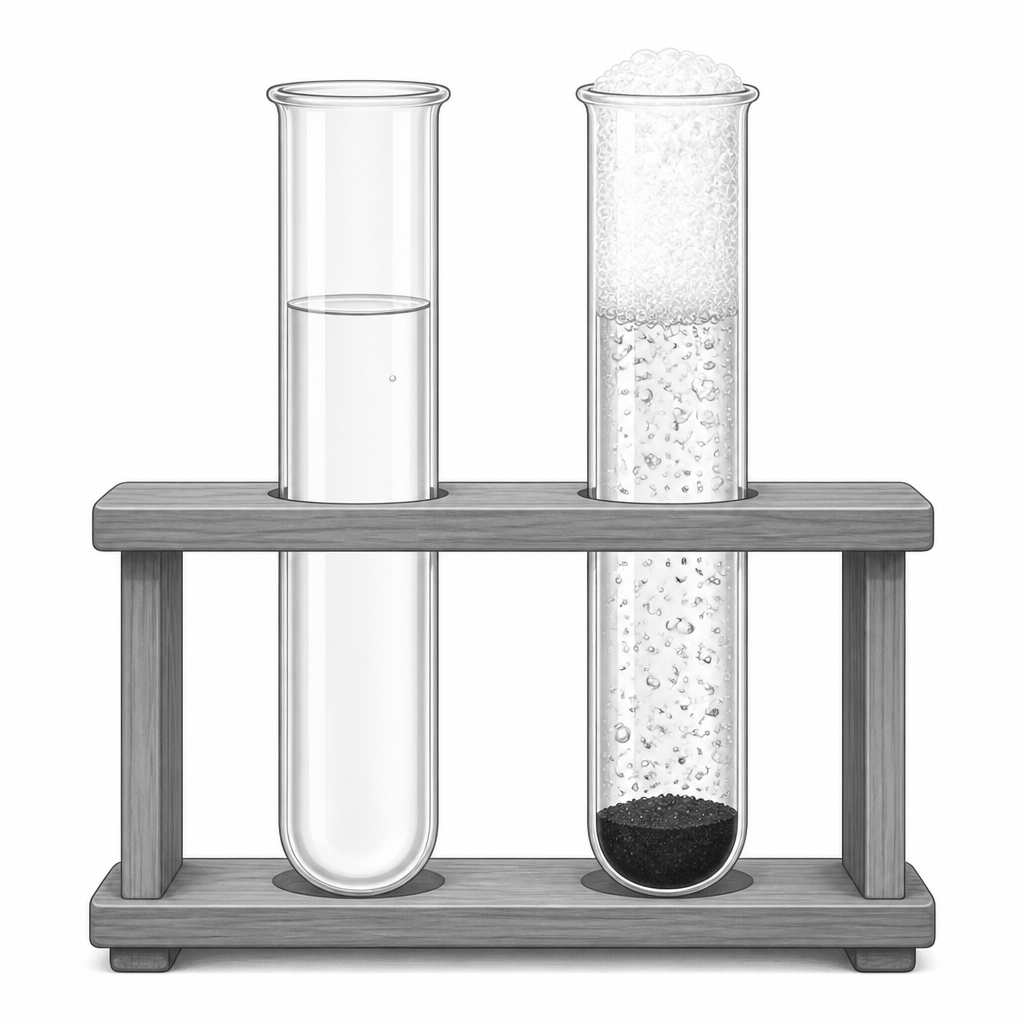
Hydrogen peroxide can burn the skin and the eyes. Pour it only with your teacher's help, keep it off your hands and face, and never taste it.
The reaction taking place in the tube with manganese dioxide is:
\[ 2\mathrm{H_2O_2} \xrightarrow{\mathrm{MnO_2}} 2\mathrm{H_2O} + \mathrm{O_2} \]
Notice that \( \mathrm{MnO_2} \) is written above the arrow and not among the reactants. That is because it is not used up. When the bubbling stops, the same black powder can be filtered out, dried and weighed, and its mass is the same as before. It can be used again. A substance that behaves like this is called a catalyst.
Catalyst: a substance which increases or decreases the rate of a chemical reaction but does not undergo any permanent chemical change itself during the reaction.
Positive and Negative Catalysts
A catalyst can push the rate in either direction, so catalysts are of two kinds.
Positive catalyst: a catalyst which increases the rate of a chemical reaction. Examples: manganese dioxide \( (\mathrm{MnO_2}) \), vanadium pentoxide \( (\mathrm{V_2O_5}) \) and iron \( (\mathrm{Fe}) \).
Potassium chlorate gives off oxygen when it is heated, but only slowly and only when strongly heated. With a little manganese dioxide mixed in, oxygen comes off quickly:
\[ 2\mathrm{KClO_3} \xrightarrow{\mathrm{MnO_2}} 2\mathrm{KCl} + 3\mathrm{O_2} \]
Here \( \mathrm{MnO_2} \) is a positive catalyst. Factories rely on positive catalysts too. Iron speeds up the making of ammonia, and vanadium pentoxide speeds up one of the steps in making sulphuric acid.
Negative catalyst: a catalyst which decreases the rate of a chemical reaction. Example: phosphoric acid \( (\mathrm{H_3PO_4}) \).
Hydrogen peroxide sold in shops would slowly turn into water if nothing were done. A small amount of phosphoric acid is added to it, which slows the breakdown so the liquid keeps longer:
\[ 2\mathrm{H_2O_2} \xrightarrow{\mathrm{H_3PO_4}} 2\mathrm{H_2O} + \mathrm{O_2} \]
Here \( \mathrm{H_3PO_4} \) is a negative catalyst. Compare this with the tube that frothed. It is the same reaction both times, yet manganese dioxide makes it race and phosphoric acid holds it back.
A catalyst is not a reactant. It is not used up and it does not appear among the products, so it is written above the arrow, never on the left side with the reactants.
Factor 2: Heat
Fill one glass with 100 ml of hot water and another with 100 ml of cold water. Drop a fizzing vitamin C tablet into each glass at the same moment. The tablet in hot water bubbles hard and is gone quickly. The one in cold water fizzes gently and lasts much longer.
Heat gives particles more energy. They move faster, so they collide more often and hit each other harder. More of those collisions end in a reaction. So, generally, the rate of a chemical reaction increases with the increase in temperature. Potassium chlorate, for example, breaks down into potassium chloride and oxygen when it is heated:
\[ 2\mathrm{KClO_3} \xrightarrow{\text{Heat}} 2\mathrm{KCl} + 3\mathrm{O_2} \]
The same rule is at work in the kitchen. Milk turns sour much sooner on a hot summer day than in winter, because the reactions that spoil it run faster when it is warm. A refrigerator keeps food cold so that those reactions slow down.
Factor 3: Pressure
Pressure matters for reactions between gases. The particles of a gas are far apart, with plenty of empty space between them. Increasing the pressure squeezes the same particles into a smaller space, so they bump into each other more often. The rate of reaction of gases therefore depends on their pressure. Generally, the rate increases as the pressure of the gases increases, so the reaction takes place with greater speed when the pressure is more. Liquids and solids can hardly be squeezed, so pressure has very little effect on them.
Ammonia is made by joining nitrogen gas and hydrogen gas:
\[ \mathrm{N_2} + 3\mathrm{H_2} \longrightarrow 2\mathrm{NH_3} \]
At ordinary pressure this reaction is far too slow to be useful. In factories the two gases are pressed together at very high pressure, with iron as a catalyst, and ammonia then forms quickly enough to make fertiliser.
Factor 4: Surface Area
When a solid reacts with a liquid or a gas, the reaction can only happen on the outside surface of the solid. The particles hidden inside a lump have to wait their turn. Break the lump into small pieces or grind it into powder and those hidden particles are brought out to the surface. The mass stays the same, but the total surface area becomes much larger.
Marble is calcium carbonate. It reacts with dilute hydrochloric acid to give carbon dioxide:
\[ \begin{aligned} &\mathrm{CaCO_3} + 2\mathrm{HCl} \longrightarrow \\ &\mathrm{CaCl_2} + \mathrm{H_2O} + \mathrm{CO_2} \end{aligned} \]
Put a few big marble chips into one beaker of acid and the same mass of marble powder into another. The chips fizz slowly for a long time. The powder froths up at once and is finished quickly. You see the same thing when lighting a fire: thin twigs catch fire at once, while a thick log of the same wood is slow to burn.
Smaller pieces give a larger surface area, and a larger surface area gives a faster reaction.
Factor 5: Light
Some reactions depend on light. Light carries energy, and that energy can break the bonds that hold reactant particles together. A mixture of hydrogen gas and chlorine gas kept in the dark reacts very slowly. In dim light it reacts steadily. In bright sunlight it reacts so fast that it explodes:
\[ \mathrm{H_2} + \mathrm{Cl_2} \xrightarrow{\text{sunlight}} 2\mathrm{HCl} \]
A mixture of hydrogen and chlorine explodes in sunlight, and chlorine itself is poisonous. This reaction is never tried at school or at home.
Silver bromide, used on old photographic film, breaks down wherever light falls on it. The tiny grains of silver it leaves behind are what form the picture:
\[ 2\mathrm{AgBr} \xrightarrow{\text{light}} 2\mathrm{Ag} + \mathrm{Br_2} \]
Green plants make their food by photosynthesis only when sunlight falls on their leaves, and it stops at night. Light also speeds up the breakdown of hydrogen peroxide, which is why it is sold in dark brown bottles. For reactions like these, the rate increases when light falls on the reactants.
The Five Factors at a Glance
| Factor | What is changed | Effect on the rate | Example |
| Catalyst | A substance is added that is not used up | A positive catalyst raises it, a negative catalyst lowers it | \( \mathrm{MnO_2} \) speeds up, \( \mathrm{H_3PO_4} \) slows down the breakdown of \( \mathrm{H_2O_2} \) |
| Heat | The temperature is raised | Increases | A vitamin C tablet fizzes away faster in hot water |
| Pressure | Gases are squeezed into less space | Increases | Nitrogen and hydrogen form ammonia faster at high pressure |
| Surface area | A solid is broken into smaller pieces | Increases | Marble powder reacts with acid faster than marble chips |
| Light | Light falls on the reactants | Increases for reactions that need light | Hydrogen and chlorine react explosively in sunlight |
The full lesson is waiting for you
The notes are free to read in full. A free account opens the rest of the practice, and tracks your progress and confidence score for every subject. Presentations and videos need approval from Learn Yeti.