Translation as One Kind of Transformation
When an object is moved from one position to another by following a fixed rule, we say it has been transformed. Reflecting a shape in a mirror line, turning it about a point and enlarging it are all transformations. Each one follows its own rule.
Transformation: changing the position of an object from one place to another according to a fixed rule.
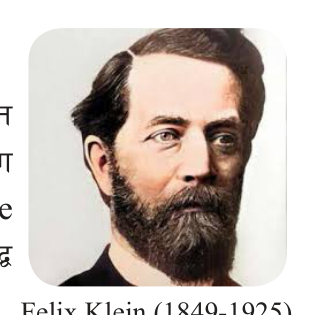
The German mathematician Felix Klein, in his Erlangen programme near the end of the 19th century, showed that geometry itself can be organised around transformations. Of all the transformations, translation is the simplest. Every point of the shape slides the same distance in the same direction. Nothing turns, nothing flips and nothing grows or shrinks.
Walking on a Grid: A First Translation
Picture a man standing on a coordinate grid at the point \( A(1, 2) \). He walks straight to the right until he reaches a point B, then turns and walks straight up until he stands at \( A'(7, 6) \).
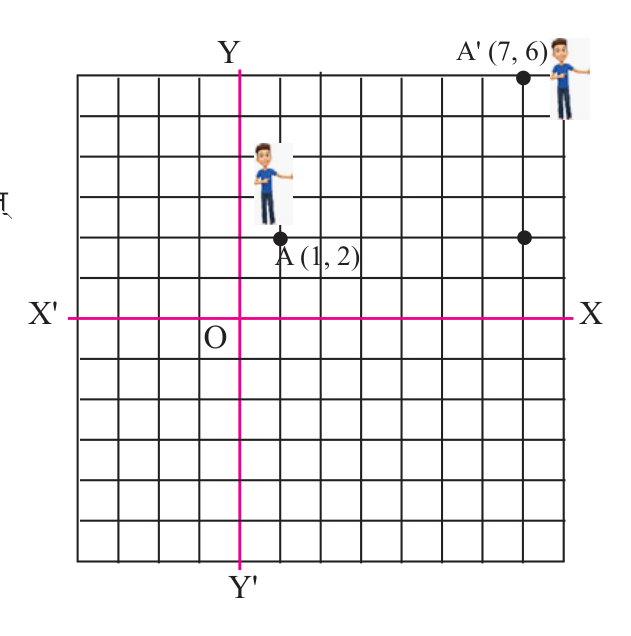
Count the squares. Walking right from \( x = 1 \) to \( x = 7 \) is 6 units, so B is the point \( (7, 2) \). Walking up from \( y = 2 \) to \( y = 6 \) is 4 units. Moving 6 units right means moving 6 units in the positive direction of the x-axis. Moving 4 units up means moving 4 units in the positive direction of the y-axis.
These two numbers together describe the whole move. We write them as a column with the x-move on top and the y-move below:
\[ \begin{pmatrix} 6 \\ 4 \end{pmatrix} \text{ or } (6, 4) \]
This pair is called the translation vector. The link between A, the vector and A' is shown by adding the top number to the x-coordinate and the bottom number to the y-coordinate:
\[ A(1, 2) \xrightarrow{(6,\,4)} A'(1 + 6,\ 2 + 4) \]
\[ A'(1 + 6,\ 2 + 4) = A'(7, 6) \]
The Translation Vector and the Translation Rule
Translation: moving every point of an object in a given direction through a fixed distance. Because a translation needs both a size (magnitude) and a direction, a translation is a vector.
Translation vector: the column \( T = \begin{pmatrix} a \\ b \end{pmatrix} \) that describes a translation. The top number a is the move along the x-axis and the bottom number b is the move along the y-axis.
Object and image: the point or shape we start with is the object. The point or shape it lands on after the translation is its image, written with a dash mark called a prime, so the image of P is P'.
What happened to A(1, 2) happens to every point. If the translation vector is \( T = \begin{pmatrix} a \\ b \end{pmatrix} \), then a is added to the x-coordinate and b is added to the y-coordinate. This single rule is the whole method for translating on a graph:
\[ P(x, y) \xrightarrow{T} P'(x + a,\ y + b) \]
Top number goes with x, bottom number goes with y. Add, do not multiply. The image of \( P(x, y) \) under \( T = \begin{pmatrix} a \\ b \end{pmatrix} \) is always \( P'(x + a, y + b) \).
Signs of the Components: Right, Left, Up and Down
The sign of each number in the vector tells the direction. A move to the right or upward is written with a plus sign. A move to the left or downward is written with a minus sign.
| Direction of the move | Sign written | Coordinate that changes |
| Right | + | x |
| Left | - | x |
| Up | + | y |
| Down | - | y |
Suppose the same man at A(1, 2) had instead walked 6 units to the left and then 4 units down. Where would he end up?
Step 1: Left is negative and down is negative, so the translation vector is:
\[ T = \begin{pmatrix} -6 \\ -4 \end{pmatrix} \]
Step 2: Adding \( -6 \) to the x-coordinate and \( -4 \) to the y-coordinate of A(1, 2):
\[ A'(1 - 6,\ 2 - 4) = A'(-5, -2) \]
So he would stand at \( (-5, -2) \), in the third quadrant.
Do not drop the minus sign of a component. Under \( T = \begin{pmatrix} 2 \\ -2 \end{pmatrix} \), the point \( (5, 6) \) goes to \( (5 + 2, 6 - 2) = (7, 4) \), not to \( (7, 8) \). Adding a negative number moves the point left or down.
Translating a Shape Without a Grid
A shape can be translated even when no coordinates are given, as long as the vector is drawn. Below, triangle PQR is to be moved in the direction and through the length of the vector \( \vec{a} \), which points straight down.
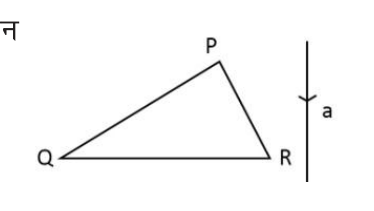
Every vertex must make exactly the same move as \( \vec{a} \). A set square is used to slide parallel lines, so the construction is:
- Step 1: Using a set square, draw a line from P parallel to \( \vec{a} \) and pointing the same way. Mark P' on it so that PP' is equal in length to \( \vec{a} \).
- Step 2: In the same way, draw QQ' from Q, equal and parallel to \( \vec{a} \).
- Step 3: Draw RR' from R, equal and parallel to \( \vec{a} \).
- Step 4: Join P', Q' and R'. Triangle P'Q'R' is the translated image of triangle PQR.
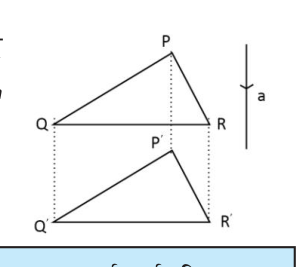
Compare the two triangles. Side P'Q' is equal and parallel to PQ, Q'R' to QR, and R'P' to RP. The angles are the same and so is the area. Triangle PQR and its image P'Q'R' are congruent. A translation changes only where a shape is. It never changes its size, its shape or the way it faces.
Congruent figures: figures with exactly the same shape and size. An object and its image under a translation are always congruent.
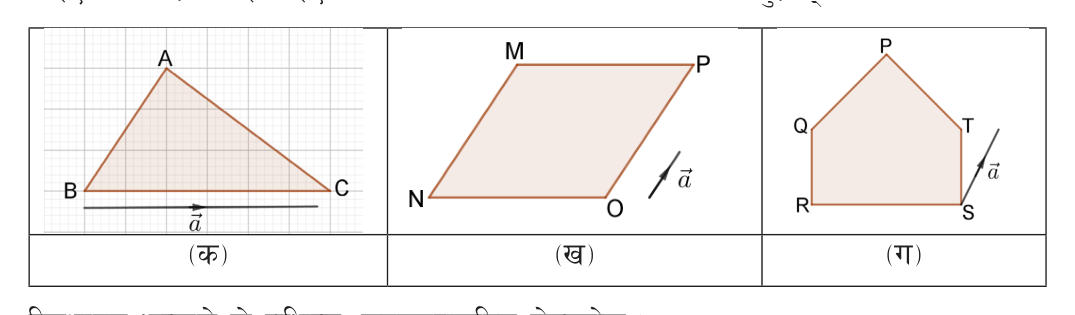
The same method works for any polygon: translate each vertex, then join the images in the same order. Try it on the three shapes below, each with its own vector \( \vec{a} \) drawn beside it.
Worked Example 1: Translating Two Points
Find the images of the points \( A(3, 1) \) and \( B(-4, 2) \) under the translation vector \( T = \begin{pmatrix} 1 \\ 4 \end{pmatrix} \).
Step 1: The rule for a translation by \( T = \begin{pmatrix} a \\ b \end{pmatrix} \) is:
\[ P(x, y) \xrightarrow{T} P'(x + a,\ y + b) \]
Step 2: Here \( a = 1 \) and \( b = 4 \). Adding them to the coordinates of A(3, 1):
\[ A'(3 + 1,\ 1 + 4) = A'(4, 5) \]
Step 3: Adding the same numbers to the coordinates of B(-4, 2):
\[ B'(-4 + 1,\ 2 + 4) = B'(-3, 6) \]
Hence the images are \( A'(4, 5) \) and \( B'(-3, 6) \). Both points moved 1 unit right and 4 units up.
Worked Example 2: Translating a Line Segment by Its Own Vector
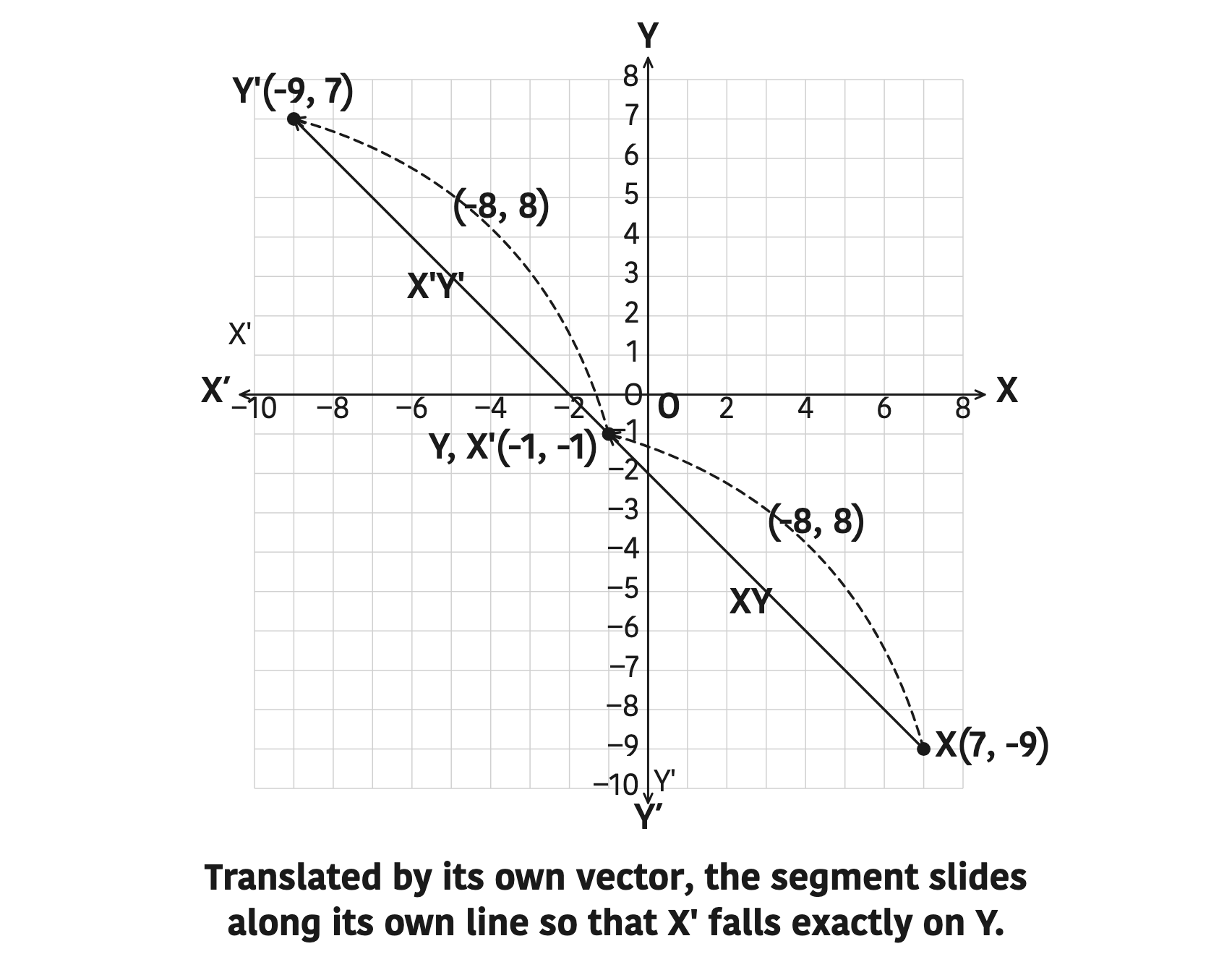
The line segment XY joins \( X(7, -9) \) and \( Y(-1, -1) \). Translate XY in the direction and through the length of \( \overrightarrow{XY} \), and find the coordinates of X' and Y'.
Step 1: The position vectors of the two ends, measured from the origin O, are:
\[ \overrightarrow{OX} = (7, -9) \]
\[ \overrightarrow{OY} = (-1, -1) \]
Step 2: A vector from X to Y is the position vector of Y minus the position vector of X:
\[ \overrightarrow{XY} = \overrightarrow{OY} - \overrightarrow{OX} \]
\[ = (-1, -1) - (7, -9) = (-8, 8) \]
Step 3: So the translation vector is \( \begin{pmatrix} -8 \\ 8 \end{pmatrix} \). Adding it to the coordinates of X(7, -9):
\[ X'(7 - 8,\ -9 + 8) = X'(-1, -1) \]
Step 4: Adding the same vector to the coordinates of Y(-1, -1):
\[ Y'(-1 - 8,\ -1 + 8) = Y'(-9, 7) \]
Hence the image of XY is X'Y' with \( X'(-1, -1) \) and \( Y'(-9, 7) \). Notice that X' lands exactly on Y. That is no accident: moving X through the vector from X to Y must bring it to Y.
Worked Example 3: Finding an Unknown Translation Vector
A translation vector moves \( M(-4, 3) \) to \( M'(4, 4) \). Find the vector, and use it to find the image of \( N(2, -5) \).
Step 1: Let the unknown vector be \( T = \begin{pmatrix} a \\ b \end{pmatrix} \). By the translation rule, M(-4, 3) goes to:
\[ M'(-4 + a,\ 3 + b) \]
Step 2: The image is given as M'(4, 4), so the two forms of M' are equal:
\[ (4, 4) = (-4 + a,\ 3 + b) \]
Step 3: Two equal points have equal x-coordinates and equal y-coordinates, which gives two equations:
\[ 4 = -4 + a \]
\[ 4 = 3 + b \]
Step 4: Solving each equation:
\[ a = 4 + 4 = 8 \]
\[ b = 4 - 3 = 1 \]
So the translation vector is \( T = \begin{pmatrix} 8 \\ 1 \end{pmatrix} \).
Step 5: Adding this vector to the coordinates of N(2, -5):
\[ N'(2 + 8,\ -5 + 1) = N'(10, -4) \]
Hence the image of N is \( N'(10, -4) \).
The equations in Step 3 always come out the same way, so you can write the vector straight from an object and its image: \( a = x' - x \) and \( b = y' - y \). Image minus object gives the translation vector.
Worked Example 4: Translating a Triangle and Drawing Both
Triangle ABC has vertices \( A(-2, 1) \), \( B(-2, -4) \) and \( C(1, 4) \). Translate it by \( T = \begin{pmatrix} 2 \\ 3 \end{pmatrix} \), find the vertices of the image and draw both triangles on a graph.
Step 1: Here \( a = 2 \) and \( b = 3 \), so each vertex moves 2 units right and 3 units up. For A(-2, 1):
\[ A'(-2 + 2,\ 1 + 3) = A'(0, 4) \]
Step 2: For B(-2, -4):
\[ B'(-2 + 2,\ -4 + 3) = B'(0, -1) \]
Step 3: For C(1, 4):
\[ C'(1 + 2,\ 4 + 3) = C'(3, 7) \]
Step 4: Plot A, B and C and join them to draw triangle ABC. Then plot A'(0, 4), B'(0, -1) and C'(3, 7) and join them to draw the image triangle A'B'C'.
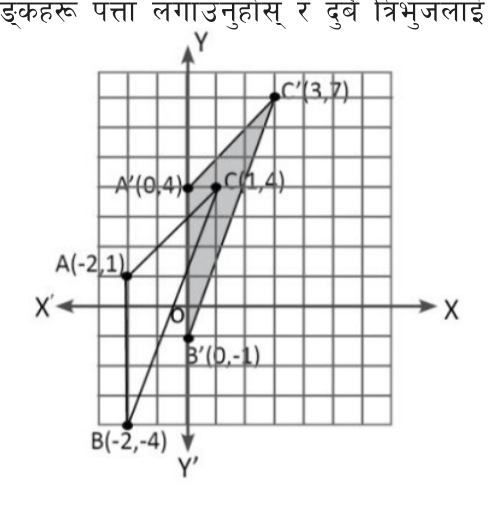
On the graph, side AB is vertical and so is A'B'. Both have length 5 units. Each side of the image is parallel and equal to the matching side of the object, which is exactly what a translation promises.
Finding the Object When the Image Is Known
Sometimes the image and the vector are given and the original point is asked for. Since the vector was added to reach the image, it is subtracted to go back: \( x = x' - a \) and \( y = y' - b \).
For example, a point P is translated by \( T = \begin{pmatrix} 2 \\ -3 \end{pmatrix} \) and its image is \( P'(5, 1) \). Find P.
Step 1: Subtracting the vector from the image:
\[ P(5 - 2,\ 1 - (-3)) = P(3, 4) \]
Step 2: Checking by translating P(3, 4) forward:
\[ P'(3 + 2,\ 4 - 3) = P'(5, 1) \]
The check gives the image we were told, so P is \( (3, 4) \).
Words of This Lesson
- Transformation: moving an object to a new position by a fixed rule.
- Translation: sliding every point of an object the same distance in the same direction.
- Translation vector: the column \( \begin{pmatrix} a \\ b \end{pmatrix} \) that tells how far to move along x and along y.
- Magnitude: the length or size of a move.
- Direction: which way a move goes, shown by the signs of a and b.
- Object: the point or shape before it is moved.
- Image: the point or shape after it is moved, marked with a prime, as in A'.
- Congruent: having exactly the same shape and size.
The full lesson is waiting for you
The notes are free to read in full. A free account opens the rest of the practice, and tracks your progress and confidence score for every subject. Presentations and videos need approval from Learn Yeti.