What a Combined Transformation Is
A point can be moved by one transformation and then moved again by a second one. The first move takes the object from its starting position to a first image. The second move takes that first image to a final image. The useful question is whether one single move could have taken the object straight from the start to the final image. Very often it can, and finding that single move is what this topic is about.
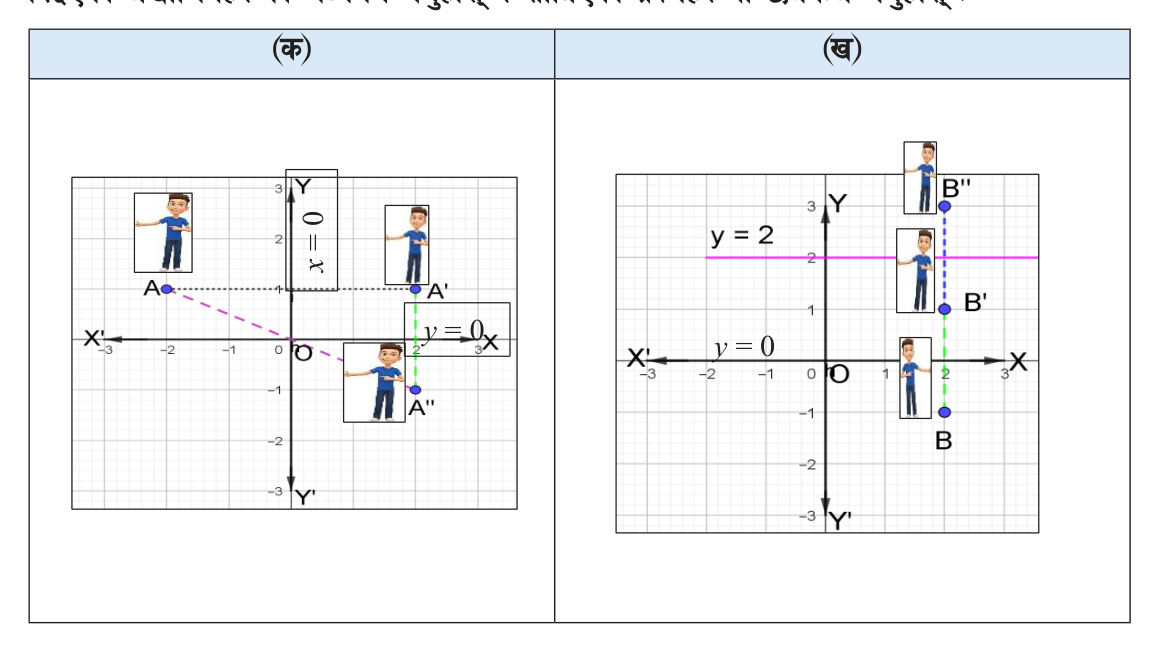
In the left graph, the point \( A(-2, 1) \) is reflected in the Y-axis, the line x = 0, to give \( A'(2, 1) \). Then A' is reflected in the X-axis, the line y = 0, to give \( A''(2, -1) \). The two mirror lines cross each other at the origin O. Compare A with A'': both coordinates have changed sign. That is exactly what a rotation of 180° about O does, so one half turn about the origin does the work of both reflections.
In the right graph, \( B(2, -1) \) is reflected in the X-axis to give \( B'(2, 1) \), and B' is reflected in the line y = 2 to give \( B''(2, 3) \). This time the two mirror lines are parallel and never meet. B has not turned at all. It has moved straight up by 4 units, so a single translation by \( \begin{pmatrix} 0 \\ 4 \end{pmatrix} \) takes B to B''.
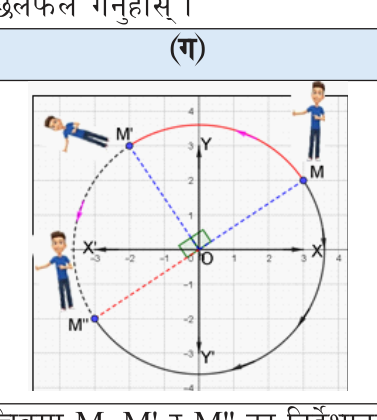
Rotations can be joined in the same way. In the next graph, \( M(3, 2) \) is turned through 90° anticlockwise about O to reach \( M'(-2, 3) \). Then M' is turned through another 90° anticlockwise about O to reach \( M''(-3, -2) \). Two quarter turns about the same centre make one half turn, so a single rotation of 180° about O takes M to M''.
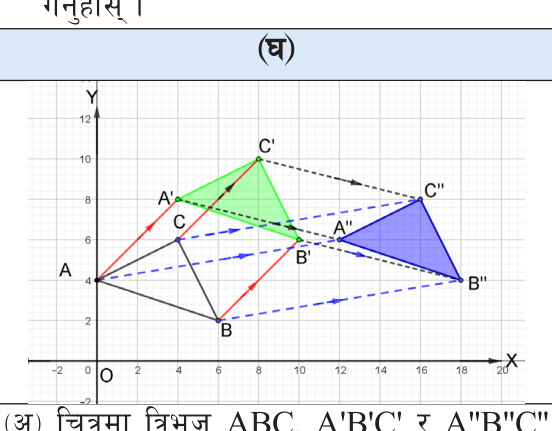
Translations join together too. Triangle ABC with \( A(0, 4) \), \( B(6, 2) \) and \( C(4, 6) \) slides 4 units right and 4 units up to become triangle A'B'C'. Then A'B'C' slides 8 units right and 2 units down to become triangle A''B''C''. Altogether every vertex has moved 12 units right and 2 units up, so a single translation by \( \begin{pmatrix} 12 \\ 2 \end{pmatrix} \) takes ABC straight to A''B''C''. For example, A(0, 4) goes to A''(12, 6).
Combined transformation: If a transformation \( r_1 \) takes an object from position A to A', and a second transformation \( r_2 \) takes it from A' to A'', then the single transformation that takes the object directly from A to A'' is called the combined transformation of \( r_1 \) and \( r_2 \).
When the two transformations are of the same kind, the result is called the combined transformation of two identical transformations. There are four such cases: two reflections, two rotations, two translations and two enlargements. Each one has its own rule.
Which Transformation Comes First
A combined transformation is written with a small o between the two names. The symbol \( R_2 \mathbin{o} R_1 \) means that \( R_1 \) is applied first and \( R_2 \) is then applied to the image. The transformation written on the right, next to the object, always acts first. It works like brackets, which are opened from the inside:
\[ R_2 \mathbin{o} R_1 (P) = R_2\big(R_1(P)\big) \]
So \( R_1 \mathbin{o} R_2 \) is a different instruction: \( R_2 \) first, then \( R_1 \). For two rotations about the same centre, two translations, or two enlargements about the same centre, the order makes no difference to the final image. For two reflections the order can change the answer.
Do not read \( R_2 \mathbin{o} R_1 \) from left to right as if \( R_2 \) came first. The transformation written on the right is always done first.
Combined Reflection
When a figure is reflected in one line and its image is then reflected in a second line, the final image faces the same way as the original. So the single transformation that replaces the two reflections is never a reflection. Which transformation it is depends on how the two mirror lines sit. Either they cross at a point, or they are parallel.
Combined Reflection When the Mirror Lines Intersect
Take the point \( P(5, -2) \). Reflect it in the X-axis, the line y = 0. The x-coordinate stays the same and the y-coordinate changes sign, so the image is \( P'(5, 2) \). Now reflect \( P'(5, 2) \) in the line y = x. Reflection in y = x swaps the two coordinates, so the final image is \( P''(2, 5) \).
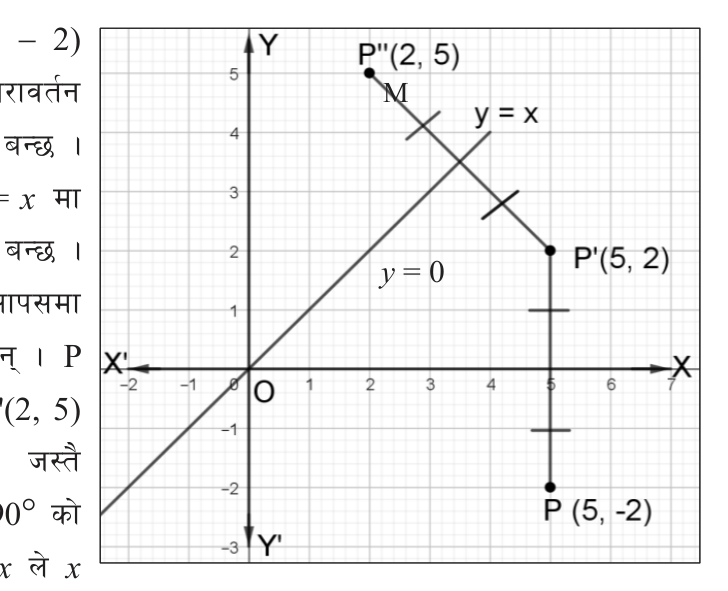
Compare \( P(5, -2) \) with \( P''(2, 5) \). The change follows the pattern \( P(x, y) \to P'(-y, x) \), which is the rule for a rotation of +90° about the origin. The mirror lines y = 0 and y = x cross at O, and the line y = x makes an angle of 45° with the X-axis. So the angle between the mirror lines is 45°, and the rotation angle, 90°, is exactly twice that.
The direction of the rotation also comes from the mirror lines. Turning from the first mirror line, the X-axis, towards the second mirror line, y = x, is an anticlockwise turn. So the rotation is anticlockwise, which is the positive direction.
Two reflections in intersecting lines: If \( R_1 \) and \( R_2 \) are reflections in two lines that intersect, then \( R_2 \mathbin{o} R_1 \) is a rotation. Its centre is the point where the two lines intersect. Its angle is twice the angle between the lines. Its direction is the direction of turning from the first mirror line to the second.
\[ \text{angle of rotation} = 2 \times \theta \]
Here \( \theta \) is the angle between the two mirror lines.
The centre of the rotation is the point where the two mirror lines cross, and that is not always the origin. The lines x = 2 and y = 1 cross at (2, 1), so reflecting in them gives a rotation about (2, 1).
Combined Reflection When the Mirror Lines Are Parallel
Now take \( A(5, 2) \) and reflect it in the line x = 3. A is 2 units to the right of this mirror, so its image is 2 units to the left of it: \( A'(1, 2) \). Next reflect \( A'(1, 2) \) in the line x = -2. A' is 3 units to the right of this mirror, so its image is 3 units to the left of it: \( A''(-5, 2) \).
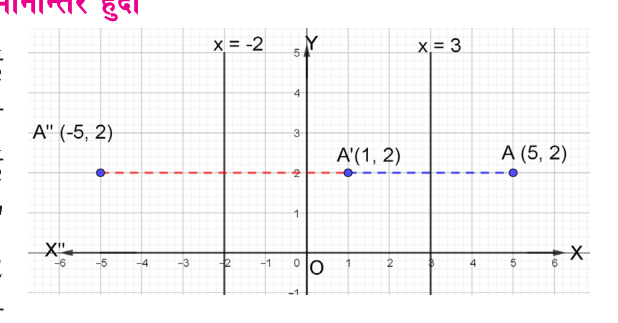
Both mirror lines are parallel to the Y-axis. The point has not turned. It has simply slid 10 units to the left, so the combined transformation is a translation. The mirror lines are 5 units apart, and the distance moved, 10 units, is twice that. Going from the first mirror line x = 3 to the second line x = -2 means moving in the negative x direction, and that is also the direction of the slide.
Step 1: The translation vector is twice the displacement from the first mirror line to the second:
\[ T = 2\begin{pmatrix} -2 - 3 \\ 0 \end{pmatrix} = \begin{pmatrix} -10 \\ 0 \end{pmatrix} \]
Step 2: Adding this vector to A(5, 2) gives the final image:
\[ A''(5 - 10,\ 2 + 0) = A''(-5, 2) \]
Two reflections in parallel lines: If \( R_1 \) and \( R_2 \) are reflections in two parallel lines, then \( R_2 \mathbin{o} R_1 \) is a translation. The translation vector is twice the displacement from the first mirror line to the second.
For mirror lines parallel to the Y-axis, let \( R_1 \) be the reflection in \( x = h_1 \) and \( R_2 \) the reflection in \( x = h_2 \). Then:
\[ R_2 \mathbin{o} R_1 = T = 2\begin{pmatrix} h_2 - h_1 \\ 0 \end{pmatrix} \]
\[ R_1 \mathbin{o} R_2 = T = 2\begin{pmatrix} h_1 - h_2 \\ 0 \end{pmatrix} \]
For mirror lines parallel to the X-axis, let \( r_1 \) be the reflection in \( y = k_1 \) and \( r_2 \) the reflection in \( y = k_2 \). Then:
\[ r_2 \mathbin{o} r_1 = T = 2\begin{pmatrix} 0 \\ k_2 - k_1 \end{pmatrix} \]
\[ r_1 \mathbin{o} r_2 = T = 2\begin{pmatrix} 0 \\ k_1 - k_2 \end{pmatrix} \]
Changing the order of the two reflections reverses the direction of the translation. This is why the order matters for reflections. Reflecting A(5, 2) in x = -2 first and then in x = 3 would move it 10 units to the right instead, to (15, 2).
Combined Rotation
Rotate \( A(4, 2) \) through -180° about the origin. The minus sign means clockwise. A half turn changes the sign of both coordinates, so the image is \( A'(-4, -2) \). Now rotate \( A'(-4, -2) \) through -90° about the origin. A clockwise quarter turn sends (x, y) to (y, -x), so the final image is \( A''(-2, 4) \).
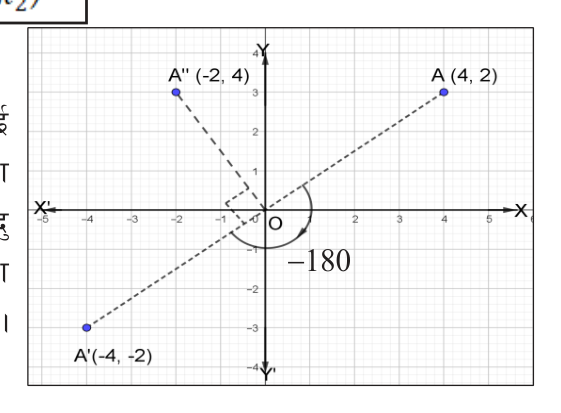
The two turns add up: \( -180^\circ + (-90^\circ) = -270^\circ \). A clockwise turn of 270° ends in the same place as an anticlockwise turn of 90°. Check this against the rule for a rotation of +90°, \( P(x, y) \to P'(-y, x) \). It sends A(4, 2) to (-2, 4), which is exactly A''.
Two rotations about the same centre: If \( R_1 \) and \( R_2 \) are rotations about the same centre through angles \( \theta_1 \) and \( \theta_2 \), the combined transformation is a single rotation about that same centre through the sum of the two angles. This is true whether the angles are equal or different, and the order does not matter.
\[ R_2 \mathbin{o} R_1 = R_1 \mathbin{o} R_2 = R_1 + R_2 \]
For rotations \( R_1[(0, 0), \theta_1] \) and \( R_2[(0, 0), \theta_2] \), this reads:
\[ R_2 \mathbin{o} R_1 = R[(0, 0),\ \theta_1 + \theta_2] \]
If one rotation is clockwise, its angle is negative and the angles are still added. For \( R_1[(0, 0), \theta_1] \) and \( R_2[(0, 0), -\theta_2] \), the combined rotation has centre (0, 0) and angle \( \theta_1 - \theta_2 \).
Angles that differ by 360° give the same rotation. So +270° and -90° are the same turn, and -270° and +90° are the same turn.
Combined Translation
Translate \( A(2, 1) \) by \( T_1 = \begin{pmatrix} 3 \\ 1 \end{pmatrix} \). Adding 3 to x and 1 to y gives \( A'(5, 2) \). Then translate \( A'(5, 2) \) by \( T_2 = \begin{pmatrix} 1 \\ -5 \end{pmatrix} \). Adding 1 to x and -5 to y gives \( A''(6, -3) \).
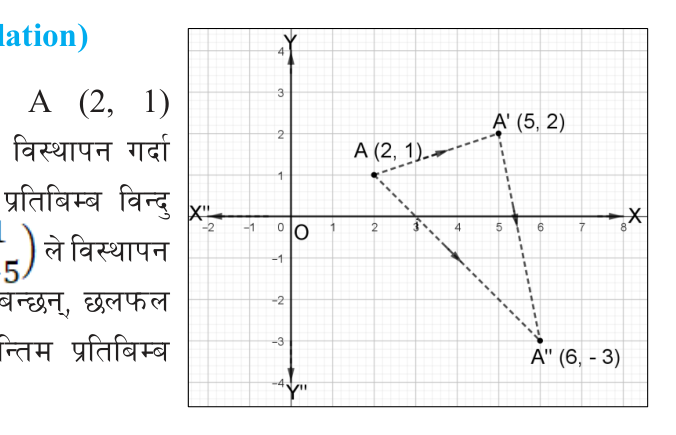
Step 1: Writing the final image as the starting point plus the total movement:
\[ A''(6, -3) = (2 + 4,\ 1 - 4) \]
Step 2: Splitting the total movement back into its two parts:
\[ \begin{pmatrix} 4 \\ -4 \end{pmatrix} = \begin{pmatrix} 3 + 1 \\ 1 - 5 \end{pmatrix} \]
\[ = \begin{pmatrix} 3 \\ 1 \end{pmatrix} + \begin{pmatrix} 1 \\ -5 \end{pmatrix} = T_1 + T_2 \]
Step 3: So the final image is the starting point moved by the sum of the two vectors:
\[ A'' = A + (T_1 + T_2) \]
Two translations: The combined transformation of two translations is also a translation, and its vector is the sum of the two translation vectors. The order does not matter.
If \( T_1 = \begin{pmatrix} a \\ b \end{pmatrix} \) is followed by \( T_2 = \begin{pmatrix} c \\ d \end{pmatrix} \), the combined translation is written \( T_2 \mathbin{o} T_1 \) or \( T_2T_1 \):
\[ T_2 \mathbin{o} T_1 = \begin{pmatrix} a \\ b \end{pmatrix} + \begin{pmatrix} c \\ d \end{pmatrix} = \begin{pmatrix} a + c \\ b + d \end{pmatrix} \]
Adding in the other order gives \( T_1 \mathbin{o} T_2 = \begin{pmatrix} c + a \\ d + b \end{pmatrix} \), which is the same vector. So \( T_1 \mathbin{o} T_2 = T_2 \mathbin{o} T_1 \).
Combined Enlargement
Triangle ABC has vertices \( A(1, 2) \), \( B(2, 1) \) and \( C(3, 2) \). Enlarge it with centre of enlargement O(0, 0) and scale factor 2. Every coordinate is doubled, giving \( A'(2, 4) \), \( B'(4, 2) \) and \( C'(6, 4) \). Enlarge A'B'C' again with the same centre O and scale factor 2. This gives \( A''(4, 8) \), \( B''(8, 4) \) and \( C''(12, 8) \).
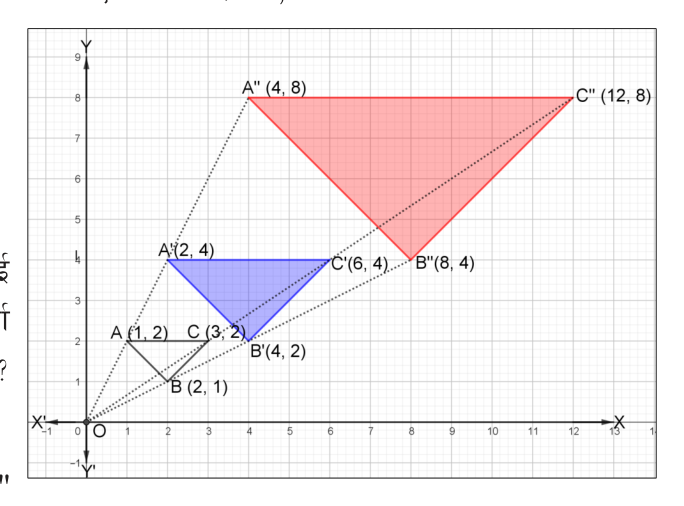
The lines joining A to A'', B to B'' and C to C'' all meet at O, so the centre of the single enlargement is still O(0, 0). Each side of A''B''C'' is 4 times as long as the matching side of ABC, because doubling and then doubling again is multiplying by 4. The scale factors are multiplied, not added.
Step 1: Multiplying the two scale factors to get the combined scale factor:
\[ k = k_1 \times k_2 = 2 \times 2 = 4 \]
Step 2: Applying E[(0, 0), 4] to each vertex by multiplying both of its coordinates by 4:
\[ A''(4 \times 1,\ 4 \times 2) = A''(4, 8) \]
\[ B''(4 \times 2,\ 4 \times 1) = B''(8, 4) \]
\[ C''(4 \times 3,\ 4 \times 2) = C''(12, 8) \]
These are exactly the vertices reached by the two separate enlargements, so ABC goes to A''B''C'' by the single enlargement E[(0, 0), 4].
Two enlargements with the same centre: The combined transformation of two enlargements with the same centre is an enlargement with that same centre, and its scale factor is the product of the two scale factors. This is true whether the scale factors are equal or different, and the order does not matter.
For \( E_1[(0, 0), k_1] \) and \( E_2[(0, 0), k_2] \):
\[ E_2 \mathbin{o} E_1 = E_1 \mathbin{o} E_2 = E[(0, 0),\ k_1 \times k_2] \]
For \( E_1[(a, b), k_1] \) and \( E_2[(a, b), k_2] \):
\[ E_2 \mathbin{o} E_1 = E_1 \mathbin{o} E_2 = E[(a, b),\ k_1 \times k_2] \]
Scale factors are multiplied, never added. Enlarging by 2 and then by 3 gives a scale factor of 6, not 5.
Worked Example 1: Reflection in Both Axes
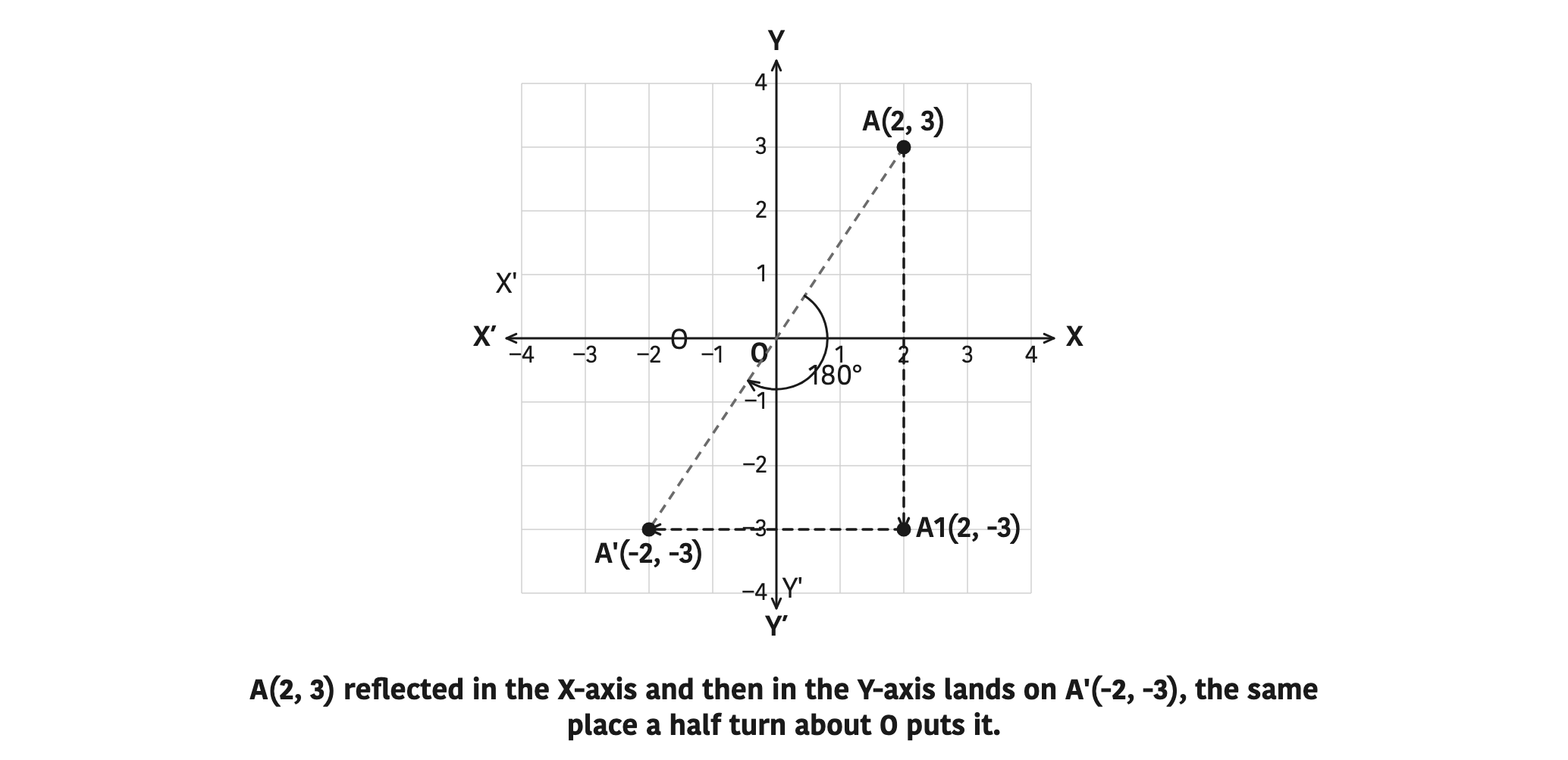
Question: \( R_1 \) is the reflection in the X-axis and \( R_2 \) is the reflection in the Y-axis. Which single transformation is \( R_2 \mathbin{o} R_1 \)? Use it to find the image of the point A(2, 3).
Step 1: Checking how the mirror lines sit. The X-axis and the Y-axis cross at the origin, and the angle between them is 90°. So the combined transformation is a rotation about (0, 0) through twice that angle:
\[ 2 \times 90^\circ = 180^\circ \]
Step 2: Writing the rule for a rotation of 180° about the origin:
\[ P(x, y) \to P'(-x, -y) \]
Step 3: Applying the rule to A(2, 3):
\[ A(2, 3) \to A'(-2, -3) \]
Another way is to do the two reflections one at a time. \( R_1 \) acts first, and reflection in the X-axis changes the sign of y:
\[ R_1(2, 3) = (2, -3) \]
Then \( R_2 \), reflection in the Y-axis, changes the sign of x:
\[ R_2(2, -3) = (-2, -3) \]
Both methods give the image A'(-2, -3).
Worked Example 2: Reflection in the Lines y = 0 and y = 3
Question: \( R_1 \) is the reflection in the X-axis and \( R_2 \) is the reflection in the line y = 3. Which single transformation is \( R_2 \mathbin{o} R_1 \)? Use it to find the image of the point B(2, -1).
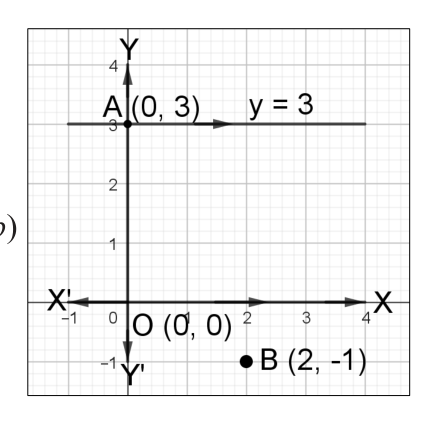
Step 1: The lines y = 0 and y = 3 are parallel, so the combined transformation is a translation. Its vector is twice the displacement from the first line to the second, measured along the Y-axis from O(0, 0) to A(0, 3):
\[ T = 2\,\overrightarrow{OA} = 2\begin{pmatrix} 0 - 0 \\ 3 - 0 \end{pmatrix} \]
\[ = 2\begin{pmatrix} 0 \\ 3 \end{pmatrix} = \begin{pmatrix} 0 \\ 6 \end{pmatrix} \]
Step 2: Writing the rule for a translation by \( \begin{pmatrix} a \\ b \end{pmatrix} \):
\[ P(x, y) \to P'(x + a,\ y + b) \]
Step 3: Applying the translation by \( \begin{pmatrix} 0 \\ 6 \end{pmatrix} \) to B(2, -1):
\[ B'(2 + 0,\ -1 + 6) = B'(2, 5) \]
So the image of B(2, -1) is B'(2, 5). Doing one reflection at a time gives the same answer: the line y = 0 sends B to (2, 1), and the line y = 3 sends (2, 1) to (2, 5).
Worked Example 3: Two Translations
Question: \( T_1 = \begin{pmatrix} 2 \\ -3 \end{pmatrix} \) and \( T_2 = \begin{pmatrix} 3 \\ 2 \end{pmatrix} \) are two translations. Using the combined translation \( T_1 \mathbin{o} T_2 \) or \( T_2 \mathbin{o} T_1 \), find the image of the point Q(-3, -4).
Step 1: Adding the two vectors, because two translations combine into one translation by their sum:
\[ T_2 \mathbin{o} T_1 = \begin{pmatrix} 2 \\ -3 \end{pmatrix} + \begin{pmatrix} 3 \\ 2 \end{pmatrix} = \begin{pmatrix} 5 \\ -1 \end{pmatrix} \]
Step 2: Adding 5 to the x-coordinate and -1 to the y-coordinate of Q(-3, -4):
\[ Q'(-3 + 5,\ -4 - 1) = Q'(2, -5) \]
So the image of Q(-3, -4) is Q'(2, -5). The order of translations does not matter, so \( T_1 \mathbin{o} T_2 \) gives the same image.
When a part of the vector is negative, adding it makes the coordinate smaller. Here \( -4 + (-1) = -5 \).
Worked Example 4: Two Enlargements
Question: \( E_1[(0, 0), 2] \) and \( E_2[(0, 0), \tfrac{3}{2}] \) are two enlargements. Using the combined transformation \( E_1 \mathbin{o} E_2 \), find the image of the point M(5, -7).
Step 1: Both enlargements have centre (0, 0), so the combined enlargement also has centre (0, 0). Its scale factor is the product of the two scale factors:
\[ k = k_1 \times k_2 = 2 \times \frac{3}{2} = 3 \]
Step 2: Writing the rule for an enlargement with centre (0, 0) and scale factor k:
\[ P(x, y) \to P'(kx,\ ky) \]
Step 3: Multiplying both coordinates of M(5, -7) by 3:
\[ M'(3 \times 5,\ 3 \times (-7)) = M'(15, -21) \]
So the image of M(5, -7) is M'(15, -21).
Worked Example 5: A Triangle Reflected in x = -1 and x = 4
Question: Triangle ABC has vertices A(-6, 1), B(-4, 3) and C(-2, 1). \( R_1 \) is the reflection in the line x = -1 and \( R_2 \) is the reflection in the line x = 4. Which single transformation is \( R_2 \mathbin{o} R_1 \)? Use it to find the image of triangle ABC, and show both triangles on one graph.
Step 1: The lines x = -1 and x = 4 are both parallel to the Y-axis, so the combined transformation is a translation. Take M(-1, 3) on the first line and N(4, 3) on the second line at the same height. The translation vector is twice \( \overrightarrow{MN} \):
\[ T = 2\,\overrightarrow{MN} = 2\begin{pmatrix} 4 + 1 \\ 3 - 3 \end{pmatrix} \]
\[ = 2\begin{pmatrix} 5 \\ 0 \end{pmatrix} = \begin{pmatrix} 10 \\ 0 \end{pmatrix} \]
Step 2: Adding 10 to each x-coordinate and 0 to each y-coordinate:
\[ A'(-6 + 10,\ 1 + 0) = A'(4, 1) \]
\[ B'(-4 + 10,\ 3 + 0) = B'(6, 3) \]
\[ C'(-2 + 10,\ 1 + 0) = C'(8, 1) \]
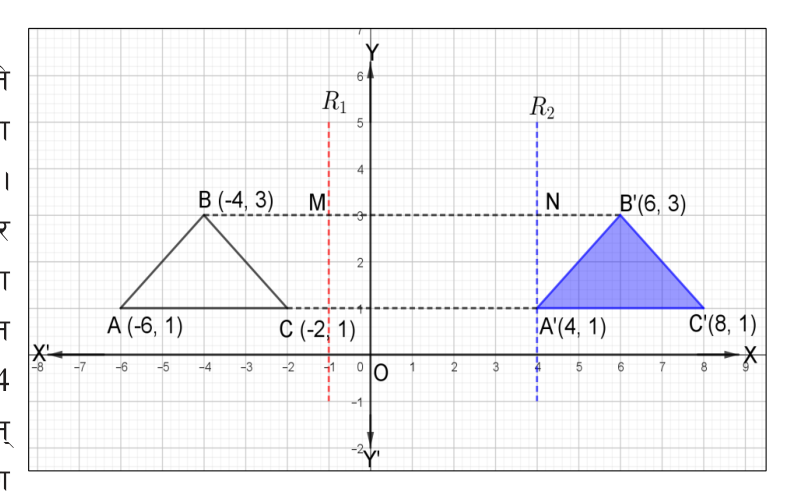
The image triangle has vertices A'(4, 1), B'(6, 3) and C'(8, 1). It is the same shape and the same size as ABC and faces the same way, which is what a translation always gives.
Worked Example 6: Two Rotations of a Triangle
Question: Triangle PQR has vertices P(4, -2), Q(2, 1) and R(5, 2). It is rotated through 180° about the origin, and then through 90° about the origin in the same direction. Which single transformation does this? Use it to find the image of triangle PQR, and show both triangles on one graph.
Step 1: Let \( R_1 \) be the rotation [(0, 0), 180°] and \( R_2 \) the rotation [(0, 0), 90°]. Both have centre (0, 0), so \( R_2 \mathbin{o} R_1 \) is a rotation about (0, 0) through the sum of the angles:
\[ 180^\circ + 90^\circ = 270^\circ \]
So the single transformation is the rotation R[(0, 0), 270°].
Step 2: Writing the rule for a rotation of +270° about the origin:
\[ P(x, y) \to P'(y, -x) \]
Step 3: Applying the rule to each vertex:
\[ P(4, -2) \to P'(-2, -4) \]
\[ Q(2, 1) \to Q'(1, -2) \]
\[ R(5, 2) \to R'(2, -5) \]
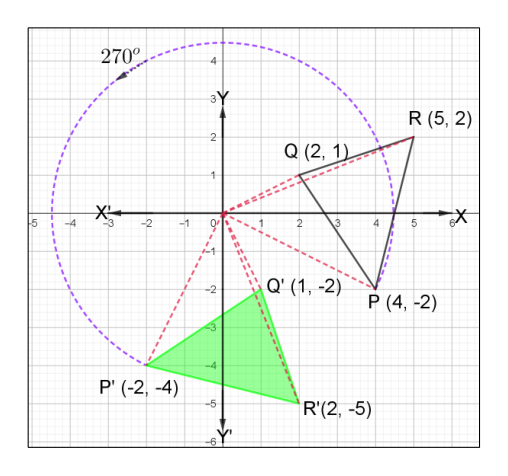
So the image triangle P'Q'R' has vertices P'(-2, -4), Q'(1, -2) and R'(2, -5).
Worked Example 7: Mirror Lines Meeting Away from the Origin
Question: The point P(5, 3) is reflected in the line x = 2 and then in the line y = 1. Which single transformation does this, and where is the final image?
Step 1: The line x = 2 is vertical and the line y = 1 is horizontal, so they cross at right angles at the point (2, 1). The combined transformation is a rotation about (2, 1) through:
\[ 2 \times 90^\circ = 180^\circ \]
Step 2: Reflecting P(5, 3) in x = 2. P is 3 units to the right of the line, so its image is 3 units to the left:
\[ P'(2 - 3,\ 3) = P'(-1, 3) \]
Step 3: Reflecting P'(-1, 3) in y = 1. P' is 2 units above the line, so its image is 2 units below:
\[ P''(-1,\ 1 - 2) = P''(-1, -1) \]
Step 4: Checking that (2, 1) is the centre of the half turn. A half turn sends a point to the far end of a line through the centre, so the centre must be the midpoint of P and P'':
\[ \left( \frac{5 + (-1)}{2},\ \frac{3 + (-1)}{2} \right) = (2, 1) \]
So the two reflections together are a rotation of 180° about (2, 1), and the final image is P''(-1, -1).
The Four Combinations at a Glance
| Two transformations | Single transformation | How to find it |
| Two reflections, lines intersect | Rotation | Centre where the lines meet; angle twice the angle between the lines, turning from the first line to the second |
| Two reflections, lines parallel | Translation | Vector twice the displacement from the first line to the second |
| Two rotations, same centre | Rotation | Same centre; angle \( \theta_1 + \theta_2 \) |
| Two translations | Translation | Vector \( T_1 + T_2 \) |
| Two enlargements, same centre | Enlargement | Same centre; scale factor \( k_1 \times k_2 \) |
Only the pair of reflections depends on the order. The other three give the same single transformation whichever of the two is done first.
The full lesson is waiting for you
The notes are free to read in full. A free account opens the rest of the practice, and tracks your progress and confidence score for every subject. Presentations and videos need approval from Learn Yeti.