Curves Hidden in Everyday Objects
Four curves turn up again and again in the objects around us. Look at a wall clock, a picture of the planets going round the Sun, a satellite dish on a rooftop and an old sand clock. Each one shows a different curve, and each curve has a name.
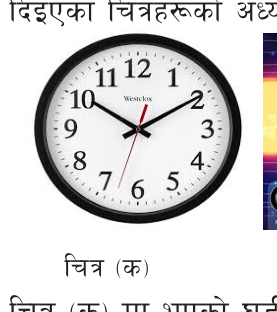
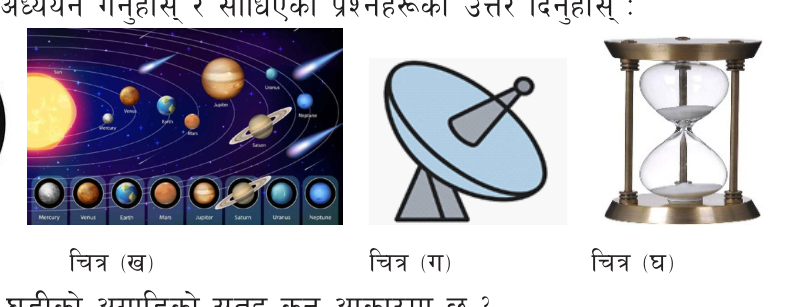
- The rim of the clock face is a circle. Measure from its centre to any point on the rim and you always get the same distance.
- The path a planet follows around the Sun looks round at first glance, but it is not perfectly round. It is stretched a little in one direction. A closed curve stretched like this is an ellipse.
- The bowl of a satellite dish, such as the ones fixed on rooftops to receive television signals, is curved in the shape of a parabola.
- An hourglass, or sand clock, is wide at the top and the bottom and narrow at the waist. The outline of its sides is shaped like a hyperbola.
The circle, the ellipse, the parabola and the hyperbola look very different from one another. The surprising fact is that all four can be cut from one and the same solid: the right circular cone. How you hold the knife decides which curve you get.
What a Conic Section Is
Conic section: the plane curve formed where a flat plane cuts (intersects) a right circular cone. The word conic simply means belonging to a cone.
Imagine a carrot trimmed into the shape of a cone. Slice it with a knife and look at the cut face. The edge of that face is a curve, and the shape of the curve depends on the angle at which the knife went in. A level slice gives one shape. A slightly tilted slice gives another. A steeper slice gives a third, and a very steep slice through a double cone gives a fourth.
In every case studied here, the cutting plane does not pass through the pointed top of the cone. A plane through the top would only touch the cone at a point or run along straight lines, and a straight line is not a conic section.
The cone never changes. Only the angle of the cut changes, and that angle alone decides which conic section appears.
The Parts of a Right Circular Cone
A right circular cone has a flat circular base and a pointed top. It is called right because the top sits exactly above the centre of the base, so the cone stands straight and does not lean. Before we can describe a cut, we need names for its parts.
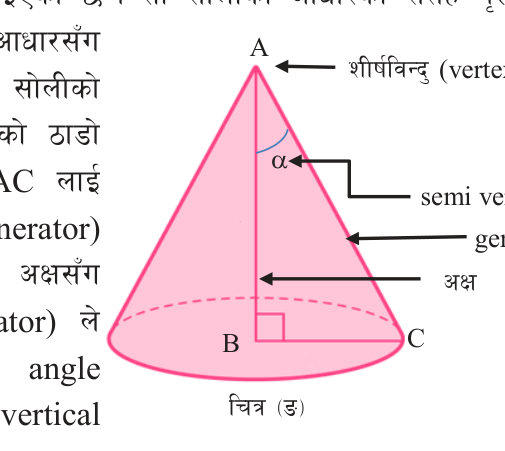
Vertex: the pointed top of the cone. In the cone ABC it is the point A.
Axis: the line joining the vertex to the centre of the base, meeting the base at right angles. In the cone ABC it is AB, which is also the vertical height of the cone.
Generator: a straight line from the vertex to any point on the edge of the base. In the cone ABC it is AC, which is also called the slant height of the cone.
Semi-vertical angle: the angle between the axis and a generator of the cone. In the cone ABC it is \( \angle BAC = \alpha \).
The generator gets its name from what it does. Hold the axis AB still and swing the line AC all the way round it. As it turns, AC sweeps out, or generates, the whole curved surface of the cone. Every position AC passes through is a generator, so a cone has countless generators, all of the same length.
The word semi means half. The full angle at the vertex is the angle between two generators on opposite sides of the cone, and the axis splits it into two equal parts. Each half is the semi-vertical angle \( \alpha \), so the full angle at the vertex is \( 2\alpha \). Because AB meets the base at right angles, triangle ABC is right angled at B, and BC is the radius of the base.
The Doubled Mapped Right Circular Cone
Now take two equal right circular cones. Turn one upside down and join the two at their vertices, so that the two axes lie along one straight line. The result looks like two ice cream cones touching at their tips.
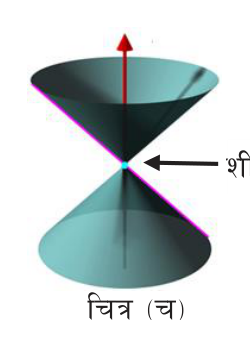
Doubled mapped right circular cone: the solid formed by joining two equal right circular cones at their vertices, one facing up and one facing down, so that their axes lie on the same straight line. It is often called a double cone.
The joining point is the vertex shared by both cones. Every generator of the lower cone runs straight on through the vertex and becomes a generator of the upper cone. We need this double shape for one curve in particular, the hyperbola, because that curve comes from a plane that cuts through both cones at once.
The Angle That Decides the Curve
Two angles decide every cut. The first is the semi-vertical angle \( \alpha \). It belongs to the cone, so it stays fixed. The second is \( \theta \), the angle that the cutting plane makes with the axis of the cone. It changes every time you tilt the plane.
Start with the plane lying level, straight across the cone. Then \( \theta = 90^\circ \). Tilt it slowly towards the axis and \( \theta \) gets smaller. First it is still bigger than \( \alpha \), then it becomes equal to \( \alpha \), and finally it becomes smaller than \( \alpha \). Each of these stages gives a different conic section.
To name a conic section, compare \( \theta \) with two numbers: \( 90^\circ \) and the semi-vertical angle \( \alpha \).
The angle \( \theta \) is measured from the AXIS of the cone, not from the base. A plane lying parallel to the base makes \( 90^\circ \) with the axis, not \( 0^\circ \).
Circle
Let a plane ABCD cut the cone straight across, parallel to its base. The plane then meets the axis at right angles. Every point on the cut edge is the same distance from the axis, so the cut edge is perfectly round.
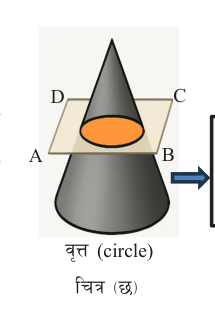
Circle (as a conic section): the plane curve formed when a plane cuts a cone at \( 90^\circ \) to its axis, that is, parallel to its base, without passing through the vertex.
\[ \theta = 90^\circ \]
Ellipse
Now tilt the plane ABCD a little, so that it is no longer level but is still less steep than the sloping side of the cone. It still slices right across the cone from one side to the other, so the cut edge is a closed curve. Because of the tilt, it is stretched in one direction, like a flattened circle.
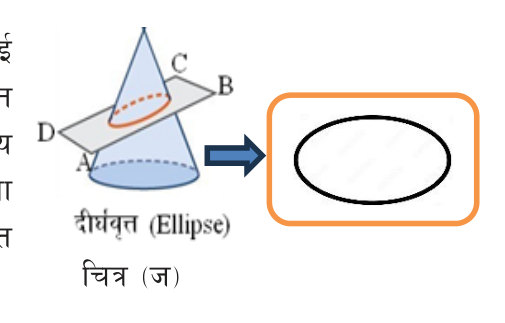
Ellipse: the plane curve formed when a plane cuts a cone so that the angle \( \theta \) it makes with the axis is greater than the semi-vertical angle \( \alpha \) and less than \( 90^\circ \).
\[ \alpha < \theta < 90^\circ \]
Parabola
Keep tilting until the plane ABCD lies exactly parallel to one generator of the cone. At this moment the plane makes the same angle with the axis as the generator does, so \( \theta = \alpha \). The plane now runs alongside the sloping side and never reaches across to the far side. The cut edge does not close up. It opens out into a single U shaped curve.
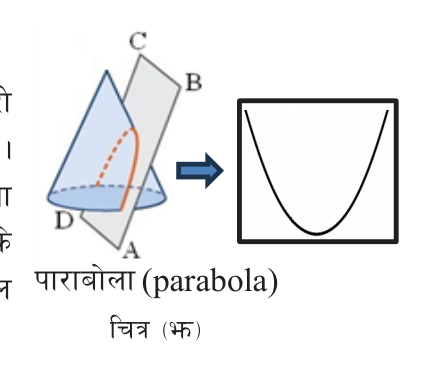
Parabola: the plane curve formed when a plane cuts a cone parallel to one of its generators, so that the angle \( \theta \) it makes with the axis equals the semi-vertical angle \( \alpha \).
\[ \theta = \alpha \]
Hyperbola
Tilt the plane further still, so it is steeper than the generator and closer to the axis. Now \( \theta \) is smaller than \( \alpha \). A plane this steep cannot stay inside one cone. Take the double cone: the plane ABCD passes through the lower cone and carries on into the upper cone, cutting both.
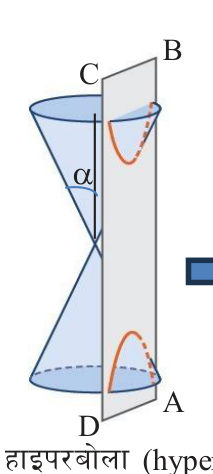
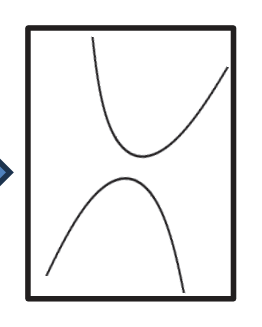
Each cone gives one open curve, so the hyperbola comes in two separate pieces called branches. The two branches face away from each other. This is the only one of the four curves that needs two cones joined at their vertices.
Hyperbola: the plane curve formed when a plane cuts both parts of a doubled mapped right circular cone, so that the angle \( \theta \) it makes with the axis is less than the semi-vertical angle \( \alpha \).
\[ \theta < \alpha \]
A hyperbola is ONE conic section made of two branches. Do not count its two pieces as two different curves, and do not try to get it from a single cone.
The Four Cuts Side by Side
| Conic section | Position of the plane | Angle with the axis | Shape of the curve |
| Circle | Perpendicular to the axis, parallel to the base | \( \theta = 90^\circ \) | Closed and round |
| Ellipse | Tilted, but cuts right across one cone | \( \alpha < \theta < 90^\circ \) | Closed and stretched |
| Parabola | Parallel to a generator | \( \theta = \alpha \) | Open, one piece |
| Hyperbola | Steeper than a generator, cuts both cones | \( \theta < \alpha \) | Open, two branches |
Read the table from top to bottom as one journey. The plane starts level and \( \theta \) is \( 90^\circ \). As the plane tilts, \( \theta \) falls. While it stays above \( \alpha \) the curve is closed: first a circle, then an ellipse. The moment \( \theta \) reaches \( \alpha \), the curve breaks open into a parabola. Once \( \theta \) drops below \( \alpha \), the plane reaches the second cone and the curve splits into the two branches of a hyperbola.
The full lesson is waiting for you
The notes are free to read in full. A free account opens the rest of the practice, and tracks your progress and confidence score for every subject. Presentations and videos need approval from Learn Yeti.