Drawing a Circle and Finding Its Rule
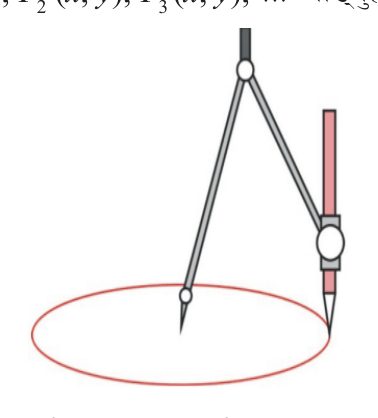
Fix the needle of a pair of compasses at one point and swing the pencil leg all the way round. The curve the pencil draws is a circle. The needle marks the centre. The opening of the compasses does not change while you draw, so the pencil is always the same distance from the centre.
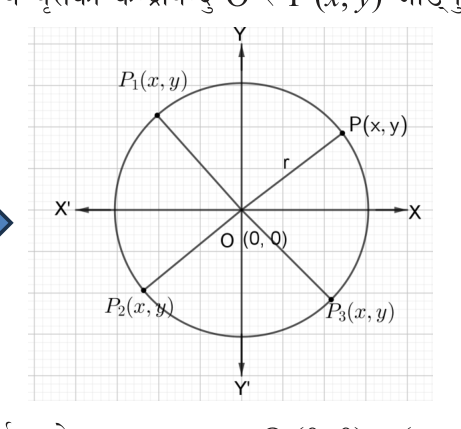
Now draw the circle on graph paper with its centre at the origin O(0, 0). Mark any point P(x, y) on the circle and join it to O. The line OP is the radius, written r. Mark more points \( P_1, P_2, P_3 \) on the circle and join each of them to O as well. To find OP, use the distance formula with O(0, 0) as \( (x_1, y_1) \) and P(x, y) as \( (x_2, y_2) \):
\[ OP^2 = r^2 = (x_2 - x_1)^2 + (y_2 - y_1)^2 \]
\[ r^2 = (x - 0)^2 + (y - 0)^2 = x^2 + y^2 \]
Work out \( OP_1^2, OP_2^2 \) and \( OP_3^2 \) in the same way and every one of them gives \( r^2 \) again. Measure OP, \( OP_1 \), \( OP_2 \) and \( OP_3 \) with a ruler and they come out equal. So every point on this circle obeys one relation, \( x^2 + y^2 = r^2 \). This relation is called the equation of the circle with centre at the origin (0, 0) and radius r.
Radius: the distance from the centre of a circle to any point on its circumference. It is written r, and all radii of one circle are equal.
Equation of a circle: a relation between x and y that is true for every point (x, y) on the circle and for no point off it.
Concentric Circles
Keep the needle in one place and draw two circles with two different openings. Call the common centre C, a point on the inner circle B and a point on the outer circle A. The inner radius is BC = r and the outer radius is AC = R. When you measure them, R is longer than r, and R minus r is the width of the ring between the two circles. The two circles share a centre but not a radius.
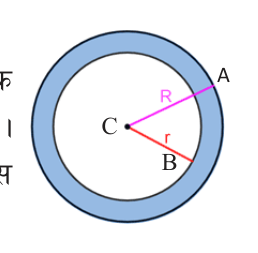
Concentric circles: two or more circles that have the same centre but different radii.
This idea is used in problems. When you are asked for a circle concentric with a given circle, the centre is copied from the given circle and only the new radius has to be found.
The Circle as a Conic Section
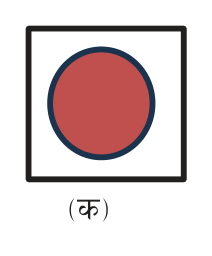
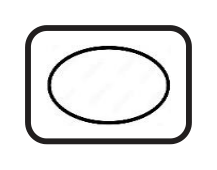
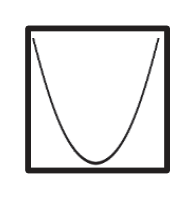
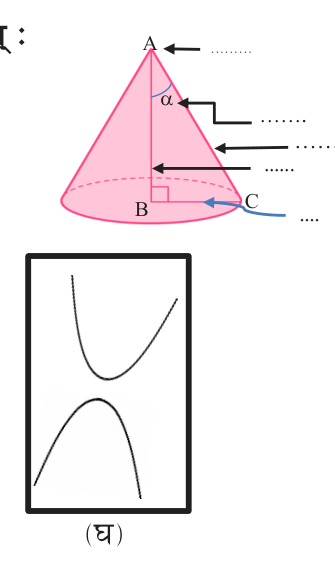
A circle can also be made by cutting a solid. Take a right circular cone and slice it with a flat plane that is parallel to its base. The cut face is a circle. If the plane is tilted, the cut gives a different curve: an ellipse, a parabola or a hyperbola. These four curves are called conic sections because each is a section of a cone.
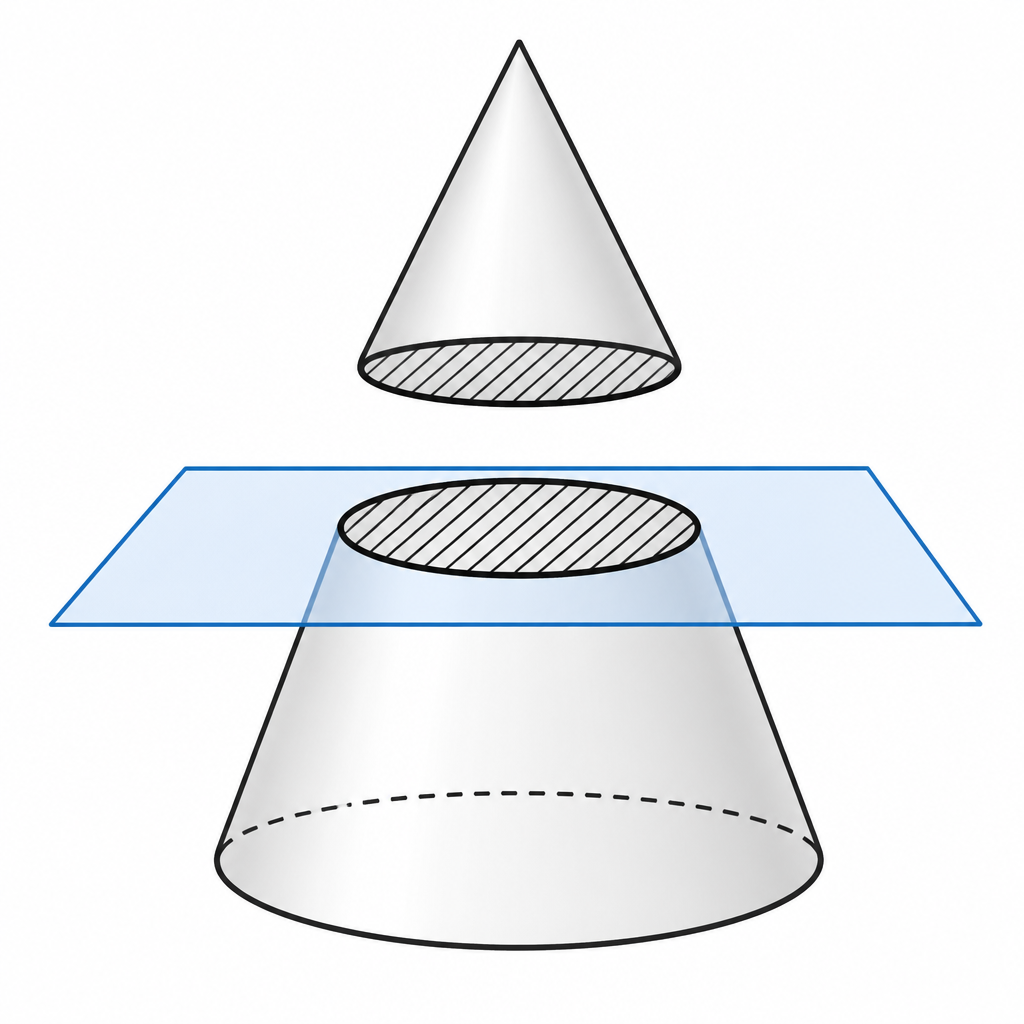
Circle as a conic section: the curve formed when a right circular cone is cut by a plane parallel to its base.
Seen on their own, the four conic sections are easy to tell apart. The circle curves by the same amount all the way round. The ellipse is a stretched, oval closed curve. The parabola is one open curve. The hyperbola has two separate open branches.
The Circle as a Locus
A locus is the path traced by a point that moves according to a rule. Suppose a point P moves so that it always stays the same distance from a fixed point O. The path it traces is a circle. The fixed point O is the centre of the circle, and the fixed distance OP is its radius, so OP = r.
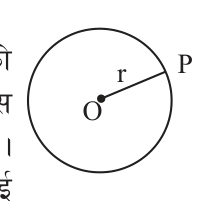
Circle as a locus: the locus of a point that moves so that its distance from a fixed point stays the same. The fixed point is the centre and the fixed distance is the radius.
The compasses, the cone and the locus all describe the same thing: every point on a circle is the same distance from its centre. Every equation of a circle comes from writing that one sentence with the distance formula.
Equation of a Circle with Centre at the Origin
Let the centre be the origin O(0, 0) and let P(x, y) be any point on the circumference. OP is the radius, so OP = r. Take O(0, 0) as \( (x_1, y_1) \) and P(x, y) as \( (x_2, y_2) \).
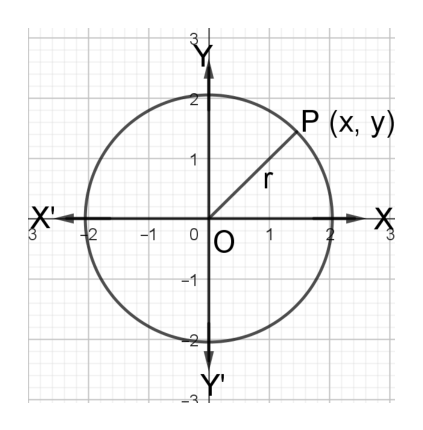
Step 1: Writing the distance formula for OP:
\[ OP = r = \sqrt{(x_2 - x_1)^2 + (y_2 - y_1)^2} \]
Step 2: Putting in the coordinates of O and P:
\[ r = \sqrt{(x - 0)^2 + (y - 0)^2} = \sqrt{x^2 + y^2} \]
Step 3: Squaring both sides to remove the square root:
\[ x^2 + y^2 = r^2 \]
Equation of a circle with centre at the origin: a circle with centre (0, 0) and radius r has the equation \( x^2 + y^2 = r^2 \).
For example, the circle with centre at the origin and radius 10 units is \( x^2 + y^2 = 100 \). Read the other way, \( x^2 + y^2 = 36 \) is the circle with centre (0, 0) and radius 6 units, because \( 6^2 = 36 \).
Equation of a Circle with Centre (h, k)
Now let the centre be a point C(h, k) that need not be the origin, and let P(x, y) be any point on the circle. CP is the radius, so CP = r. Take C(h, k) as \( (x_1, y_1) \) and P(x, y) as \( (x_2, y_2) \).
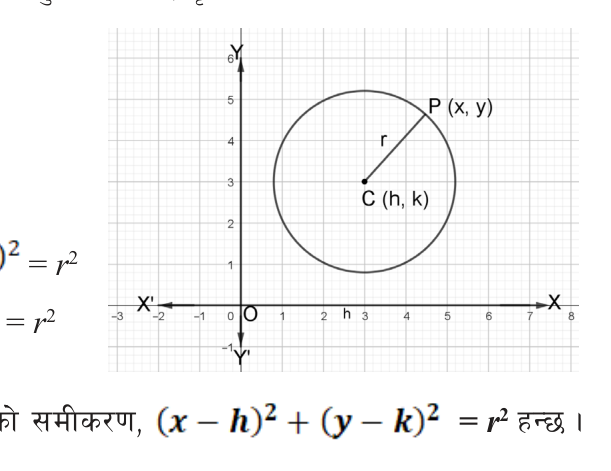
Step 1: Squaring the distance formula for CP, which equals the radius:
\[ CP^2 = (x_2 - x_1)^2 + (y_2 - y_1)^2 = r^2 \]
Step 2: Putting in the coordinates of C and P:
\[ (x - h)^2 + (y - k)^2 = r^2 \]
Equation of a circle with centre (h, k): a circle with centre (h, k) and radius r has the equation \( (x - h)^2 + (y - k)^2 = r^2 \).
Put h = 0 and k = 0 and this becomes \( x^2 + y^2 = r^2 \). So the circle centred at the origin is just one special case of this equation.
The signs inside the brackets are the opposite of the signs of the centre. A centre (1, -5) gives \( (x - 1)^2 + (y + 5)^2 \), because \( y - (-5) = y + 5 \). Read backwards, \( (x + 3)^2 + (y - 4)^2 = 49 \) has centre (-3, 4) and radius 7, not centre (3, -4).
Equation of a Circle from the Ends of a Diameter
Let C be the centre of a circle and let AB be a diameter with ends \( A(x_1, y_1) \) and \( B(x_2, y_2) \). Take any other point P(x, y) on the circle and join PA and PB. The angle APB stands on the diameter, so it is an angle in a semicircle, and an angle in a semicircle is a right angle. So \( \angle APB = 90^\circ \), which means AP and BP are perpendicular.
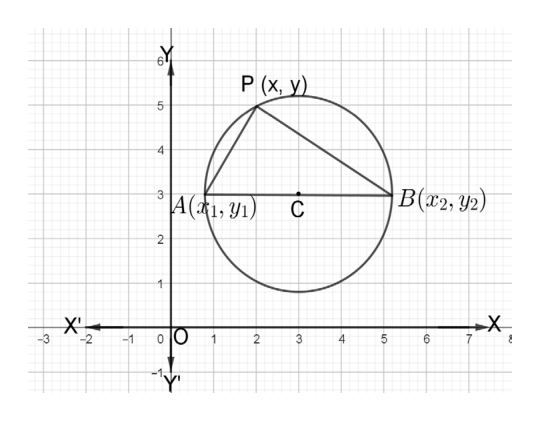
The slope of AP, the line through \( A(x_1, y_1) \) and P(x, y), is \( m_1 = \frac{y - y_1}{x - x_1} \). In the same way the slope of BP is \( m_2 = \frac{y - y_2}{x - x_2} \). Two lines are perpendicular when the product of their slopes is -1.
Step 1: Writing the condition for AP and BP to be perpendicular:
\[ m_1 \times m_2 = -1 \]
Step 2: Putting in the two slopes:
\[ \frac{y - y_1}{x - x_1} \times \frac{y - y_2}{x - x_2} = -1 \]
Step 3: Multiplying both sides by \( (x - x_1)(x - x_2) \):
\[ (y - y_1)(y - y_2) = -(x - x_1)(x - x_2) \]
Step 4: Moving every term to the left side:
\[ (x - x_1)(x - x_2) + (y - y_1)(y - y_2) = 0 \]
Equation of a circle in diameter form: a circle whose diameter has ends \( (x_1, y_1) \) and \( (x_2, y_2) \) has the equation \( (x - x_1)(x - x_2) + (y - y_1)(y - y_2) = 0 \).
The diameter form needs neither the centre nor the radius. The two ends of a diameter are enough. Notice that the x brackets use only the x coordinates and the y brackets use only the y coordinates.
The General Form of the Equation of a Circle
Start from the equation with centre (h, k) and radius r and expand it.
Step 1: The equation of the circle with centre (h, k) and radius r is:
\[ (x - h)^2 + (y - k)^2 = r^2 \]
Step 2: Expanding both squares:
\[ x^2 - 2hx + h^2 + y^2 - 2ky + k^2 = r^2 \]
Step 3: Rearranging with every term on the left:
\[ x^2 + y^2 + 2(-h)x + 2(-k)y + h^2 + k^2 - r^2 = 0 \]
Step 4: Writing g for -h, f for -k and c for \( h^2 + k^2 - r^2 \):
\[ x^2 + y^2 + 2gx + 2fy + c = 0 \]
General form of the equation of a circle: \( x^2 + y^2 + 2gx + 2fy + c = 0 \), where g = -h, f = -k and \( c = h^2 + k^2 - r^2 \).
Turning these round gives h = -g, k = -f and \( r^2 = h^2 + k^2 - c \). So the centre and the radius can be read straight from the general form:
\[ (h, k) = (-g, -f) \]
\[ r = \sqrt{h^2 + k^2 - c} = \sqrt{g^2 + f^2 - c} \]
The general form has two features that mark an equation as a circle:
- (a) It is of degree 2 in x and y.
- (b) The coefficient of \( x^2 \) is equal to the coefficient of \( y^2 \).
Take \( x^2 + y^2 - 6x + 4y - 12 = 0 \). Comparing it with the general form, 2g = -6 so g = -3, 2f = 4 so f = 2, and c = -12. The centre is (-g, -f) = (3, -2) and the radius is \( \sqrt{9 + 4 + 12} = \sqrt{25} = 5 \) units.
In the general form the coefficient of \( x^2 \) and \( y^2 \) is 1. If an equation begins \( 9x^2 + 9y^2 \), divide every term by 9 first. Only then can you read off 2g, 2f and c. Comparing without dividing gives a wrong centre and a wrong radius.
Circles That Touch the Axes
When a circle just touches an axis, the radius drawn to the point of touching is perpendicular to that axis. So the radius is equal to the distance of the centre from that axis. For a centre (h, k), the distance from the x-axis is k and the distance from the y-axis is h.
- Touching the x-axis: r = k, so the equation is \( (x - h)^2 + (y - k)^2 = k^2 \), or \( (x - h)^2 + (y - r)^2 = r^2 \).
- Touching the y-axis: r = h, so the equation is \( (x - h)^2 + (y - k)^2 = h^2 \), or \( (x - r)^2 + (y - k)^2 = r^2 \).
- Touching both axes: r = h = k, so the equation is \( (x - h)^2 + (y - h)^2 = h^2 \), or \( (x - k)^2 + (y - k)^2 = k^2 \), or \( (x - r)^2 + (y - r)^2 = r^2 \).
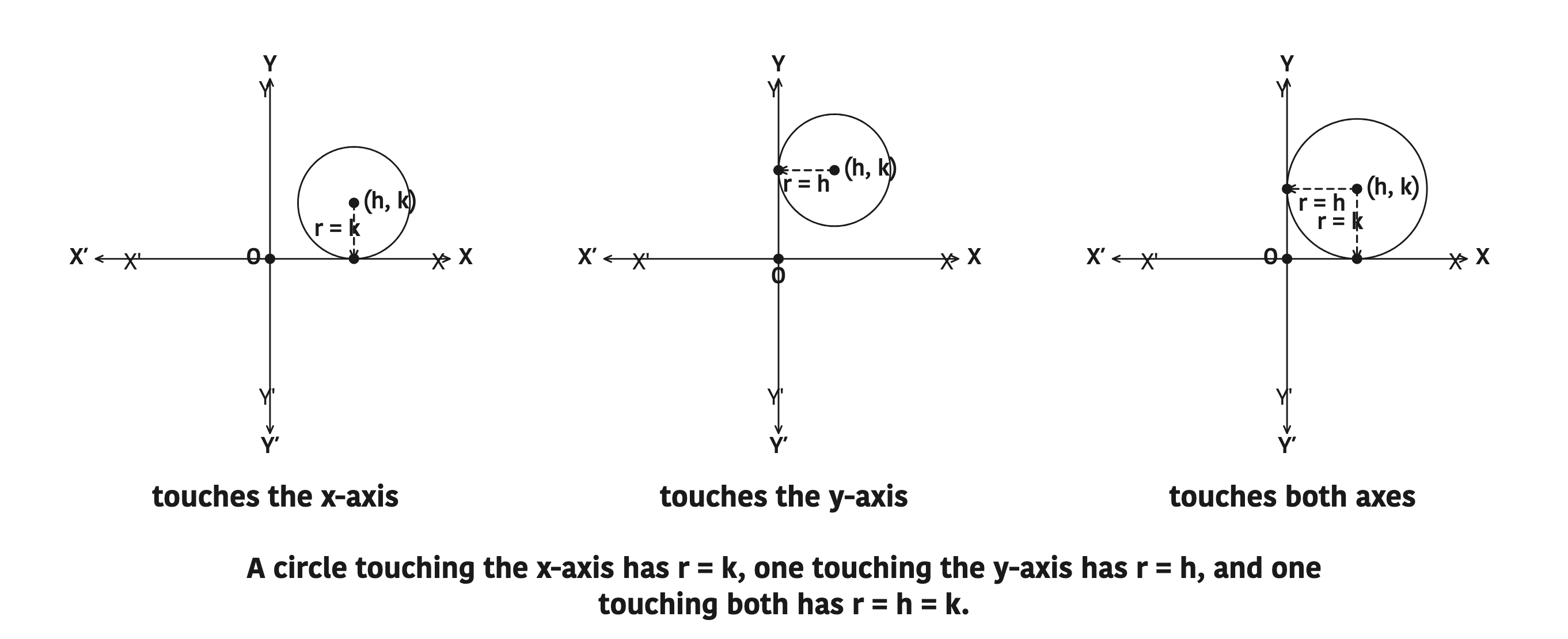
The results r = k and r = h are written for a centre above the x-axis and to the right of the y-axis. Below the x-axis or to the left of the y-axis the coordinate is negative, and the radius is its size without the sign. The squared forms such as \( k^2 \) stay correct either way. For a circle of radius r that touches both axes, the quadrant fixes the signs of the centre:
- First quadrant: centre (r, r).
- Second quadrant: centre (-r, r).
- Third quadrant: centre (-r, -r).
- Fourth quadrant: centre (r, -r).
All the Forms Together
| Situation | Equation of the circle |
| Centre at the origin (0, 0), radius r | \( x^2 + y^2 = r^2 \) |
| Centre (h, k), radius r | \( (x - h)^2 + (y - k)^2 = r^2 \) |
| Ends of a diameter \( (x_1, y_1) \) and \( (x_2, y_2) \) | \( (x - x_1)(x - x_2) + (y - y_1)(y - y_2) = 0 \) |
| Touching the x-axis (r = k) | \( (x - h)^2 + (y - k)^2 = k^2 \) |
| Touching the y-axis (r = h) | \( (x - h)^2 + (y - k)^2 = h^2 \) |
| Touching both axes (r = h = k) | \( (x - r)^2 + (y - r)^2 = r^2 \) |
| General form | \( x^2 + y^2 + 2gx + 2fy + c = 0 \), centre (-g, -f), \( r = \sqrt{g^2 + f^2 - c} \) |
Worked Example 1: Centre and Radius Given
Find the equation of the circle with centre (1, -5) and radius 4 units. Here (h, k) = (1, -5) and r = 4.
Step 1: Writing the equation for a centre (h, k):
\[ (x - h)^2 + (y - k)^2 = r^2 \]
Step 2: Substituting h = 1, k = -5 and r = 4:
\[ (x - 1)^2 + (y + 5)^2 = 4^2 \]
Step 3: Expanding both squares:
\[ x^2 - 2x + 1 + y^2 + 10y + 25 = 16 \]
Step 4: Bringing every term to the left side:
\[ x^2 + y^2 - 2x + 10y + 1 + 25 - 16 = 0 \]
Step 5: Adding the numbers:
\[ x^2 + y^2 - 2x + 10y + 10 = 0 \]
This is the required equation. As a check, g = -1 and f = 5, so the centre (-g, -f) is (1, -5), and \( r^2 = 1 + 25 - 10 = 16 \), so r = 4.
Worked Example 2: Ends of a Diameter Given
The ends of a diameter of a circle are (2, -4) and (-3, 7). Find its equation. Take (2, -4) as \( (x_1, y_1) \) and (-3, 7) as \( (x_2, y_2) \).
Step 1: Writing the diameter form:
\[ (x - x_1)(x - x_2) + (y - y_1)(y - y_2) = 0 \]
Step 2: Substituting the two ends:
\[ (x - 2)(x + 3) + (y + 4)(y - 7) = 0 \]
Step 3: Multiplying out each pair of brackets:
\[ x^2 + 3x - 2x - 6 + y^2 - 7y + 4y - 28 = 0 \]
Step 4: Collecting like terms:
\[ x^2 + y^2 + x - 3y - 34 = 0 \]
This is the required equation.
Worked Example 3: Centre and Diameter from the General Form
The equation of a circle is \( 9x^2 + 9y^2 - 36x + 6y - 107 = 0 \). Find the coordinates of its centre and its diameter.
Step 1: Dividing every term by 9, so that \( x^2 \) and \( y^2 \) have coefficient 1 as in the general form:
\[ x^2 + y^2 - 4x + \frac{2}{3}y - \frac{107}{9} = 0 \]
Step 2: Comparing with \( x^2 + y^2 + 2gx + 2fy + c = 0 \) gives 2g = -4, so g = -2. Also \( 2f = \frac{2}{3} \), so \( f = \frac{1}{3} \), and \( c = -\frac{107}{9} \). The centre is (-g, -f):
\[ (h, k) = \left(2, -\frac{1}{3}\right) \]
Step 3: Putting h, k and c into the radius formula:
\[ r = \sqrt{(2)^2 + \left(-\frac{1}{3}\right)^2 - \left(-\frac{107}{9}\right)} \]
Step 4: Squaring and removing the double minus sign:
\[ r = \sqrt{4 + \frac{1}{9} + \frac{107}{9}} \]
Step 5: Writing everything over the common denominator 9 and taking the root:
\[ r = \sqrt{\frac{36 + 1 + 107}{9}} = \sqrt{\frac{144}{9}} = \sqrt{16} = 4 \]
Step 6: Doubling the radius to get the diameter:
\[ d = 2r = 2 \times 4 = 8 \text{ units} \]
So the centre is \( \left(2, -\frac{1}{3}\right) \) and the diameter is 8 units. Dividing by 9 at the start was necessary because g, f and c can only be read from an equation whose \( x^2 \) and \( y^2 \) terms have coefficient 1.
Worked Example 4: Touching Both Axes in the Third Quadrant
Find the equation of the circle of radius 5 units that lies wholly in the third quadrant and touches both axes. The circle touches the x-axis, so its centre is 5 units below it. It touches the y-axis, so its centre is 5 units to the left of it. In the third quadrant both coordinates are negative.
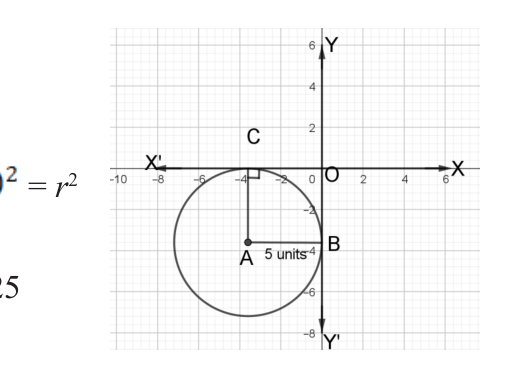
Step 1: Writing the centre for the third quadrant:
\[ (h, k) = (-r, -r) = (-5, -5) \]
Step 2: Substituting into \( (x - h)^2 + (y - k)^2 = r^2 \):
\[ (x + 5)^2 + (y + 5)^2 = 5^2 \]
Step 3: Expanding both squares:
\[ x^2 + 10x + 25 + y^2 + 10y + 25 = 25 \]
Step 4: Subtracting 25 from both sides and arranging the terms:
\[ x^2 + y^2 + 10x + 10y + 25 = 0 \]
Worked Example 5: Through the Origin with Given Intercepts
A circle passes through the origin and cuts off an x-intercept of 12 units and a y-intercept of 8 units. Find its equation. The circle meets the x-axis at A(12, 0) and the y-axis at B(0, 8), and it also passes through O. The angle AOB is the angle between the axes, so \( \angle AOB = 90^\circ \). A right angle on a circle stands on a diameter, so AB is a diameter.
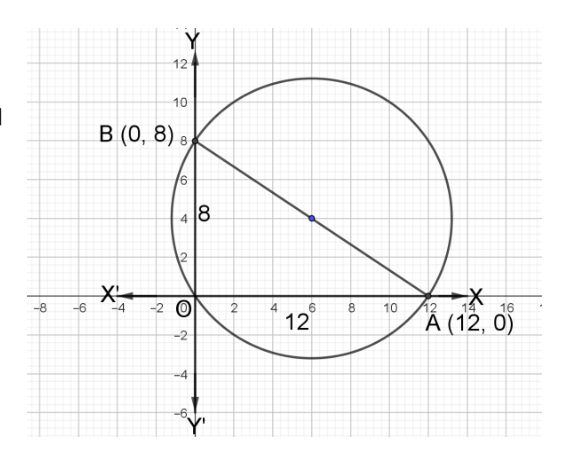
Step 1: Putting A(12, 0) as \( (x_1, y_1) \) and B(0, 8) as \( (x_2, y_2) \) into the diameter form:
\[ (x - 12)(x - 0) + (y - 0)(y - 8) = 0 \]
Step 2: Multiplying out:
\[ x^2 - 12x + y^2 - 8y = 0 \]
Step 3: Arranging in general form:
\[ x^2 + y^2 - 12x - 8y = 0 \]
There is no constant term. That is always the case for a circle through the origin, because (0, 0) must satisfy the equation.
Worked Example 6: Through Two Points, Centre on a Line
Find the equation of the circle that passes through A(2, 3) and B(5, 4) and whose centre lies on the line 2x + 3y = 7. Let the centre be P(h, k) and the radius r. Two facts give two equations: P lies on the line, and PA = PB because both are radii of the same circle.
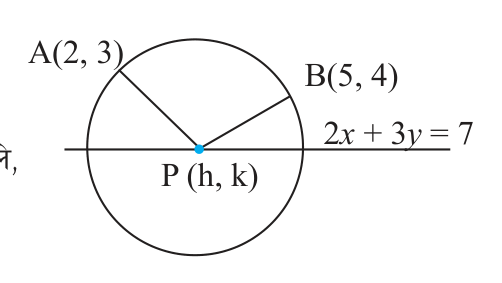
Step 1: The centre lies on the line, so its coordinates satisfy it. Solving for h:
\[ 2h + 3k = 7, \text{ so } h = \frac{7 - 3k}{2} \quad \text{(i)} \]
Step 2: Since PA = PB, their squares are equal:
\[ (h - 2)^2 + (k - 3)^2 = (h - 5)^2 + (k - 4)^2 \]
Step 3: Expanding both sides:
\[ h^2 - 4h + 4 + k^2 - 6k + 9 = h^2 - 10h + 25 + k^2 - 8k + 16 \]
Step 4: Cancelling \( h^2 \) and \( k^2 \) from both sides:
\[ 13 - 4h - 6k = 41 - 10h - 8k \]
Step 5: Collecting the h terms on the left:
\[ 6h = -2k + 28 \]
Step 6: Replacing h by its value from (i):
\[ 6\left(\frac{7 - 3k}{2}\right) = -2k + 28 \]
Step 7: Simplifying the left side, since 6 divided by 2 is 3:
\[ 21 - 9k = -2k + 28 \]
Step 8: Solving for k:
\[ -7k = 7, \text{ so } k = -1 \]
Step 9: Putting k = -1 back into (i):
\[ h = \frac{7 - 3 \times (-1)}{2} = \frac{10}{2} = 5 \]
Step 10: Finding the radius from PA, with P(5, -1) and A(2, 3):
\[ r^2 = (5 - 2)^2 + (-1 - 3)^2 = 9 + 16 = 25 \]
So r = 5 units. Step 11: Writing the equation with centre (5, -1) and radius 5:
\[ (x - 5)^2 + (y + 1)^2 = 5^2 \]
Step 12: Expanding and simplifying:
\[ x^2 + y^2 - 10x + 2y + 1 = 0 \]
One More Circle Through Two Points
The same method works for any circle through two known points with its centre on a known line. A circle passes through P(4, 1) and Q(6, 5), and its centre C(h, k) lies on the line 4x + y = 16.
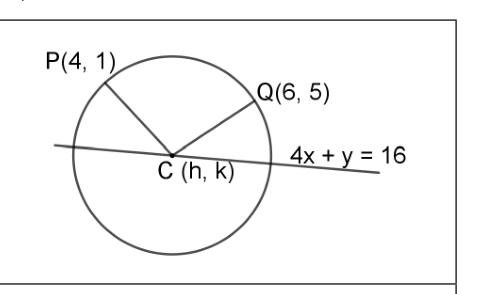
Step 1: The centre lies on the line, so:
\[ k = 16 - 4h \quad \text{(i)} \]
Step 2: Setting \( CP^2 = CQ^2 \):
\[ (h - 4)^2 + (k - 1)^2 = (h - 6)^2 + (k - 5)^2 \]
Step 3: Expanding, cancelling \( h^2 \) and \( k^2 \), and dividing by 4:
\[ h + 2k = 11 \]
Step 4: Putting k from (i) into this equation:
\[ h + 32 - 8h = 11, \text{ so } h = 3 \]
Then k = 16 - 12 = 4, so the centre is (3, 4). Step 5: Finding the square of the radius from P(4, 1):
\[ r^2 = (3 - 4)^2 + (4 - 1)^2 = 1 + 9 = 10 \]
Step 6: Writing the equation and expanding:
\[ x^2 + y^2 - 6x - 8y + 15 = 0 \]
Worked Example 7: A Concentric Circle Through a Point
Find the equation of the circle that is concentric with \( x^2 + y^2 - 8x + 6y - 5 = 0 \) and passes through the point (-2, -7). Concentric means the same centre, so the centre is taken from the given circle and the radius is the distance from that centre to (-2, -7).
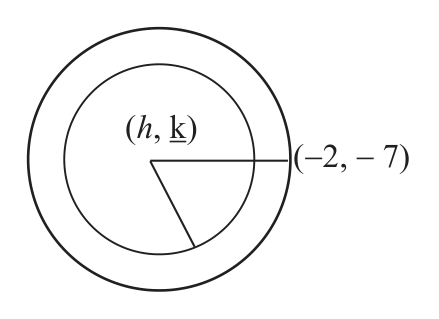
Step 1: Comparing the given equation with the general form gives 2g = -8, 2f = 6 and c = -5, so g = -4 and f = 3. The centre is:
\[ (h, k) = (-g, -f) = (4, -3) \]
Step 2: Using the distance formula from (4, -3) to (-2, -7) for the radius:
\[ r = \sqrt{(-2 - 4)^2 + (-7 + 3)^2} = \sqrt{36 + 16} \]
Step 3: Simplifying the surd:
\[ r = \sqrt{52} = 2\sqrt{13} \text{ units} \]
Step 4: Writing the equation with centre (4, -3):
\[ (x - 4)^2 + (y + 3)^2 = \left(2\sqrt{13}\right)^2 \]
Step 5: Expanding, with \( \left(2\sqrt{13}\right)^2 = 52 \):
\[ x^2 - 8x + 16 + y^2 + 6y + 9 = 52 \]
Step 6: Bringing every term to the left side:
\[ x^2 + y^2 - 8x + 6y - 27 = 0 \]
Compare it with the given circle. Only the constant term has changed. Concentric circles always keep the same x and y terms and differ only in c.
The full lesson is waiting for you
The notes are free to read in full. A free account opens the rest of the practice, and tracks your progress and confidence score for every subject. Presentations and videos need approval from Learn Yeti.