Two Lines, Two Angles
Draw any two straight lines on a graph that are not parallel. They cross at exactly one point, and they make four angles around it. Angles opposite each other are equal, so there are really only two different sizes of angle. Call one of them \( \theta \) and its neighbour \( \alpha \). These two sit side by side on a straight line, so \( \theta + \alpha = 180^\circ \). If one of them is acute, the other is obtuse.
The slope of a line is the tangent of the angle the line makes with the positive direction of the x-axis. A line with inclination \( \theta_1 \) has slope \( m = \tan\theta_1 \). Slope carries the direction of a line, so two slopes are enough to tell us the angle between two lines. No protractor is needed, and not even a drawing.
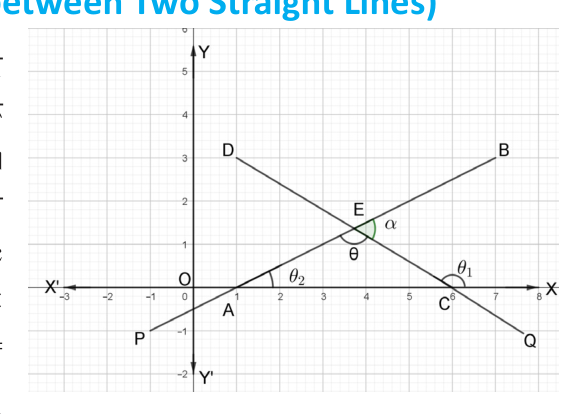
In the figure below, the lines DQ and PB cross at the point E. Let their equations in slope form be \( y = m_1x + c_1 \) for DQ and \( y = m_2x + c_2 \) for PB. DQ cuts the x-axis at C and makes \( \angle DCX = \theta_1 \), so \( m_1 = \tan\theta_1 \). PB cuts the x-axis at A and makes \( \angle BAX = \theta_2 \), so \( m_2 = \tan\theta_2 \). At E the two lines make \( \angle QEP = \theta \) and \( \angle QEB = \alpha \).
Deriving the Formula for the Angle
The triangle EAC in the figure links the three angles \( \theta \), \( \theta_1 \) and \( \theta_2 \). The angle \( \angle ECX \) is an exterior angle of this triangle. An exterior angle of a triangle equals the sum of the two opposite interior angles, and that one fact gives the whole formula.
Step 1: Writing the exterior angle of triangle EAC as the sum of the two opposite interior angles, \( \angle ECX = \angle AEC + \angle EAC \), which in our letters is:
\[ \theta_1 = \theta + \theta_2 \]
Step 2: Subtracting \( \theta_2 \) from both sides to make \( \theta \) the subject:
\[ \theta = \theta_1 - \theta_2 \]
Step 3: Taking the tangent of both sides and expanding with the compound angle formula for \( \tan(A - B) \):
\[ \tan\theta = \frac{\tan\theta_1 - \tan\theta_2}{1 + \tan\theta_1\tan\theta_2} \]
Step 4: Replacing \( \tan\theta_1 \) by \( m_1 \) and \( \tan\theta_2 \) by \( m_2 \). Call this result (i):
\[ \tan\theta = \frac{m_1 - m_2}{1 + m_1m_2} \]
Step 5: Finding the other angle. Since \( \theta \) and \( \alpha \) are adjacent angles on a straight line, \( \alpha = 180^\circ - \theta \). Taking the tangent of both sides:
\[ \tan\alpha = \tan(180^\circ - \theta) = -\tan\theta \]
Step 6: Putting result (i) into this. Call this result (ii):
\[ \tan\alpha = -\frac{m_1 - m_2}{1 + m_1m_2} \]
Step 7: Joining (i) and (ii) into one statement with a plus or minus sign, because the angle between the lines can be either of the two:
\[ \tan\theta = \pm\left(\frac{m_1 - m_2}{1 + m_1m_2}\right) \]
Angle between two straight lines: If two straight lines have slopes \( m_1 \) and \( m_2 \), the angle \( \theta \) between them is given by \( \theta = \tan^{-1}\pm\left(\frac{m_1 - m_2}{1 + m_1m_2}\right) \).
\[ \theta = \tan^{-1}\pm\left(\frac{m_1 - m_2}{1 + m_1m_2}\right) \]
The sign tells you which angle you have found. When the value of \( \tan\theta \) is positive, \( \theta \) is the acute angle between the lines. When it is negative, \( \theta \) is the obtuse angle. Find one of them and the other is 180° minus it.
The denominator is \( 1 + m_1m_2 \), with a plus sign, while the numerator has a minus sign. Students who mix this up with the formula for \( \tan(A + B) \) write \( 1 - m_1m_2 \) and get a wrong angle. It does not matter which line you call the first one, because the \( \pm \) sign covers both orders.
Condition for Parallelism of Two Straight Lines
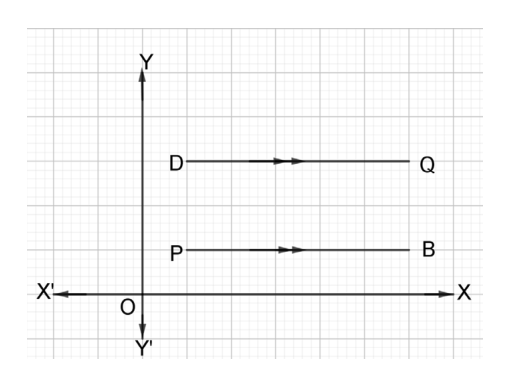
Parallel lines run in the same direction and never meet. The angle between them is 0°, or 180° if we measure it the other way round. Since \( \tan 0^\circ = 0 \) and \( \tan 180^\circ = 0 \) as well, we can put this into the angle formula and see what it says about the slopes.
Step 1: Putting \( \theta = 0^\circ \) into the angle formula:
\[ \tan 0^\circ = \pm\left(\frac{m_1 - m_2}{1 + m_1m_2}\right) \]
Step 2: Using \( \tan 0^\circ = 0 \):
\[ 0 = \pm\left(\frac{m_1 - m_2}{1 + m_1m_2}\right) \]
Step 3: Multiplying both sides by \( 1 + m_1m_2 \):
\[ 0 \times (1 + m_1m_2) = \pm(m_1 - m_2) \]
Step 4: Simplifying the left side, then dividing by \( \pm 1 \), since 0 divided by \( \pm 1 \) is still 0:
\[ 0 = m_1 - m_2 \]
Step 5: Rearranging:
\[ m_1 = m_2 \]
Condition for parallelism: Two straight lines are parallel to each other when their slopes are equal, that is, \( m_1 = m_2 \).
For example, \( y = 2x + 1 \) and \( y = 2x - 5 \) both have slope 2, so they are parallel. They differ only in where they cut the y-axis. It also works the other way round: if you are told that two lines are parallel, you may set their slopes equal and solve for any unknown.
Condition for Perpendicular of Two Straight Lines
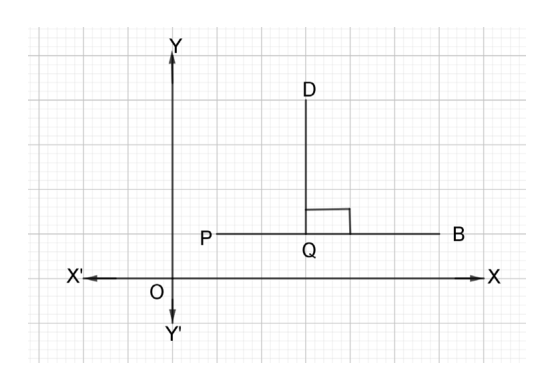
Two lines are perpendicular when they meet at a right angle, so \( \theta = 90^\circ \). The tangent of 90° is not a number at all, and that is exactly what gives us the condition.
Step 1: Putting \( \theta = 90^\circ \) into the angle formula:
\[ \tan 90^\circ = \pm\left(\frac{m_1 - m_2}{1 + m_1m_2}\right) \]
Step 2: Writing \( \tan 90^\circ \) as \( \frac{\sin 90^\circ}{\cos 90^\circ} \), where \( \sin 90^\circ = 1 \) and \( \cos 90^\circ = 0 \):
\[ \frac{1}{0} = \pm\left(\frac{m_1 - m_2}{1 + m_1m_2}\right) \]
Step 3: Cross multiplying:
\[ 1 + m_1m_2 = \pm 0 \times (m_1 - m_2) \]
Step 4: Since 0 multiplied by any value is 0:
\[ 1 + m_1m_2 = 0 \]
Step 5: Subtracting 1 from both sides:
\[ m_1m_2 = -1 \]
Condition for perpendicularity: Two straight lines are perpendicular to each other when the product of their slopes is \( -1 \), that is, \( m_1m_2 = -1 \), or \( m_1 = -\frac{1}{m_2} \).
The second form says the slopes are negative reciprocals of each other. Turn one slope upside down and change its sign, and you get the other. A line of slope \( \frac{2}{3} \) is perpendicular to every line of slope \( -\frac{3}{2} \), because \( \frac{2}{3} \times \left(-\frac{3}{2}\right) = -1 \). In the same way, a line of slope 4 is perpendicular to a line of slope \( -\frac{1}{4} \).
A horizontal line has slope 0, and a vertical line has no slope at all because \( \tan 90^\circ \) is undefined. Such a pair is perpendicular, but \( m_1m_2 = -1 \) cannot be used to show it. The condition works only when both lines have a slope.
The Angle When Lines Are in General Form
Lines are usually given in the general form \( ax + by + c = 0 \) rather than as \( y = mx + c \). You do not have to rearrange each one, because the slope can be read straight from the coefficients:
\[ m = -\frac{\text{coefficient of } x}{\text{coefficient of } y} = -\frac{a}{b} \]
Suppose the two lines are \( a_1x + b_1y + c_1 = 0 \) and \( a_2x + b_2y + c_2 = 0 \). Putting their slopes into the angle formula gives a version that works with the coefficients directly.
Step 1: Writing the slopes of the two lines:
\[ m_1 = -\frac{a_1}{b_1} \]
\[ m_2 = -\frac{a_2}{b_2} \]
Step 2: Working out the numerator of the formula over the common denominator \( b_1b_2 \):
\[ m_1 - m_2 = \frac{a_2b_1 - a_1b_2}{b_1b_2} \]
Step 3: Working out the denominator of the formula in the same way:
\[ 1 + m_1m_2 = \frac{b_1b_2 + a_1a_2}{b_1b_2} \]
Step 4: Dividing the two, so that \( b_1b_2 \) cancels, and letting the \( \pm \) sign take care of the change of sign on top:
\[ \theta = \tan^{-1}\pm\left(\frac{a_1b_2 - a_2b_1}{a_1a_2 + b_1b_2}\right) \]
Both forms of the formula give the same angle. The slope form is quicker when the slopes are simple numbers. The coefficient form saves a line of working when both equations are already in general form.
Equation of a Line Parallel to a Given Line
Suppose we want the equation of a line parallel to \( ax + by + c = 0 \). The slope of the given line is \( m_1 = -\frac{a}{b} \). Let the parallel line be \( y = m_2x + c_1 \), and call it equation (ii).
Step 1: Since the lines are parallel, \( m_2 = m_1 = -\frac{a}{b} \). Putting this into equation (ii):
\[ y = -\frac{a}{b}x + c_1 \]
Step 2: Multiplying every term by b:
\[ by = -ax + bc_1 \]
Step 3: Moving all the terms to the left side:
\[ ax + by - bc_1 = 0 \]
Step 4: Writing a single letter k for the constant \( -bc_1 \):
\[ ax + by + k = 0 \]
A line parallel to \( ax + by + c = 0 \) keeps exactly the same x and y terms. Only the constant changes, and it is written k. The value of k comes from a point the new line passes through. For example, every line parallel to \( 5x - 2y + 9 = 0 \) has the form \( 5x - 2y + k = 0 \).
Equation of a Line Perpendicular to a Given Line
A line perpendicular to \( ax + by + c = 0 \) has the equation \( bx - ay + k = 0 \). The coefficients of x and y swap places, and one of them changes sign. We can check that this line really is perpendicular by multiplying the two slopes.
Step 1: The slope of \( ax + by + c = 0 \) is:
\[ m_1 = -\frac{a}{b} \]
Step 2: The slope of \( bx - ay + k = 0 \), found the same way from its coefficients:
\[ m_2 = -\frac{b}{-a} = \frac{b}{a} \]
Step 3: Multiplying the two slopes:
\[ m_1m_2 = -\frac{a}{b} \times \frac{b}{a} = -1 \]
The product is \( -1 \), so the two lines are perpendicular whatever the values of a, b and k. For example, every line perpendicular to \( 3x + 2y - 8 = 0 \) has the form \( 2x - 3y + k = 0 \).
Swapping the coefficients without changing a sign gives \( bx + ay + k = 0 \), which is not perpendicular in general. For \( 3x + 2y - 8 = 0 \), the line \( 2x + 3y + k = 0 \) has slope \( -\frac{2}{3} \), and \( \left(-\frac{3}{2}\right) \times \left(-\frac{2}{3}\right) = 1 \), not \( -1 \).
Results for Two Straight Lines at a Glance
- Angle between two straight lines: \( \theta = \tan^{-1}\pm\left(\frac{m_1 - m_2}{1 + m_1m_2}\right) \)
- Two straight lines are parallel when \( m_1 = m_2 \).
- Two straight lines are perpendicular when \( m_1m_2 = -1 \), that is, \( m_1 = -\frac{1}{m_2} \).
- A line parallel to \( ax + by + c = 0 \) has the equation \( ax + by + k = 0 \).
- A line perpendicular to \( ax + by + c = 0 \) has the equation \( bx - ay + k = 0 \).
Worked Example 1: Acute and Obtuse Angles between Two Lines
Two straight lines have the equations \( 3x + 4y - 10 = 0 \), called (i), and \( 4x - 5y + 2 = 0 \), called (ii). Find:
- (a) the acute angle between the lines;
- (b) the obtuse angle between the lines.
Step 1: Finding the slope of line (i) from its coefficients:
\[ m_1 = -\frac{3}{4} \]
Step 2: Finding the slope of line (ii) the same way:
\[ m_2 = -\frac{4}{-5} = \frac{4}{5} \]
Step 3: Putting both slopes into the angle formula:
\[ \tan\theta = \pm\left(\frac{-\frac{3}{4} - \frac{4}{5}}{1 + \left(-\frac{3}{4}\right)\times\frac{4}{5}}\right) \]
Step 4: Simplifying the top and the bottom over the common denominator 20:
\[ \tan\theta = \pm\left(\frac{\frac{-15 - 16}{20}}{\frac{20 - 12}{20}}\right) \]
Step 5: Cancelling the 20s:
\[ \tan\theta = \pm\left(\frac{-31}{8}\right) \]
Step 6: Taking the positive value, because a positive tangent gives the acute angle:
\[ \theta = \tan^{-1}\left(\frac{31}{8}\right) = 75.53^\circ \]
Answer to (a): the acute angle between the lines is 75.53°.
Step 7: Subtracting the acute angle from 180°, since the two angles at the crossing are supplementary:
\[ 180^\circ - 75.53^\circ = 104.47^\circ \]
Answer to (b): the obtuse angle between the lines is 104.47°.
Worked Example 2: An Unknown Coefficient in Parallel Lines
The straight lines \( ax + 10y + 20 = 0 \) and \( 4x - 8y + 7 = 0 \) are parallel to each other. Find the value of a.
Step 1: Finding the slope of the first line:
\[ m_1 = -\frac{a}{10} \]
Step 2: Finding the slope of the second line:
\[ m_2 = -\frac{4}{-8} = \frac{1}{2} \]
Step 3: Setting the slopes equal, because the lines are parallel:
\[ -\frac{a}{10} = \frac{1}{2} \]
Step 4: Cross multiplying:
\[ -2a = 10 \]
Step 5: Dividing both sides by \( -2 \):
\[ a = -5 \]
So the value of a is \( -5 \). A quick check: with \( a = -5 \) the first line is \( -5x + 10y + 20 = 0 \), whose slope is \( \frac{5}{10} = \frac{1}{2} \), the same as the slope of the second line.
Worked Example 3: A Perpendicular Line through a Given Point
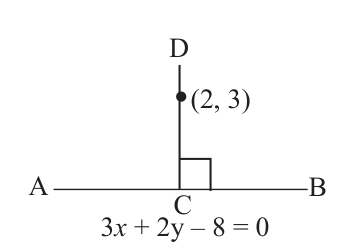
Find the equation of the straight line that passes through the point (2, 3) and is perpendicular to the line \( 3x + 2y - 8 = 0 \). Let AB be the given line, called (i), and let CD be the required line through (2, 3).
Step 1: Finding the slope of AB from its coefficients:
\[ m_1 = -\frac{3}{2} \]
Step 2: Writing the equation of CD through (2, 3) in point slope form \( y - y_1 = m(x - x_1) \), with its slope m still unknown. Call this equation (ii):
\[ y - 3 = m(x - 2) \]
Step 3: Using \( m_1m_2 = -1 \) with \( m_2 = m \), because AB and CD are perpendicular:
\[ -\frac{3}{2} \times m = -1 \]
Step 4: Solving for m:
\[ m = \frac{2}{3} \]
Step 5: Putting this slope into equation (ii):
\[ y - 3 = \frac{2}{3}(x - 2) \]
Step 6: Multiplying both sides by 3 to clear the fraction:
\[ 3y - 9 = 2x - 4 \]
Step 7: Bringing every term to one side:
\[ 2x - 3y + 5 = 0 \]
So the required line is \( 2x - 3y + 5 = 0 \). Check: at (2, 3) we get \( 4 - 9 + 5 = 0 \), so the point lies on the line.
Another method uses the ready result for a perpendicular line. Swapping the coefficients of \( 3x + 2y - 8 = 0 \) and changing one sign, the required line has the form:
\[ 2x - 3y + k = 0 \]
Putting x = 2 and y = 3, because the line passes through (2, 3):
\[ 2 \times 2 - 3 \times 3 + k = 0 \]
Simplifying, \( 4 - 9 + k = 0 \), so:
\[ k = 5 \]
Putting k = 5 back gives the same line, \( 2x - 3y + 5 = 0 \). Both methods must agree, which makes the second one a good way to check the first.
Worked Example 4: A Parallel Line through the Point of Intersection
The lines \( 3x + y = 7 \) and \( 4x - 3y = 5 \) meet at the point Z.
- (a) Find the coordinates of Z.
- (b) Find the equation of the line through Z that is parallel to the line \( 2x - y = 3 \).
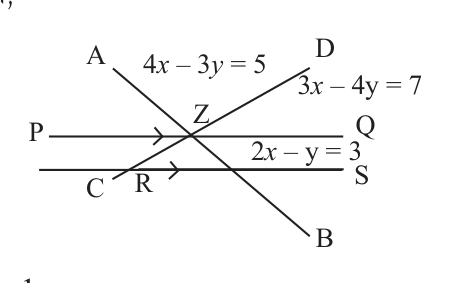
Part (a) is solved by treating the two equations as simultaneous equations.
Step 1: Making y the subject of \( 3x + y = 7 \):
\[ y = 7 - 3x \]
Step 2: Substituting this into \( 4x - 3y = 5 \):
\[ 4x - 3(7 - 3x) = 5 \]
Step 3: Removing the bracket:
\[ 4x - 21 + 9x = 5 \]
Step 4: Collecting like terms:
\[ 13x = 26 \]
Step 5: Dividing both sides by 13:
\[ x = 2 \]
Step 6: Putting x = 2 into \( y = 7 - 3x \):
\[ y = 7 - 6 = 1 \]
So Z is the point (2, 1).
Part (b) uses the fact that a line parallel to \( 2x - y = 3 \) keeps the same x and y terms.
Step 1: Writing the parallel line with an unknown constant k:
\[ 2x - y + k = 0 \]
Step 2: Putting x = 2 and y = 1, because the line passes through Z:
\[ 2 \times 2 - 1 + k = 0 \]
Step 3: Solving for k, since \( 4 - 1 + k = 0 \):
\[ k = -3 \]
Step 4: Putting k back into the equation:
\[ 2x - y - 3 = 0 \]
The required line is \( 2x - y - 3 = 0 \).
Worked Example 5: The Perpendicular Bisector of a Line Segment
Perpendicular bisector: The perpendicular bisector of a line segment is the straight line that passes through the midpoint of the segment and is perpendicular to it.
Find the equation of the perpendicular bisector of the line segment joining A(4, 3) and B(8, 11). Two facts fix the bisector: it passes through the midpoint of AB, and its slope is the negative reciprocal of the slope of AB.
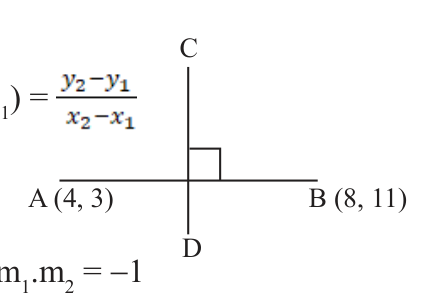
Step 1: Finding the midpoint of AB with the midpoint formula \( \left(\frac{x_1 + x_2}{2}, \frac{y_1 + y_2}{2}\right) \):
\[ (x, y) = \left(\frac{4 + 8}{2}, \frac{3 + 11}{2}\right) = (6, 7) \]
Step 2: Finding the slope of AB with \( m = \frac{y_2 - y_1}{x_2 - x_1} \):
\[ m_1 = \frac{11 - 3}{8 - 4} = \frac{8}{4} = 2 \]
Step 3: Using \( m_1m_2 = -1 \) with \( m_2 = m \), because CD is perpendicular to AB:
\[ 2m = -1 \]
Step 4: Solving for m:
\[ m = -\frac{1}{2} \]
Step 5: Writing the equation of CD through the midpoint (6, 7):
\[ y - 7 = -\frac{1}{2}(x - 6) \]
Step 6: Multiplying both sides by 2:
\[ 2y - 14 = -x + 6 \]
Step 7: Bringing every term to the left side:
\[ x + 2y - 20 = 0 \]
The perpendicular bisector is \( x + 2y - 20 = 0 \). Checking with the midpoint: \( 6 + 2 \times 7 - 20 = 0 \), so the line does pass through (6, 7).
The bisector passes through the midpoint (6, 7), not through either end of the segment. When you expand \( -\frac{1}{2}(x - 6) \), copy the 6 exactly. Any other number moves the line off the midpoint, and putting the midpoint into your answer shows the slip at once.
Worked Example 6: Lines Making 45 Degrees with a Given Line
Find the equations of the straight lines that pass through the point (3, 5) and make an angle of 45° with the line \( 3x - 4y + 15 = 0 \). There are two such lines, one leaning each way.
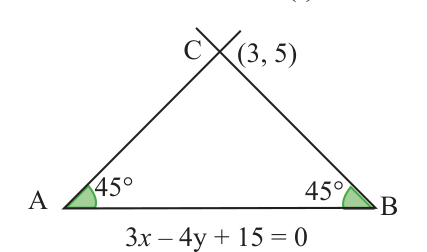
Step 1: Finding the slope of the given line AB from its coefficients:
\[ m_1 = -\frac{3}{-4} = \frac{3}{4} \]
Step 2: Writing a line through (3, 5) with unknown slope m. Call it equation (ii):
\[ y - 5 = m(x - 3) \]
Step 3: Putting \( \theta = 45^\circ \), \( m_1 = \frac{3}{4} \) and \( m_2 = m \) into the angle formula:
\[ \tan 45^\circ = \pm\left(\frac{\frac{3}{4} - m}{1 + \frac{3}{4}m}\right) \]
Step 4: Using \( \tan 45^\circ = 1 \) and multiplying the top and bottom of the fraction by 4:
\[ 1 = \pm\left(\frac{3 - 4m}{4 + 3m}\right) \]
Step 5: Cross multiplying:
\[ 4 + 3m = \pm(3 - 4m) \]
The plus or minus sign now splits the work into two cases, one for each line.
Case 1: Taking the positive sign:
\[ 4 + 3m = 3 - 4m \]
Collecting the m terms on one side gives \( 7m = -1 \), so:
\[ m = -\frac{1}{7} \]
Case 2: Taking the negative sign:
\[ 4 + 3m = -3 + 4m \]
Collecting the m terms on one side gives \( -m = -7 \), so:
\[ m = 7 \]
Step 6: Putting \( m = -\frac{1}{7} \) into equation (ii):
\[ y - 5 = -\frac{1}{7}(x - 3) \]
Step 7: Multiplying by 7, which gives \( 7y - 35 = -x + 3 \), and collecting the terms on one side:
\[ x + 7y - 38 = 0 \]
Step 8: Putting \( m = 7 \) into equation (ii):
\[ y - 5 = 7(x - 3) \]
Step 9: Expanding, which gives \( y - 5 = 7x - 21 \), and collecting the terms on one side:
\[ 7x - y - 16 = 0 \]
The two required lines are \( x + 7y - 38 = 0 \) and \( 7x - y - 16 = 0 \). Both pass through (3, 5), because \( 3 + 35 - 38 = 0 \) and \( 21 - 5 - 16 = 0 \).
When a question asks for the lines through a point that make a given acute angle with a line, expect two answers. The \( \pm \) sign in the formula is what produces them, so never drop it.
The full lesson is waiting for you
The notes are free to read in full. A free account opens the rest of the practice, and tracks your progress and confidence score for every subject. Presentations and videos need approval from Learn Yeti.