Measuring Heights We Cannot Reach
How tall is your school building? How far apart are two electric poles that stand on opposite sides of a river? You cannot climb a tall tree carrying a measuring tape, and you cannot stretch a tape across a river. Yet surveyors, engineers and pilots find heights and distances like these every day. They measure one angle and one length they can reach, and a right-angled triangle gives them the rest.
In every problem of this kind, the thing being measured (a tree, a pole, a tower, a cliff) stands straight up on level ground. The vertical height, the level ground and the straight line from an eye to the top make a right-angled triangle. If you know one side and one acute angle of that triangle, the trigonometric ratios give you every other side. So the whole topic rests on two skills: marking the correct angle, and choosing the correct ratio.
Angle of Elevation
When you look up at the top of a tree, an imaginary straight line runs from your eye to the top. This is the line of sight. Another line runs straight out from your eye, parallel to the ground. This is the horizontal line. The angle between these two lines tells how far you have to raise your eyes.
Angle of elevation: when an object is above the level of the observer's eye, the angle between the line of sight and the horizontal line is called the angle of elevation.
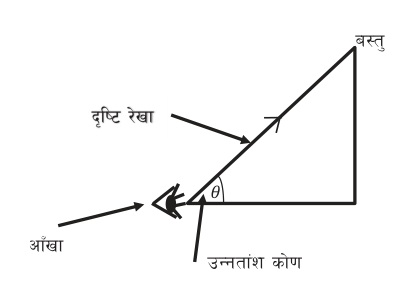
Standing on the ground and looking at the top of a house, a pole or a tree gives an angle of elevation. The angle always sits at the eye of the person looking, and it opens upwards from the horizontal line.
Angle of Depression
Now imagine you are on the roof of a house, looking down at a bird sitting in the yard. This time you lower your eyes. The line of sight slopes downwards from your eye to the bird, and the horizontal line still runs straight out from your eye.
Angle of depression: when an object is below the level of the observer's eye, the angle between the line of sight and the horizontal line through the eye is called the angle of depression.
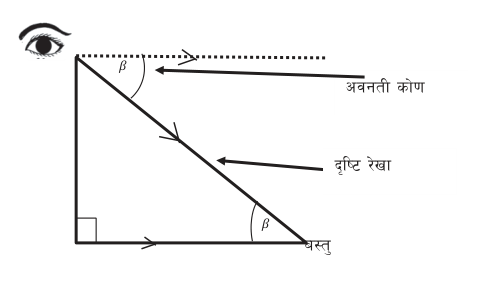
Looking from the roof of a house at a bird in the yard, or from a tall tower or tree at something lying on the ground, gives an angle of depression.
The angle of depression is measured downwards from the horizontal line through the eye. It is never measured from the vertical wall, pole or cliff. If you mark it against the vertical, you have marked its complement, and every step after that goes wrong.
Why the Two Angles Are Equal
Suppose a girl stands at the top A of a tower and looks down at a boy at C on the ground, while the boy looks up at her. The girl's horizontal line is parallel to the ground. The line of sight AC crosses both of these parallel lines. So the angle of depression at A and the angle of elevation at C are alternate angles, and alternate angles made by a line crossing two parallel lines are equal.
The angle of depression of an object seen from a point A is equal to the angle of elevation of A seen from that object. This lets you move a given angle of depression down to the ground, inside the right-angled triangle, where it is easy to use.
The Ratios and Values You Will Use
In a right-angled triangle, name the sides from the angle you are using. The side facing the angle is the perpendicular \( p \). The side lying along the ground next to the angle is the base \( b \). The longest side, opposite the right angle, is the hypotenuse \( h \). Then \( \sin\theta = \frac{p}{h} \), \( \cos\theta = \frac{b}{h} \) and \( \tan\theta = \frac{p}{b} \).
| Ratio | 30° | 45° | 60° |
| \( \sin\theta \) | \( \frac{1}{2} \) | \( \frac{1}{\sqrt{2}} \) | \( \frac{\sqrt{3}}{2} \) |
| \( \cos\theta \) | \( \frac{\sqrt{3}}{2} \) | \( \frac{1}{\sqrt{2}} \) | \( \frac{1}{2} \) |
| \( \tan\theta \) | \( \frac{1}{\sqrt{3}} \) | \( 1 \) | \( \sqrt{3} \) |
The ratio you will use most is \( \tan\theta \), because a height and a distance along the ground are the two shorter sides of the triangle, and tan links exactly those two. Use sin or cos only when the slanting side, such as a ladder or a kite string, is given or asked for. For decimal answers, take \( \sqrt{3} = 1.732 \) and \( \sqrt{2} = 1.414 \).
A Method for Every Problem
Every height and distance question, however it is worded, can be solved by the same routine:
- Draw a neat diagram: a vertical line for the height, a horizontal line for the ground, and the line of sight joining the eye to the object.
- Mark every given angle and length on it, and give a letter to the length you must find.
- If an angle of depression is given, carry it to the other end of the line of sight, where it becomes an equal angle of elevation.
- Choose a right-angled triangle that holds one known side and the unknown, and choose the ratio that links them.
- Solve the equation, then add or subtract any extra length, such as the height of the observer's eye.
- Write the answer with its unit.
Example 1: A Tree Seen by a Standing Man
A man 6 ft tall stands 30 ft away from a tree. He sees the top of the tree at an angle of elevation of 30°. Find the height of the tree.
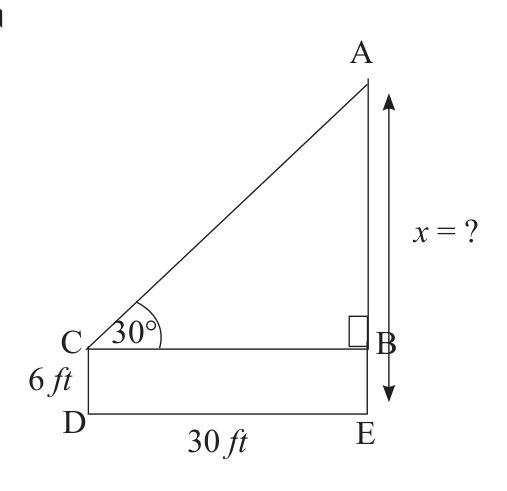
Let AE be the tree and CD the man. The horizontal line from his eye C meets the tree at B. So BE = CD = 6 ft, CB = DE = 30 ft and ∠ACB = 30°. We need the height AE = x.
Step 1: In right-angled triangle ABC we know the base BC and want the perpendicular AB, so we use tan:
\[ \tan 30^\circ = \frac{AB}{BC} \]
Step 2: Putting \( \tan 30^\circ = \frac{1}{\sqrt{3}} \) and BC = 30 ft:
\[ \frac{1}{\sqrt{3}} = \frac{AB}{30} \]
Step 3: Cross multiplying:
\[ \sqrt{3}\,AB = 30 \]
Step 4: Dividing both sides by \( \sqrt{3} \):
\[ AB = \frac{30}{\sqrt{3}} = 17.32 \text{ ft} \]
Step 5: Adding the part of the tree below the man's eye:
\[ AE = AB + BE = 17.32 + 6 = 23.32 \text{ ft} \]
So the tree is 23.32 ft tall.
The angle is measured at the man's eye, not at his feet. AB is only the part of the tree above his eye level, so the man's height must be added at the end.
Example 2: Two Observation Points on the Same Side
The top of a tree is seen from a point on the ground at an angle of elevation of 45°. From another point 45 m farther away, in the same straight line, the angle of elevation is 30°. Find the height of the tree.
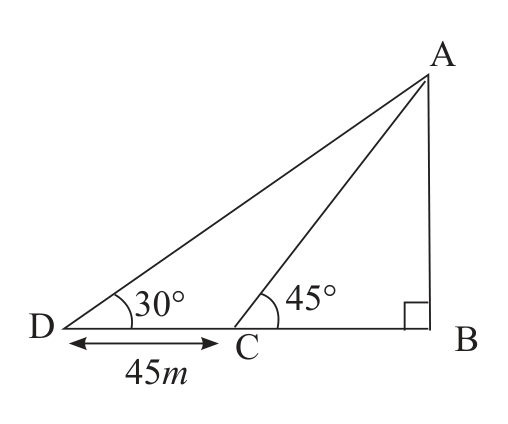
Let AB be the tree, with C and D the two points, so ∠ACB = 45°, ∠ADB = 30° and CD = 45 m. We need AB.
Step 1: In right-angled triangle ABC, using tan 45°:
\[ \tan 45^\circ = \frac{AB}{BC} \]
Step 2: Since \( \tan 45^\circ = 1 \), the height equals the base. Call this result (i):
\[ AB = BC \quad \text{(i)} \]
Step 3: In right-angled triangle ABD the base is BD = BC + CD, so:
\[ \tan 30^\circ = \frac{AB}{BC + CD} \]
Step 4: Putting in \( \frac{1}{\sqrt{3}} \), CD = 45 m, and BC = AB from (i):
\[ \frac{1}{\sqrt{3}} = \frac{AB}{AB + 45} \]
Step 5: Cross multiplying:
\[ \sqrt{3}\,AB = AB + 45 \]
Step 6: Bringing the AB terms together and taking AB common:
\[ AB(\sqrt{3} - 1) = 45 \]
Step 7: Using \( \sqrt{3} = 1.732 \), so that \( \sqrt{3} - 1 = 0.732 \):
\[ AB = \frac{45}{0.732} = 61.48 \text{ m} \]
So the tree is about 61.48 m tall.
When two triangles share the same height, use the first triangle to write one side in terms of the height, then put that into the second triangle. You are left with one equation in one unknown.
Example 3: Two Points Seen from a Cliff
From the top of a cliff 100 m high, two points on level ground on the same side of the cliff are observed. The angles of depression are 60° and 45°. Find the distance between the two points.
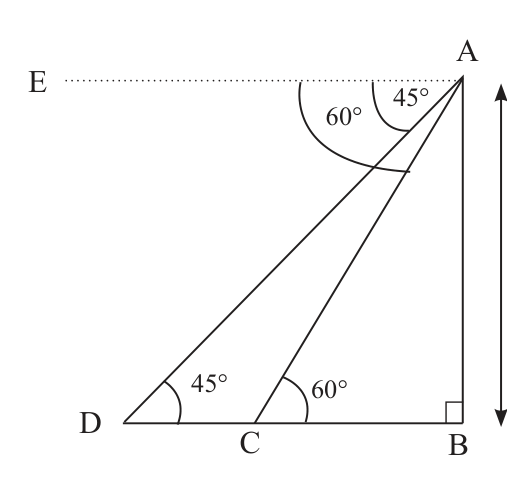
Let AB = 100 m be the cliff and AE the horizontal line at its top. The nearer point C has angle of depression 60°, so ∠ACB = ∠EAC = 60° as alternate angles. In the same way ∠ADB = ∠EAD = 45°. We need CD.
Step 1: In right-angled triangle ABC, using tan 60°:
\[ \tan 60^\circ = \frac{AB}{BC} \]
Step 2: Putting \( \tan 60^\circ = \sqrt{3} \) and AB = 100 m:
\[ \sqrt{3} = \frac{100}{BC} \]
Step 3: Solving for BC. Call this result (i):
\[ BC = \frac{100}{\sqrt{3}} = 57.74 \text{ m} \quad \text{(i)} \]
Step 4: In right-angled triangle ABD, the base is BD = BC + CD:
\[ \tan 45^\circ = \frac{100}{BC + CD} \]
Step 5: Since \( \tan 45^\circ = 1 \), and BC = 57.74 m from (i):
\[ 57.74 + CD = 100 \]
Step 6: Subtracting 57.74 from both sides:
\[ CD = 100 - 57.74 = 42.26 \text{ m} \]
So the two points are 42.26 m apart.
Example 4: Complementary Angles of Elevation
Two points lie 16 m and 25 m from the foot of a pole, on the same side of it. The angles of elevation of the top of the pole from these points are complementary, which means they add up to 90°. Find the height of the pole.
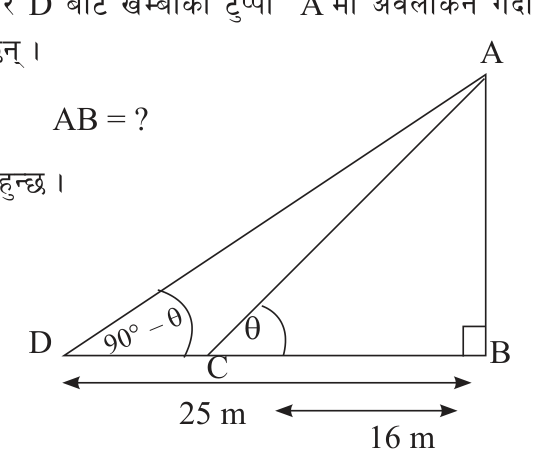
Let AB be the pole, BC = 16 m and BD = 25 m. Let ∠ACB = θ. Then ∠ADB = \( 90^\circ - \theta \). We need AB.
Step 1: In right-angled triangle ABC, using tan θ. Call this result (i):
\[ \tan\theta = \frac{AB}{16} \quad \text{(i)} \]
Step 2: In right-angled triangle ABD, using the angle at D:
\[ \tan(90^\circ - \theta) = \frac{AB}{25} \]
Step 3: Since \( \tan(90^\circ - \theta) = \cot\theta = \frac{1}{\tan\theta} \), turning both sides upside down gives:
\[ \tan\theta = \frac{25}{AB} \]
Step 4: Equating this with (i):
\[ \frac{AB}{16} = \frac{25}{AB} \]
Step 5: Cross multiplying:
\[ AB^2 = 16 \times 25 = 400 \]
Step 6: Taking the positive square root, since a height cannot be negative:
\[ AB = \sqrt{400} = 20 \text{ m} \]
So the pole is 20 m tall.
If the angles of elevation of the top of a pole from two points at distances \( a \) and \( b \) on the same side of it are complementary, the height is \( h = \sqrt{ab} \). Here \( \sqrt{16 \times 25} = 20 \).
Example 5: A Tree Seen from a Hilltop
From the top of a hill 200 m high, the angles of depression of the top and the foot of a tree are 30° and 45°. Find the height of the tree.
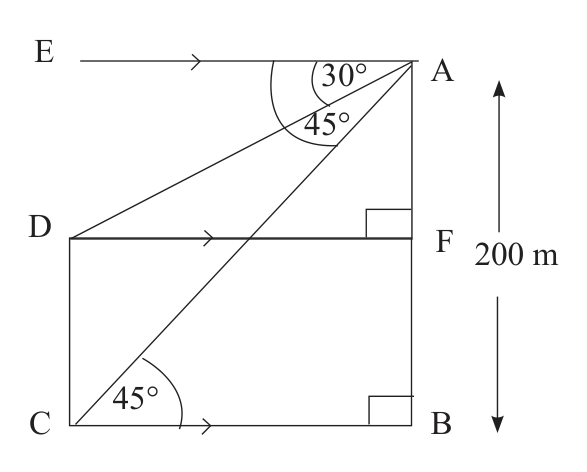
Let AB = 200 m be the hill, C the foot and D the top of the tree, and AE the horizontal line at the hilltop. Then ∠ACB = ∠EAC = 45° and ∠ADF = ∠EAD = 30°, as alternate angles. We need CD.
Step 1: In right-angled triangle ABC, using tan 45° = 1:
\[ 1 = \frac{200}{BC} \]
Step 2: So the base is equal to the height. Call this result (i):
\[ BC = 200 \text{ m} \quad \text{(i)} \]
Step 3: DFBC is a rectangle, so DF = BC = 200 m. In right-angled triangle AFD, using tan 30°:
\[ \frac{1}{\sqrt{3}} = \frac{AF}{200} \]
Step 4: Solving for AF:
\[ AF = \frac{200}{\sqrt{3}} = 115.47 \text{ m} \]
Step 5: The tree's height equals BF, which is the hill minus the part AF above the tree's top:
\[ CD = BF = AB - AF \]
\[ CD = 200 - 115.47 = 84.53 \text{ m} \]
So the tree is 84.53 m tall.
Shadows and the Height of the Sun
The height of the sun in the sky is given by its angle of elevation, often called the altitude of the sun. A vertical pole, its shadow on level ground and the ray of sunlight passing the top of the pole to the tip of the shadow form a right-angled triangle. The angle at the tip of the shadow is the sun's angle of elevation. The higher the sun, the shorter the shadow.
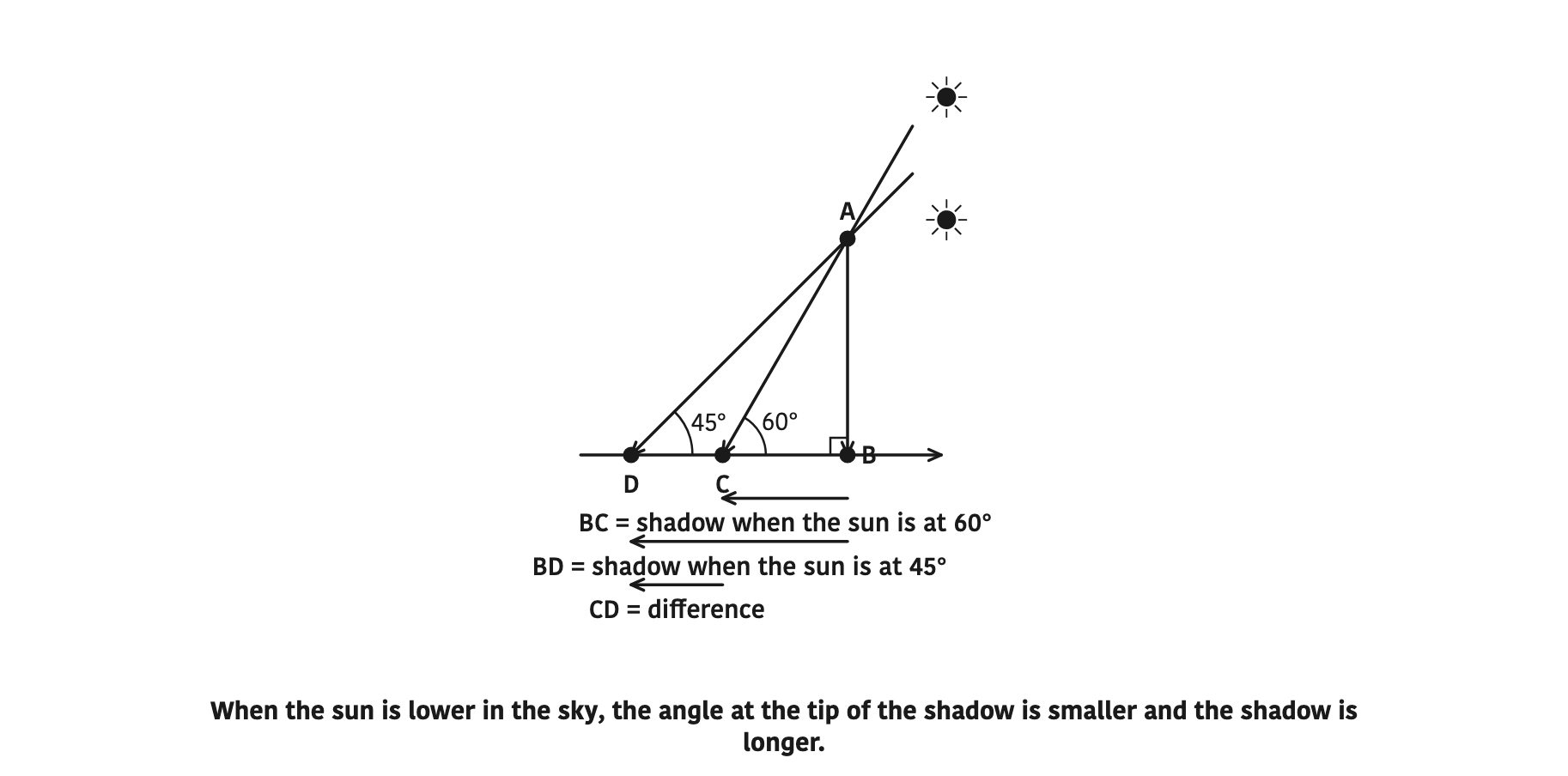
A tower's shadow is 20 m longer when the sun's altitude is 45° than when it is 60°. Let the height be h.
Step 1: At 60°, the shadow is the base of a triangle with \( \tan 60^\circ = \frac{h}{\text{shadow}} \), so:
\[ \text{shadow at } 60^\circ = \frac{h}{\sqrt{3}} \]
Step 2: At 45°, since \( \tan 45^\circ = 1 \):
\[ \text{shadow at } 45^\circ = h \]
Step 3: Writing the difference between the two shadows:
\[ h - \frac{h}{\sqrt{3}} = 20 \]
Step 4: Multiplying every term by \( \sqrt{3} \) and taking h common:
\[ h(\sqrt{3} - 1) = 20\sqrt{3} \]
Step 5: Using \( \sqrt{3} = 1.732 \):
\[ h = \frac{34.64}{0.732} = 47.32 \text{ m} \]
How the Angle Changes with Distance
For an object of height h seen from a distance d on level ground, \( \tan\theta = \frac{h}{d} \). Walk towards the object and d gets smaller while h stays the same, so \( \tan\theta \) gets bigger, and so does θ. Walk away and the angle of elevation gets smaller. A few special angles are worth knowing by heart:
- An angle of elevation of 0° means the object is at the level of your eye.
- An angle of elevation of 45° means the height equals the distance, because \( \tan 45^\circ = 1 \).
- An angle less than 45° means the distance is greater than the height.
- An angle greater than 45° means the height is greater than the distance.
The nearer you stand to a tall object, the larger its angle of elevation. The same object, seen from farther away, looks lower in the sky.
The full lesson is waiting for you
The notes are free to read in full. A free account opens the rest of the practice, and tracks your progress and confidence score for every subject. Presentations and videos need approval from Learn Yeti.