Trigonometry and Where It Came From
Trigonometry is the part of mathematics that studies how the sides and the angles of a triangle are related. It is very old. People in ancient Egypt and Babylon already used the link between the angles and sides of a triangle when they built pyramids, and in an early form they used it to measure the positions of the stars.
Trigonometry: the branch of mathematics that studies the relationship between the sides and the angles of a triangle.
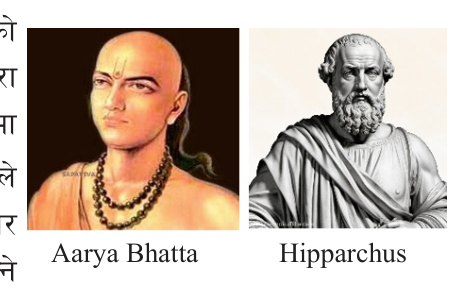
Later, the Greek mathematician Hipparchus used the chords of a circle to prepare trigonometric tables. For this he is called the father of trigonometry. The Indian mathematician Aarya Bhatta developed the ideas of sine, which he called jya, and cosine, and this brought trigonometry close to the form we use today. After him, Islamic scholars developed tangent and cotangent, and later Leonhard Euler gave trigonometry the form of functions.
Because of this long development, trigonometry now solves problems in everyday life, science, technology, engineering, land surveying, architecture and astronomy. A surveyor finding the height of a hill, an engineer setting the slope of a roof and an astronomer measuring the angle of a star are all using it.
What a Compound Angle Is
Start with two ordinary angles. Call the larger one A and the smaller one B.
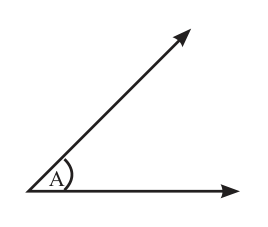
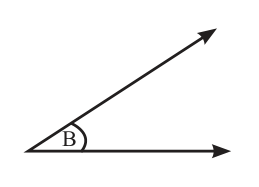
Now join them. Place B so that it sits on top of A, sharing the vertex and one arm. The angle from the lowest arm to the highest arm is \( A + B \). Instead, place B inside A, starting from the same lowest arm. What is left of A above B is \( A - B \).
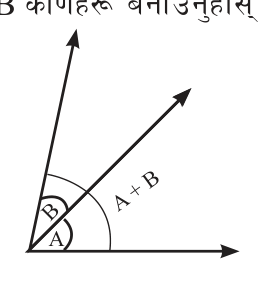
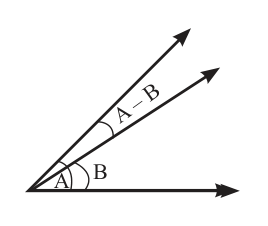
Compound angle: an angle formed by adding or subtracting two or more angles. If A and B are two angles, then \( A + B \) and \( A - B \) are compound angles.
Many angles you meet can be written this way. For example \( 75^\circ = 45^\circ + 30^\circ \), \( 15^\circ = 45^\circ - 30^\circ \) and \( 105^\circ = 60^\circ + 45^\circ \). The angles on the right are angles whose sine, cosine and tangent you already know exactly. So if we can find the ratios of a compound angle from the ratios of its parts, we can find exact values for 75°, 15°, 105° and many more, without a calculator.
The sine of a sum is NOT the sum of the sines. Try \( A = B = 30^\circ \). Then \( \sin(A + B) = \sin 60^\circ = \frac{\sqrt3}{2} \), which is about 0.87, but \( \sin 30^\circ + \sin 30^\circ = 1 \). The same is true for cosine and tangent. The correct formulas are built below.
The Standard Values You Will Need
Every worked example in this topic splits an angle into standard angles and then puts in their values. Keep this table in front of you until you know it by heart.
| Ratio | \( 0^\circ \) | \( 30^\circ \) | \( 45^\circ \) | \( 60^\circ \) | \( 90^\circ \) |
| sin | \( 0 \) | \( \frac12 \) | \( \frac{1}{\sqrt2} \) | \( \frac{\sqrt3}{2} \) | \( 1 \) |
| cos | \( 1 \) | \( \frac{\sqrt3}{2} \) | \( \frac{1}{\sqrt2} \) | \( \frac12 \) | \( 0 \) |
| tan | \( 0 \) | \( \frac{1}{\sqrt3} \) | \( 1 \) | \( \sqrt3 \) | not defined |
The Unit Circle Picture
To find the formulas we use a circle with centre O at the origin and radius 1 unit. On such a circle, the point reached by turning an angle \( \theta \) anticlockwise from the positive x-axis has coordinates \( (\cos\theta, \sin\theta) \). This single fact does all the work.
Mark the point P where the circle cuts the positive x-axis, so P is \( (1, 0) \). Turn through angle A to reach Q, so \( \angle POQ = A \). Turn a further angle B to reach R, so \( \angle QOR = B \) and therefore \( \angle POR = A + B \). Finally, from P turn through angle B the other way, clockwise, to reach S. So \( \angle POS = B \) below the axis, which is the angle \( -B \). Then \( \angle QOS = A + B \) as well, because it is made of A above the axis and B below it.
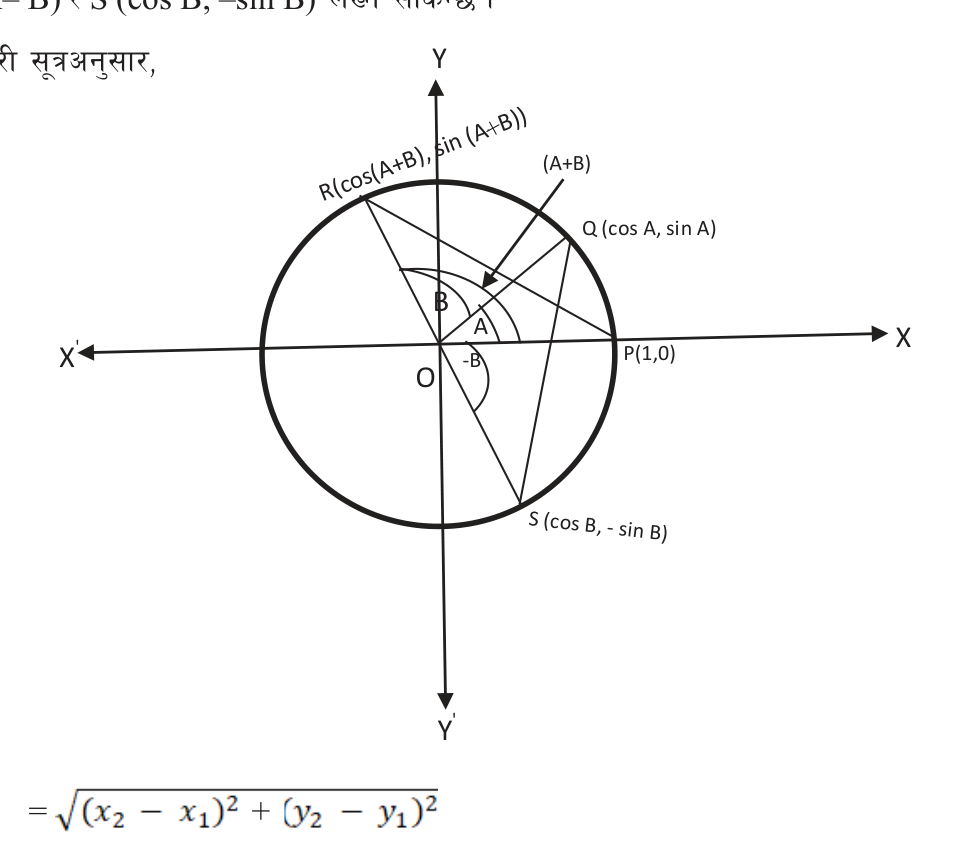
- P is \( (1, 0) \)
- Q is \( (\cos A, \sin A) \)
- R is \( (\cos(A+B), \sin(A+B)) \)
- S is \( (\cos B, -\sin B) \)
S sits at angle \( -B \), which is a mirror image of B in the x-axis. It has the same x-coordinate and the opposite y-coordinate. That is why \( \cos(-B) = \cos B \) and \( \sin(-B) = -\sin B \). Both facts are used again below.
The Cosine of a Sum
The plan is simple. Work out the length of chord PR, work out the length of chord QS, and set them equal.
Step 1: The distance between two points \( (x_1, y_1) \) and \( (x_2, y_2) \) is:
\[ d = \sqrt{(x_2 - x_1)^2 + (y_2 - y_1)^2} \]
Step 2: Using it for P(1, 0) and R, and squaring both sides to avoid carrying the root:
\[ PR^2 = \{\cos(A+B) - 1\}^2 + \{\sin(A+B) - 0\}^2 \]
Step 3: Expanding the first bracket and putting the square terms together:
\[ \begin{aligned} PR^2 &= \cos^2(A+B) + \sin^2(A+B) \\ &\quad - 2\cos(A+B) + 1 \end{aligned} \]
Step 4: Since \( \sin^2\theta + \cos^2\theta = 1 \) for any angle, the first two terms make 1:
\[ PR^2 = 2 - 2\cos(A+B) \]
Step 5: Using the distance formula for Q and S:
\[ \begin{aligned} QS^2 &= (\cos B - \cos A)^2 \\ &\quad + (-\sin B - \sin A)^2 \end{aligned} \]
Step 6: Expanding both squares:
\[ \begin{aligned} QS^2 &= \cos^2 B - 2\cos A\cos B + \cos^2 A \\ &\quad + \sin^2 B + 2\sin A\sin B + \sin^2 A \end{aligned} \]
Step 7: Grouping \( \sin^2 A + \cos^2 A \) and \( \sin^2 B + \cos^2 B \), each of which is 1:
\[ QS^2 = 2 - 2(\cos A\cos B - \sin A\sin B) \]
Step 8: In a circle, chords that make equal angles at the centre are equal. Both PR and QS make the angle \( A + B \) at O, so \( PR = QS \) and \( PR^2 = QS^2 \):
\[ \begin{aligned} &2 - 2\cos(A+B) \\ &= 2 - 2(\cos A\cos B - \sin A\sin B) \end{aligned} \]
Step 9: Taking 2 away from both sides and then dividing both sides by \( -2 \):
\[ \cos(A+B) = \cos A\cos B - \sin A\sin B \]
The Cosine of a Difference
There is no need to draw a new circle. A difference is a sum with a negative angle, so the formula we already have does the job.
Step 1: Writing \( A - B \) as a sum:
\[ \cos(A-B) = \cos\{A + (-B)\} \]
Step 2: Using the formula for \( \cos(A+B) \) with \( -B \) in place of B:
\[ = \cos A\cos(-B) - \sin A\sin(-B) \]
Step 3: Since \( \cos(-B) = \cos B \) and \( \sin(-B) = -\sin B \), the minus sign becomes a plus:
\[ \cos(A-B) = \cos A\cos B + \sin A\sin B \]
The Sine of a Sum and a Difference
The sine of an angle is the cosine of its complement: \( \sin\theta = \cos(90^\circ - \theta) \) and \( \cos\theta = \sin(90^\circ - \theta) \). This turns the cosine formula into a sine formula.
Step 1: Writing the sine as the cosine of the complement:
\[ \sin(A+B) = \cos\{90^\circ - (A+B)\} \]
Step 2: Regrouping the angle as \( (90^\circ - A) - B \):
\[ = \cos\{(90^\circ - A) - B\} \]
Step 3: Expanding with the formula for \( \cos(A-B) \):
\[ \begin{aligned} &= \cos(90^\circ - A)\cos B \\ &\quad + \sin(90^\circ - A)\sin B \end{aligned} \]
Step 4: Since \( \cos(90^\circ - A) = \sin A \) and \( \sin(90^\circ - A) = \cos A \):
\[ \sin(A+B) = \sin A\cos B + \cos A\sin B \]
For the difference, write \( A - B \) as \( A + (-B) \) once more.
Step 1: Using the sine of a sum with \( -B \) in place of B:
\[ \sin(A-B) = \sin A\cos(-B) + \cos A\sin(-B) \]
Step 2: Putting in \( \cos(-B) = \cos B \) and \( \sin(-B) = -\sin B \):
\[ \sin(A-B) = \sin A\cos B - \cos A\sin B \]
The Tangent of a Sum and a Difference
Step 1: Tangent is sine divided by cosine:
\[ \tan(A+B) = \frac{\sin(A+B)}{\cos(A+B)} \]
Step 2: Putting in the two expansions:
\[ = \frac{\sin A\cos B + \cos A\sin B}{\cos A\cos B - \sin A\sin B} \]
Step 3: Dividing every term, above and below the line, by \( \cos A\cos B \). Each sine over its own cosine becomes a tangent, and \( \frac{\cos A\cos B}{\cos A\cos B} = 1 \):
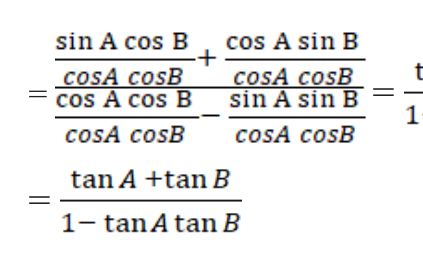
\[ \tan(A+B) = \frac{\tan A + \tan B}{1 - \tan A\tan B} \]
Working the same way with \( -B \) in place of B, and using \( \tan(-B) = -\tan B \), gives the difference formula:
\[ \tan(A-B) = \frac{\tan A - \tan B}{1 + \tan A\tan B} \]
The Six Compound Angle Identities
Compound angle identities: the six formulas that give the sine, cosine and tangent of \( A + B \) and \( A - B \) in terms of the ratios of A and B. They are true for every value of A and B for which both sides are defined.
- \( \cos(A+B) = \cos A\cos B - \sin A\sin B \)
- \( \cos(A-B) = \cos A\cos B + \sin A\sin B \)
- \( \sin(A+B) = \sin A\cos B + \cos A\sin B \)
- \( \sin(A-B) = \sin A\cos B - \cos A\sin B \)
- \( \tan(A+B) = \frac{\tan A + \tan B}{1 - \tan A\tan B} \)
- \( \tan(A-B) = \frac{\tan A - \tan B}{1 + \tan A\tan B} \)
Watch the signs. In a sine formula the sign in the middle is the same as the sign in the angle. In a cosine formula it is the opposite. In a tangent formula the top keeps the sign of the angle and the bottom takes the opposite sign. Sine formulas mix sin and cos (sin cos, cos sin); cosine formulas keep them together (cos cos, sin sin).
Writing \( \cos(A+B) = \cos A\cos B + \sin A\sin B \) is the error students make most often. The cosine of a SUM has a MINUS sign in the middle.
Worked Example 1: Exact Value of sin 15°
Prove, without using a calculator, that \( \sin 15^\circ = \frac{\sqrt3 - 1}{2\sqrt2} \). The angle 15° is not in the table, but it is the difference of two angles that are.
Step 1: Writing the left-hand side as a compound angle:
\[ \text{L.H.S.} = \sin 15^\circ = \sin(45^\circ - 30^\circ) \]
Step 2: Expanding with the formula for \( \sin(A-B) \):
\[ = \sin 45^\circ\cos 30^\circ - \cos 45^\circ\sin 30^\circ \]
Step 3: Putting in the standard values:
\[ = \frac{1}{\sqrt2}\times\frac{\sqrt3}{2} - \frac{1}{\sqrt2}\times\frac12 \]
Step 4: Multiplying the fractions:
\[ = \frac{\sqrt3}{2\sqrt2} - \frac{1}{2\sqrt2} \]
Step 5: Subtracting over the common denominator:
\[ = \frac{\sqrt3 - 1}{2\sqrt2} = \text{R.H.S.} \]
Another way is to write 15° as 60° minus 45°. Both routes must give the same answer, which makes a useful check.
Step 1: Splitting the angle differently and expanding:
\[ \begin{aligned} \sin 15^\circ &= \sin(60^\circ - 45^\circ) \\ &= \sin 60^\circ\cos 45^\circ - \cos 60^\circ\sin 45^\circ \end{aligned} \]
Step 2: Putting in the values:
\[ = \frac{\sqrt3}{2}\times\frac{1}{\sqrt2} - \frac12\times\frac{1}{\sqrt2} \]
Step 3: Simplifying:
\[ = \frac{\sqrt3}{2\sqrt2} - \frac{1}{2\sqrt2} = \frac{\sqrt3 - 1}{2\sqrt2} \]
Any split works as long as both parts are standard angles. Choose the one with the easiest values.
Worked Example 2: Finding Values from Given Ratios
If \( \sin A = \frac35 \) and \( \cos B = \frac{5}{13} \), find \( \sin(A+B) \) and \( \tan(A-B) \). Take A and B as acute angles, so every ratio is positive. The formulas need all four of \( \sin A \), \( \cos A \), \( \sin B \) and \( \cos B \), so the missing two are found first.
Step 1: Finding \( \cos A \) from \( \sin^2 A + \cos^2 A = 1 \):
\[ \cos A = \sqrt{1 - \left(\frac35\right)^2} = \sqrt{1 - \frac{9}{25}} \]
Step 2: Simplifying under the root:
\[ \cos A = \sqrt{\frac{25 - 9}{25}} = \sqrt{\frac{16}{25}} = \frac45 \]
Step 3: Finding \( \sin B \) in the same way:
\[ \sin B = \sqrt{1 - \left(\frac{5}{13}\right)^2} = \sqrt{\frac{169 - 25}{169}} \]
Step 4: Simplifying:
\[ \sin B = \sqrt{\frac{144}{169}} = \frac{12}{13} \]
Step 5: Putting the four values into the formula for \( \sin(A+B) \):
\[ \sin(A+B) = \frac35\times\frac{5}{13} + \frac45\times\frac{12}{13} \]
Step 6: Multiplying and adding:
\[ = \frac{15}{65} + \frac{48}{65} = \frac{63}{65} \]
Step 7: Finding the two tangents as sine over cosine:
\[ \tan A = \frac{3/5}{4/5} = \frac34 \]
\[ \tan B = \frac{12/13}{5/13} = \frac{12}{5} \]
Step 8: Putting them into the formula for \( \tan(A-B) \):
\[ \tan(A-B) = \frac{\frac34 - \frac{12}{5}}{1 + \frac34\times\frac{12}{5}} \]
Step 9: Writing the top and the bottom over the common denominator 20:
\[ = \frac{\frac{15 - 48}{20}}{\frac{20 + 36}{20}} = \frac{-33}{56} \]
So \( \sin(A+B) = \frac{63}{65} \) and \( \tan(A-B) = -\frac{33}{56} \). The tangent is negative because B is larger than A here, so \( A - B \) is a negative angle.
Worked Example 3: sin 105° − cos 75°
Prove, without a calculator, that \( \sin 105^\circ - \cos 75^\circ = \frac{1}{\sqrt2} \). Here both angles are sums of standard angles: \( 105^\circ = 60^\circ + 45^\circ \) and \( 75^\circ = 45^\circ + 30^\circ \).
Step 1: The left-hand side, with each angle written as a sum:
\[ \sin(60^\circ + 45^\circ) - \cos(45^\circ + 30^\circ) \]
Step 2: Expanding the first part with the formula for \( \sin(A+B) \):
\[ \begin{aligned} &\sin 60^\circ\cos 45^\circ + \cos 60^\circ\sin 45^\circ \\ &= \frac{\sqrt3}{2}\times\frac{1}{\sqrt2} + \frac12\times\frac{1}{\sqrt2} \\ &= \frac{\sqrt3 + 1}{2\sqrt2} \end{aligned} \]
Step 3: Expanding the second part with the formula for \( \cos(A+B) \):
\[ \begin{aligned} &\cos 45^\circ\cos 30^\circ - \sin 45^\circ\sin 30^\circ \\ &= \frac{1}{\sqrt2}\times\frac{\sqrt3}{2} - \frac{1}{\sqrt2}\times\frac12 \\ &= \frac{\sqrt3 - 1}{2\sqrt2} \end{aligned} \]
Step 4: Subtracting the second part from the first:
\[ \frac{\sqrt3 + 1}{2\sqrt2} - \frac{\sqrt3 - 1}{2\sqrt2} = \frac{2}{2\sqrt2} \]
Step 5: Cancelling the 2:
\[ = \frac{1}{\sqrt2} = \text{R.H.S.} \]
When a whole expansion is subtracted, keep it in a bracket. The minus sign in front changes the sign of every term inside, so \( -(\cos 45^\circ\cos 30^\circ - \sin 45^\circ\sin 30^\circ) \) becomes \( -\cos 45^\circ\cos 30^\circ + \sin 45^\circ\sin 30^\circ \).
Worked Example 4: Spotting a Formula Inside an Expression
Prove that \( \sin(28^\circ + \alpha)\cos(62^\circ - \alpha) + \cos(28^\circ + \alpha)\sin(62^\circ - \alpha) = 1 \). The angles look awkward, but the shape is "sin cos plus cos sin", which is the expansion of a sine of a sum. Give the two angles short names: let \( A = 28^\circ + \alpha \) and \( B = 62^\circ - \alpha \).
Step 1: With these names the left-hand side becomes:
\[ \sin A\cos B + \cos A\sin B \]
Step 2: Reading the formula for \( \sin(A+B) \) backwards:
\[ = \sin(A+B) \]
Step 3: Putting the angles back:
\[ = \sin(28^\circ + \alpha + 62^\circ - \alpha) \]
Step 4: The \( \alpha \) terms cancel and \( 28^\circ + 62^\circ = 90^\circ \):
\[ = \sin 90^\circ = 1 = \text{R.H.S.} \]
The formulas work in both directions. Expanding turns \( \sin(A+B) \) into four ratios; reading them backwards squeezes four ratios into one. Many proofs are simply a matter of recognising the shape.
Worked Example 5: The Formula for cot(A + B)
Prove that \( \cot(A+B) = \frac{\cot A\cot B - 1}{\cot B + \cot A} \).
Step 1: Cotangent is cosine divided by sine:
\[ \text{L.H.S.} = \cot(A+B) = \frac{\cos(A+B)}{\sin(A+B)} \]
Step 2: Putting in both expansions:
\[ = \frac{\cos A\cos B - \sin A\sin B}{\sin A\cos B + \cos A\sin B} \]
Step 3: Dividing every term above and below by \( \sin A\sin B \). Then \( \frac{\cos A\cos B}{\sin A\sin B} = \cot A\cot B \), \( \frac{\sin A\cos B}{\sin A\sin B} = \cot B \) and \( \frac{\cos A\sin B}{\sin A\sin B} = \cot A \):
\[ = \frac{\cot A\cot B - 1}{\cot B + \cot A} = \text{R.H.S.} \]
To reach tangents, divide by \( \cos A\cos B \). To reach cotangents, divide by \( \sin A\sin B \).
Worked Example 6: When A + B Is a Known Angle
If \( A + B = \left(\frac{3\pi}{4}\right)^c \), prove that \( (1 - \tan A)(1 - \tan B) = 2 \). The small c means radians, and \( \frac{3\pi}{4} \) radians is 135°. When the sum of two angles is given, take the tangent of both sides.
Step 1: Taking tan of both sides:
\[ \tan(A+B) = \tan 135^\circ \]
Step 2: Expanding the left side; the right side is \( -1 \), because \( 135^\circ = 180^\circ - 45^\circ \) lies in the second quadrant, where tangent is negative:
\[ \frac{\tan A + \tan B}{1 - \tan A\tan B} = -1 \]
Step 3: Multiplying both sides by the denominator:
\[ \tan A + \tan B = -1 + \tan A\tan B \]
Step 4: Moving terms so that 1 stands alone on the left:
\[ 1 = -\tan A - \tan B + \tan A\tan B \]
Step 5: Adding 1 to both sides, so the right side can be factorised:
\[ 2 = 1 - \tan A - \tan B + \tan A\tan B \]
Step 6: Grouping the terms in pairs:
\[ 2 = 1(1 - \tan A) - \tan B(1 - \tan A) \]
Step 7: Taking out the common factor \( (1 - \tan A) \):
\[ (1 - \tan A)(1 - \tan B) = 2 \]
Worked Example 7: Adding cos(A + B) and cos(A − B)
Prove that \( \cos(A+B) + \cos(A-B) = 2\cos A\cos B \).
Step 1: Expanding both terms of the left-hand side:
\[ \begin{aligned} &\cos A\cos B - \sin A\sin B \\ &+ \cos A\cos B + \sin A\sin B \end{aligned} \]
Step 2: The two \( \sin A\sin B \) terms have opposite signs and cancel, leaving two equal terms:
\[ = 2\cos A\cos B = \text{R.H.S.} \]
Worked Example 8: Turning a Ratio into cot 35°
Prove that \( \frac{\cos 10^\circ + \sin 10^\circ}{\cos 10^\circ - \sin 10^\circ} = \cot 35^\circ \). This time it is easier to start from the right-hand side, because \( 35^\circ = 45^\circ - 10^\circ \) and the 45° values are equal.
Step 1: Writing the cotangent as cosine over sine of a compound angle:
\[ \text{R.H.S.} = \cot 35^\circ = \frac{\cos(45^\circ - 10^\circ)}{\sin(45^\circ - 10^\circ)} \]
Step 2: Expanding the top with the formula for \( \cos(A-B) \) and the bottom with the formula for \( \sin(A-B) \):
\[ = \frac{\cos 45^\circ\cos 10^\circ + \sin 45^\circ\sin 10^\circ}{\sin 45^\circ\cos 10^\circ - \cos 45^\circ\sin 10^\circ} \]
Step 3: Putting in \( \sin 45^\circ = \cos 45^\circ = \frac{1}{\sqrt2} \) and taking it out as a common factor:
\[ = \frac{\frac{1}{\sqrt2}(\cos 10^\circ + \sin 10^\circ)}{\frac{1}{\sqrt2}(\cos 10^\circ - \sin 10^\circ)} \]
Step 4: Cancelling \( \frac{1}{\sqrt2} \) from the top and the bottom:
\[ = \frac{\cos 10^\circ + \sin 10^\circ}{\cos 10^\circ - \sin 10^\circ} = \text{L.H.S.} \]
Worked Example 9: tan 28° + tan 17° + tan 28° tan 17° = 1
Prove that \( \tan 28^\circ + \tan 17^\circ + \tan 28^\circ\tan 17^\circ = 1 \). Neither angle is in the table, but together they make one that is: \( 28^\circ + 17^\circ = 45^\circ \).
Step 1: Taking tan of both sides of \( 28^\circ + 17^\circ = 45^\circ \):
\[ \tan(28^\circ + 17^\circ) = \tan 45^\circ \]
Step 2: Expanding the left side, with \( \tan 45^\circ = 1 \):
\[ \frac{\tan 28^\circ + \tan 17^\circ}{1 - \tan 28^\circ\tan 17^\circ} = 1 \]
Step 3: Multiplying both sides by the denominator:
\[ \tan 28^\circ + \tan 17^\circ = 1 - \tan 28^\circ\tan 17^\circ \]
Step 4: Moving the product term to the left side:
\[ \tan 28^\circ + \tan 17^\circ + \tan 28^\circ\tan 17^\circ = 1 \]
So L.H.S. = R.H.S. and the statement is proved.
Whenever a question mixes tangents of two angles that add up to 45°, 90° or 135°, start from the tangent of their sum. The same move works for any pair: if \( A + B = 45^\circ \), then \( \tan A + \tan B + \tan A\tan B = 1 \).
The full lesson is waiting for you
The notes are free to read in full. A free account opens the rest of the practice, and tracks your progress and confidence score for every subject. Presentations and videos need approval from Learn Yeti.