Putting Standard Angles into a Relation
A trigonometric relation says that two expressions made of angles are equal. You can test one by putting real angles into it and working out each side on its own. When the two sides come out equal every time, the relation is probably true for all angles. If they come out different even once, it is not.
Here are five relations to test. Put \( \theta \), A and B equal to 0°, 30°, 45°, 60° and 90° in turn:
- (a) \( \sin 2\theta = 2\sin\theta\cos\theta \)
- (b) \( \cos 3\theta = 4\cos^3\theta - 3\cos\theta \)
- (c) \( \sin(A + B) = \sin A\cos B + \cos A\sin B \)
- (d) \( \sin A + \cos B = 1 \)
- (e) \( \tan A = \cot B \)
Take relation (a) with \( \theta = 30^\circ \). The left side is \( \sin 60^\circ = \frac{\sqrt{3}}{2} \). The right side is \( 2 \times \frac{1}{2} \times \frac{\sqrt{3}}{2} = \frac{\sqrt{3}}{2} \). They match. Try any other angle from the list and they match again. Relations (b) and (c) behave the same way: whatever angles you choose, both sides agree.
Relations (d) and (e) are different. With A = 0° and B = 0°, relation (d) gives \( 0 + 1 = 1 \), which is true. With A = 30° and B = 30°, it gives \( \frac{1}{2} + \frac{\sqrt{3}}{2} \), which is about 1.37 and not 1. Relation (e) is true for A = 30° and B = 60°, but false for A = 45° and B = 60°. The table shows these trials side by side.
| Relation | Angles tried | L.H.S. | R.H.S. | Equal? |
| (a) | \( \theta = 30^\circ \) | \( \frac{\sqrt{3}}{2} \) | \( \frac{\sqrt{3}}{2} \) | Yes |
| (b) | \( \theta = 60^\circ \) | \( -1 \) | \( -1 \) | Yes |
| (d) | A = 0°, B = 0° | 1 | 1 | Yes |
| (d) | A = 30°, B = 30° | \( \frac{1 + \sqrt{3}}{2} \) | 1 | No |
| (e) | A = 30°, B = 60° | \( \frac{1}{\sqrt{3}} \) | \( \frac{1}{\sqrt{3}} \) | Yes |
| (e) | A = 45°, B = 60° | 1 | \( \frac{1}{\sqrt{3}} \) | No |
For relation (b) at \( \theta = 60^\circ \), the left side is \( \cos 180^\circ = -1 \) and the right side is \( 4 \times \frac{1}{8} - 3 \times \frac{1}{2} = \frac{1}{2} - \frac{3}{2} = -1 \).
Relations (a), (b) and (c) are true for all angles. Relations (d) and (e) are true for some angles and false for others. So not every trigonometric relation is true for every angle.
Identities and Conditional Identities
The trials split the relations into two kinds, and each kind has a name.
Trigonometric identity: a trigonometric relation that is true for every value of the angles in it. Example: \( \sin 2\theta = 2\sin\theta\cos\theta \) is true for all values of \( \theta \).
Conditional trigonometric identity: a trigonometric relation that is true only when the angles in it satisfy a certain condition. Example: \( \tan A = \cot B \) is not true for all angles, but it is true whenever \( A + B = 90^\circ \).
Look back at relation (e). It worked for A = 30° and B = 60°, and \( 30^\circ + 60^\circ = 90^\circ \). It failed for A = 45° and B = 60°, and \( 45^\circ + 60^\circ = 105^\circ \). The condition \( A + B = 90^\circ \) is exactly what decides whether it works. Relation (d), on the other hand, is simply not an identity.
The conditions you meet most often are about sums of angles. The two main ones are \( A + B = 90^\circ \), which is true for the two acute angles of a right-angled triangle, and \( A + B + C = 180^\circ \), which is true for the three angles of any triangle.
Getting equal sides for a few angles does not prove a relation is an identity. It only checks it for those angles. But one set of angles that gives unequal sides is enough to show a relation is NOT an identity.
Where the Conditions Come From
A condition works because it lets you write one angle in terms of the others. Then the rules for complementary and allied angles do the rest.
If \( A + B = 90^\circ \), then \( B = 90^\circ - A \). A and B are complementary angles, so:
\[ \cos B = \cos(90^\circ - A) = \sin A \]
\[ \cot B = \cot(90^\circ - A) = \tan A \]
If \( A + B + C = 180^\circ \), then \( A + B = 180^\circ - C \). The sine of \( 180^\circ - C \) equals \( \sin C \), while its cosine and tangent change sign:
\[ \sin(A + B) = \sin(180^\circ - C) = \sin C \]
\[ \cos(A + B) = \cos(180^\circ - C) = -\cos C \]
Halving the same condition gives \( \frac{A + B}{2} = 90^\circ - \frac{C}{2} \), so the half angles are complementary. The table collects what each condition gives.
| Condition | Relation it gives |
| \( A + B = 90^\circ \) | \( \sin A = \cos B \) |
| \( A + B = 90^\circ \) | \( \tan A = \cot B \) |
| \( A + B = 90^\circ \) | \( \sec A = \csc B \) |
| \( A + B + C = 180^\circ \) | \( \sin(A + B) = \sin C \) |
| \( A + B + C = 180^\circ \) | \( \cos(A + B) = -\cos C \) |
| \( A + B + C = 180^\circ \) | \( \tan(A + B) = -\tan C \) |
| \( A + B + C = 180^\circ \) | \( \sin\frac{A + B}{2} = \cos\frac{C}{2} \) |
| \( A + B + C = 180^\circ \) | \( \cos\frac{A + B}{2} = \sin\frac{C}{2} \) |
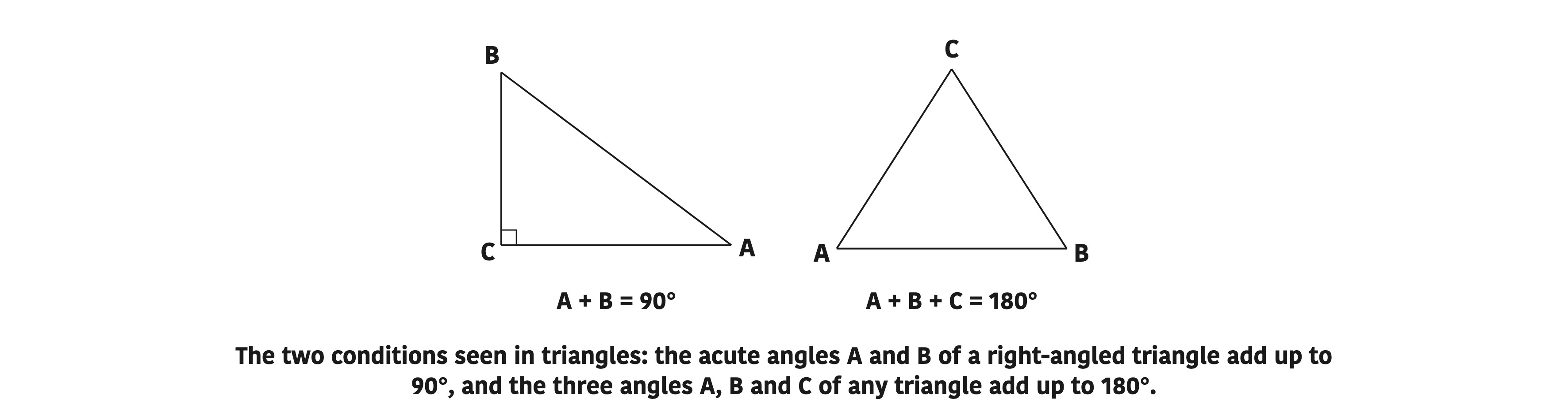
Every triangle satisfies \( A + B + C = 180^\circ \). So a conditional identity built on that condition holds for the angles of every triangle you can draw.
How to Test a Relation for Given Angles
Testing, or verifying, a relation for given angles always follows the same order. Work each side separately and never move terms across the equals sign.
- Step 1: Write down the given angles.
- Step 2: If the relation is a conditional identity, check that the angles meet the condition, for example by adding the three angles of a triangle.
- Step 3: Work out the left-hand side (L.H.S.), replacing each trigonometric ratio by its value.
- Step 4: Work out the right-hand side (R.H.S.) in the same way, on its own.
- Step 5: Compare the two results. If they are equal, write L.H.S. = R.H.S. and the relation is verified for those angles.
You need the values of the ratios at the standard angles, including the obtuse ones that appear in triangles. An angle between 90° and 180° has a positive sine but a negative cosine and a negative tangent.
| Angle | sin | cos | tan |
| 0° | 0 | 1 | 0 |
| 30° | \( \frac{1}{2} \) | \( \frac{\sqrt{3}}{2} \) | \( \frac{1}{\sqrt{3}} \) |
| 45° | \( \frac{1}{\sqrt{2}} \) | \( \frac{1}{\sqrt{2}} \) | 1 |
| 60° | \( \frac{\sqrt{3}}{2} \) | \( \frac{1}{2} \) | \( \sqrt{3} \) |
| 90° | 1 | 0 | not defined |
| 120° | \( \frac{\sqrt{3}}{2} \) | \( -\frac{1}{2} \) | \( -\sqrt{3} \) |
| 135° | \( \frac{1}{\sqrt{2}} \) | \( -\frac{1}{\sqrt{2}} \) | \( -1 \) |
| 150° | \( \frac{1}{2} \) | \( -\frac{\sqrt{3}}{2} \) | \( -\frac{1}{\sqrt{3}} \) |
| 180° | 0 | \( -1 \) | 0 |
\( \tan 90^\circ \), \( \cot 0^\circ \), \( \cot 180^\circ \) and \( \cot 360^\circ \) are not defined. If a relation needs one of them at the given angles, it cannot be tested at those angles. Zero multiplied by something undefined is not zero.
Worked Example 1: The Sine of a Sum
Test \( \sin(A + B) = \sin A\cos B + \cos A\sin B \) when A = 30° and B = 60°.
Step 1: Adding the angles on the left-hand side and finding the sine:
\[ \text{L.H.S.} = \sin(30^\circ + 60^\circ) = \sin 90^\circ = 1 \]
Step 2: Putting the angles into the right-hand side:
\[ \text{R.H.S.} = \sin 30^\circ\cos 60^\circ + \cos 30^\circ\sin 60^\circ \]
Step 3: Replacing each ratio by its value from the table:
\[ = \frac{1}{2} \times \frac{1}{2} + \frac{\sqrt{3}}{2} \times \frac{\sqrt{3}}{2} \]
Step 4: Multiplying each pair and adding the results:
\[ = \frac{1}{4} + \frac{3}{4} = 1 \]
Hence L.H.S. = R.H.S. This relation is an identity, so no condition had to be checked first. The test only confirms it for these two angles.
Worked Example 2: The Tangent of a Sum
Test \( \tan(A + B) = \frac{\tan A + \tan B}{1 - \tan A\tan B} \) when A = 30° and B = 30°.
Step 1: Working out the left-hand side:
\[ \text{L.H.S.} = \tan(30^\circ + 30^\circ) = \tan 60^\circ = \sqrt{3} \]
Step 2: Putting \( \tan 30^\circ = \frac{1}{\sqrt{3}} \) into the right-hand side:
\[ \text{R.H.S.} = \frac{\frac{1}{\sqrt{3}} + \frac{1}{\sqrt{3}}}{1 - \frac{1}{\sqrt{3}} \times \frac{1}{\sqrt{3}}} \]
Step 3: Adding in the numerator and multiplying in the denominator:
\[ = \frac{\frac{2}{\sqrt{3}}}{1 - \frac{1}{3}} = \frac{\frac{2}{\sqrt{3}}}{\frac{2}{3}} \]
Step 4: Dividing by a fraction, which means multiplying by its reciprocal:
\[ = \frac{2}{\sqrt{3}} \times \frac{3}{2} = \frac{3}{\sqrt{3}} = \sqrt{3} \]
Hence L.H.S. = R.H.S. Notice that \( \frac{3}{\sqrt{3}} = \sqrt{3} \) because \( 3 = \sqrt{3} \times \sqrt{3} \).
Worked Example 3: Angles of a Triangle
The three angles of a triangle are \( \alpha = 90^\circ \), \( \beta = 30^\circ \) and \( \gamma = 60^\circ \). Test two relations: first \( \sin(\alpha + \beta) = \sin\gamma \), then \( \cos(\alpha + \beta) = -\cos\gamma \).
Step 1: Checking the condition by adding the three angles:
\[ 90^\circ + 30^\circ + 60^\circ = 180^\circ \]
Step 2: Working out the left-hand side of the sine relation. Since \( 120^\circ = 180^\circ - 60^\circ \), its sine equals \( \sin 60^\circ \):
\[ \sin(90^\circ + 30^\circ) = \sin 120^\circ = \frac{\sqrt{3}}{2} \]
Step 3: Working out the right-hand side of the sine relation:
\[ \sin\gamma = \sin 60^\circ = \frac{\sqrt{3}}{2} \]
So the sine relation is verified. Step 4: Working out the left-hand side of the cosine relation. The cosine of an obtuse angle is negative:
\[ \cos(90^\circ + 30^\circ) = \cos 120^\circ = -\frac{1}{2} \]
Step 5: Working out the right-hand side of the cosine relation:
\[ -\cos\gamma = -\cos 60^\circ = -\frac{1}{2} \]
Hence L.H.S. = R.H.S. for both relations. They hold here because \( \alpha + \beta = 180^\circ - \gamma \).
Worked Example 4: Double Angles in a Triangle
Test \( \sin 2A + \sin 2B + \sin 2C = 4\sin A\sin B\sin C \) when A = 45°, B = 45° and C = 90°.
Step 1: Checking the condition:
\[ 45^\circ + 45^\circ + 90^\circ = 180^\circ \]
Step 2: Doubling each angle:
\[ 2A = 90^\circ,\ 2B = 90^\circ,\ 2C = 180^\circ \]
Step 3: Working out the left-hand side:
\[ \sin 90^\circ + \sin 90^\circ + \sin 180^\circ = 1 + 1 + 0 = 2 \]
Step 4: Putting the values into the right-hand side:
\[ 4 \times \frac{1}{\sqrt{2}} \times \frac{1}{\sqrt{2}} \times 1 = 4 \times \frac{1}{2} = 2 \]
Hence L.H.S. = R.H.S. Now see what happens when the condition is broken. Take A = B = C = 30°, whose sum is only 90°.
Step 5: Working out the left-hand side, where each double angle is 60°:
\[ 3\sin 60^\circ = \frac{3\sqrt{3}}{2} \]
Step 6: Working out the right-hand side, where each sine is \( \frac{1}{2} \):
\[ 4 \times \left(\frac{1}{2}\right)^3 = \frac{4}{8} = \frac{1}{2} \]
The two sides are not equal. So this relation is a conditional identity: it is true only when \( A + B + C = 180^\circ \).
Worked Example 5: Tangents of the Three Angles
The angles of triangle ABC are A = 45°, B = 60° and C = 75°. Test \( \tan A + \tan B + \tan C = \tan A\tan B\tan C \). You found \( \tan 75^\circ = 2 + \sqrt{3} \) earlier from \( \tan(45^\circ + 30^\circ) \).
Step 1: Checking the condition:
\[ 45^\circ + 60^\circ + 75^\circ = 180^\circ \]
Step 2: Adding the three tangents on the left-hand side:
\[ 1 + \sqrt{3} + (2 + \sqrt{3}) = 3 + 2\sqrt{3} \]
Step 3: Multiplying the three tangents on the right-hand side:
\[ 1 \times \sqrt{3} \times (2 + \sqrt{3}) \]
Step 4: Opening the bracket, using \( \sqrt{3} \times \sqrt{3} = 3 \):
\[ = 2\sqrt{3} + 3 \]
Hence L.H.S. = R.H.S. The sum of the tangents of a triangle's angles equals their product.
This relation cannot be tested on a right-angled triangle, because \( \tan 90^\circ \) is not defined. Choose three angles, none of them 90°, that add up to 180°.
Worked Example 6: Squares of Cosines
The angles of triangle ABC are A = 120°, B = 30° and C = 30°. Test \( \cos^2 A + \cos^2 B + \cos^2 C = 1 - 2\cos A\cos B\cos C \).
Step 1: Checking the condition:
\[ 120^\circ + 30^\circ + 30^\circ = 180^\circ \]
Step 2: Writing the left-hand side with the angles in place:
\[ \cos^2 120^\circ + \cos^2 30^\circ + \cos^2 30^\circ \]
Step 3: Squaring each value. Since \( \cos 120^\circ = -\frac{1}{2} \), its square is \( \frac{1}{4} \), and \( \left(\frac{\sqrt{3}}{2}\right)^2 = \frac{3}{4} \):
\[ = \frac{1}{4} + \frac{3}{4} + \frac{3}{4} = \frac{7}{4} \]
Step 4: Putting the values into the right-hand side:
\[ 1 - 2\left(-\frac{1}{2}\right)\left(\frac{\sqrt{3}}{2}\right)\left(\frac{\sqrt{3}}{2}\right) \]
Step 5: Multiplying. The product \( 2 \times \left(-\frac{1}{2}\right) \times \frac{3}{4} \) is \( -\frac{3}{4} \), and subtracting a negative number adds it:
\[ = 1 + \frac{3}{4} = \frac{7}{4} \]
Hence L.H.S. = R.H.S.
The minus sign of \( \cos 120^\circ \) disappears when it is squared, but it stays when it is multiplied. Students often keep it in the square or drop it in the product, and then the two sides do not match.
The full lesson is waiting for you
The notes are free to read in full. A free account opens the rest of the practice, and tracks your progress and confidence score for every subject. Presentations and videos need approval from Learn Yeti.