Moving a Graph Without Changing Its Shape
Imagine a curve cut out of stiff paper and laid on a sheet of graph paper. Push it across the sheet without twisting it. Every point of the cut-out travels the same distance in the same direction. The curve does not stretch, it does not shrink and it does not turn over. Only its position changes. A movement of this kind is called a displacement, and in this topic it is also called a transformation of the graph.
Displacement (transformation of a graph): a movement in which every point of a figure moves through the same distance in the same direction. The figure keeps its size and its shape; only its position changes.
The figure we move here is the graph of the quadratic function \( y = x^2 \), which is a parabola. A displacement of it can happen in three ways:
- Horizontal transformation: the graph moves to the right or to the left, along the x-axis.
- Vertical transformation: the graph moves up or down, along the y-axis.
- Combined transformation: the graph moves sideways and then up or down, one after the other.
For each kind of move we will ask the same three questions. Where does the vertex go? What is the new equation? Has the shape stayed the same?
The Graph of y = x²
To draw \( y = x^2 \) we choose some values of \( x \), square each one to get \( y \), and plot the points. Squaring a negative number gives a positive answer, so \( x = -2 \) and \( x = 2 \) both give \( y = 4 \).
| x | -2 | -1 | 0 | 1 | 2 |
| y = x² | 4 | 1 | 0 | 1 | 4 |
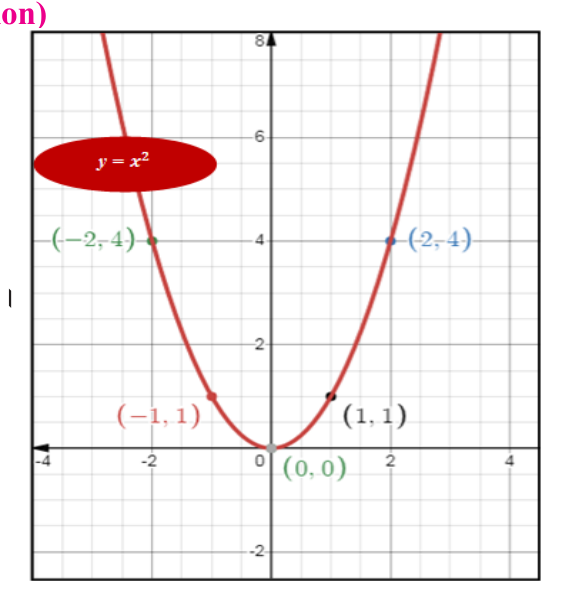
Joining the points with a smooth curve gives a U-shaped graph that opens upward. Its lowest point is (0, 0). This is where the graph stops going down and starts going up, so it is called the vertex or turning point. The y-axis cuts the curve into two halves that match exactly: (1, 1) sits opposite (-1, 1), and (2, 4) sits opposite (-2, 4). The equation of the y-axis is \( x = 0 \), so the axis of symmetry of \( y = x^2 \) is \( x = 0 \).
Vertex (turning point): the point where a parabola turns. It is the lowest point of a parabola that opens upward and the highest point of one that opens downward.
Axis of symmetry: the vertical line through the vertex that divides a parabola into two matching halves. For a vertex (h, k) its equation is \( x = h \).
Horizontal Transformation
Now draw \( y = (x - 2)^2 \) on the same axes as \( y = x^2 \). A table of values for the new function gives (0, 4), (1, 1), (2, 0), (3, 1) and (4, 4). For example, when \( x = 4 \), \( y = (4 - 2)^2 = 4 \).
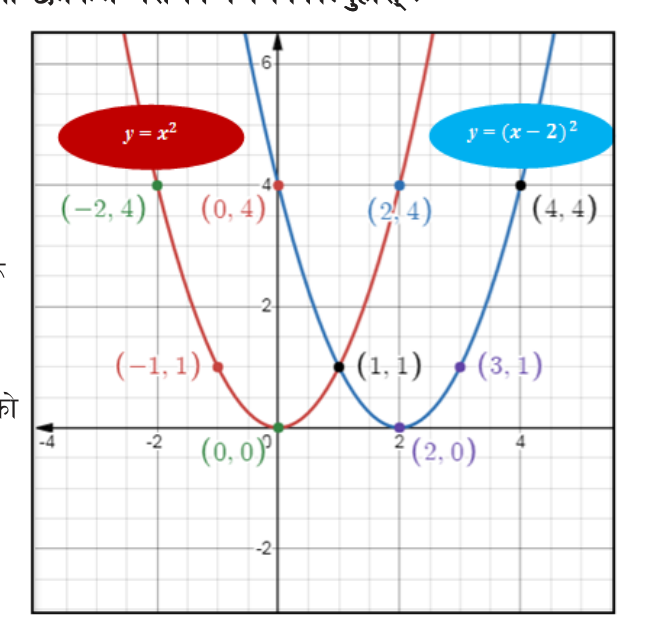
The two curves have exactly the same shape and size. The vertex of the first is (0, 0) and the vertex of the second is (2, 0), which is 2 units to the right. Every other point does the same thing, as the table shows.
| Point on y = x² | Matching point on y = (x - 2)² | Change |
| (-2, 4) | (0, 4) | 2 units right |
| (-1, 1) | (1, 1) | 2 units right |
| (0, 0) | (2, 0) | 2 units right |
| (1, 1) | (3, 1) | 2 units right |
| (2, 4) | (4, 4) | 2 units right |
Why does a minus sign push the curve to the right? In \( y = x^2 \), the value \( y = 0 \) happens at \( x = 0 \). In \( y = (x - 2)^2 \), the bracket is zero only when \( x = 2 \). So each value of \( y \) now arrives 2 units later along the x-axis, and the whole curve sits 2 units further right. In the same way, \( y = (x + 2)^2 \) is zero at \( x = -2 \), so that curve sits 2 units to the left.
Horizontal transformation: moving \( y = x^2 \) through h units to the right gives \( y = (x - h)^2 \), with vertex (h, 0). Moving it h units to the left gives \( y = (x + h)^2 \), with vertex (-h, 0). The curve keeps the same size and shape.
The sign inside the bracket works the opposite way to what many students expect. A minus inside, as in \( (x - 3)^2 \), moves the graph to the RIGHT. A plus inside, as in \( (x + 3)^2 \), moves it to the LEFT. Always ask: which value of x makes the bracket zero?
Worked example 1. Move \( y = x^2 \) through 2 units to the left. Find the new function and its vertex.
Step 1: The given function is:
\[ y = x^2 \]
Step 2: A move of h units to the left replaces \( x \) by \( x + h \). Here \( h = 2 \), so the new function is:
\[ y = (x + 2)^2 \]
Step 3: Finding where the bracket becomes zero, which gives the x-coordinate of the vertex:
\[ x + 2 = 0 \Rightarrow x = -2 \]
Step 4: Checking with one point. The point (1, 1) of \( y = x^2 \) should move to (-1, 1). Substituting \( x = -1 \):
\[ y = (-1 + 2)^2 = 1^2 = 1 \]
The check works, so the new function is \( y = (x + 2)^2 \), its vertex is (-2, 0) and its axis of symmetry is \( x = -2 \). The curve has the same shape as \( y = x^2 \) and simply sits 2 units to the left.
Vertical Transformation
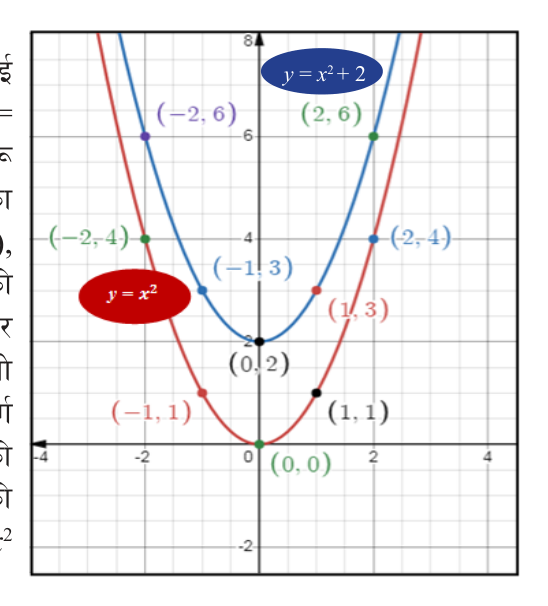
This time the x-coordinates stay as they are and only the y-coordinates change. Take the five points of \( y = x^2 \), including the vertex, and move each one 2 units up by adding 2 to its y-coordinate:
| Point on y = x² | Point 2 units up |
| (-2, 4) | (-2, 6) |
| (-1, 1) | (-1, 3) |
| (0, 0) | (0, 2) |
| (1, 1) | (1, 3) |
| (2, 4) | (2, 6) |
Each new y-coordinate is the old one plus 2, and the old one was \( x^2 \). So every new point obeys \( y = x^2 + 2 \). Joining the new points gives a curve of exactly the same size, still opening upward, lifted 2 units above the first.
Moving the curve 2 units down works the same way: subtract 2 from every y-coordinate. The vertex (0, 0) goes to (0, -2) and the equation becomes \( y = x^2 - 2 \). So when the vertex of \( y = x^2 \) starts at the origin, a move of 2 units up or down puts the vertex at (0, 2) or (0, -2). The axis of symmetry does not change. It is still the y-axis, \( x = 0 \), because nothing moved sideways.
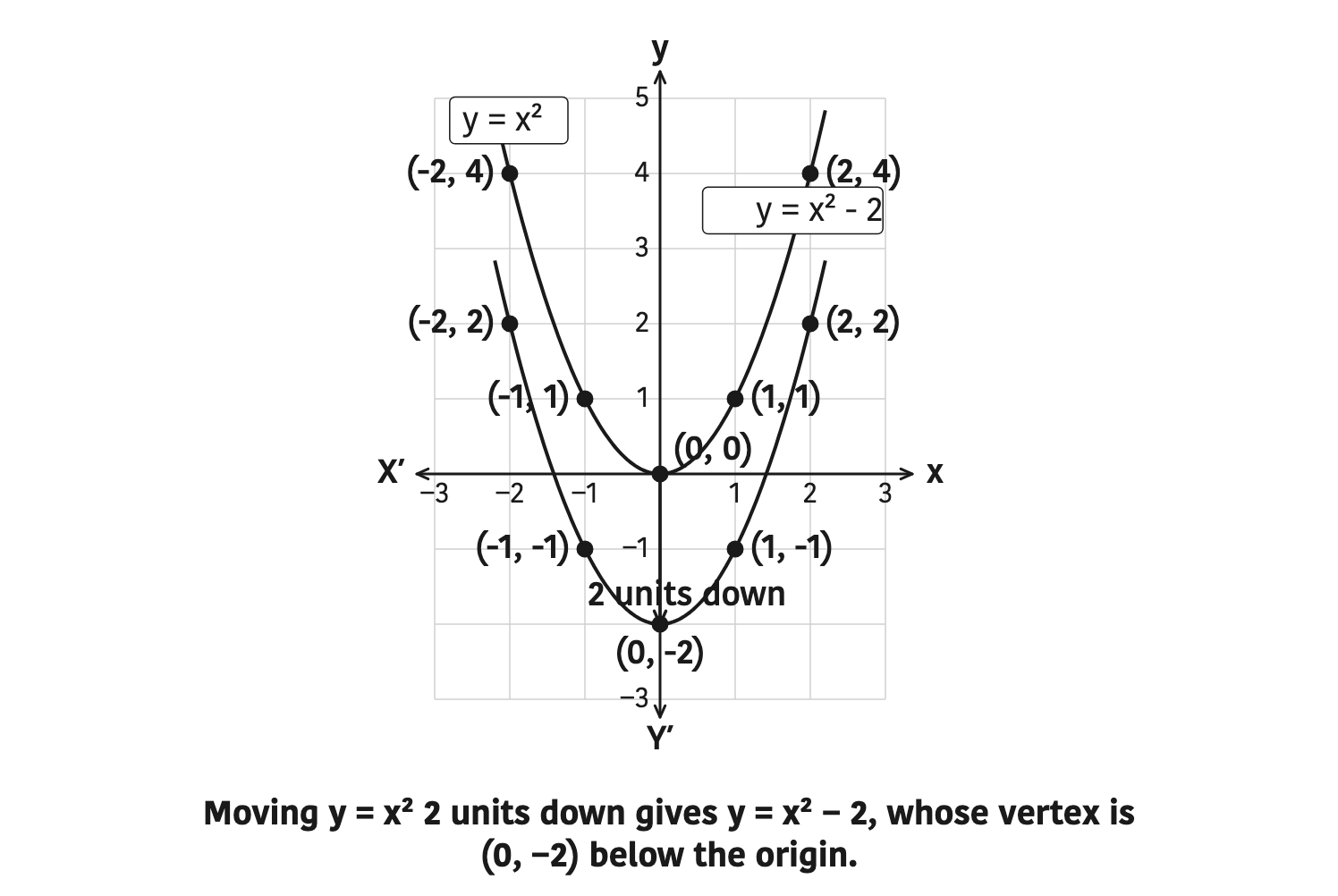
Vertical transformation: moving \( y = x^2 \) through k units up gives \( y = x^2 + k \), and moving it k units down gives \( y = x^2 - k \). The vertex becomes (0, k) or (0, -k), and the size and shape of the parabola stay the same as \( y = x^2 \).
A number joined to x INSIDE the bracket moves the graph sideways. A number added to the whole expression OUTSIDE the bracket moves the graph up or down.
Combined Transformation
A graph can make both moves, one after the other. Move \( y = x^2 \) first 2 units to the right, and then 3 units up. The move to the right changes the function to \( y = (x - 2)^2 \). The move up then adds 3 to every y-coordinate, so the function becomes \( y = (x - 2)^2 + 3 \).
A table of values shows where the new curve lies. For example, when \( x = 0 \), \( y = (0 - 2)^2 + 3 = 4 + 3 = 7 \).
| x | 0 | 1 | 2 | 3 | 4 |
| y = (x - 2)² + 3 | 7 | 4 | 3 | 4 | 7 |
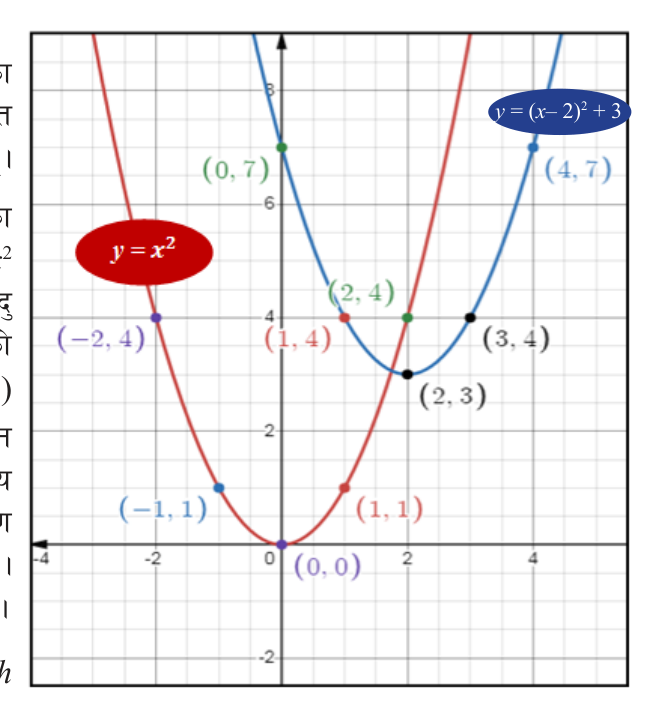
Both curves are the same parabola. The vertex (0, 0) has gone to (2, 3), which is 2 right and 3 up. Every other point has made the same journey: (-1, 1) goes to (1, 4), (1, 1) goes to (3, 4), (-2, 4) goes to (0, 7) and (2, 4) goes to (4, 7). The new axis of symmetry is the vertical line through the new vertex, \( x = 2 \).
The same reasoning works for any distances. Move \( y = x^2 \) first h units to the right, and then k units up. The first move gives \( y = (x - h)^2 \) and the second adds k:
\[ y = (x - h)^2 + k \]
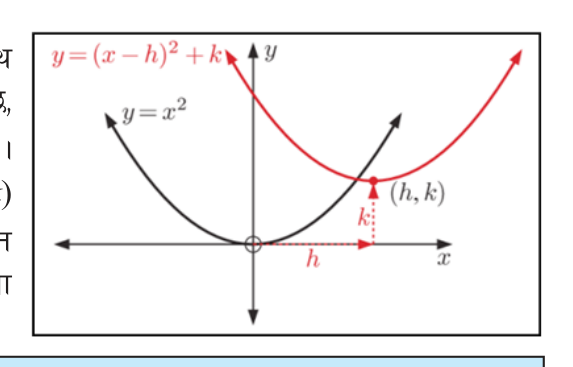
Combined transformation: moving \( y = x^2 \) first h units to the right and then k units up gives \( y = (x - h)^2 + k \). The new vertex is (h, k) and the axis of symmetry is \( x = h \).
Vertex form of a parabola: the equation \( y = (x - h)^2 + k \). It is called the vertex form because the vertex (h, k) can be read straight from it.
Compare the equation with \( y = (x - h)^2 + k \) before you write the vertex. In \( y = (x + 4)^2 - 1 \), the bracket is \( x - (-4) \), so \( h = -4 \) and \( k = -1 \). The vertex is (-4, -1), not (4, -1).
Changing an Equation into Vertex Form
Many quadratic functions are written as \( y = x^2 + bx + c \). In that form the vertex cannot be seen. To find it, we complete the square and rewrite the function as \( y = (x - h)^2 + k \). Then the graph can be described as \( y = x^2 \) moved h units sideways and k units up or down.
Worked example 2. Write \( y = x^2 - 4x + 7 \) in vertex form. Find its vertex and axis of symmetry.
Step 1: The given function is:
\[ y = x^2 - 4x + 7 \]
Step 2: Half of the coefficient of x is -2, and its square is 4. Adding 4 and subtracting 4, which leaves the value unchanged:
\[ y = x^2 - 4x + 4 - 4 + 7 \]
Step 3: Writing the first three terms as a perfect square, since \( x^2 - 4x + 4 = (x - 2)^2 \), and adding the numbers:
\[ y = (x - 2)^2 + 3 \]
Step 4: Comparing with \( y = (x - h)^2 + k \):
\[ h = 2, \quad k = 3 \]
So the vertex is (2, 3) and the axis of symmetry is \( x = 2 \). The graph is \( y = x^2 \) moved 2 units right and 3 units up, which is exactly the curve of the combined transformation above.
Worked example 3. When \( x^2 \) has a minus sign in front, take out -1 first. Write \( y = -x^2 - 2x + 3 \) in vertex form.
Step 1: Taking -1 common from the two terms that contain x:
\[ y = -(x^2 + 2x) + 3 \]
Step 2: Half of 2 is 1, and its square is 1. Adding 1 and subtracting 1 inside the bracket:
\[ y = -(x^2 + 2x + 1 - 1) + 3 \]
Step 3: Writing the perfect square and bringing the -1 out of the bracket, where the minus sign in front turns it into +1:
\[ y = -(x + 1)^2 + 1 + 3 \]
Step 4: Adding the constants:
\[ y = -(x + 1)^2 + 4 \]
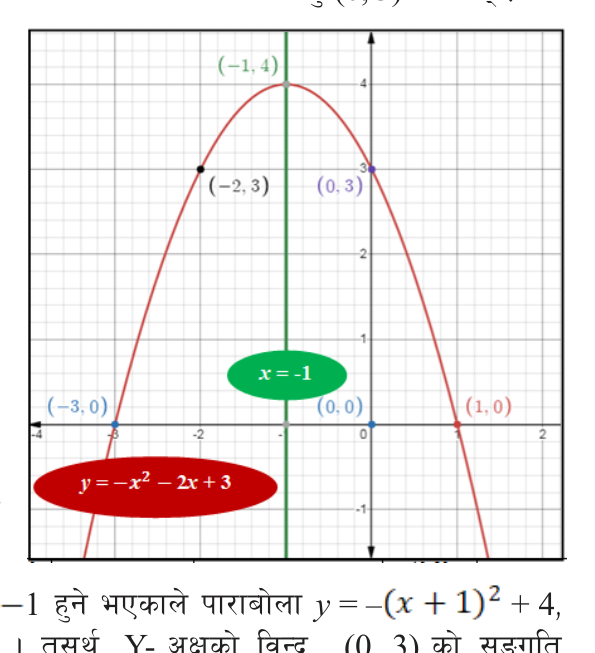
Here \( h = -1 \) and \( k = 4 \), so the vertex is (-1, 4) and the axis of symmetry is \( x = -1 \). Because of the minus sign in front of the bracket, this parabola opens downward and the vertex is its highest point. It cuts the y-axis at (0, 3) and the x-axis at (-3, 0) and (1, 0). Check one of them: at \( x = 1 \), \( y = -(1 + 1)^2 + 4 = -4 + 4 = 0 \).
Different Cases of Quadratic Graphs
The table gathers the common forms of a quadratic function in one place. For each form it gives the vertex and the direction in which the parabola opens. When the number multiplying \( x^2 \) is positive the parabola opens upward like \( \cup \); when it is negative the parabola opens downward like \( \cap \).
| No. | Equation of the parabola | Vertex | Direction it opens |
| 1 | \( y = x^2 \) | (0, 0) | Upward |
| 2 | \( y = -x^2 \) | (0, 0) | Downward |
| 3 | \( y = ax^2,\ a > 0 \) | (0, 0) | Upward |
| 4 | \( y = -ax^2,\ a > 0 \) | (0, 0) | Downward |
| 5 | \( y = x^2 + k \) | (0, k) | Upward |
| 6 | \( y = -x^2 + k \) | (0, k) | Downward |
| 7 | \( y = (x + k)^2 \) | (-k, 0) | Upward |
| 8 | \( y = (x - k)^2 \) | (k, 0) | Upward |
| 9 | \( y = a(x - h)^2 + k,\ a > 0 \) | (h, k) | Upward |
Read the table as a set of patterns rather than nine facts to learn by heart. Rows 1 to 4 have nothing added, so the vertex stays at the origin, and the sign in front of \( x^2 \) decides the direction. Rows 5 and 6 only move up or down, so the vertex stays on the y-axis. Rows 7 and 8 only move sideways, so the vertex stays on the x-axis. Row 9 does everything at once and holds all the others as special cases.
For any parabola \( y = a(x - h)^2 + k \): the vertex is (h, k), the axis of symmetry is \( x = h \), and it opens upward when a is positive and downward when a is negative.
The full lesson is waiting for you
The notes are free to read in full. A free account opens the rest of the practice, and tracks your progress and confidence score for every subject. Presentations and videos need approval from Learn Yeti.