Solving an Equation by Drawing It
The equation \( ax^2 + bx + c = 0 \) is the general quadratic equation. Here \( a \), \( b \) and \( c \) are real numbers and \( a \neq 0 \). If \( a \) were zero, the \( x^2 \) term would disappear and the equation would only be linear.
Quadratic equation: an equation of the form \( ax^2 + bx + c = 0 \), where \( a \), \( b \) and \( c \) are real numbers and \( a \neq 0 \). Its highest power of \( x \) is 2.
You already know three ways to solve a quadratic equation: factorisation, using the formula, and completing the square. All three work with symbols alone. The graph method is different. You draw the equation on graph paper and read the answer from the picture. The picture also shows why a quadratic equation can have two solutions, one solution, or none at all.
Parabola: the U-shaped graph of \( y = ax^2 + bx + c \). It opens upward when \( a > 0 \) and downward when \( a < 0 \).
Every parabola is a copy of the simplest one, \( y = x^2 \), moved sideways, moved up or down, and stretched or flipped by the number \( a \). The point where it turns is the most useful point to know before you draw it.
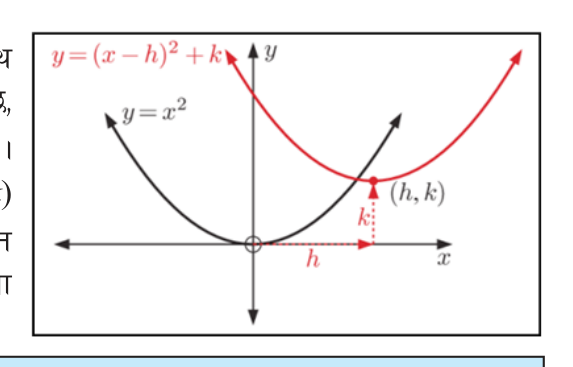
Vertex: the turning point of a parabola. It is the lowest point when the parabola opens upward and the highest point when it opens downward. The parabola is symmetric about the vertical line through its vertex.
Because the curve is symmetric about its vertex, a good table of values takes a few values of \( x \) on each side of the vertex. For \( y = ax^2 + bx + c \), the vertex \( V(h, k) \) is found with this formula:
\[ V(h, k) = V\left(-\frac{b}{2a}, \frac{4ac - b^2}{4a}\right) \]
For the simpler forms, the vertex and the direction can be read straight from the equation:
| Equation of the parabola | Vertex | The parabola opens |
| \( y = x^2 \) | \( (0, 0) \) | upward |
| \( y = -x^2 \) | \( (0, 0) \) | downward |
| \( y = ax^2,\ a > 0 \) | \( (0, 0) \) | upward |
| \( y = -ax^2,\ a > 0 \) | \( (0, 0) \) | downward |
| \( y = x^2 + k \) | \( (0, k) \) | upward |
| \( y = -x^2 + k \) | \( (0, k) \) | downward |
| \( y = (x + k)^2 \) | \( (-k, 0) \) | upward |
| \( y = (x - k)^2 \) | \( (k, 0) \) | upward |
| \( y = a(x - h)^2 + k \) | \( (h, k) \) | upward if \( a > 0 \), downward if \( a < 0 \) |
Method 1: Meeting Points of a Parabola and a Line
The first method splits the quadratic equation into two graphs that are easy to draw: the parabola \( y = x^2 \) and a straight line. The solutions are hidden where these two graphs meet. Here is the method worked on the equation \( x^2 - 2x - 3 = 0 \).
Step 1: Writing the given equation:
\[ x^2 - 2x - 3 = 0 \]
Step 2: Keeping \( x^2 \) alone on the left by moving the other two terms to the right. Each term changes its sign as it crosses the equals sign:
\[ x^2 = 2x + 3 \]
Step 3: Letting each side equal \( y \). The left side gives a parabola and the right side gives a straight line:
\[ y = x^2 \quad \ldots \text{(i)} \]
\[ y = 2x + 3 \quad \ldots \text{(ii)} \]
Step 4: Making a table of values for the parabola (i). Each value of \( y \) is the square of \( x \):
| \( x \) | \( -3 \) | \( -2 \) | \( -1 \) | \( 0 \) | \( 1 \) | \( 2 \) | \( 3 \) |
| \( y \) | 9 | 4 | 1 | 0 | 1 | 4 | 9 |
Step 5: Making a table for the line (ii). Two points are enough to fix a straight line, and a third point checks that nothing has gone wrong:
| \( x \) | \( -1 \) | \( 0 \) | \( 3 \) |
| \( y \) | 1 | 3 | 9 |
Step 6: Plotting both sets of points on the same axes, using the same scale. The points of the parabola are joined by a smooth curve drawn freehand. The points of the line are joined with a ruler.
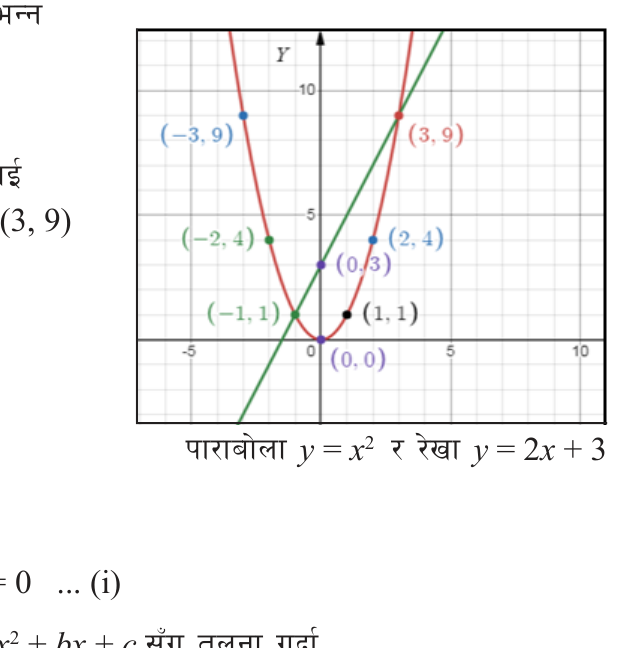
Step 7: Reading where the two graphs cross. The line cuts the parabola at \( (-1, 1) \) and \( (3, 9) \).
Why does this work? At a meeting point, the parabola and the line have the same \( y \) for the same \( x \). So at that point \( x^2 = 2x + 3 \), which is our equation after rearranging. The equation contains only \( x \), so only the \( x \)-coordinates of the meeting points answer it:
\[ x = -1 \quad \text{or} \quad x = 3 \]
A check by substitution confirms it. Putting \( x = -1 \) gives \( 1 + 2 - 3 = 0 \), and putting \( x = 3 \) gives \( 9 - 6 - 3 = 0 \). Both values make the equation true.
The meeting points are \( (-1, 1) \) and \( (3, 9) \), but the solutions of \( x^2 - 2x - 3 = 0 \) are \( x = -1 \) and \( x = 3 \). An equation in \( x \) alone is answered with values of \( x \), not with whole points.
Method 2: Where the Parabola Cuts the X-axis
The second method draws the whole quadratic as a single parabola, \( y = x^2 - 2x - 3 \), and then looks only at the X-axis. Every point on the X-axis has \( y = 0 \). So wherever the parabola crosses the X-axis, \( x^2 - 2x - 3 = 0 \), which is exactly the equation we want to solve.
Solutions from a graph: the solutions (roots) of \( ax^2 + bx + c = 0 \) are the \( x \)-coordinates of the points where the graph of \( y = ax^2 + bx + c \) cuts the X-axis.
Step 1: Comparing \( y = x^2 - 2x - 3 \) with \( y = ax^2 + bx + c \) to read off the three numbers:
\[ a = 1, \quad b = -2, \quad c = -3 \]
Step 2: Finding the \( x \)-coordinate of the vertex with \( h = -\frac{b}{2a} \):
\[ h = -\frac{-2}{2 \times 1} = 1 \]
Step 3: Finding the \( y \)-coordinate of the vertex with \( k = \frac{4ac - b^2}{4a} \):
\[ \begin{aligned} k &= \frac{4 \times 1 \times (-3) - (-2)^2}{4 \times 1} \\ &= \frac{-12 - 4}{4} \\ &= \frac{-16}{4} = -4 \end{aligned} \]
So the vertex is \( V(1, -4) \). It is the lowest point of the curve, because \( a = 1 \) is positive and the parabola opens upward.
Step 4: Making a table with values of \( x \) on both sides of \( x = 1 \):
| \( x \) | \( -3 \) | \( -2 \) | \( -1 \) | \( 0 \) | \( 1 \) | \( 2 \) | \( 3 \) | \( 4 \) | \( 5 \) |
| \( y \) | 12 | 5 | 0 | \( -3 \) | \( -4 \) | \( -3 \) | 0 | 5 | 12 |
Look at the symmetry. The values of \( y \) repeat as you move the same distance to the left and to the right of \( x = 1 \): 12 at both \( x = -3 \) and \( x = 5 \), and 5 at both \( x = -2 \) and \( x = 4 \). This is a quick way to catch a mistake in the table.
Step 5: Plotting the points and joining them with a smooth curve.
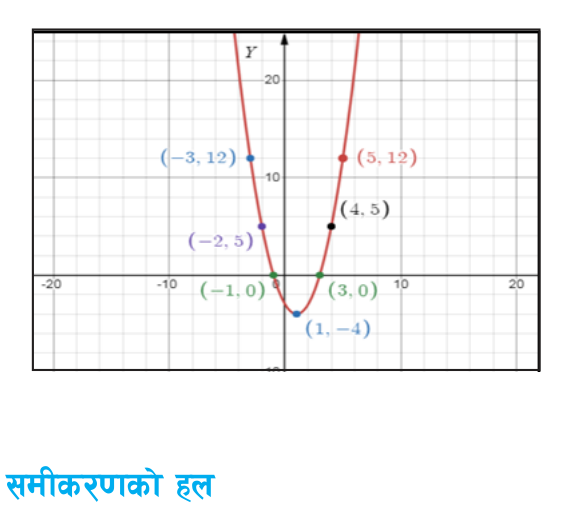
Step 6: Reading the points where the curve cuts the X-axis. They are \( (-1, 0) \) and \( (3, 0) \), so the solutions are:
\[ x = -1 \quad \text{or} \quad x = 3 \]
Both methods give the same answer, as they must. They are two different pictures of the same equation. Method 1 is handy when the numbers are small, because \( y = x^2 \) is always the same curve. Method 2 draws only one graph and suits any value of \( a \), for example \( 2x^2 - 7x + 3 = 0 \).
How Many Solutions Can a Graph Show?
A parabola and a straight line can meet in only three different ways, and each way tells you how many solutions the equation has. The X-axis is itself a straight line, so the same three cases apply to Method 2.
- Two meeting points: the equation has two different solutions. This is what happened with \( x^2 - 2x - 3 = 0 \).
- One point where the line only touches the curve: the equation has one solution. The parabola \( y = x^2 + 2x + 1 = (x + 1)^2 \) only touches the X-axis at \( (-1, 0) \), so \( x^2 + 2x + 1 = 0 \) has the single solution \( x = -1 \).
- No meeting point: the equation has no real solution. The parabola \( y = x^2 - 4x + 7 = (x - 2)^2 + 3 \) has its vertex at \( (2, 3) \), above the X-axis, and opens upward. It never reaches the X-axis, so \( x^2 - 4x + 7 = 0 \) has no real solution.
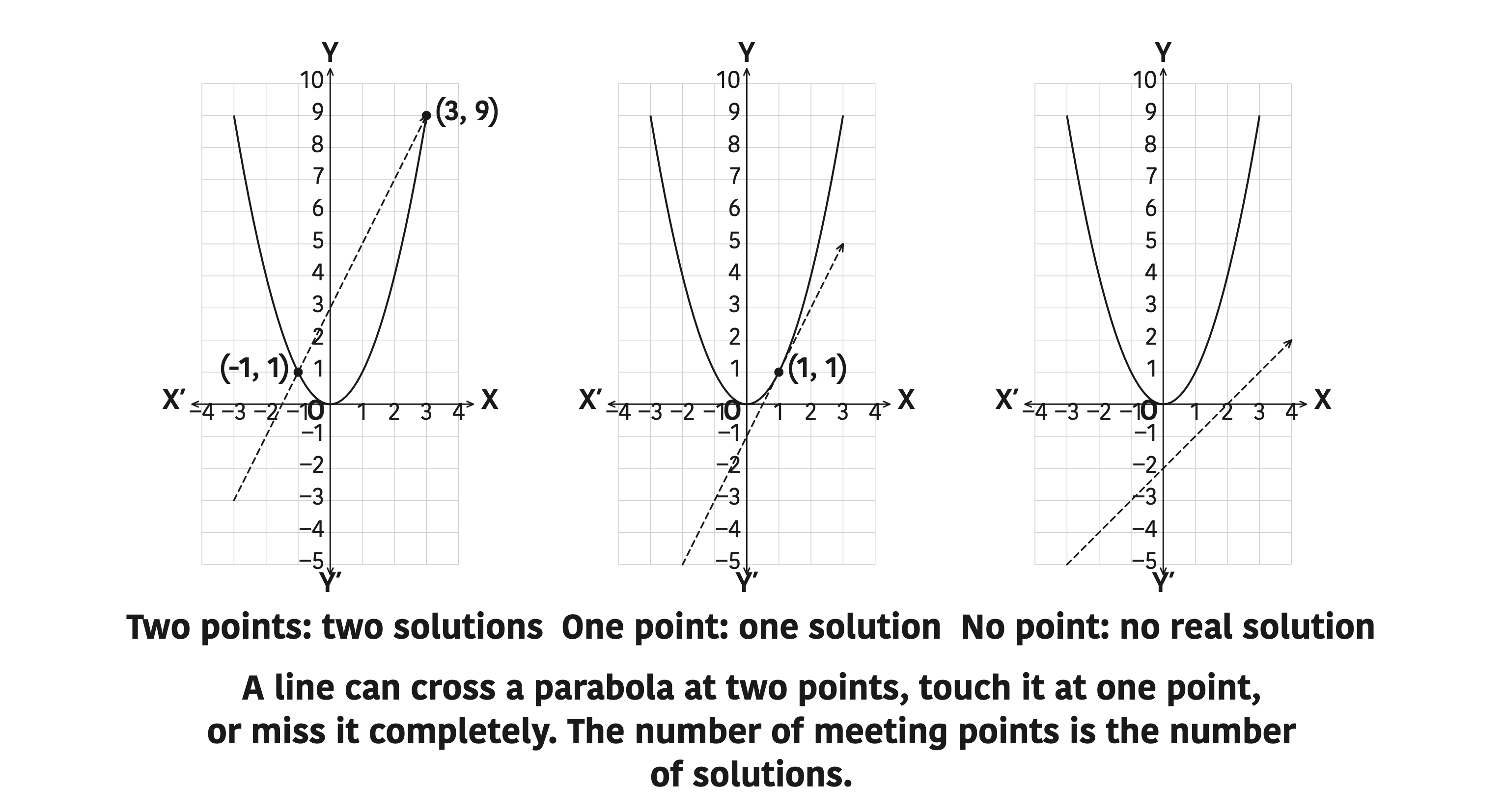
Find the vertex before you draw. If the parabola opens upward and its vertex is above the X-axis, or opens downward and its vertex is below the X-axis, the curve can never cross the X-axis and the equation has no real solution.
Solving a Quadratic and a Linear Equation Together
Linear equation: an equation such as \( y = mx + c \), in which \( x \) and \( y \) appear only to the power 1. Its graph is a straight line.
Sometimes a quadratic equation \( y = ax^2 + bx + c \) and a linear equation \( y = mx + c \) are given together. Now there are two unknowns, \( x \) and \( y \), and a solution is a pair of values that makes both equations true at the same time. On a graph, such a pair is a point that lies on the parabola and on the line at once. So we draw the parabola and the line on the same axes, and the points where they cross are the solutions.
Solution of a quadratic and a linear equation: each point \( (x, y) \) where the parabola and the straight line cut each other.
Worked example: solve \( y = x^2 - x - 3 \) and \( x + y = -2 \) by graph.
Step 1: Naming the two given equations:
\[ y = x^2 - x - 3 \quad \ldots \text{(i)} \]
\[ x + y = -2 \quad \ldots \text{(ii)} \]
Step 2: Making \( y \) the subject of equation (ii), so that its table is easy to fill:
\[ y = -2 - x \]
Step 3: Comparing (i) with \( y = ax^2 + bx + c \) gives \( a = 1 \), \( b = -1 \), \( c = -3 \). Finding the \( x \)-coordinate of the vertex:
\[ h = -\frac{-1}{2 \times 1} = \frac{1}{2} \]
Step 4: Finding the \( y \)-coordinate of the vertex:
\[ \begin{aligned} k &= \frac{4 \times 1 \times (-3) - (-1)^2}{4 \times 1} \\ &= \frac{-12 - 1}{4} \\ &= \frac{-13}{4} = -3.25 \end{aligned} \]
So the vertex is \( V(0.5, -3.25) \), and the table is built around \( x = 0.5 \).
Step 5: Making a table for the parabola (i):
| \( x \) | \( -3 \) | \( -2 \) | \( -1 \) | 0.5 | 1 | 2 | 3 | 4 |
| \( y \) | 9 | 3 | \( -1 \) | \( -3.25 \) | \( -3 \) | \( -1 \) | 3 | 9 |
Step 6: Making a table for the line \( y = -2 - x \):
| \( x \) | \( -1 \) | 0 | 1 |
| \( y \) | \( -1 \) | \( -2 \) | \( -3 \) |
Step 7: Plotting both tables on the same axes, joining the parabola with a smooth curve and the line with a ruler.
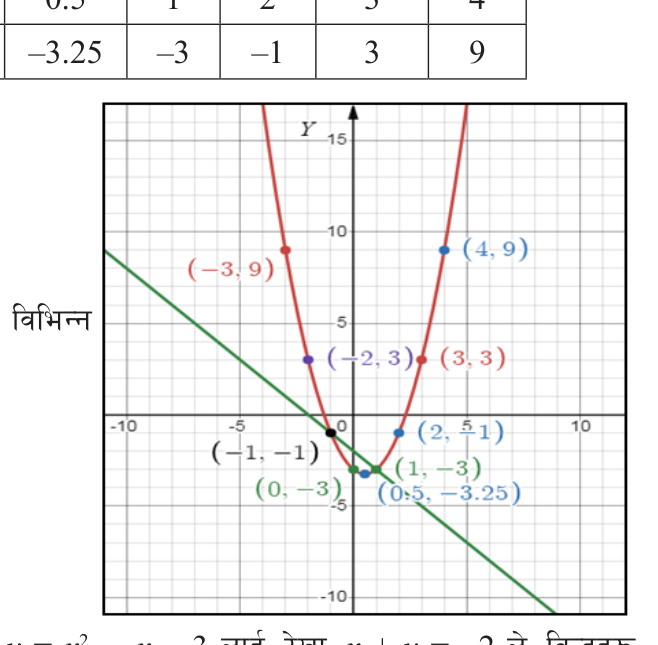
Step 8: Reading the crossing points. The line cuts the parabola at \( (-1, -1) \) and \( (1, -3) \). So the solutions are \( x = -1, y = -1 \) and \( x = 1, y = -3 \).
A check: at \( (-1, -1) \), equation (ii) gives \( -1 + (-1) = -2 \) and equation (i) gives \( 1 + 1 - 3 = -1 \). At \( (1, -3) \), equation (ii) gives \( 1 + (-3) = -2 \) and equation (i) gives \( 1 - 1 - 3 = -3 \). Each point satisfies both equations, so each is a true solution. The vertex \( (0.5, -3.25) \) is on the parabola but not on the line, so it is not a solution.
For a single quadratic equation in \( x \), write the values of \( x \). For a quadratic and a linear equation in \( x \) and \( y \) together, write the full points \( (x, y) \), because both unknowns must be found.
Finding the Equation of a Parabola from Its Graph
The graph method also works backwards. If you can read a few points on a parabola, you can find its equation \( y = ax^2 + bx + c \). There are three unknown numbers, \( a \), \( b \) and \( c \), so three points are needed. Putting each point into the equation gives three equations in \( a \), \( b \) and \( c \), which are then solved together. A fourth point, if the graph shows one, is used to check the answer.
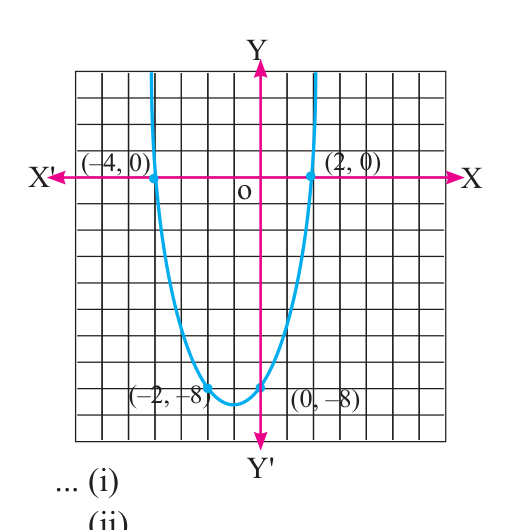
Worked example: find the equation of the parabola through \( A(-4, 0) \), \( B(2, 0) \), \( C(0, -8) \) and \( D(-2, -8) \).
Step 1: Letting the equation of the parabola be:
\[ y = ax^2 + bx + c \]
Step 2: Putting \( x = -4, y = 0 \) from point A into the equation:
\[ 0 = 16a - 4b + c \quad \ldots \text{(i)} \]
Step 3: Putting \( x = 2, y = 0 \) from point B into the equation:
\[ 0 = 4a + 2b + c \quad \ldots \text{(ii)} \]
Step 4: Putting \( x = 0, y = -8 \) from point C into the equation. Both \( a \) and \( b \) are multiplied by zero, so \( c \) comes out at once:
\[ -8 = c \quad \ldots \text{(iii)} \]
Step 5: Putting \( c = -8 \) into (i) and taking out the common factor 4:
\[ \begin{aligned} 16a - 4b - 8 &= 0 \\ 4(4a - b - 2) &= 0 \\ 4a - b &= 2 \quad \ldots \text{(iv)} \end{aligned} \]
Step 6: Putting \( c = -8 \) into (ii), taking out the common factor 2, and making \( b \) the subject:
\[ \begin{aligned} 4a + 2b - 8 &= 0 \\ 2(2a + b - 4) &= 0 \\ b &= 4 - 2a \quad \ldots \text{(v)} \end{aligned} \]
Step 7: Substituting (v) into (iv) to leave only \( a \):
\[ \begin{aligned} 4a - (4 - 2a) &= 2 \\ 6a - 4 &= 2 \\ 6a &= 6 \\ a &= 1 \end{aligned} \]
Step 8: Putting \( a = 1 \) into (v) to find \( b \):
\[ b = 4 - 2 \times 1 = 2 \]
Step 9: Putting \( a = 1 \), \( b = 2 \) and \( c = -8 \) into \( y = ax^2 + bx + c \):
\[ y = x^2 + 2x - 8 \]
Checking with the point not yet used, \( D(-2, -8) \): \( (-2)^2 + 2(-2) - 8 = 4 - 4 - 8 = -8 \). The point fits, so the required equation is \( y = x^2 + 2x - 8 \).
A point on the Y-axis has \( x = 0 \), so it gives \( c \) straight away. Using that point first leaves only two equations in \( a \) and \( b \) to solve.
Steps for the Graph Method
Whichever form the question takes, the working follows the same pattern:
- Write each equation with \( y \) as the subject: either split the quadratic into \( y = x^2 \) and a line, or keep it whole as \( y = ax^2 + bx + c \).
- Find the vertex with \( h = -\frac{b}{2a} \) and \( k = \frac{4ac - b^2}{4a} \).
- Make a table of values for the parabola with \( x \) values on both sides of the vertex.
- Make a table of at least two, and better three, points for any straight line.
- Plot all the points on the same axes with one scale, join the parabola with a smooth curve and the line with a ruler.
- Read the crossing points: with the line for Method 1 and for a pair of equations, with the X-axis for Method 2.
- Write the answer in the right form and check it by substitution.
Never join the points of a parabola with straight ruler lines. The curve is smooth and rounded at the vertex, and a pointed V at the bottom is marked wrong. Choose a scale so the vertex and all the crossing points fit on the paper.
The full lesson is waiting for you
The notes are free to read in full. A free account opens the rest of the practice, and tracks your progress and confidence score for every subject. Presentations and videos need approval from Learn Yeti.