Yearly, Half-Yearly or Quarterly: Which Earns More?
Suppose your uncle has Rs. 1,00,000 to put in a bank for one year at 15% compound interest per annum. The bank lets him choose how often the interest is added to the principal: once a year, twice a year or four times a year. The principal, the rate and the time are the same in all three choices. Which one should he pick?
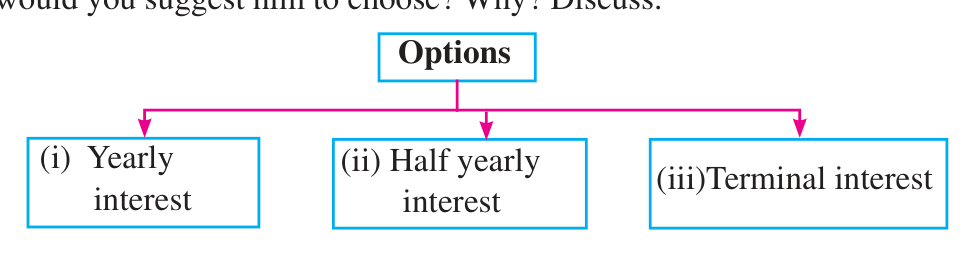
| Option | How often interest is added | Interest in 1 year |
| Yearly | once, at 15% | Rs. 15,000 |
| Half-yearly | twice, at 7.5% each time | Rs. 15,562.50 |
| Quarterly (terminal) | four times, at 3.75% each time | Rs. 15,865.04 |
The quarterly option pays Rs. 865.04 more than the yearly option and Rs. 302.54 more than the half-yearly option, so quarterly compounding is the right advice. The reason is simple. Every time interest is added to the principal, the next interest is worked out on a bigger principal. The more often this happens, the more the interest itself earns interest.
For the same principal, the same rate and the same time, quarterly compound interest is more than half-yearly compound interest, and half-yearly compound interest is more than yearly compound interest.
Yearly compound interest: interest that is worked out at the end of every year and added to the principal, so that the next year's interest is worked out on the new, larger principal.
Half-yearly compound interest: interest that is worked out and added to the principal every 6 months. The rate for each period is \( \frac{R}{2}\% \) and the number of periods is \( 2T \).
Quarterly (terminal) compound interest: interest that is worked out and added to the principal every 3 months, that is, four times a year. The rate for each period is \( \frac{R}{4}\% \) and the number of periods is \( 4T \).
The examples below use these two results, where P is the principal, R% the yearly rate and T the time in years. The compound amount is:
\[ CA = P\left(1 + \frac{R}{100}\right)^T \]
The compound interest is what is left when the principal is taken away from the amount:
\[ CI = P\left[\left(1 + \frac{R}{100}\right)^T - 1\right] \]
| Compounding | Rate for each period | Number of periods |
| Yearly | \( R\% \) | \( T \) |
| Half-yearly | \( \frac{R}{2}\% \) | \( 2T \) |
| Quarterly | \( \frac{R}{4}\% \) | \( 4T \) |
Example 1: Compound Interest Worked Year by Year
Question: Find the compound interest and the compound amount of Rs. 2,000 at 12% per annum for 2 years, without using the formula.
Compound interest is simply simple interest worked out one year at a time, with each year's interest added to the principal before the next year starts. So we find the first year's simple interest, add it to make a new principal, and repeat. Here \( P_1 = \text{Rs. } 2000 \), \( R = 12\% \) and \( T = 2 \) years.
Step 1: Finding the simple interest for the first year on Rs. 2,000:
\[ I_1 = \frac{2000 \times 1 \times 12}{100} = 240 \]
Step 2: Adding the first year's interest to the principal to get the principal for the second year:
\[ P_2 = P_1 + I_1 = 2000 + 240 = 2240 \]
Step 3: Finding the simple interest for the second year, now on Rs. 2,240:
\[ I_2 = \frac{2240 \times 1 \times 12}{100} = 268.80 \]
Step 4: Adding the two years' interest to get the compound interest:
\[ CI = I_1 + I_2 = 240 + 268.80 = 508.80 \]
Step 5: Adding the compound interest to the original principal to get the compound amount:
\[ CA = P_1 + CI = 2000 + 508.80 = 2508.80 \]
So the compound interest is Rs. 508.80 and the compound amount is Rs. 2,508.80. The formula gives the same answer: \( 2000\left[(1.12)^2 - 1\right] = 2000 \times 0.2544 = 508.80 \). The formula is only a shortcut for this year-by-year working.
Example 2: Using the Compound Interest Formula
Question: A loan of Rs. 25,000 is repaid after exactly 3 years at 12% yearly compound interest. Find the compound interest and the compound amount. Here \( P = \text{Rs. } 25000 \), \( R = 12\% \) and \( T = 3 \) years. Working three years one at a time is slow, so we use the formula directly.
Step 1: Putting the values into the compound interest formula:
\[ CI = 25000\left[\left(1 + \frac{12}{100}\right)^3 - 1\right] \]
Step 2: Simplifying inside the bracket, since \( 1 + \frac{12}{100} = \frac{112}{100} = 1.12 \):
\[ CI = 25000\left[(1.12)^3 - 1\right] \]
Step 3: Working out the power, \( (1.12)^3 = 1.404928 \), and multiplying:
\[ CI = 25000 \times 0.404928 = 10123.20 \]
Step 4: Adding the principal and the compound interest:
\[ CA = 25000 + 10123.20 = 35123.20 \]
So the compound interest is Rs. 10,123.20 and the compound amount is Rs. 35,123.20.
Do not drop the \( -1 \) inside the bracket. \( 25000 \times 1.404928 = 35123.20 \) is the amount, not the interest. The interest only appears after 1 is subtracted.
Example 3: Borrowing at Simple Interest, Lending at Compound Interest
Question: A man borrows Rs. 32,000 from a friend at 12.5% per annum simple interest. He lends the whole sum to a shopkeeper at the same rate of compound interest. How much more money does he get in 3 years?
He pays simple interest to his friend and receives compound interest from the shopkeeper, so his gain is the difference between the two: \( CI - SI \). Here \( P = \text{Rs. } 32000 \), \( R = 12.5\% \) and \( T = 3 \) years.
Step 1: Finding the simple interest he pays to his friend:
\[ SI = \frac{32000 \times 3 \times 12.5}{100} = 12000 \]
Step 2: Putting the values into the compound interest formula for what the shopkeeper pays:
\[ CI = 32000\left[\left(1 + \frac{12.5}{100}\right)^3 - 1\right] \]
Step 3: Working out the power, since \( (1.125)^3 = 1.423828125 \), and multiplying:
\[ CI = 32000 \times 0.423828125 = 13562.50 \]
Step 4: Subtracting the simple interest from the compound interest:
\[ CI - SI = 13562.50 - 12000 = 1562.50 \]
So he gets Rs. 1,562.50 more in 3 years. In the first year the two interests are equal, because both are worked out on Rs. 32,000. From the second year on, compound interest also charges interest on the earlier interest, so the gap keeps growing.
Example 4: Half-Yearly or Yearly Compound Interest?
Question: Sameer decides to invest Rs. 5,000 at 8% per annum for 2 years. He has two safe choices: half-yearly compound interest or yearly compound interest. Which would you suggest to him? Give a reason.
Part (a), half-yearly interest: the rate for each half year is \( \frac{8}{2} = 4\% \) and 2 years contain \( 2 \times 2 = 4 \) half years.
Step 1: Writing the half-yearly compound interest formula:
\[ CI_1 = P\left[\left(1 + \frac{R}{200}\right)^{2T} - 1\right] \]
Step 2: Putting in the values:
\[ CI_1 = 5000\left[\left(1 + \frac{8}{200}\right)^{4} - 1\right] \]
Step 3: Working out the power, since \( (1.04)^4 = 1.16985856 \), and multiplying:
\[ CI_1 = 5000 \times 0.16985856 = 849.29 \]
Part (b), yearly interest:
Step 4: Putting the values into the yearly compound interest formula:
\[ CI_2 = 5000\left[\left(1 + \frac{8}{100}\right)^{2} - 1\right] \]
Step 5: Working out the power, since \( (1.08)^2 = 1.1664 \), and multiplying:
\[ CI_2 = 5000 \times 0.1664 = 832 \]
Step 6: Finding the difference between the two interests:
\[ CI_1 - CI_2 = 849.29 - 832 = 17.29 \]
The half-yearly choice earns Rs. 17.29 more, so we advise Sameer to take half-yearly compound interest.
For half-yearly or quarterly interest, change BOTH the rate and the time. Halving the rate but keeping the power T, or doubling the power but keeping the rate R, are both wrong.
Example 5: Finding the Rate from One Year's Amount
Question: A student invests Rs. 10,000 for 2 years at yearly compound interest. After 1 year the compound amount is Rs. 11,200.
- (a) Find the rate of yearly compound interest.
- (b) Find the compound amount at the end of the second year.
This time the rate is unknown but the amount is known. So we put the known values into the amount formula and solve the equation for R.
Step 1: Writing the amount formula with \( T = 1 \):
\[ 11200 = 10000\left(1 + \frac{R}{100}\right) \]
Step 2: Dividing both sides by 10000:
\[ 1.12 = 1 + \frac{R}{100} \]
Step 3: Subtracting 1 from both sides and multiplying by 100:
\[ R = 0.12 \times 100 = 12 \]
Answer to (a): the rate of yearly compound interest is 12%.
Step 4: For part (b), putting \( R = 12 \) and \( T = 2 \) into the amount formula:
\[ CA = 10000\left(1 + \frac{12}{100}\right)^2 \]
Step 5: Multiplying by \( (1.12)^2 = 1.2544 \):
\[ CA = 10000 \times 1.2544 = 12544 \]
Answer to (b): the compound amount at the end of the second year is Rs. 12,544. There is a quick check: the Rs. 11,200 at the end of the first year earns one more year at 12%, and \( 11200 \times 1.12 = 12544 \).
Example 6: A Different Rate Every Year
Question: Rs. 2,00,000 is invested for 3 years. The rate is 8% p.a. in the first year, 10% p.a. in the second and 12% p.a. in the third. Find the compound interest and the compound amount.
At the end of each year the money is multiplied by that year's factor: 1.08 for 8%, 1.10 for 10% and 1.12 for 12%. With different rates a power cannot be used, so each year's factor is multiplied in separately:
\[ CA = P\left(1+\frac{R_1}{100}\right)\left(1+\frac{R_2}{100}\right)\left(1+\frac{R_3}{100}\right) \]
Step 1: Putting in \( R_1 = 8 \), \( R_2 = 10 \), \( R_3 = 12 \) and writing each bracket as a decimal:
\[ CA = 200000 \times 1.08 \times 1.10 \times 1.12 \]
Step 2: Multiplying the factors, since \( 1.08 \times 1.10 = 1.188 \) and \( 1.188 \times 1.12 = 1.33056 \):
\[ CA = 200000 \times 1.33056 = 266112 \]
Step 3: Subtracting the principal from the amount to get the compound interest:
\[ CI = 266112 - 200000 = 66112 \]
So the compound amount is Rs. 2,66,112 and the compound interest is Rs. 66,112.
Example 7: Rate and Principal from Two Amounts
Question: A sum amounts to Rs. 14,520 in 2 years and to Rs. 15,972 in 3 years at a certain rate of yearly compound interest.
- (a) Find the rate of compound interest.
- (b) Find the principal.
Let the principal be \( \text{Rs. } x \) and the rate be R%. There are two unknowns, so we build two equations.
Step 1: Writing the first equation from the 2-year amount:
\[ x\left(1 + \frac{R}{100}\right)^2 = 14520 \quad \text{(i)} \]
Step 2: Writing the second equation from the 3-year amount:
\[ x\left(1 + \frac{R}{100}\right)^3 = 15972 \quad \text{(ii)} \]
Step 3: Dividing equation (ii) by (i). The \( x \) cancels and two of the three brackets cancel, leaving one:
\[ 1 + \frac{R}{100} = \frac{15972}{14520} = 1.10 \]
Step 4: Subtracting 1 and multiplying by 100:
\[ R = 0.10 \times 100 = 10 \]
Answer to (a): the rate is 10% p.a.
Step 5: For part (b), putting \( R = 10 \) into equation (i), where \( (1.10)^2 = 1.21 \):
\[ 1.21x = 14520 \]
Step 6: Dividing both sides by 1.21:
\[ x = \frac{14520}{1.21} = 12000 \]
Answer to (b): the principal is Rs. 12,000.
Another way: in the third year, the 2-year amount of Rs. 14,520 simply earns one more year's interest. So \( 14520\left(1 + \frac{R}{100}\right) = 15972 \), which is the same equation as above. Put plainly, the extra Rs. 1,452 is one year's interest on Rs. 14,520, and \( \frac{1452}{14520} \times 100 = 10\% \).
Example 8: Tax on Interest and a Change in Compounding
Question: A person deposits Rs. 2,00,000 in a development bank for 2 years to earn half-yearly compound interest at 10% per annum, with 5% tax deducted from the interest. Right after one year, the bank changes its policy and pays the interest terminally (quarterly) at the same rate.
- (a) Find the first year's interest after tax.
- (b) What is the second year's interest after tax?
- (c) What is the difference between the two years' interest after tax?
- (d) By what percentage does the second year's interest after tax differ from the first year's?
Two things are new here. First, tax is taken from the interest only, never from the principal; with 5% tax the depositor keeps 95% of the interest. Second, the first year's interest after tax joins the principal, and that total becomes the principal for the second year. In the second year interest is quarterly, so the rate per quarter is \( \frac{10}{4} = 2.5\% \) and there are 4 quarters in the year.
Part (a): the first year.
Step 1: Setting up the half-yearly compound interest for 1 year, where \( 2T = 2 \):
\[ CI_1 = 200000\left[\left(1 + \frac{10}{200}\right)^{2} - 1\right] \]
Step 2: Using \( (1.05)^2 = 1.1025 \) and multiplying:
\[ CI_1 = 200000 \times 0.1025 = 20500 \]
Step 3: Working out the 5% tax on this interest:
\[ 20500 \times \frac{5}{100} = 1025 \]
Step 4: Subtracting the tax from the interest:
\[ 20500 - 1025 = 19475 \]
Answer to (a): the first year's interest after tax is Rs. 19,475.
Part (b): the second year.
Step 5: Adding the first year's interest after tax to get the second year's principal:
\[ 200000 + 19475 = 219475 \]
Step 6: Setting up the quarterly compound interest for 1 year, where \( 4T = 4 \):
\[ CI_2 = 219475\left[\left(1 + \frac{10}{400}\right)^{4} - 1\right] \]
Step 7: Using \( (1.025)^4 = 1.10381289 \) and multiplying, keeping three decimal places because the tax is still to come:
\[ CI_2 = 219475 \times 0.10381289 = 22784.334 \]
Step 8: Working out the 5% tax on this interest:
\[ 22784.334 \times \frac{5}{100} = 1139.217 \]
Step 9: Subtracting the tax from the interest:
\[ 22784.334 - 1139.217 = 21645.117 \]
Answer to (b): the second year's interest after tax is about Rs. 21,645.12.
Part (c): subtracting the first year's interest from the second year's:
\[ 21645.12 - 19475 = 2170.12 \]
Part (d): writing the difference as a percentage of the first year's interest:
\[ \frac{2170.12}{19475} \times 100\% = 11.14\% \]
So after tax, the second year's interest is Rs. 2,170.12, or 11.14%, more than the first year's. There are two reasons: the second year starts with a bigger principal, and interest is added four times instead of twice.
Tax is taken from the interest only, never from the principal. When you build the next year's principal, add the interest after tax, not the full interest.
Example 9: Dividing a Loan So the Amounts Are Equal
Question: A commercial bank lends a total of Rs. 52,500 to Babulal and Jibanlal at 10% yearly compound interest. The amount Babulal repays after 2 years equals the amount Jibanlal repays after 3 years. How much did each of them borrow?
Let Babulal's loan be \( \text{Rs. } x \). The total is Rs. 52,500, so Jibanlal's loan is \( \text{Rs. } (52500 - x) \). We write both amounts and set them equal.
Step 1: Writing Babulal's amount after 2 years, where \( (1.1)^2 = 1.21 \):
\[ CA_1 = x\left(1 + \frac{10}{100}\right)^2 = 1.21x \]
Step 2: Writing Jibanlal's amount after 3 years:
\[ CA_2 = (52500 - x)\left(1 + \frac{10}{100}\right)^3 \]
Step 3: Expanding, since \( (1.1)^3 = 1.331 \) and \( 52500 \times 1.331 = 69877.5 \):
\[ CA_2 = 69877.5 - 1.331x \]
Step 4: Setting the two amounts equal, as the question says:
\[ 1.21x = 69877.5 - 1.331x \]
Step 5: Adding \( 1.331x \) to both sides to collect the x terms:
\[ 2.541x = 69877.5 \]
Step 6: Dividing both sides by 2.541:
\[ x = \frac{69877.5}{2.541} = 27500 \]
So Babulal borrowed Rs. 27,500 and Jibanlal borrowed \( 52500 - 27500 = 25000 \), that is, Rs. 25,000. Check: \( 27500 \times 1.21 = 33275 \) and \( 25000 \times 1.331 = 33275 \), which are equal. The answer also makes sense: Jibanlal pays interest for longer, so his loan must be the smaller one.
Which Method for Which Question
The nine examples cover eight kinds of question. Once you see what a question gives and what it asks for, the method follows.
| What the question gives or asks | What to do |
| Compound interest without the formula | Find each year's simple interest and add it to the principal before the next year |
| P, R and T given | \( CA = P(1 + \frac{R}{100})^T \), then \( CI = CA - P \) |
| Simple against compound interest | Find both, then \( CI - SI \) |
| Half-yearly or quarterly | \( \frac{R}{200} \) with \( 2T \), or \( \frac{R}{400} \) with \( 4T \) |
| A different rate each year | Multiply by each year's \( (1 + \frac{R}{100}) \) |
| Amount given, rate asked | Write the amount formula and solve for R |
| Amounts for two years in a row | Later amount divided by earlier gives \( 1 + \frac{R}{100} \) |
| Tax on interest | Keep (100 minus tax)% of the interest and add that to the principal |
| Split a sum so amounts are equal | Let one part be x and the other (total minus x), then equate the amounts |
The full lesson is waiting for you
The notes are free to read in full. A free account opens the rest of the practice, and tracks your progress and confidence score for every subject. Presentations and videos need approval from Learn Yeti.