Simple Interest: The Starting Point
Money that is borrowed or saved grows because of interest. The sum first borrowed or deposited is the principal, written P. The rate of interest, written R, is the interest charged on every Rs. 100 for one year, so it is given as a percentage per annum (per year). The number of years the money is kept is the time, written T. In simple interest, the interest for every year is worked out on the same original principal.
Simple interest is the interest calculated on the original principal only, for the whole time the money is kept.
\[ SI = \frac{P \times T \times R}{100} \]
The amount is the principal and the interest added together. It is written A, where \( A = P + SI \).
For example, a shopkeeper borrows Rs. 40,000 for 3 years at 9% per annum. Here is how the interest and the amount are found.
Step 1: Putting the values into the simple interest formula:
\[ SI = \frac{40{,}000 \times 3 \times 9}{100} \]
Step 2: Dividing 40,000 by 100 to get 400, and multiplying \( 3 \times 9 = 27 \):
\[ SI = 400 \times 27 = 10{,}800 \]
Step 3: Adding the interest to the principal to get the amount:
\[ A = 40{,}000 + 10{,}800 = 50{,}800 \]
So the interest is Rs. 10,800 and the amount is Rs. 50,800. Each of the three years brought exactly the same interest, Rs. 3,600, because every year the interest was taken on the same Rs. 40,000. A principal that never changes is the mark of simple interest, and it is exactly this that compound interest changes.
When Interest Is Left Unpaid
Think about what happens when a borrower cannot pay the interest at the end of a year. The bank does not forget that money. The unpaid interest is added to the loan, and from the next year the borrower pays interest on the bigger sum. In other words, interest is now being charged on interest.
Ramesh borrowed Rs. 20,000 from a cooperative for 2 years at 10% per annum. At the end of the first year he could not pay the interest. Let us find the total interest he must pay for the two years.
Step 1: Finding the first year's interest on the original principal, with T = 1 year:
\[ I_1 = \frac{20{,}000 \times 1 \times 10}{100} = 2{,}000 \]
Step 2: Adding the unpaid interest to the principal to get the second year's principal:
\[ P_2 = 20{,}000 + 2{,}000 = 22{,}000 \]
Step 3: Finding the second year's interest on the new principal:
\[ I_2 = \frac{22{,}000 \times 1 \times 10}{100} = 2{,}200 \]
Step 4: Adding the interest of the two years:
\[ I_1 + I_2 = 2{,}000 + 2{,}200 = 4{,}200 \]
The two years did not bring equal interest. The second year's interest is Rs. 200 more than the first. That Rs. 200 is exactly 10% of the Rs. 2,000 that was left unpaid, so the unpaid interest has itself earned interest. Under simple interest Ramesh would have paid only Rs. 4,000, but because the interest was added to the principal he pays Rs. 4,200. The first and second years differ for one reason: the second year's principal is bigger.
Compound Interest and Compound Amount
What happened to Ramesh's loan has its own name in mathematics. Interest is added to the principal at the end of a fixed period, and the next interest is worked out on that new total. The period can be a year, half a year or a quarter of a year.
When the interest on a principal is calculated at the end of every fixed period (yearly, half-yearly or quarterly), added to the principal, and the interest is then calculated again on this new principal, the interest obtained is called compound interest, written CI.
The sum of the principal and the compound interest is called the compound amount, written CA.
Interest is compounded annually (yearly) when it is added to the principal once, at the end of every year.
Every calculation in this topic is compounded annually. So here the time T is a number of years and the rate R is a rate per year.
Simple and Compound Interest Side by Side
Now compare the two kinds of interest on the same sum, at the same rate, for the same time. Suppose Rs. 50,000 is borrowed for 3 years at 8% per annum. Under simple interest every year's principal stays at Rs. 50,000. Under compound interest each year's principal is the amount of the year before: the second year's principal is \( 50{,}000 + 4{,}000 = 54{,}000 \) and the third year's is \( 54{,}000 + 4{,}320 = 58{,}320 \).
| Year | SI: principal (Rs.) | SI: interest (Rs.) | CI: principal (Rs.) | CI: interest (Rs.) |
| 1st | 50,000 | 4,000 | 50,000 | 4,000 |
| 2nd | 50,000 | 4,000 | 54,000 | 4,320 |
| 3rd | 50,000 | 4,000 | 58,320 | 4,665.60 |
| Total interest | 12,000 | 12,985.60 |
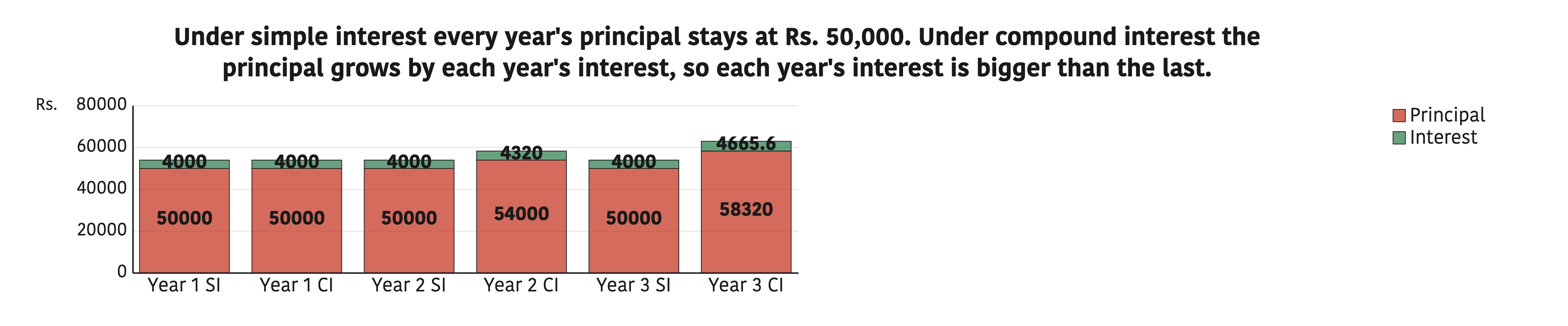
The table shows three things. In the first year both interests are equal, because both are worked out on the original principal. From the second year the gap opens, and it widens every year. Over three years the compound interest is \( 12{,}985.60 - 12{,}000 = 985.60 \), that is Rs. 985.60, more than the simple interest.
In simple interest the principal is the same every year. In compound interest the principal changes every year: the second year's principal is the first year's amount, the third year's principal is the second year's amount, and so on. So on the same principal, at the same rate, for the same time, compound interest is more than simple interest.
Building the Formula Year by Year
Working year by year is easy for two or three years, but for 10 years it would take a long time. So we repeat the same working with letters in place of numbers and look for a pattern. Suppose a principal P is deposited at R% per annum for T years, and the interest is added to the principal at the end of every year.
Step 1: Finding the first year's interest, with T = 1:
\[ I_1 = \frac{P \times 1 \times R}{100} = \frac{PR}{100} \]
Step 2: Finding the amount at the end of the first year, taking P out as a common factor:
\[ A_1 = P + \frac{PR}{100} = P\left(1 + \frac{R}{100}\right) \]
Step 3: Since the first year's amount becomes the second year's principal:
\[ P_2 = P\left(1 + \frac{R}{100}\right) \]
Step 4: Finding the second year's interest on the new principal \( P_2 \):
\[ I_2 = P\left(1 + \frac{R}{100}\right) \times \frac{R}{100} \]
Step 5: Finding the amount at the end of the second year by adding \( P_2 \) and \( I_2 \):
\[ A_2 = P_2 + P_2 \times \frac{R}{100} \]
Step 6: Taking \( P_2 \) out as a common factor:
\[ A_2 = P_2\left(1 + \frac{R}{100}\right) \]
Step 7: Putting \( P_2 = P\left(1 + \frac{R}{100}\right) \) back in:
\[ A_2 = P\left(1 + \frac{R}{100}\right)^2 \]
Step 8: The second year's amount becomes the third year's principal. Multiplying it once more by \( \left(1 + \frac{R}{100}\right) \) gives the third year's amount:
\[ A_3 = P\left(1 + \frac{R}{100}\right)^3 \]
Now look at the pattern. At the end of the first year the power is 1, at the end of the second year it is 2, and at the end of the third year it is 3. Each year the money is multiplied once by \( \left(1 + \frac{R}{100}\right) \), so at the end of T years the power is T.
With yearly compounding, the money is multiplied by \( \left(1 + \frac{R}{100}\right) \) at the end of every year. In T years this multiplication happens T times.
The Two Formulas for Yearly Compounding
From the pattern above, the compound amount at the end of T years is:
\[ CA = P\left(1 + \frac{R}{100}\right)^T \]
Compound interest is what is left when the principal is taken away from the compound amount, that is \( CI = CA - P \). So:
\[ CI = P\left(1 + \frac{R}{100}\right)^T - P \]
Taking out P, which is common to both terms:
\[ CI = P\left[\left(1 + \frac{R}{100}\right)^T - 1\right] \]
- CA = compound amount
- CI = compound interest
- P = principal
- R = rate of interest per annum, as a percentage
- T = time, in years
\( P\left(1 + \frac{R}{100}\right)^T \) gives the amount, not the interest. If the question asks for the compound interest, the principal must still be subtracted at the end. Also, for a rate of 8%, put R = 8 in the formula, not 0.08, because the formula already divides by 100.
Worked Examples Using the Formula
Example 1: Use the formula to find the compound amount and the compound interest on Rs. 50,000 for 3 years at 8% per annum. Here P = Rs. 50,000, R = 8 and T = 3 years.
Step 1: Putting the values into the compound amount formula:
\[ CA = 50{,}000\left(1 + \frac{8}{100}\right)^3 \]
Step 2: Simplifying the bracket, since \( 1 + \frac{8}{100} = \frac{108}{100} = \frac{27}{25} \):
\[ CA = 50{,}000 \times \left(\frac{27}{25}\right)^3 \]
Step 3: Cubing the fraction:
\[ CA = 50{,}000 \times \frac{19{,}683}{15{,}625} \]
Step 4: Dividing 50,000 by 15,625 gives 3.2, so multiplying:
\[ CA = 3.2 \times 19{,}683 = 62{,}985.60 \]
Step 5: Subtracting the principal from the amount to get the compound interest:
\[ CI = 62{,}985.60 - 50{,}000 = 12{,}985.60 \]
So the compound amount is Rs. 62,985.60 and the compound interest is Rs. 12,985.60. This matches exactly the total found year by year in the table above, which shows the formula does the same job in one line.
Example 2: Find the compound interest on Rs. 80,000 for 2 years at 5% per annum, using the CI formula directly.
Step 1: Putting the values into the compound interest formula:
\[ CI = 80{,}000\left[\left(1 + \frac{5}{100}\right)^2 - 1\right] \]
Step 2: Simplifying the inner bracket, since \( 1 + \frac{5}{100} = \frac{105}{100} = \frac{21}{20} \):
\[ CI = 80{,}000\left[\left(\frac{21}{20}\right)^2 - 1\right] \]
Step 3: Squaring the fraction:
\[ CI = 80{,}000\left[\frac{441}{400} - 1\right] \]
Step 4: Subtracting inside the bracket, writing 1 as \( \frac{400}{400} \):
\[ CI = 80{,}000 \times \frac{41}{400} \]
Step 5: Dividing 80,000 by 400 gives 200, so:
\[ CI = 200 \times 41 = 8{,}200 \]
So the compound interest is Rs. 8,200, and the compound amount is \( 80{,}000 + 8{,}200 = 88{,}200 \), that is Rs. 88,200.
Example 3: Find the difference between the compound interest and the simple interest on Rs. 1,20,000 for 2 years at 10% per annum.
Step 1: Finding the simple interest:
\[ SI = \frac{1{,}20{,}000 \times 2 \times 10}{100} = 24{,}000 \]
Step 2: Putting the values into the compound amount formula, since \( 1 + \frac{10}{100} = \frac{11}{10} \):
\[ CA = 1{,}20{,}000 \times \left(\frac{11}{10}\right)^2 \]
Step 3: Squaring and multiplying:
\[ CA = 1{,}20{,}000 \times \frac{121}{100} = 1{,}45{,}200 \]
Step 4: Subtracting the principal to get the compound interest:
\[ CI = 1{,}45{,}200 - 1{,}20{,}000 = 25{,}200 \]
Step 5: Finding the difference between the two interests:
\[ CI - SI = 25{,}200 - 24{,}000 = 1{,}200 \]
So the compound interest is Rs. 1,200 more than the simple interest. That Rs. 1,200 is the 10% interest charged in the second year on the first year's interest of Rs. 12,000.
The full lesson is waiting for you
The notes are free to read in full. A free account opens the rest of the practice, and tracks your progress and confidence score for every subject. Presentations and videos need approval from Learn Yeti.