Compound Interest Added Once a Year
When interest is compounded yearly, the interest of each year is added to the principal at the end of that year. The next year's interest is then calculated on this bigger sum, so interest itself starts earning interest. For a principal P at R% per annum for T years, the compound amount and the compound interest are:
\[ \text{CA} = P\left(1 + \frac{R}{100}\right)^{T} \]
\[ \text{CI} = P\left[\left(1 + \frac{R}{100}\right)^{T} - 1\right] \]
Here \( 1 + \frac{R}{100} \) can be read as a growth factor: it is how many times the sum grows in one year, and over T years it is multiplied T times. This formula quietly assumes three things. The rate stays the same every year, the time is a whole number of years, and interest is added only once a year. In banks and savings accounts one of these is often not true. There are four such situations, and in each one the formula changes in a small, sensible way:
- (a) The rate of interest is different every year.
- (b) The time is given as T years and M months.
- (c) Interest is compounded half yearly, every 6 months.
- (d) Interest is compounded terminally, every 3 months.
(a) A Different Rate of Interest Every Year
Suppose a bank gives \( R_1\% \) in the first year, \( R_2\% \) in the second year and \( R_3\% \) in the third year. After the first year the sum becomes \( P\left(1 + \frac{R_1}{100}\right) \). In the second year this whole sum grows at \( R_2\% \), so it is multiplied by \( \left(1 + \frac{R_2}{100}\right) \). The third year multiplies it again, this time by \( \left(1 + \frac{R_3}{100}\right) \). Each year brings its own growth factor, so the compound amount for three years is:
\[ \begin{aligned} \text{CA} &= P\left(1 + \frac{R_1}{100}\right)\left(1 + \frac{R_2}{100}\right) \\ &\quad \times \left(1 + \frac{R_3}{100}\right) \end{aligned} \]
The compound interest is what remains when the principal is taken away from the amount:
\[ \begin{aligned} \text{CI} = P\Big[&\left(1 + \frac{R_1}{100}\right)\left(1 + \frac{R_2}{100}\right) \\ &\times \left(1 + \frac{R_3}{100}\right) - 1\Big] \end{aligned} \]
There is one bracket for each year: two brackets for two years, four brackets for four years. If every year has the same rate, all the brackets are equal and we are back to the ordinary yearly formula.
Worked example: Rs 20,000 is deposited for 3 years. The bank gives 5% compound interest in the first year, 8% in the second and 10% in the third. Find the compound amount and the compound interest.
Step 1: The first year's growth factor is \( \frac{105}{100} \), so the sum after the first year is:
\[ 20000 \times \frac{105}{100} = 21000 \]
Step 2: Rs 21,000 now becomes the principal and grows by the factor \( \frac{108}{100} \). The sum after the second year is:
\[ 21000 \times \frac{108}{100} = 22680 \]
Step 3: Multiplying by the third year's factor \( \frac{110}{100} \) gives the compound amount:
\[ \text{CA} = 22680 \times \frac{110}{100} = 24948 \]
Step 4: Subtracting the principal from the compound amount gives the compound interest:
\[ \text{CI} = 24948 - 20000 = 4948 \]
So the compound amount is Rs 24,948 and the compound interest is Rs 4,948. Working year by year is exactly the same as multiplying the three brackets of the formula one after another.
Adding the three rates (5 + 8 + 10 = 23) and using 23% once is wrong, because it leaves out the interest earned on interest. Taking the average rate is also wrong. Each year's factor must be multiplied in separately.
(b) Time Given in Years and Months
Sometimes the time is not a whole number of years, for example 2 years 6 months. For the T full years, interest is added every year, so the amount after those years is \( P\left(1 + \frac{R}{100}\right)^{T} \). The remaining M months are less than a year, so on this amount only simple interest is added for those months. M months is \( \frac{M}{12} \) of a year, which makes the rate for that part \( R \times \frac{M}{12} \div 100 = \frac{MR}{1200} \). This gives:
\[ \text{CA} = P\left(1 + \frac{R}{100}\right)^{T}\left(1 + \frac{MR}{1200}\right) \]
\[ \begin{aligned} \text{CI} &= P\Big[\left(1 + \frac{R}{100}\right)^{T} \\ &\quad \times \left(1 + \frac{MR}{1200}\right) - 1\Big] \end{aligned} \]
Worked example: Find the compound amount and compound interest on Rs 40,000 at 10% per annum compounded yearly for 2 years 6 months. Here T = 2 and M = 6.
Step 1: Finding the amount for the 2 full years:
\[ 40000\left(1 + \frac{10}{100}\right)^{2} = 40000 \times 1.21 = 48400 \]
Step 2: Finding the growth factor for the extra 6 months:
\[ 1 + \frac{6 \times 10}{1200} = 1 + \frac{60}{1200} = 1.05 \]
Step 3: Multiplying the 2-year amount by this factor gives the compound amount:
\[ \text{CA} = 48400 \times 1.05 = 50820 \]
Step 4: Subtracting the principal gives the compound interest:
\[ \text{CI} = 50820 - 40000 = 10820 \]
So the compound amount is Rs 50,820 and the compound interest is Rs 10,820.
Writing 2 years 6 months as T = 2.6 is wrong. Six months is half a year, not 0.6 of a year. Keep the full years in T and the leftover months in M.
(c) Half Yearly Compound Interest
Half yearly compound interest: interest that is calculated every 6 months and added to the principal, so that the interest of the next 6 months is calculated on the principal plus the interest of the previous 6 months.
For example, a financial institution pays interest at R% per annum into its depositors' accounts twice a year, on the first of Magh and on the first of Shrawan. The interest paid on the first of Shrawan joins the principal, and the interest up to the first of Magh is then worked out on that larger sum.
A year holds two six-month periods. So the rate for one period is half the yearly rate, \( \frac{R}{2}\% \), and T years contain \( 2T \) periods. Putting \( \frac{R}{2} \) in place of R and \( 2T \) in place of T in the yearly formula gives:
\[ \begin{aligned} \text{CA} &= P\left(1 + \frac{R}{2 \times 100}\right)^{2T} \\ &= P\left(1 + \frac{R}{200}\right)^{2T} \end{aligned} \]
\[ \text{CI} = P\left[\left(1 + \frac{R}{200}\right)^{2T} - 1\right] \]
Worked example: Find the compound amount and compound interest on Rs 50,000 at 8% per annum for \( 1\frac{1}{2} \) years, compounded half yearly. Here \( \frac{R}{2} = 4 \) and \( 2T = 3 \).
Step 1: Putting the values into the formula:
\[ \text{CA} = 50000\left(1 + \frac{8}{200}\right)^{3} \]
Step 2: Simplifying the bracket, since \( 1 + 0.04 = 1.04 \):
\[ \text{CA} = 50000 \times (1.04)^{3} \]
Step 3: Multiplying, since \( (1.04)^{3} = 1.124864 \):
\[ \text{CA} = 50000 \times 1.124864 = 56243.20 \]
Step 4: Subtracting the principal gives the compound interest:
\[ \text{CI} = 56243.20 - 50000 = 6243.20 \]
So the compound amount is Rs 56,243.20 and the compound interest is Rs 6,243.20.
Halve the rate AND double the time, always together. Halving only the rate gives far too little interest, and doubling only the time gives far too much.
Yearly or Half Yearly: Where the Extra Comes From
What is the difference between yearly and half yearly compound interest? Compare both ways on Rs 50,000 at 8% per annum for 1 year.
Yearly: interest is added only once, at the end of the year. 8% of Rs 50,000 is Rs 4,000.
Half yearly: interest for the first 6 months is 4% of Rs 50,000, which is Rs 2,000. It is added to the principal at once, making Rs 52,000. Interest for the second 6 months is 4% of Rs 52,000, which is Rs 2,080. The total interest is Rs 4,080.
Where did the extra Rs 80 come from? The Rs 2,000 earned in the first six months earned 4% of its own in the second six months, and 4% of 2000 is 80. With yearly interest that Rs 2,000 is not added until the year ends, so it earns nothing. That is the whole difference between the two.
For the same principal, the same yearly rate and the same time, half yearly compound interest is more than yearly compound interest, because the interest joins the principal sooner and starts earning interest sooner.
(d) Terminal Compound Interest
Terminal compound interest: compound interest that is calculated and added to the principal every 3 months (every quarter), that is, four times a year.
A year holds four quarters. So the rate for one quarter is \( \frac{R}{4}\% \), and T years contain \( 4T \) quarters. Terminal compound interest is worked out in exactly the same way as yearly and half yearly compound interest; only the rate and the number of periods change:
\[ \begin{aligned} \text{CA} &= P\left(1 + \frac{R}{4 \times 100}\right)^{4T} \\ &= P\left(1 + \frac{R}{400}\right)^{4T} \end{aligned} \]
\[ \text{CI} = P\left[\left(1 + \frac{R}{400}\right)^{4T} - 1\right] \]
The picture below shows how many times interest is added within one year in each of the three ways. The lower the row, the more often interest joins the principal.
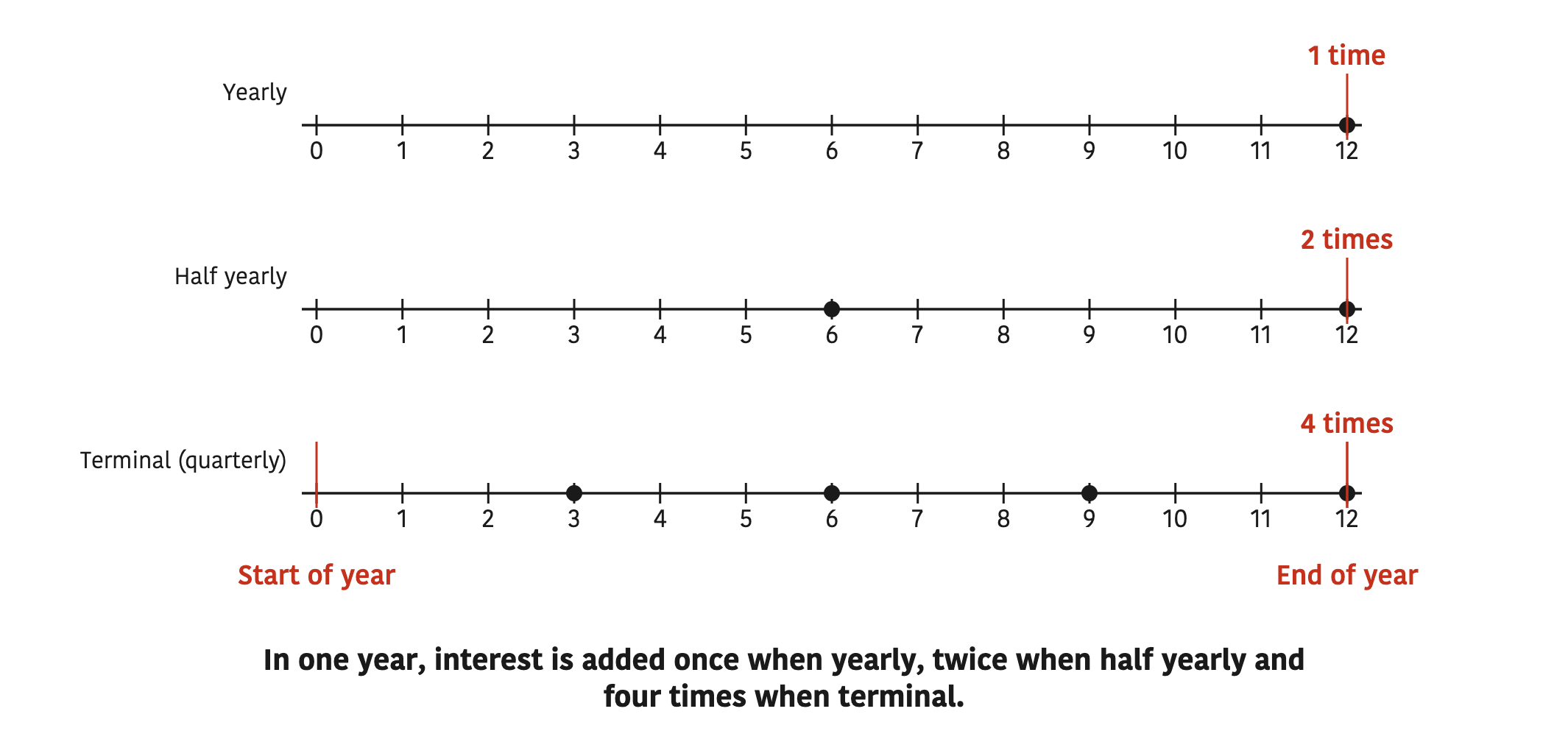
Worked example: Find the compound amount and compound interest on Rs 10,000 at 12% per annum for 1 year, compounded terminally. Here \( \frac{R}{4} = 3 \) and \( 4T = 4 \).
Step 1: Putting the values into the formula:
\[ \text{CA} = 10000\left(1 + \frac{12}{400}\right)^{4} \]
Step 2: Simplifying the bracket, since \( 1 + 0.03 = 1.03 \):
\[ \text{CA} = 10000 \times (1.03)^{4} \]
Step 3: Since \( (1.03)^{2} = 1.0609 \), squaring again gives \( (1.03)^{4} = 1.12550881 \). Multiplying:
\[ \text{CA} = 10000 \times 1.12550881 \approx 11255.09 \]
Step 4: Subtracting the principal gives the compound interest:
\[ \text{CI} = 11255.09 - 10000 = 1255.09 \]
So the compound amount is about Rs 11,255.09 and the compound interest is about Rs 1,255.09. With yearly compounding the same sum would have earned only Rs 1,200.
Choosing the Best Option: Yearly, Half Yearly or Terminal
Suppose your uncle plans to invest Rs 1,00,000 for one year at 15% compound interest per annum. He has three choices and wants the one that brings him the most benefit.
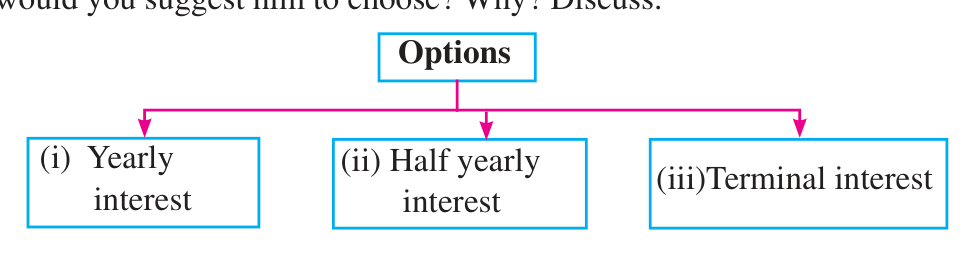
Here the principal P = Rs 1,00,000, the rate R = 15% and the time T = 1 year. For the first option, yearly interest:
\[ \text{CI} = 1{,}00{,}000\left[\left(1 + \frac{15}{100}\right)^{1} - 1\right] \]
\[ = 1{,}00{,}000 \times 0.15 = 15000 \]
For the second option, half yearly interest, the rate per period is \( \frac{15}{200} \) and there are \( 2 \times 1 = 2 \) periods:
\[ \text{CI} = 1{,}00{,}000\left[\left(1 + \frac{15}{200}\right)^{2} - 1\right] \]
Since \( (1.075)^{2} = 1.155625 \):
\[ \begin{aligned} \text{CI} &= 1{,}00{,}000 \times 0.155625 \\ &= 15562.50 \end{aligned} \]
For the third option, terminal interest, the rate per period is \( \frac{15}{400} \) and there are \( 4 \times 1 = 4 \) periods:
\[ \text{CI} = 1{,}00{,}000\left[\left(1 + \frac{15}{400}\right)^{4} - 1\right] \]
Since \( (1.0375)^{4} \approx 1.1586504 \):
\[ \begin{aligned} \text{CI} &\approx 1{,}00{,}000 \times 0.1586504 \\ &\approx 15865.04 \end{aligned} \]
| Option | Times interest is added in the year | Compound interest |
| (i) Yearly | 1 | Rs 15,000 |
| (ii) Half yearly | 2 | Rs 15,562.50 |
| (iii) Terminal | 4 | Rs 15,865.04 |
Your uncle should be advised to choose the third option, terminal interest, because it earns the most. It gives Rs 865.04 more than yearly interest and Rs 302.54 more than half yearly interest. Half yearly interest itself gives Rs 562.50 more than yearly interest.
For the same sum, the same rate and the same time, terminal compound interest is more than half yearly compound interest, and half yearly compound interest is more than yearly compound interest. The more often interest is added, the more it earns.
The Four Formulas Side by Side
One idea runs through all four cases: multiply the principal by the growth factor of each period. The only things that change are what the factor is and how many times it is used.
| Situation | Growth factor | How many times |
| Yearly, same rate | \( 1 + \frac{R}{100} \) | T times |
| Different rate each year | \( 1 + \frac{R_1}{100} \), \( 1 + \frac{R_2}{100} \), ... | once for each year |
| T years M months | \( 1 + \frac{R}{100} \), then \( 1 + \frac{MR}{1200} \) | T times, then once |
| Half yearly | \( 1 + \frac{R}{200} \) | 2T times |
| Terminal | \( 1 + \frac{R}{400} \) | 4T times |
In every case, once the compound amount is known, the compound interest follows from \( \text{CI} = \text{CA} - P \).
The full lesson is waiting for you
The notes are free to read in full. A free account opens the rest of the practice, and tracks your progress and confidence score for every subject. Presentations and videos need approval from Learn Yeti.