What a cyclic quadrilateral is
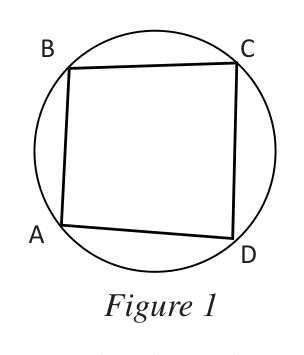
Draw a circle and mark any four points on it. Join them in order, going round the circle, and you get a quadrilateral whose four corners all sit on the circle. This kind of quadrilateral has its own name, and its angles obey a rule that an ordinary quadrilateral does not. A square drawn inside a circle with all four corners touching the circle is one example. A parallelogram that is not a rectangle can never be drawn this way. Wherever you place the circle, at least one corner stays off it.
Cyclic quadrilateral: a quadrilateral whose four vertices all lie on the circumference of one circle.
Concyclic points: points that all lie on one circle. The four vertices of a cyclic quadrilateral are concyclic.
Opposite angles of a quadrilateral: two angles that do not share a side. In ABCD, \( \angle A \) and \( \angle C \) are one opposite pair, and \( \angle B \) and \( \angle D \) are the other.
Angle facts the proofs lean on
Every result in this part is built from a few facts about angles in a circle. An angle with its vertex at the centre is a central angle. An angle with its vertex on the circumference and both arms as chords is an inscribed angle, also called a circumference angle. Each kind of angle stands on an arc: the arc lying between its two arms.
- A central angle is twice the inscribed angle standing on the same arc.
- Inscribed angles standing on the same arc are equal.
- An inscribed angle standing on a diameter is \( 90^\circ \).
- Angles round a point add up to \( 360^\circ \), and angles on a straight line add up to \( 180^\circ \).
- The angles of a triangle add up to \( 180^\circ \). A triangle with two radii as sides is isosceles, so its base angles are equal.
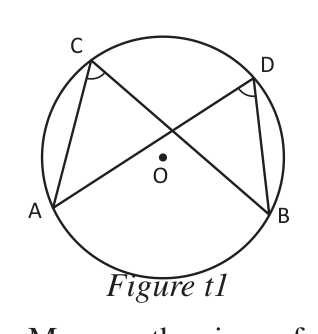
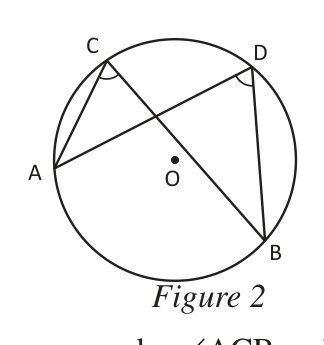
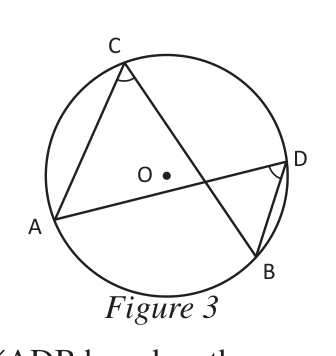
The second fact comes up again and again below. In each of these circles, \( \angle ACB \) and \( \angle ADB \) both stand on arc AB. However C and D move round the circle, as long as they stay on the same side of AB, the two angles stay equal.
Checking by measurement
Before proving anything, it helps to see the rule with your own protractor. Draw three circles of different radii and draw a cyclic quadrilateral ABCD in each. Make the three look different: one nearly square, one tilted, and one shaped like a trapezium with a long side.
- Draw three circles with different radii.
- In each circle mark four points A, B, C and D on the circumference and join them in order to make the cyclic quadrilateral ABCD.
- Measure \( \angle DAB \), \( \angle ABC \), \( \angle BCD \) and \( \angle ADC \) with a protractor.
- Add each opposite pair: \( \angle DAB + \angle BCD \) and \( \angle ABC + \angle ADC \).
- Record the results in a table and write a conclusion.
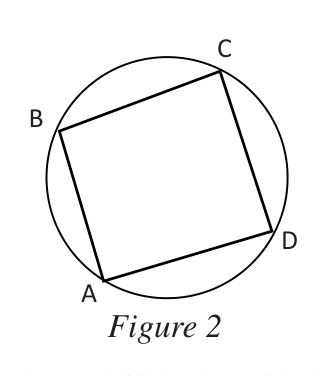
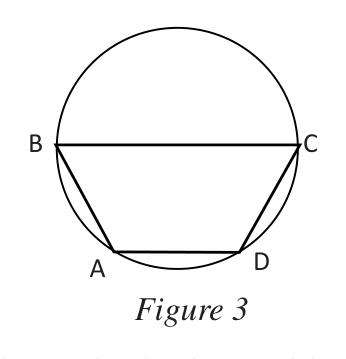
Write the four angles of each figure and the sums of the opposite pairs in a table like this.
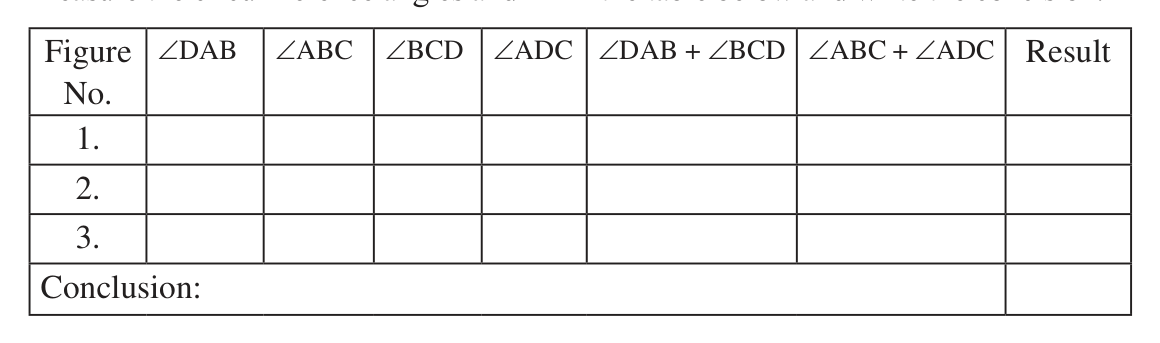
Here is one sample set of readings taken from three such drawings:
| Figure | ∠DAB | ∠ABC | ∠BCD | ∠ADC | ∠DAB + ∠BCD | ∠ABC + ∠ADC |
| 1 | 88° | 91° | 92° | 89° | 180° | 180° |
| 2 | 97° | 84° | 83° | 96° | 180° | 180° |
| 3 | 118° | 61° | 63° | 117° | 181° | 178° |
In the first two figures, both opposite pairs add up to exactly 180°. In the third, they come to 181° and 178°. A protractor reading can be a degree or so out. The four angles of the third figure also came to 359° instead of 360°, which shows that the error is in the measuring and not in the rule.
Conclusion: in every cyclic quadrilateral we drew, \( \angle DAB + \angle BCD = 180^\circ \) and \( \angle ABC + \angle ADC = 180^\circ \).
Measuring shows the rule only for the drawings in front of us. A proof shows it for every cyclic quadrilateral that could ever be drawn.
Theorem 3: opposite angles are supplementary
Supplementary angles: two angles whose sum is \( 180^\circ \).
Theorem 3: The opposite angles of a cyclic quadrilateral are supplementary.
- Given: O is the centre of a circle and ABCD is a cyclic quadrilateral.
- To prove: \( \angle ABC + \angle ADC = 180^\circ \) and \( \angle BCD + \angle BAD = 180^\circ \)
- Construction: join the centre O to A and to C.
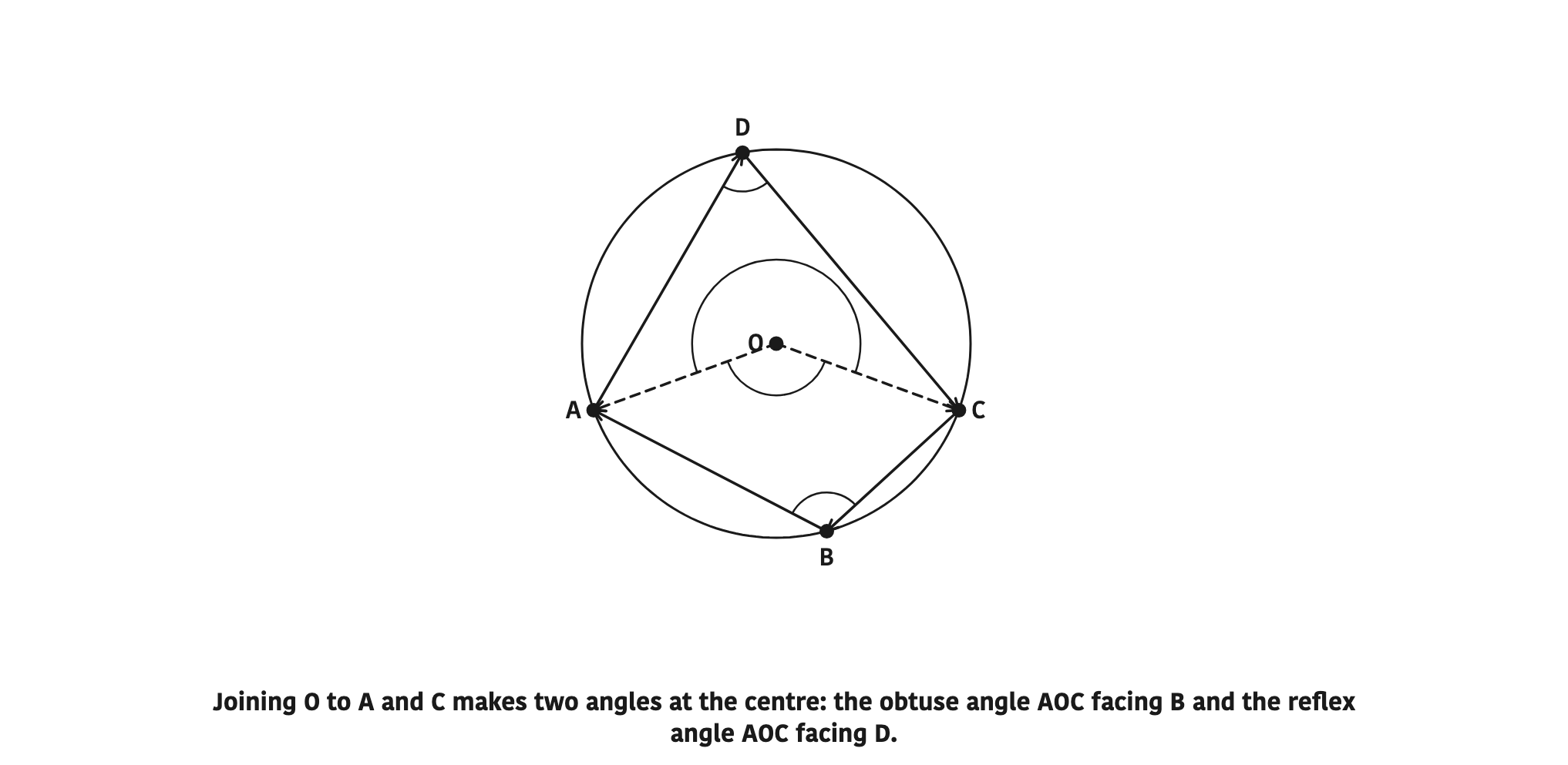
The idea is simple. OA and OC split the full turn at O into two central angles. The smaller one, the obtuse angle AOC, stands on arc ABC, the arc through B. The inscribed angle on that arc is the angle at D. The larger one, the reflex angle AOC, stands on arc ADC, and its inscribed angle is the angle at B. Each central angle is twice its inscribed angle, and the two central angles together make a full turn.
| Statements | Reasons |
| 1. Obtuse \( \angle AOC = 2\angle ADC \) | Central angle and inscribed angle on the same arc ABC |
| 2. Reflex \( \angle AOC = 2\angle ABC \) | Central angle and inscribed angle on the same arc ADC |
| 3. \( 2\angle ADC + 2\angle ABC = 360^\circ \) | Adding 1 and 2; angles round the point O add up to \( 360^\circ \) |
| 4. \( \angle ADC + \angle ABC = 180^\circ \) | Dividing both sides of 3 by 2 |
| 5. \( \angle DAB + \angle DCB = 180^\circ \) | In the same way, joining O to B and D |
Here is the algebra that takes statement 3 to statement 4. First, taking out the common factor 2:
\[ 2(\angle ADC + \angle ABC) = 360^\circ \]
Then dividing both sides by 2:
\[ \angle ADC + \angle ABC = \frac{360^\circ}{2} = 180^\circ \]
For the other pair, join O to B and D instead. Of the two angles BOD at the centre, one stands on the arc through A and the other on the arc through C. Their inscribed angles are \( \angle BCD \) and \( \angle BAD \), and the same three moves give \( \angle BAD + \angle BCD = 180^\circ \).
The theorem pairs OPPOSITE angles only. Two neighbouring angles, such as \( \angle A \) and \( \angle B \), need not add up to \( 180^\circ \). All four vertices must be on the circle, too. If one vertex is the centre O, the shape is not a cyclic quadrilateral and the rule does not apply.
Example 1: a reflex central angle
P, Q and R are points on a circle with centre O, and \( \angle PQR = 100^\circ \). Find \( \angle OPR \).
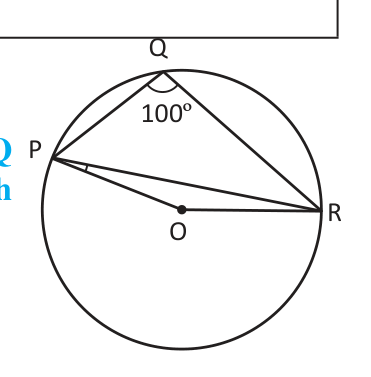
Step 1: The central angle on the arc that \( \angle PQR \) stands on is the reflex angle POR, and it is twice the inscribed angle:
\[ \text{reflex } \angle POR = 2 \times 100^\circ = 200^\circ \]
Step 2: The two angles POR at O add up to \( 360^\circ \), so subtracting the reflex one gives the obtuse angle:
\[ \text{obtuse } \angle POR = 360^\circ - 200^\circ = 160^\circ \]
Step 3: OP and OR are radii, so triangle POR is isosceles and \( \angle OPR = \angle ORP \). Using the angle sum of the triangle:
\[ 2\angle OPR + 160^\circ = 180^\circ \]
Step 4: Subtracting \( 160^\circ \) and dividing by 2:
\[ \angle OPR = \frac{20^\circ}{2} = 10^\circ \]
Example 2: angles on the same arc
A, B, C and D lie on a circle. \( \angle ABC = 74^\circ \) and \( \angle ACB = 30^\circ \). Find \( \angle BDC \).
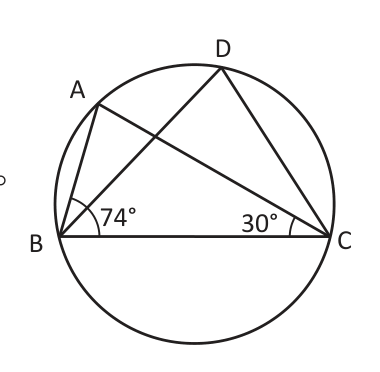
Step 1: The angles of triangle ABC add up to \( 180^\circ \):
\[ 74^\circ + 30^\circ + \angle BAC = 180^\circ \]
Step 2: Subtracting \( 104^\circ \) from both sides:
\[ \angle BAC = 180^\circ - 104^\circ = 76^\circ \]
Step 3: \( \angle BDC \) and \( \angle BAC \) are inscribed angles on the same arc BC, so they are equal:
\[ \angle BDC = \angle BAC = 76^\circ \]
Example 3: chords crossing inside the circle
A, B, C and D are points on a circle. Chords AC and BD cross at E. \( \angle BEC = 130^\circ \) and \( \angle ECD = 20^\circ \). Find \( \angle BAC \).
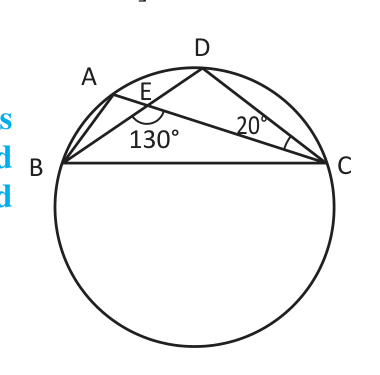
Step 1: B, E and D lie on one straight line, so \( \angle BEC + \angle CED = 180^\circ \):
\[ \angle CED = 180^\circ - 130^\circ = 50^\circ \]
Step 2: Using the angle sum of triangle EDC:
\[ \angle EDC = 180^\circ - 50^\circ - 20^\circ = 110^\circ \]
Step 3: \( \angle BAC \) and \( \angle BDC \), which is \( \angle EDC \), stand on the same arc BC:
\[ \angle BAC = 110^\circ \]
A check: \( \angle BEC \) is an exterior angle of triangle EDC, so it must equal the sum of the two interior opposite angles. \( 110^\circ + 20^\circ = 130^\circ \), and it does.
Example 4: diagonals of a cyclic quadrilateral
In a cyclic quadrilateral ABCD, the diagonals AC and BD meet at E. \( \angle DBC = 70^\circ \) and \( \angle BAC = 30^\circ \). Find \( \angle BCD \). If also AB = BC, find \( \angle ECD \).
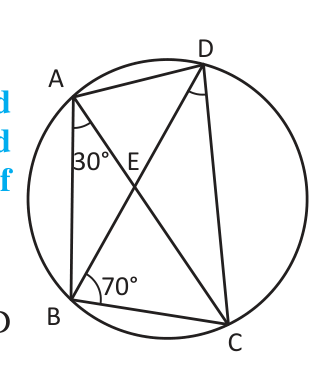
Step 1: \( \angle DAC \) and \( \angle DBC \) stand on the same arc CD:
\[ \angle DAC = \angle DBC = 70^\circ \]
Step 2: The whole angle at A is the sum of its two parts (whole part axiom):
\[ \angle DAB = 70^\circ + 30^\circ = 100^\circ \]
Step 3: \( \angle BCD \) and \( \angle DAB \) are opposite angles of the cyclic quadrilateral, so they are supplementary (Theorem 3):
\[ \angle BCD = 180^\circ - 100^\circ = 80^\circ \]
Step 4: AB = BC, so triangle ABC is isosceles and the angles opposite the equal sides are equal:
\[ \angle BCA = \angle BAC = 30^\circ \]
Step 5: The angle at C is made of \( \angle BCA \) and \( \angle ACD \). E lies on AC, so \( \angle ECD \) is the same angle as \( \angle ACD \):
\[ \angle ECD = 80^\circ - 30^\circ = 50^\circ \]
Example 5: the exterior angle
ABCD is a cyclic quadrilateral in a circle with centre O. The side AB is produced to a point E. Prove that \( \angle ADC = \angle CBE \).
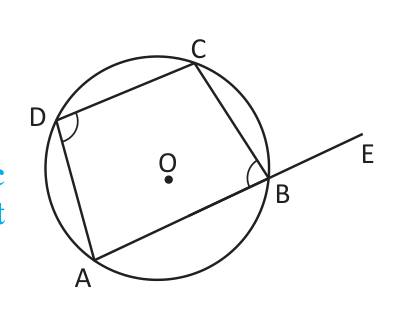
| Statements | Reasons |
| 1. \( \angle ADC + \angle ABC = 180^\circ \) | Opposite angles of a cyclic quadrilateral (Theorem 3) |
| 2. \( \angle ABC + \angle CBE = 180^\circ \) | A, B and E lie on a straight line |
| 3. \( \angle ADC + \angle ABC = \angle ABC + \angle CBE \) | From 1 and 2, both sums are \( 180^\circ \) |
| 4. \( \angle ADC = \angle CBE \) | Taking \( \angle ABC \) from both sides |
Exterior angle of a cyclic quadrilateral: the angle between one side and the next side produced. Here \( \angle CBE \) is the exterior angle at B, and \( \angle ADC \) is its interior opposite angle.
An exterior angle of a cyclic quadrilateral equals the interior opposite angle.
Using the theorem the other way round
Theorem 3 starts from a circle and ends with two angles adding up to 180°. The reverse is also true: if one pair of opposite angles of a quadrilateral adds up to 180°, a circle can be drawn through all four vertices. To prove that four points are concyclic, it is enough to show that one pair of opposite angles is supplementary, or that an exterior angle equals the interior opposite angle.
Converse of Theorem 3: if a pair of opposite angles of a quadrilateral is supplementary, the quadrilateral is cyclic.
For example, a quadrilateral with angles 80°, 95°, 100° and 85° in order is cyclic, because 80° + 100° = 180°. A parallelogram with angles 70°, 110°, 70° and 110° is not, because its opposite angles are equal and 70° + 70° is only 140°. A parallelogram is cyclic only when it is a rectangle.
Choosing the right fact
Most circle problems are solved the moment you spot which arc each angle stands on. Read the figure first and ask what each marked angle stands on.
| What you see in the figure | Fact to use |
| An angle at the centre and one at the circumference on the same arc | Central angle = 2 × inscribed angle |
| Two angles at the circumference on the same arc | They are equal |
| An angle at the circumference standing on a diameter | It is 90° |
| A quadrilateral with all four corners on the circle | Opposite angles add up to 180° |
| A side of a cyclic quadrilateral produced | Exterior angle = interior opposite angle |
| A triangle with two radii as sides | Isosceles; base angles equal |
When an inscribed angle is more than 90°, the central angle on its arc is more than 180°, so it is reflex. Doubling 100° gives the reflex angle of 200°, not the 160° angle you see inside the triangle. Always check which of the two angles at the centre faces the arc you are using.
The full lesson is waiting for you
The notes are free to read in full. A free account opens the rest of the practice, and tracks your progress and confidence score for every subject. Presentations and videos need approval from Learn Yeti.