Central Angles, Inscribed Angles and Their Arcs
Every angle in this topic sits inside a circle, so begin by naming the two kinds that matter. Join the centre O to two points A and B on the circle and you get \( \angle AOB \). Its vertex is at the centre, so it is called a central angle. Now take a third point C on the circle and join it to A and to B. The angle \( \angle ACB \) has its vertex on the circle itself, so it is called an inscribed angle. You will also hear it called an angle at the circumference or a circumference angle. All three names mean the same thing.
Central angle: an angle whose vertex is at the centre of a circle and whose two arms are radii.
Inscribed angle: an angle whose vertex lies on the circumference of a circle and whose two arms are chords.
Arc an angle stands on: the part of the circle cut off between the two arms of the angle, on the side away from the vertex. Both \( \angle AOB \) and \( \angle ACB \) above stand on arc AB.
A central angle and the arc it cuts off are measured in the same degrees. A straight angle at the centre cuts off half the circle. A right angle at the centre cuts off a quarter of it. A smaller angle cuts off a smaller arc.
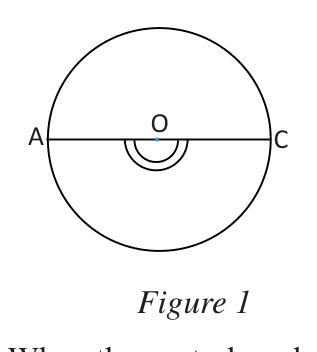
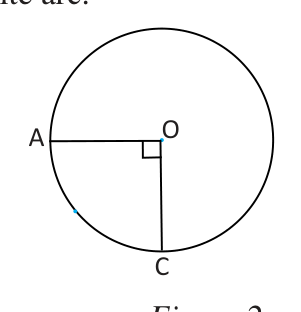
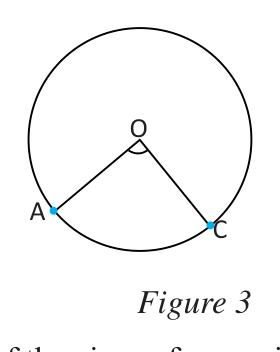
\[ \angle AOC \;\widehat{=}\; \overset{\frown}{AC} \]
An inscribed angle behaves differently. It is only double the inscribed angle that has the same degree measure as the arc opposite it:
\[ 2\angle ACB \;\widehat{=}\; \overset{\frown}{AB} \]
Put these two facts side by side and a guess appears. If the central angle matches the arc and the inscribed angle is half the arc, then the central angle should be twice the inscribed angle standing on the same arc. That guess can be tested three ways: by folding paper, by measuring with a protractor, and by a proof.
The Central Angle Is Double: Seeing It with Paper
Draw a circle with centre O on chart paper. Mark A, B and C on the circle and draw the central angle \( \angle AOB \) and the inscribed angle \( \angle ACB \). Both stand on the same arc AB. Cut out the central angle with scissors along its two radii. Fold it so that OA lies exactly on OB. The crease splits the central angle into two equal halves.
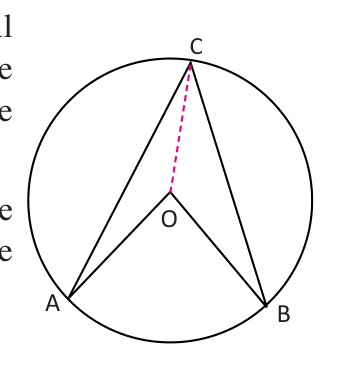
Lay one folded half on the inscribed angle at C and the two fit exactly. Half the central angle equals the inscribed angle, so the whole central angle is twice the inscribed angle.
The central angle is double the inscribed angle standing on the same arc: \( \angle AOB = 2\angle ACB \)
Checking the Relation by Measuring
Folding paper convinces the eye; a protractor gives numbers. Draw three circles with different radii, and place C in a different position in each.
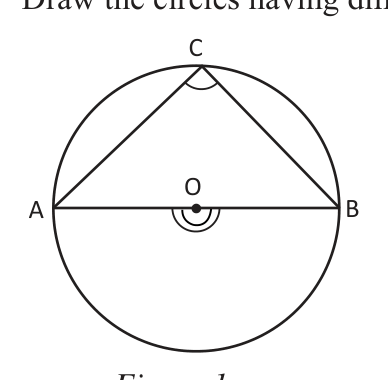
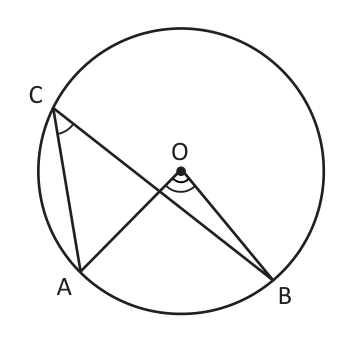
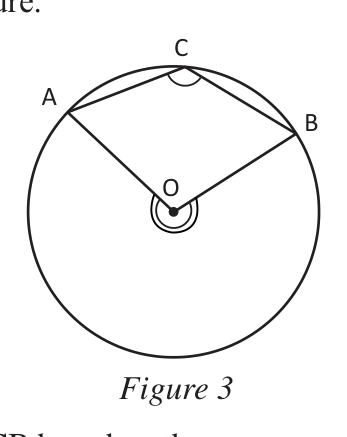
In the first circle AB is a diameter. In the second, the centre O falls outside the arms of angle ACB. In the third, C has moved onto the small arc. Then \( \angle ACB \) looks across at the large arc, and the central angle on that large arc is bigger than \( 180^\circ \). So in that circle it is the reflex angle at O that must be measured.
Reflex angle: an angle greater than \( 180^\circ \) and less than \( 360^\circ \). Reflex \( \angle AOB = 360^\circ - \angle AOB \).
When C is on the minor arc, do not use the ordinary \( \angle AOB \). Take the central angle on the same arc as the inscribed angle, and that is the reflex angle.
Record the readings in a table with one row for each circle and a last row for the conclusion.
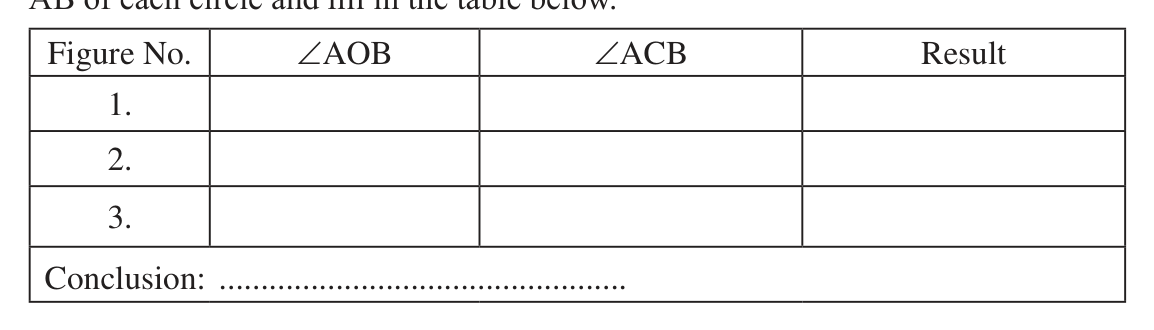
Here is one sample set of readings from circles drawn like these. Your own circles will give different numbers, but the same relation.
| Circle | \( \angle AOB \) | \( \angle ACB \) | Result |
| 1 (AB a diameter) | \( 180^\circ \) | \( 90^\circ \) | \( \angle AOB = 2\angle ACB \) |
| 2 (O outside the angle) | \( 84^\circ \) | \( 42^\circ \) | \( \angle AOB = 2\angle ACB \) |
| 3 (C on the minor arc) | reflex \( 250^\circ \) | \( 125^\circ \) | \( \angle AOB = 2\angle ACB \) |
In all three circles the central angle comes out exactly twice the inscribed angle. That is the conclusion.
Theorem 1: The Proof
Theorem 1: The central angle is double the inscribed angle based on the same arc.
Measuring shows the result for a few circles. A proof shows it must hold in every circle.
Given: O is the centre of the circle. The central angle \( \angle AOB \) and the inscribed angle \( \angle ACB \) stand on the same arc AB.
To prove: \( \angle AOB = 2\angle ACB \)
Construction: Join C and O, and produce CO to the point D.
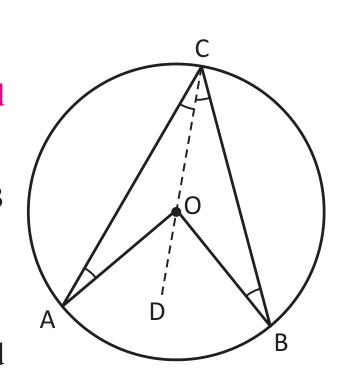
The idea behind the proof is simple. OA, OB and OC are all radii, so triangles AOC and BOC are both isosceles. An exterior angle of a triangle equals the sum of the two opposite interior angles. Together these two facts show that on each side of the line OD, the angle at the centre is double the angle at C.
| S.N. | Statement | Reason |
| 1 (i) | In \( \triangle AOC \), \( \angle OAC = \angle OCA \) | \( OA = OC \) (radii of the same circle), so these are the base angles of an isosceles triangle |
| 1 (ii) | \( \angle AOD = \angle OAC + \angle OCA \) | An exterior angle of \( \triangle AOC \) equals the sum of its opposite interior angles |
| 1 (iii) | \( \angle AOD = 2\angle OCA \) | From statements 1 (i) and 1 (ii) |
| 2 | In \( \triangle BOC \), \( \angle BOD = 2\angle OCB \) | By the same facts and reasons as statement 1 |
| 3 | \( \angle AOD + \angle BOD \) \( = 2\angle OCA + 2\angle OCB \) | Adding statements 1 (iii) and 2 |
| 4 | \( \therefore \angle AOB = 2\angle ACB \) | From statement 3, by the whole part axiom |
The whole part axiom is used in the last step because \( \angle AOD \) and \( \angle BOD \) together make the whole \( \angle AOB \), and \( \angle OCA \) and \( \angle OCB \) together make the whole \( \angle ACB \). Conclusion: the central angle is double the inscribed angle on the same arc. Put the other way round, the inscribed angle is half the central angle on the same arc.
Worked Examples on Theorem 1
Example 1: O is the centre of a circle. A, B and C lie on the circle, with C on the major arc, and \( \angle AOB = 130^\circ \). Find \( \angle ACB \).
Step 1: Both angles stand on the same arc AB, so Theorem 1 gives:
\[ \angle AOB = 2\angle ACB \]
Step 2: Putting in the value of the central angle:
\[ 130^\circ = 2\angle ACB \]
Step 3: Dividing both sides by 2:
\[ \angle ACB = 65^\circ \]
Example 2: The inscribed angle \( \angle ACB = 48^\circ \) stands on arc AB. Find the central angle \( \angle AOB \) on the same arc.
Step 1: The central angle is twice the inscribed angle, so putting in the value:
\[ \angle AOB = 2 \times 48^\circ \]
Step 2: Multiplying:
\[ \angle AOB = 96^\circ \]
Example 3: In a circle with centre O, \( \angle AOB = 100^\circ \) and C is a point on the minor arc AB. Find \( \angle ACB \).
Step 1: C is on the minor arc, so \( \angle ACB \) stands on the major arc. The central angle on that arc is the reflex angle, found by subtracting from \( 360^\circ \):
\[ \text{Reflex } \angle AOB = 360^\circ - 100^\circ = 260^\circ \]
Step 2: Applying Theorem 1 with the reflex angle:
\[ 2\angle ACB = 260^\circ \]
Step 3: Dividing by 2:
\[ \angle ACB = 130^\circ \]
Example 4: In a circle with centre O, chord AB is drawn and \( \angle OAB = 20^\circ \). C is on the major arc. Find \( \angle AOB \) and \( \angle ACB \).
Step 1: OA and OB are radii, so triangle OAB is isosceles and its base angles are equal:
\[ \angle OBA = \angle OAB = 20^\circ \]
Step 2: The angles of triangle OAB add up to \( 180^\circ \), so the central angle is:
\[ \angle AOB = 180^\circ - 20^\circ - 20^\circ = 140^\circ \]
Step 3: The inscribed angle is half the central angle on the same arc:
\[ \angle ACB = \frac{1}{2} \times 140^\circ = 70^\circ \]
The Angle in a Semicircle
Now let AB be a diameter of the circle. The central angle \( \angle AOB \) is then a straight angle, and an angle \( \angle ACB \) made at any point C on the circle stands on half the circle. Such an angle is called an angle in a semicircle. Draw three circles with different radii, put C in a different place each time, and measure \( \angle ACB \).
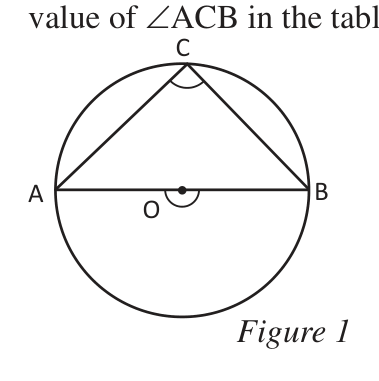
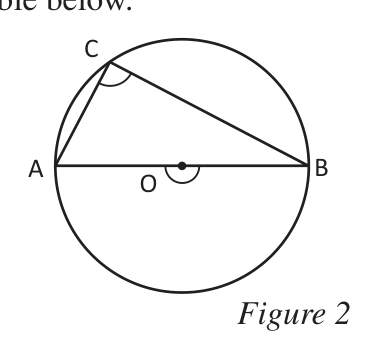
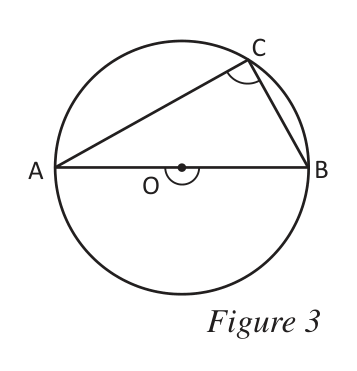
The triangle changes shape each time, but the angle at C reads \( 90^\circ \) every time. Record the readings in a table.
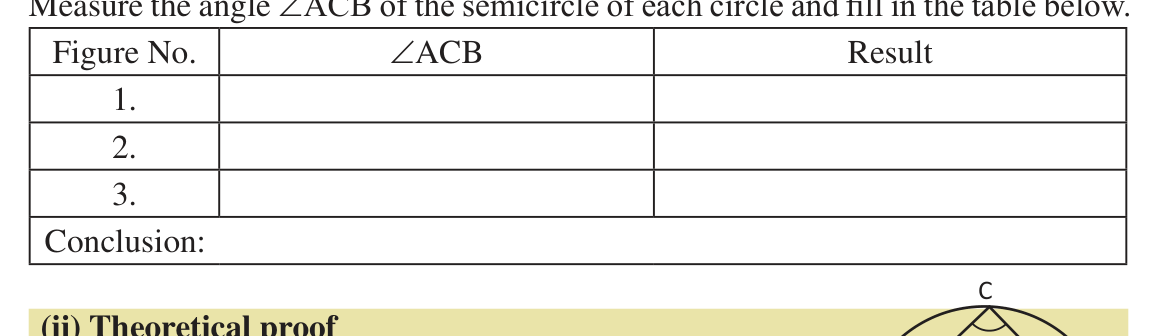
Angle in a semicircle: an inscribed angle whose arms pass through the two ends of a diameter.
This result follows straight from Theorem 1. Given: O is the centre of a circle in which AOB is a diameter, and \( \angle ACB \) is an angle at the circumference standing on the diameter. To prove: \( \angle ACB = 90^\circ \)
| S.N. | Statement | Reason |
| 1 | \( \angle ACB = \frac{1}{2}\angle AOB \) | An inscribed angle is half the central angle standing on the same arc |
| 2 | \( \angle AOB = 180^\circ \) | \( \angle AOB \) is a straight angle |
| 3 | \( \angle ACB = \frac{1}{2} \times 180^\circ = 90^\circ \) | From statements 1 and 2 |
An angle in a semicircle is a right angle. Join the two ends of a diameter to any point on the circle and the angle there is \( 90^\circ \).
Worked Examples on the Angle in a Semicircle
Example 5: AB is a diameter of a circle and C is a point on the circle. If \( \angle CAB = 35^\circ \), find \( \angle ABC \).
Step 1: \( \angle ACB \) is an angle in a semicircle, so:
\[ \angle ACB = 90^\circ \]
Step 2: The three angles of triangle ABC add up to \( 180^\circ \), so:
\[ \angle ABC = 180^\circ - 90^\circ - 35^\circ \]
Step 3: Subtracting:
\[ \angle ABC = 55^\circ \]
Example 6: AB is a diameter and C is on the circle. If \( \angle CAB = 2x \) and \( \angle CBA = 3x \), find x and both angles.
Step 1: The angle at C is \( 90^\circ \), so the other two angles of the triangle must add up to \( 90^\circ \):
\[ 2x + 3x = 90^\circ \]
Step 2: Collecting like terms:
\[ 5x = 90^\circ \]
Step 3: Dividing both sides by 5:
\[ x = 18^\circ \]
Step 4: Substituting x into the first angle:
\[ \angle CAB = 2 \times 18^\circ = 36^\circ \]
Step 5: Substituting x into the second angle:
\[ \angle CBA = 3 \times 18^\circ = 54^\circ \]
Check: \( 36^\circ + 54^\circ + 90^\circ = 180^\circ \), so the answer is right.
Theorem 2: Inscribed Angles on the Same Arc
Now take two inscribed angles standing on the same arc AB: \( \angle ACB \) at C and \( \angle ADB \) at D. Draw both on chart paper, cut one out with scissors and lay it on the other.
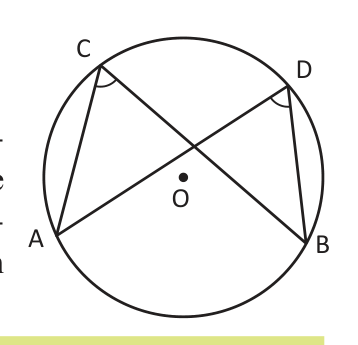
The cut angle fits exactly. Measure the same pair in three circles of different radii, with C and D moved to different places on the same arc, and the protractor gives two equal readings every time.
Theorem 2: The angles on the circumference of a circle based on the same arc are equal.
Given: O is the centre of a circle in which the inscribed angles \( \angle ACB \) and \( \angle ADB \) stand on the same arc AB.
To prove: \( \angle ACB = \angle ADB \)
Construction: Join the centre O to the points A and B. Mark a point P on the arc on the far side from C and D, so the arc can be named APB.
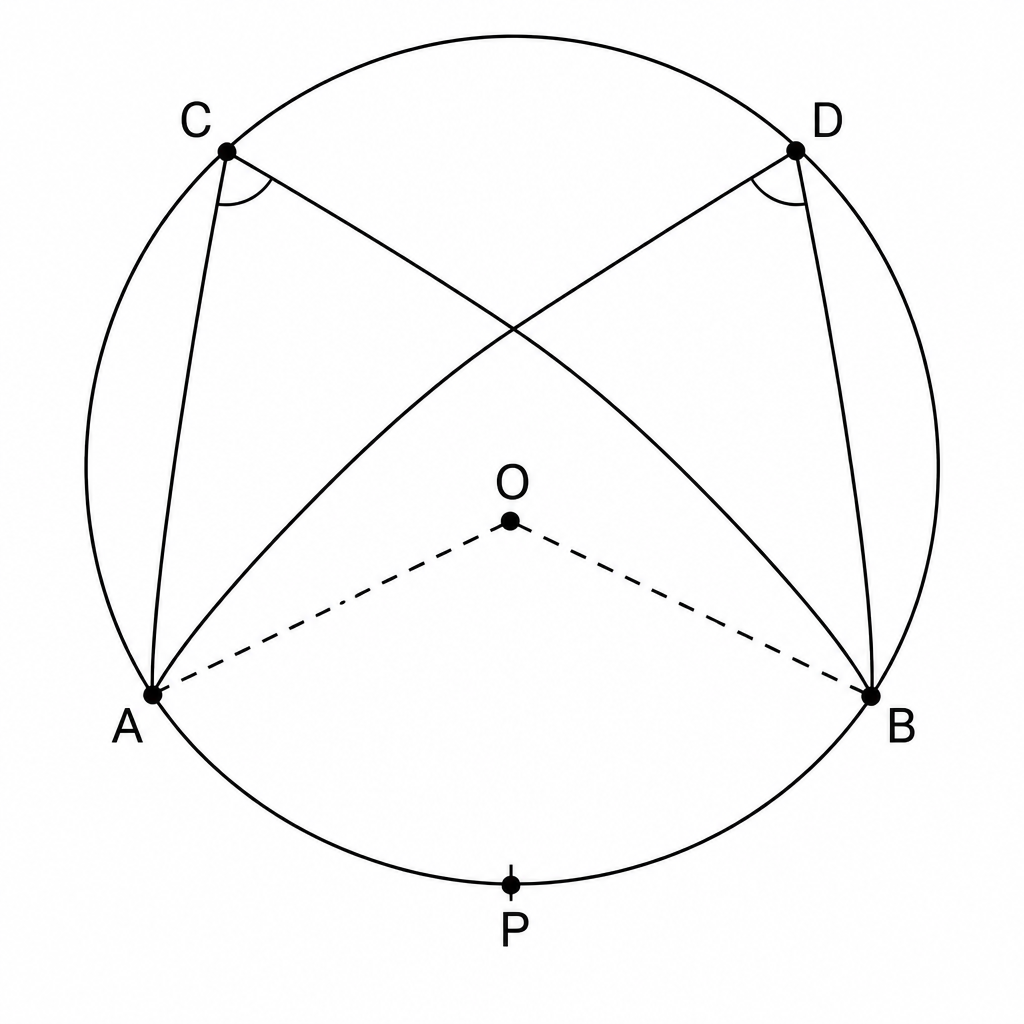
The key to the proof is that both inscribed angles are half of the same central angle, and halves of the same thing are equal.
| S.N. | Statement | Reason |
| 1 | \( \angle AOB = 2\angle ACB \) | The central angle and the inscribed angle stand on the same arc APB |
| 2 | \( \angle AOB = 2\angle ADB \) | The central angle and the inscribed angle stand on the same arc APB |
| 3 | \( 2\angle ACB = 2\angle ADB \), so \( \angle ACB = \angle ADB \) | From statements 1 and 2 |
Conclusion: the angles on the circumference of a circle standing on the same arc are equal.
C and D must be on the same side of chord AB. If D crosses to the other side, \( \angle ADB \) stands on the other arc and is no longer equal to \( \angle ACB \).
Worked Examples on Theorem 2
Example 7: Two inscribed angles on the same arc AB are \( \angle ACB = (3x - 10)^\circ \) and \( \angle ADB = (2x + 15)^\circ \). Find x and the size of each angle.
Step 1: By Theorem 2 the two angles are equal, which gives the equation:
\[ 3x - 10 = 2x + 15 \]
Step 2: Moving 2x to the left and 10 to the right:
\[ x = 25 \]
Step 3: Substituting x to find the angle:
\[ \angle ACB = (3 \times 25 - 10)^\circ = 65^\circ \]
Check: \( (2 \times 25 + 15)^\circ = 65^\circ \), so \( \angle ADB \) is \( 65^\circ \) as well.
Example 8: In a circle with centre O, \( \angle AOB = 120^\circ \). C and D both lie on the major arc. Find \( \angle ACB \) and \( \angle ADB \).
Step 1: By Theorem 1 the inscribed angle is half the central angle:
\[ \angle ACB = \frac{1}{2} \times 120^\circ = 60^\circ \]
Step 2: D is on the same arc, so by Theorem 2:
\[ \angle ADB = \angle ACB = 60^\circ \]
The Three Results Together
All three results grow from one root. Theorem 1 comes first. The angle in a semicircle is Theorem 1 with the central angle set to \( 180^\circ \). Theorem 2 is Theorem 1 used twice on the same central angle.
| Result | In symbols | When it applies |
| Theorem 1 | \( \angle AOB = 2\angle ACB \) | Both angles stand on the same arc AB |
| Angle in a semicircle | \( \angle ACB = 90^\circ \) | AB is a diameter |
| Theorem 2 | \( \angle ACB = \angle ADB \) | Both inscribed angles stand on the same arc AB |
When you meet an angle in a circle problem, first ask which arc it stands on. If you can find the central angle or another inscribed angle on that same arc, these results apply.
The full lesson is waiting for you
The notes are free to read in full. A free account opens the rest of the practice, and tracks your progress and confidence score for every subject. Presentations and videos need approval from Learn Yeti.