Chords and the Centre of a Circle
Every point on a circle is the same distance from one fixed point, the centre, which we usually name O. That distance is the radius. A line segment joining two points on the circle is a chord, and the longest chord, the one that passes through O, is the diameter. The centre and a chord are tied together by three facts. You can check each of them yourself with a compass, a ruler and a set square: draw a circle, draw a chord, and measure. Everything else in this topic is built on these facts.
- (a) The perpendicular drawn from the centre of a circle to a chord bisects the chord.
- (b) The line joining the centre of a circle to the midpoint of a chord is perpendicular to the chord.
- (c) Chords which are equidistant from the centre of a circle are equal.
Fact (a) has a short reason behind it. Suppose OM is perpendicular to chord AB, and join OA and OB. Both are radii, so OA = OB. The right triangles OMA and OMB share the side OM and have equal hypotenuses, so they are congruent by the RHS condition. Corresponding sides of congruent triangles are equal, so AM = MB, which means M is the midpoint of AB. Fact (b) is proved by the same argument run the other way. In fact (c), equal distances from the centre give equal half chords, so the whole chords are equal too.
Worked example. A circle has radius 5 cm. A chord AB lies at a perpendicular distance of 3 cm from the centre, so OM = 3 cm, where M is the foot of the perpendicular. Find the length of AB.
Step 1: In the right triangle OMA, OA is the hypotenuse. By Pythagoras theorem:
\[ AM^2 = OA^2 - OM^2 \]
Step 2: Substituting OA = 5 cm and OM = 3 cm:
\[ AM^2 = 5^2 - 3^2 = 25 - 9 = 16 \]
Step 3: Taking the square root of both sides:
\[ AM = 4 \text{ cm} \]
Step 4: The perpendicular from the centre bisects the chord, so AB is twice AM:
\[ AB = 2 \times 4 = 8 \text{ cm} \]
The same working also shows fact (c) at work: any other chord of this circle that lies 3 cm from the centre is also exactly 8 cm long.
Central Angle
Take a circle with centre O, mark two points A and B on it, and join OA and OB. These two radii make an angle \( \angle AOB \) at the centre. Its vertex sits exactly at the centre of the circle, and both of its arms are radii, so the arms are always equal in length.
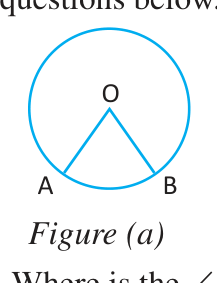
Central angle: the angle formed by two radii at the centre of a circle is called a central angle.
A central angle can have any size. If the two radii lie along one straight line, together they form a diameter and the central angle is 180°. If the radii are perpendicular to each other, the central angle is 90°.
Inscribed Angle
Now mark three points P, Q and R on a circle and draw the chords QP and QR. These two chords meet at Q, a point on the circle, and make the angle \( \angle PQR \). This time the vertex is not at the centre but on the circumference itself, and the arms are chords rather than radii.
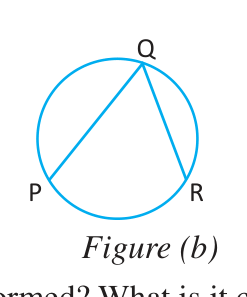
Inscribed angle (circumference angle): the angle formed by joining two chords of a circle at a point on the circumference is called an inscribed angle, or circumference angle.
A central angle and an inscribed angle differ in two things: where the vertex is, and what the arms are. The table sets them side by side.
| Feature | Central angle | Inscribed angle |
| Vertex | At the centre of the circle | On the circumference |
| Arms | Two radii | Two chords |
| Length of arms | Always equal | Not necessarily equal |
| Example | ∠AOB | ∠PQR |
Minor Arc and Major Arc
Any part of the circumference of a circle is called an arc. Two points A and B on a circle split it into two arcs. Unless A and B are the ends of a diameter, one arc is smaller than a semicircle and the other is larger. In the picture below, the short way round from A to B is one arc, and the long way round, passing through P, is the other.
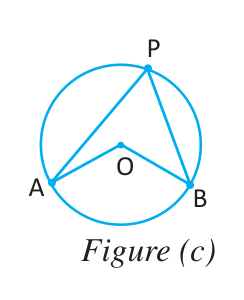
Minor arc: an arc that is smaller than a semicircle is called a minor arc.
Major arc: an arc that is larger than a semicircle is called a major arc.
An arc is written with a small curved mark over its letters. A minor arc is named by its two end points, \( \overset{\frown}{AB} \). A major arc gets a third letter, a point lying on it, so that it cannot be confused with the minor one: \( \overset{\frown}{APB} \). In the picture above, \( \overset{\frown}{APB} \) is a major arc and \( \overset{\frown}{AB} \) is a minor arc. When A and B are the ends of a diameter, both arcs are semicircles and they are equal.
The opposite arc of an angle is the arc cut off between its two arms, on the side away from its vertex. In the picture above, the opposite arc of both ∠AOB and ∠APB is the minor arc AB.
Central Angle and Its Opposite Arc
One full turn about the centre O is 360°. So the whole circumference can be thought of as split into 360 equal parts, and each part is called one degree of arc. This lets us measure an arc in degrees. The whole circle is 360° of arc and a semicircle is 180° of arc.
Degree measure of an arc: the size of an arc expressed in degrees, taking the whole circumference as 360°.
In the three circles below, the central angle gets smaller each time. In the first, AC is a diameter; in the second, OA and OC are perpendicular; in the third, the angle is smaller still. As the angle shrinks, the arc opposite it shrinks in exactly the same proportion.
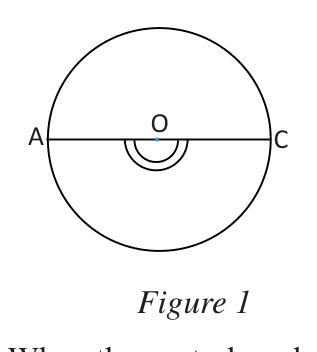
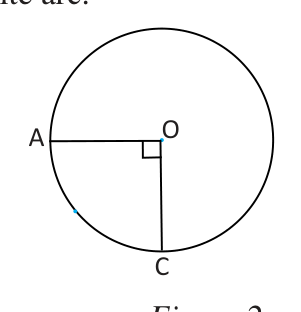
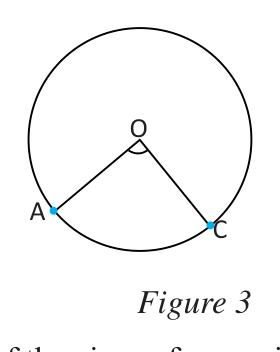
| Central angle | Part of a full turn | Opposite arc | Degree measure of arc |
| 180° | one half | half the circumference (semicircle) | 180° |
| 90° | one quarter | one quarter of the circumference | 90° |
| 60° | one sixth | one sixth of the circumference | 60° |
The table shows that whatever fraction of a full turn the central angle is, its opposite arc is that same fraction of the whole circumference. So there is a direct relationship between a central angle and its opposite arc, and their degree measures are equal:
\[ \angle AOC \overset{\circ}{=} \overset{\frown}{AC} \]
The symbol \( \overset{\circ}{=} \): read as 'equals in degree measure', also read as 'equal influence'. So \( \angle AOC \overset{\circ}{=} \overset{\frown}{AC} \) is read 'angle AOC equals arc AC in degree measure'.
An angle and an arc are different kinds of quantity. An angle measures an amount of turning, while an arc is a piece of the circumference. Do not join them with a plain '=' sign. They match only in degree measure, so write \( \overset{\circ}{=} \).
The minor arc and the major arc cut off by the same two points make up the whole circle between them, so their degree measures always add up to 360°.
Worked Examples: Central Angle and Arc
Example 1: In a circle with centre O, \( \angle AOB = 72^\circ \). Find the degree measure of the minor arc AB, what fraction of the circumference it is, and the degree measure of the major arc.
Step 1: A central angle equals its opposite arc in degree measure, so the minor arc AB is:
\[ \overset{\frown}{AB} \overset{\circ}{=} \angle AOB = 72^\circ \]
Step 2: The whole circumference is 360°, so dividing by 360° gives the fraction:
\[ \frac{72^\circ}{360^\circ} = \frac{1}{5} \]
Step 3: The major arc is what is left of 360° after the minor arc:
\[ 360^\circ - 72^\circ = 288^\circ \]
So the minor arc AB is 72°, it is \( \frac{1}{5} \) of the circumference, and the major arc is 288°.
Example 2: In a circle with centre O, the minor arc PQ is one third of the whole circumference. Find the central angle POQ.
Step 1: The whole circumference is 360°, so the arc PQ in degrees is:
\[ \frac{1}{3} \times 360^\circ = 120^\circ \]
Step 2: A central angle equals its opposite arc in degree measure, so:
\[ \angle POQ = 120^\circ \]
Inscribed Angle and Its Opposite Arc
The link between a central angle and its arc is direct. For an inscribed angle, the link has to be reasoned out. In a circle with centre O, take the central angle \( \angle AOB \) and the inscribed angle \( \angle ACB \), both standing on the same arc AB. Now join O and C. The line OC splits the figure into two triangles, OAC and OBC.
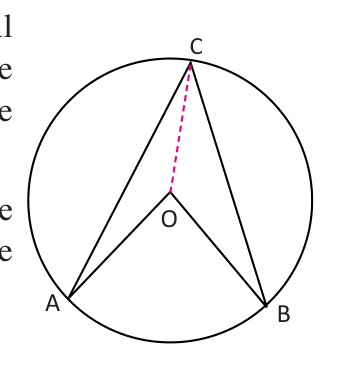
Step 1: OA, OB and OC are radii of the same circle, so:
\[ OA = OB = OC \]
So triangle OAC has OA = OC and triangle OBC has OB = OC. Both are isosceles triangles, and in an isosceles triangle the angles opposite the equal sides are equal. Hence \( \angle OAC = \angle OCA \) and \( \angle OBC = \angle OCB \).
Step 2: The three angles of triangle OAC add up to 180°:
\[ \angle OAC + \angle OCA + \angle AOC = 180^\circ \]
Step 3: Since \( \angle OAC = \angle OCA \), replacing \( \angle OAC \) by \( \angle OCA \) and moving \( \angle AOC \) to the right gives equation (i):
\[ 2\angle OCA = 180^\circ - \angle AOC \quad \text{(i)} \]
Step 4: In the same way, in the isosceles triangle OBC, using \( \angle OBC = \angle OCB \) gives equation (ii):
\[ 2\angle OCB = 180^\circ - \angle BOC \quad \text{(ii)} \]
Step 5: Adding equations (i) and (ii):
\[ \begin{aligned} &2(\angle OCA + \angle OCB) \\ &= 360^\circ - (\angle AOC + \angle BOC) \end{aligned} \]
Step 6: Together, \( \angle OCA \) and \( \angle OCB \) make \( \angle ACB \). Together, \( \angle AOC \) and \( \angle BOC \) make the reflex angle AOB, the angle at O measured round the side where C is. So:
\[ 2\angle ACB = 360^\circ - \text{reflex } \angle AOB \]
Step 7: The reflex angle AOB and \( \angle AOB \) together make a full turn of 360°, so taking the reflex angle away from 360° leaves \( \angle AOB \):
\[ 2\angle ACB = \angle AOB \]
Step 8: The central angle AOB equals its opposite arc AB in degree measure, so:
\[ 2\angle ACB \overset{\circ}{=} \overset{\frown}{AB} \]
Twice an inscribed angle equals its opposite arc in degree measure: \( 2\angle ACB \overset{\circ}{=} \overset{\frown}{AB} \). Put another way, an inscribed angle is half of its opposite arc in degree measure.
Do not write an inscribed angle as equal to its opposite arc. A central angle equals its arc, but for an inscribed angle it is TWICE the angle that equals the arc. If the arc is 80°, the inscribed angle is 40°, not 80°.
Checking the Result with Numbers
The proof above can be tested with real numbers. Suppose that in the same figure \( \angle OCA = 25^\circ \) and \( \angle OCB = 30^\circ \).
Step 1: In the isosceles triangle OAC, \( \angle OAC = \angle OCA = 25^\circ \), so the third angle is:
\[ \angle AOC = 180^\circ - 25^\circ - 25^\circ = 130^\circ \]
Step 2: In the isosceles triangle OBC, \( \angle OBC = \angle OCB = 30^\circ \), so:
\[ \angle BOC = 180^\circ - 30^\circ - 30^\circ = 120^\circ \]
Step 3: Adding these gives the reflex angle AOB, and subtracting from 360° gives \( \angle AOB \):
\[ 130^\circ + 120^\circ = 250^\circ \]
\[ \angle AOB = 360^\circ - 250^\circ = 110^\circ \]
Step 4: The inscribed angle ACB is the sum of its two parts, and doubling it gives:
\[ \angle ACB = 25^\circ + 30^\circ = 55^\circ \]
\[ 2 \times 55^\circ = 110^\circ \]
Twice the inscribed angle is 110°, exactly the size of \( \angle AOB \). So the arc AB is 110° in degree measure and the result holds. Try other values for \( \angle OCA \) and \( \angle OCB \): the two sides always agree.
Worked Examples: Inscribed Angle and Arc
Example 1: An inscribed angle \( \angle ACB = 48^\circ \) stands on the minor arc AB of a circle. Find the degree measures of the minor arc AB and of the major arc.
Step 1: Twice an inscribed angle equals its opposite arc in degree measure, so:
\[ \overset{\frown}{AB} \overset{\circ}{=} 2 \times 48^\circ = 96^\circ \]
Step 2: Subtracting the minor arc from 360° gives the major arc:
\[ 360^\circ - 96^\circ = 264^\circ \]
Example 2: The minor arc PR of a circle measures 140°, and the point Q lies on the major arc. Find the inscribed angle PQR.
Step 1: \( \angle PQR \) is an inscribed angle standing on the minor arc PR, so the relation is:
\[ 2\angle PQR \overset{\circ}{=} 140^\circ \]
Step 2: Dividing both sides by 2:
\[ \angle PQR = 70^\circ \]
These two examples use one rule in two directions. Given the angle, double it to get the arc. Given the arc, halve it to get the angle.
The full lesson is waiting for you
The notes are free to read in full. A free account opens the rest of the practice, and tracks your progress and confidence score for every subject. Presentations and videos need approval from Learn Yeti.