Same base and between the same parallels
In geometry, two figures are often drawn side by side so that they share a side. When one side of each figure is exactly the same line segment, the figures are said to stand on the same base. If that base lies on one straight line, and the side or vertex opposite the base lies on a second line parallel to the first, the figures lie between the same parallel lines. This whole topic is built on these two conditions together.
Figures on the same base and between the same parallels: figures that share one side as their common base, where the base lies on one line and the opposite side or vertex of each figure lies on another line parallel to it.
In the figure below, the line XY is parallel to AB. The parallelogram ABCD and the rectangle ABPQ both use AB as their base, and the top side of each, DC and QP, lies on XY. So the two figures stand on the same base AB and lie between the same parallels AB and XY.
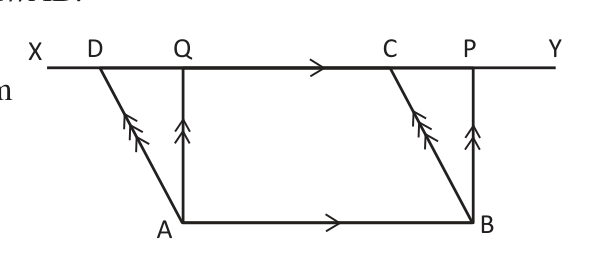
Two parallel lines stay the same distance apart all along their length. The height of a figure standing between them is exactly that distance, so every figure between the same parallels has the same height. In the figure, AQ is perpendicular to both AB and XY. It is the height of the rectangle, and it is also the height of the parallelogram.
Figures that lie between the same parallel lines always have equal heights. That height is the distance between the two lines.
Two area formulas carry this topic. For a triangle with base \( b \) and height \( h \), the area is:
\[ A = \frac{1}{2} \times b \times h \]
For a parallelogram with base \( b \) and height \( h \), the area is:
\[ A = b \times h \]
One more fact about parallelograms is already established, and the proof in this topic rests on it: parallelograms standing on the same base and lying between the same parallels are equal in area. In the figure above, the area of parallelogram ABCD equals the area of rectangle ABPQ, because each of them is \( AB \times AQ \).
A triangle and a parallelogram on one base: measuring first
Before proving anything, it helps to measure one real case. In the figure below, ABCD is a parallelogram with base AB = 8 cm. The point E lies on the line DC, straight above A, so AE is perpendicular to AB and AE = 6 cm. Joining E to B makes the triangle ABE. The triangle and the parallelogram share the base AB, and both lie between the parallel lines AB and EC.
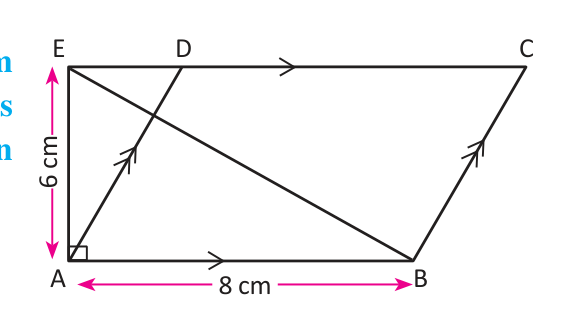
Step 1: Triangle ABE has a right angle at A, so its base is AB = 8 cm and its height is AE = 6 cm. Using half of base times height, its area is:
\[ \frac{1}{2} \times 8 \text{ cm} \times 6 \text{ cm} = 24 \text{ cm}^2 \]
Step 2: Parallelogram ABCD stands on the same base AB = 8 cm. Its height is the distance between AB and EC, which is AE = 6 cm. Multiplying base by height:
\[ 8 \text{ cm} \times 6 \text{ cm} = 48 \text{ cm}^2 \]
Step 3: Comparing the two areas by dividing the triangle's area by the parallelogram's area:
\[ \frac{24 \text{ cm}^2}{48 \text{ cm}^2} = \frac{1}{2} \]
The triangle covers exactly half of the parallelogram. Read the other way round, the parallelogram is twice the triangle: \( 48 = 2 \times 24 \).
Notice where the half comes from. Both shapes have the same base and the same height, so the only difference between their formulas is the factor \( \frac{1}{2} \) in the triangle's formula. The relation therefore does not depend on the numbers 8 and 6. Any triangle and parallelogram that share a base and lie between the same parallels will show it.
The theorem: a triangle is half of a parallelogram
Theorem: The area of a triangle is half of the area of a parallelogram standing on the same base and lying between the same parallels.
For triangle ABE and parallelogram ABCD on the base AB between the parallels AB and EC: area of \( \triangle ABE = \frac{1}{2} \) area of parallelogram ABCD. Written the other way, area of parallelogram ABCD \( = 2 \times \) area of \( \triangle ABE \).
Measuring checks one case only. A proof shows that the result holds for every triangle and parallelogram arranged this way, wherever the third vertex of the triangle sits on the upper line. The proof uses no numbers at all. It needs the fact about parallelograms on the same base, together with one fact about a diagonal.
A diagonal bisects a parallelogram: each diagonal of a parallelogram divides it into two triangles of equal area, so each triangle is half of the parallelogram.
Proof of the theorem
Given: Parallelogram ABCD and triangle ABE stand on the same base AB and lie between the same parallels AB and EC.
To be proved: Area of \( \triangle ABE = \frac{1}{2} \) area of parallelogram ABCD.
Construction: Through B, draw BF parallel to AE, meeting the line EC at F. Now AE // BF and AB // EF, so ABFE is a parallelogram.
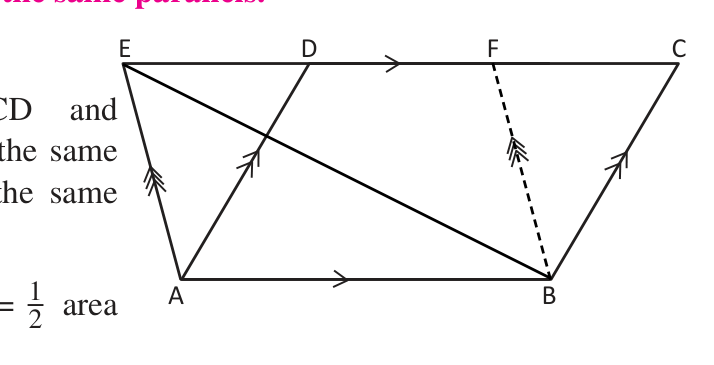
| No. | Statements | Reasons |
| 1 | Area of parallelogram ABFE = area of parallelogram ABCD | Both stand on the same base AB and lie between the same parallels AB and EC. |
| 2 | Area of \( \triangle ABE = \frac{1}{2} \) area of parallelogram ABFE | The diagonal EB bisects parallelogram ABFE. |
| 3 | Area of \( \triangle ABE = \frac{1}{2} \) area of parallelogram ABCD | From statements (1) and (2). |
Hence the area of a triangle is half the area of a parallelogram standing on the same base and lying between the same parallels. Proved.
The construction is the clever part of this proof. Triangle ABE cannot be compared with ABCD straight away, because E is not a corner of ABCD. Drawing BF builds a new parallelogram ABFE in which EB is a diagonal. The triangle is exactly half of ABFE, and ABFE has the same area as ABCD. Half of one of two equal areas is also half of the other.
Reason 2 can be checked quickly. The diagonal EB splits ABFE into the triangles ABE and FEB. In these two triangles AB = FE and AE = FB, since opposite sides of a parallelogram are equal, and EB is common to both. So the triangles are congruent by the S.S.S. condition, and congruent triangles have equal areas.
The reason for statement 1 is never 'they look the same size'. Write the full condition: both stand on the same base AB and lie between the same parallels AB and EC. Leaving out either part makes the reason incomplete.
When can the theorem be used?
Before using the theorem in a problem, check three things about the triangle and the parallelogram:
- They share one side, and that side is the base of both figures.
- The base lies on one line, and the side of the parallelogram opposite the base lies on a second line parallel to it.
- The third vertex of the triangle lies on that second parallel line.
The third check is where students hesitate. The vertex may sit between the ends of the parallelogram's top side, or beyond either end on the same line extended. In the measured case above, E was not between D and C at all. It was on the line DC extended past D, and the triangle was still exactly half. All that matters is that the vertex is on the parallel line, because then the triangle's height is the distance between the lines.
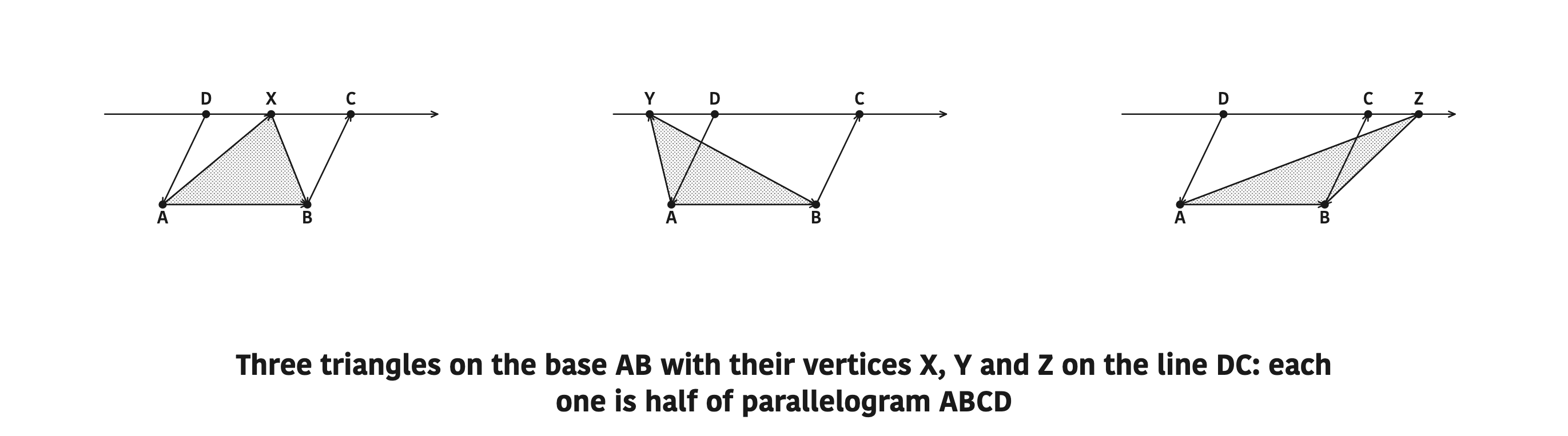
If the third vertex is below the upper line or above it, the triangle's height is no longer the distance between the parallels, and the triangle is not half of the parallelogram. Also keep the half with the triangle: writing 'parallelogram = \( \frac{1}{2} \) triangle' turns the result upside down.
Using the theorem with numbers
Worked example 1: PQRS is a parallelogram with base PQ = 12 cm, and the distance between the parallel sides PQ and SR is 5 cm. T is any point on SR. Find the area of triangle PQT.
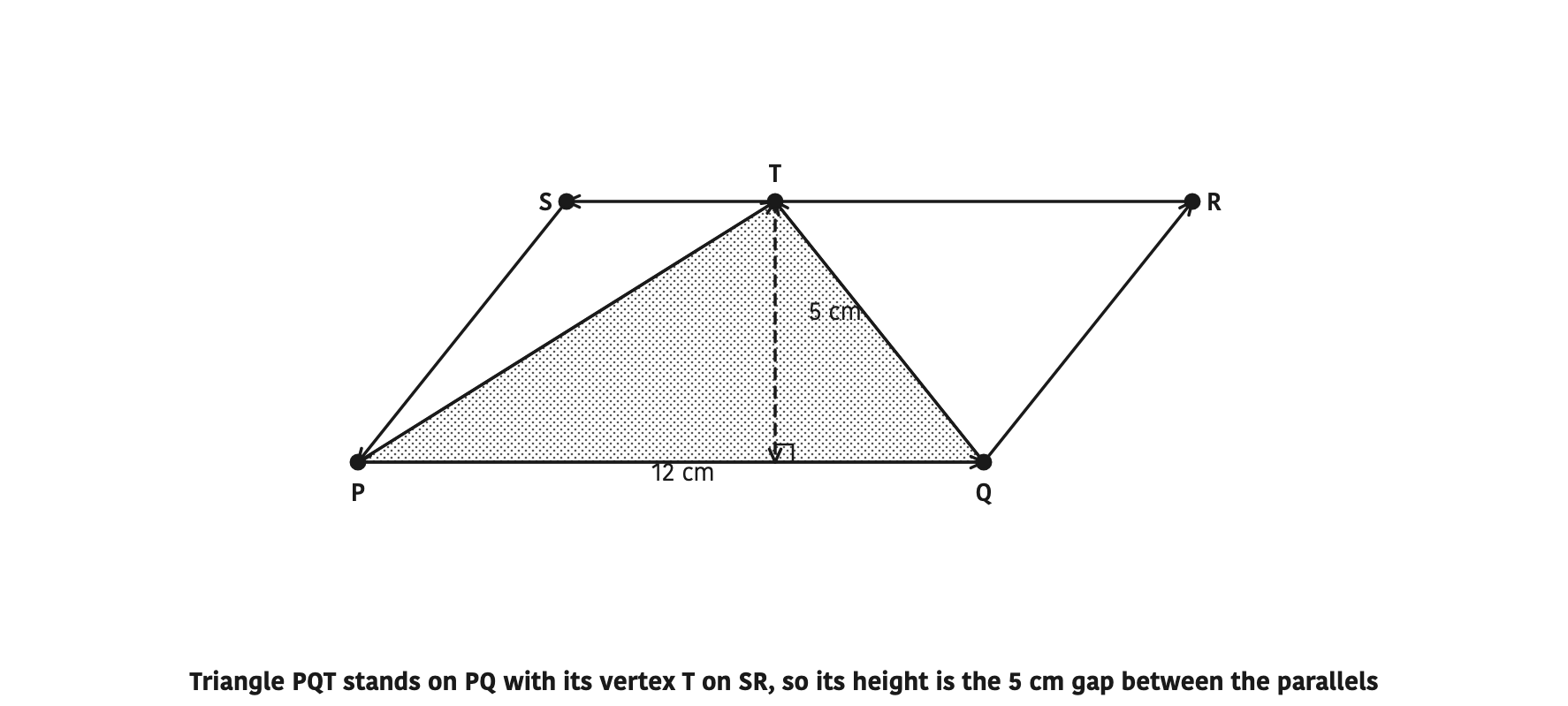
Triangle PQT and parallelogram PQRS share the base PQ, and T lies on SR, which is parallel to PQ. So they are on the same base and between the same parallels, and the theorem applies.
Step 1: Finding the area of the parallelogram as base times height:
\[ 12 \text{ cm} \times 5 \text{ cm} = 60 \text{ cm}^2 \]
Step 2: Taking half of it, because the triangle is half of the parallelogram:
\[ \frac{1}{2} \times 60 \text{ cm}^2 = 30 \text{ cm}^2 \]
A check with the triangle's own formula gives the same answer: \( \frac{1}{2} \times 12 \times 5 = 30 \). So the area of triangle PQT is 30 cm², and it stays 30 cm² wherever T moves along SR.
Worked example 2: Triangle ABE and parallelogram ABCD stand on the same base AB = 9 cm and lie between the same parallels. The area of the triangle is 27 cm². Find the area of the parallelogram and the distance between the parallel lines.
Step 1: Doubling the triangle's area, because the parallelogram is twice the triangle:
\[ 2 \times 27 \text{ cm}^2 = 54 \text{ cm}^2 \]
Step 2: Finding the height by dividing the parallelogram's area by its base, since area = base × height:
\[ h = \frac{54 \text{ cm}^2}{9 \text{ cm}} = 6 \text{ cm} \]
The parallelogram has an area of 54 cm², and the parallel lines are 6 cm apart.
An area is written in square units such as cm², and a length such as a height is written in cm. An answer without its unit is marked wrong.
Worked example: the parallelogram joining the midpoints
The theorem is most useful when a triangle and a parallelogram are hidden inside a bigger figure. Here is a well known case. E, F, G and H are the midpoints of the sides AB, BC, CD and DA of parallelogram ABCD. Prove that the area of parallelogram EFGH is half the area of parallelogram ABCD.
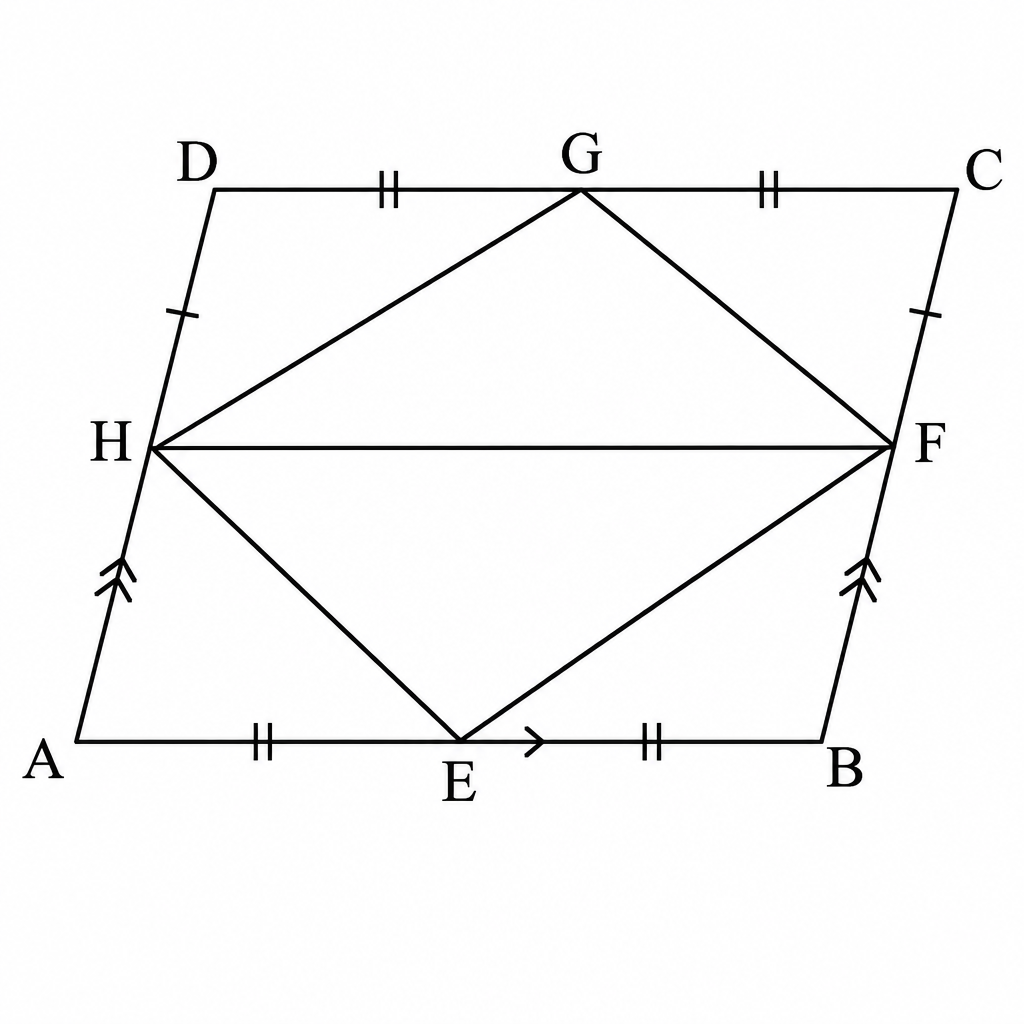
Given: E, F, G and H are the midpoints of sides AB, BC, CD and DA respectively of parallelogram ABCD.
To be proved: Area of parallelogram EFGH = \( \frac{1}{2} \) area of parallelogram ABCD.
The plan: the line HF cuts ABCD into two smaller parallelograms, ABFH below and CDHF above. The same line cuts EFGH into two triangles, HEF below and HGF above. Triangle HEF stands on the base HF, and its vertex E lies on AB, which is parallel to HF. So by the theorem it is half of ABFH. The same thing happens above the line, and adding the two halves finishes the proof.
| No. | Statements | Reasons |
| 1 | \( AH = \frac{1}{2} AD \) | H is the midpoint of AD. |
| 2 | \( BF = \frac{1}{2} BC \) | F is the midpoint of BC. |
| 3 | AD = BC | Opposite sides of parallelogram ABCD. |
| 4 | AH = BF and AH // BF | From statements (1), (2) and (3), and AD // BC. |
| 5 | ABFH is a parallelogram. | AH // BF and AH = BF. |
| 6 | Similarly, CDHF is a parallelogram. | CF // DH and CF = DH. |
| 7 | Area of \( \triangle HEF = \frac{1}{2} \) area of parallelogram ABFH | Both stand on the same base HF and lie between the same parallels HF and AB. |
| 8 | Area of \( \triangle HGF = \frac{1}{2} \) area of parallelogram CDHF | Both stand on the same base HF and lie between the same parallels HF and CD. |
| 9 | Area of \( \triangle HEF \) + area of \( \triangle HGF = \frac{1}{2} \) (area of ABFH + area of CDHF) | Adding statements (7) and (8). |
| 10 | Area of parallelogram EFGH = \( \frac{1}{2} \) area of parallelogram ABCD | The two triangles together make EFGH, and the two parallelograms together make ABCD. |
Proved.
Statement 5 uses a test for a parallelogram: a quadrilateral in which one pair of opposite sides is both equal and parallel is a parallelogram. That is why AH = BF on its own is not enough. The proof also needs AH // BF, which comes from AD // BC.
The result works with numbers too. If parallelogram ABCD has an area of 96 cm², the area of EFGH is:
\[ \frac{1}{2} \times 96 \text{ cm}^2 = 48 \text{ cm}^2 \]
Because H and F cut AD and BC in half, the line HF splits ABCD into two equal parallelograms, so ABFH and CDHF are 48 cm² each. Each triangle, HEF and HGF, is then half of 48 cm², which is 24 cm². The two triangles add up to 48 cm², which agrees with the answer above.
The full lesson is waiting for you
The notes are free to read in full. A free account opens the rest of the practice, and tracks your progress and confidence score for every subject. Presentations and videos need approval from Learn Yeti.