Triangles on the same base and between the same parallels
Picture two parallel lines drawn across a page. Mark a segment AB on the lower line. Choose any point on the upper line and join it to A and to B: you get a triangle standing on the base AB. Choose a different point on the upper line and you get a second triangle on the very same base. These two triangles stand on the same base AB and lie between the same parallel lines.
Two triangles stand on the same base and lie between the same parallels when they share one side as their base and their third vertices (their apexes) lie on one line parallel to that base.
The height of a triangle is the perpendicular distance from its apex to the line of its base. Two parallel lines stay the same distance apart all along their length, so wherever the apex sits on the upper line, the height is the same. A triangle's area is \( \frac{1}{2} \times \text{base} \times \text{height} \), so the same base with the same height must give the same area.
Three facts about areas are already known, and every proof in this topic leans on them:
- Parallelograms standing on the same base and lying between the same parallels are equal in area.
- When a triangle and a parallelogram stand on the same base and lie between the same parallels, the area of the triangle is half the area of the parallelogram.
- A diagonal divides a parallelogram into two triangles of equal area.
Measuring two triangles on one base
In the figure below, AB = 8 cm lies on the lower line and EC is parallel to AB. AE is perpendicular to AB and AE = 6 cm. Triangles ABE and ABC both stand on AB, and their apexes E and C both lie on the line EC. In the working, \( \triangle ABE \) written in an equation means the area of triangle ABE.
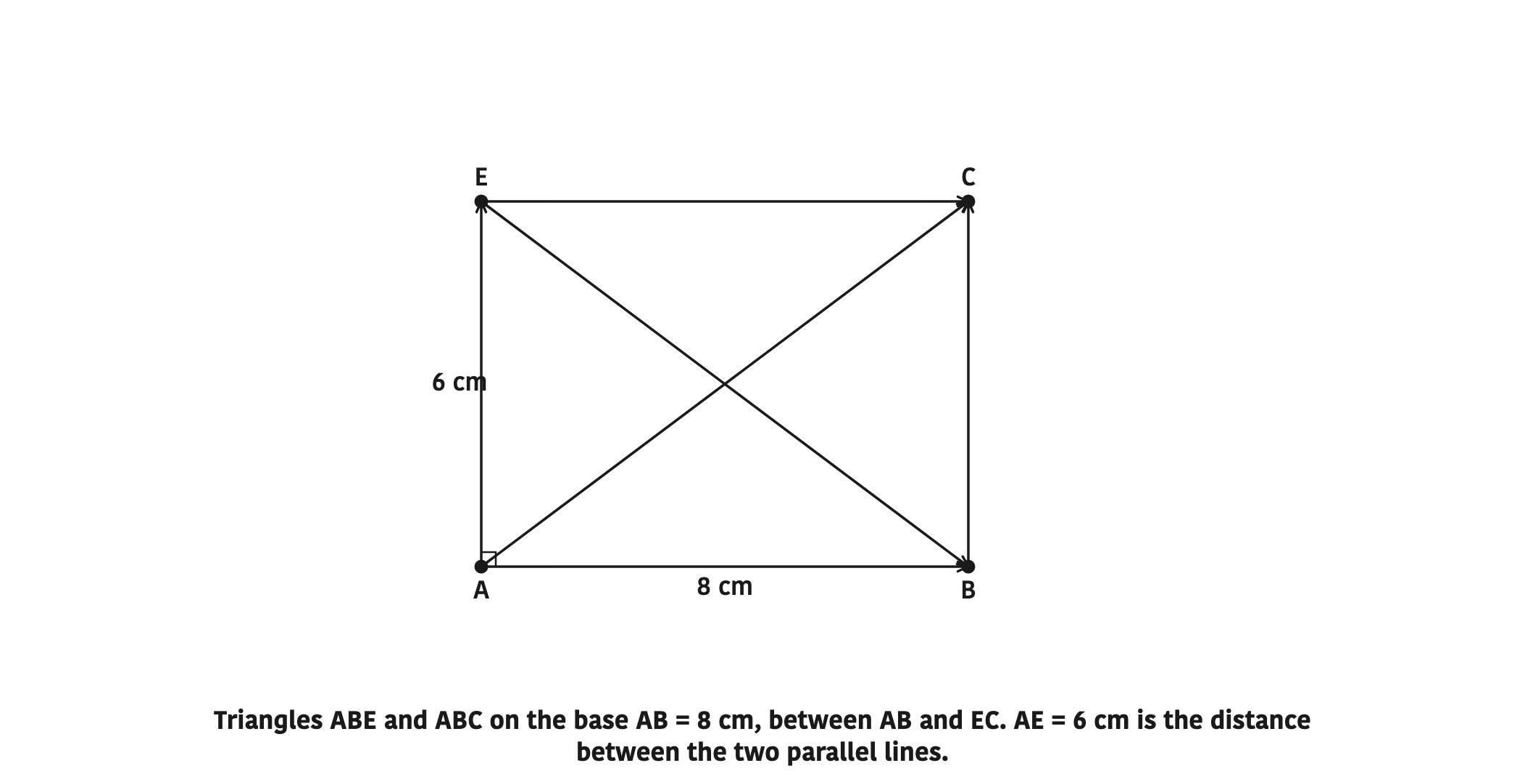
Step 1: Triangle ABE has a right angle at A, so its base is AB = 8 cm and its height is AE = 6 cm:
\[ \triangle ABE = \frac{1}{2} \times 8 \times 6 = 24 \text{ cm}^2 \]
Step 2: Triangle ABC also has base AB = 8 cm. Its height is the distance from C down to AB, and since EC is parallel to AB this distance equals AE = 6 cm:
\[ \triangle ABC = \frac{1}{2} \times 8 \times 6 = 24 \text{ cm}^2 \]
Step 3: Comparing the two areas:
\[ \triangle ABE = \triangle ABC \]
The two triangles look very different. One is right-angled and the other leans far to the right. Their areas still match, because they share the base and, lying between the same parallels, they share the height too.
Theorem 3 and its proof
Theorem 3: The areas of triangles standing on the same base and lying between the same parallels are equal.
Measuring worked for one pair of numbers. A proof shows the result is true for every such pair of triangles, whatever their size or shape. The proof is set out in the usual way:
- Given: Triangles ABE and ABC stand on the same base AB and lie between the parallel lines AB and EC.
- To prove: Area of \( \triangle ABE \) = area of \( \triangle ABC \).
- Construction: Draw AD parallel to BC, meeting EC at D. Now ABCD is a parallelogram.
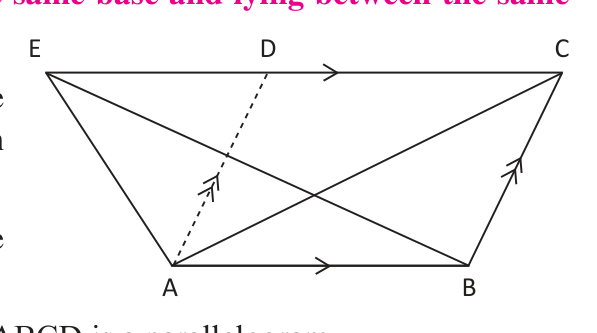
| No. | Statements | Reasons |
| 1 | Area of \( \triangle ABC = \frac{1}{2} \) area of parallelogram ABCD | The diagonal AC bisects parallelogram ABCD. |
| 2 | Area of \( \triangle ABE = \frac{1}{2} \) area of parallelogram ABCD | \( \triangle ABE \) and parallelogram ABCD stand on the same base AB and lie between AB // EC. |
| 3 | Area of \( \triangle ABE \) = area of \( \triangle ABC \) | From statements 1 and 2. |
The construction is the clever part. The two triangles cannot be compared with each other directly, but each one can be compared with the same parallelogram ABCD. Each triangle is exactly half of that parallelogram, and two things that are each half of the same thing are equal to each other. Proved.
Keep the base fixed and slide the apex along the parallel line. The triangle changes its shape at every position, but its area never changes.
The reasons these proofs use
Most proofs about area are short chains of statements. Each link is backed by one of the three area facts, by Theorem 3, or by one of the reasons below. Knowing them by name makes the reasons column easy to write.
Whole part axiom: the whole is equal to the sum of its parts. If O is a point on side QR of \( \triangle PQR \), then \( \triangle PQR = \triangle PQO + \triangle POR \).
Adding equals: if the same area is added to two equal areas, the results are equal.
Remainder axiom: if equal areas are taken away from equal areas, the areas that remain are equal.
One more fact is useful when a midpoint appears. A median joins a vertex to the midpoint of the opposite side. It cuts the triangle into two triangles with equal bases and the same height, so the two halves have equal area.
Example: two triangles meeting at a point inside a parallelogram
ABCD is a parallelogram and P is any point inside it. Prove that area of \( \triangle APB \) + area of \( \triangle PCD = \frac{1}{2} \) area of parallelogram ABCD.
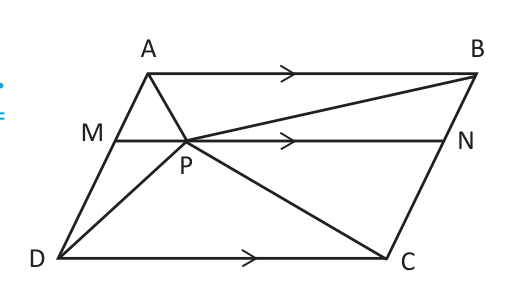
- Given: ABCD is a parallelogram and P is a point inside it.
- To prove: \( \triangle APB + \triangle PCD = \frac{1}{2} \) parallelogram ABCD.
- Construction: Through P draw MN parallel to CD, with M on AD and N on BC. Then ABNM and MNCD are parallelograms.
| No. | Statements | Reasons |
| 1 | \( \triangle APB = \frac{1}{2} \) parallelogram ABNM | They stand on the same base AB and lie between AB // MN. |
| 2 | \( \triangle PCD = \frac{1}{2} \) parallelogram MNCD | They stand on the same base CD and lie between CD // MN. |
| 3 | \( \triangle APB + \triangle PCD = \frac{1}{2} \) (ABNM + MNCD) | Adding statements 1 and 2. |
| 4 | \( \triangle APB + \triangle PCD = \frac{1}{2} \) parallelogram ABCD | From 3, since ABNM + MNCD = ABCD (whole part axiom). |
Notice that P could be anywhere inside the parallelogram. The two remaining triangles, APD and BPC, must then make up the other half. A single line through P is enough to split the problem into two easy pieces. Proved.
Example: triangles drawn to two different sides
PQRS is a parallelogram. X and Y are any two points on PS and SR respectively. Prove that area of \( \triangle PQY \) = area of \( \triangle QRX \).
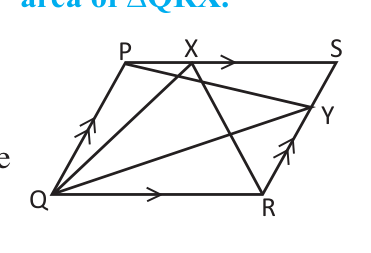
- Given: PQRS is a parallelogram; X is on PS and Y is on SR.
- To prove: \( \triangle PQY = \triangle QRX \).
| No. | Statements | Reasons |
| 1 | \( \triangle PQY = \frac{1}{2} \) parallelogram PQRS | They stand on the same base PQ and lie between PQ // SR. |
| 2 | \( \triangle QRX = \frac{1}{2} \) parallelogram PQRS | They stand on the same base QR and lie between QR // PS. |
| 3 | \( \triangle PQY = \triangle QRX \) | From statements 1 and 2. |
The two triangles do not share a base at all, so Theorem 3 cannot be used on them directly. Instead each one is measured against the whole parallelogram, using a different pair of its parallel sides each time. Proved.
Example: taking away a shared triangle
PQRS is a parallelogram and O is any point on the side QR. SO is joined and produced, and PQ is produced, so that they meet at T. Prove that area of \( \triangle PQO \) = area of \( \triangle RTO \).
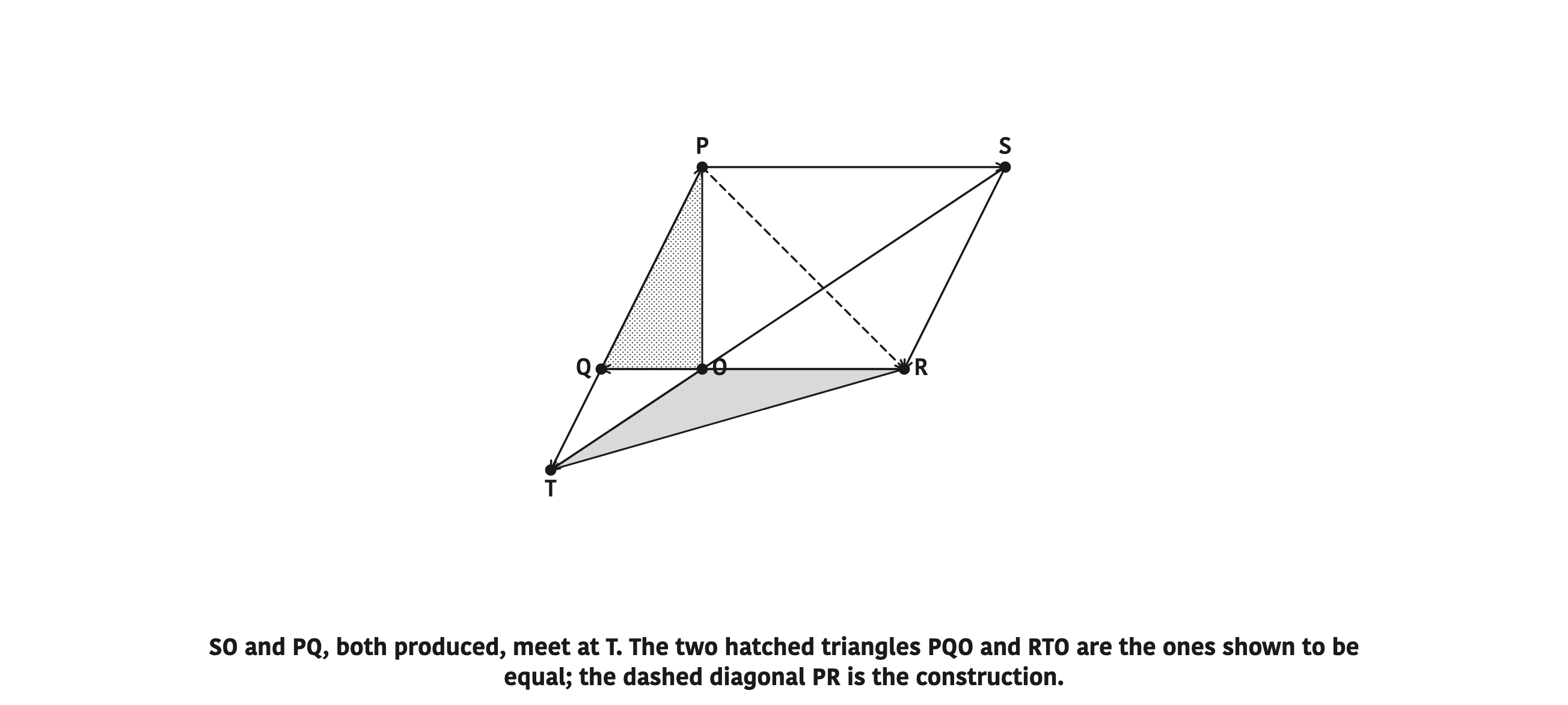
- Given: O is on side QR of parallelogram PQRS; PQ and SO produced meet at T.
- To prove: \( \triangle PQO = \triangle RTO \).
- Construction: Draw the diagonal PR.
| No. | Statements | Reasons |
| 1 | \( \triangle PRS = \triangle PQR \) | The diagonal PR bisects parallelogram PQRS. |
| 2 | \( \triangle PRS = \triangle TRS \) | They stand on the same base SR and lie between SR // PT. |
| 3 | \( \triangle PQR = \triangle TRS \) | From statements 1 and 2. |
| 4 | \( \triangle POR = \triangle SOR \) | They stand on the same base OR and lie between OR // PS. |
| 5 | \( \triangle PQR - \triangle POR = \triangle TRS - \triangle SOR \) | Subtracting statement 4 from statement 3 (remainder axiom). |
| 6 | \( \triangle PQO = \triangle RTO \) | From 5, since O lies on QR and on ST (whole part axiom). |
Here two big triangles, PQR and TRS, are shown equal first. Then two equal pieces, POR and SOR, are cut away from them, and what is left over must be equal. When the triangles you want are the leftovers of bigger equal triangles, subtract. Proved.
Example: the line joining midpoints of opposite sides
ABCD is a parallelogram. M and N are the midpoints of BC and AD respectively. Prove that MN divides parallelogram ABCD into two parallelograms of equal area.
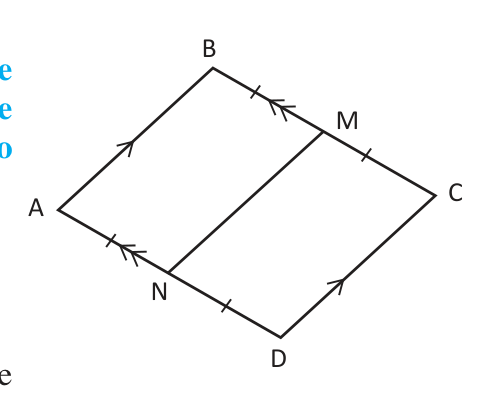
- Given: ABCD is a parallelogram; M and N are the midpoints of BC and AD.
- To prove: area of parallelogram ABMN = area of parallelogram CDNM.
| No. | Statements | Reasons |
| 1 | AD = BC and AD // BC | Opposite sides of a parallelogram. |
| 2 | BM = MC and AN = ND | M and N are the midpoints of BC and AD. |
| 3 | AN = BM and AN // BM | From statements 1 and 2 (halves of equal sides are equal). |
| 4 | ABMN is a parallelogram | AN and BM are equal and parallel. |
| 5 | DN = CM and DN // CM | Same reasoning as statement 3. |
| 6 | CDNM is a parallelogram | DN and CM are equal and parallel. |
| 7 | Parallelogram ABMN = parallelogram CDNM | Parallelograms standing on equal bases AN = ND and lying between AD // BC. |
The area results work for equal bases as well as for the same base. What matters is equal base length and equal height, and the same pair of parallel lines gives the equal height. Proved.
Example: adding a shared triangle
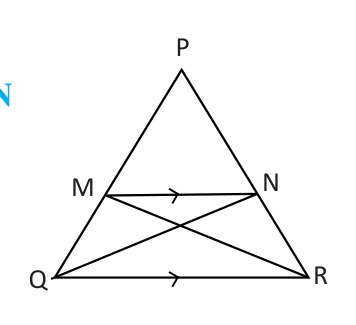
In triangle PQR, M is a point on PQ and N is a point on PR such that MN // QR. Prove that area of \( \triangle PQN \) = area of \( \triangle PRM \).
| No. | Statements | Reasons |
| 1 | \( \triangle MNQ = \triangle MNR \) | They stand on the same base MN and lie between MN // QR (Theorem 3). |
| 2 | \( \triangle PMN + \triangle MNQ = \triangle PMN + \triangle MNR \) | Adding \( \triangle PMN \) to both sides of statement 1. |
| 3 | \( \triangle PQN = \triangle PRM \) | From 2, since M lies on PQ and N lies on PR (whole part axiom). |
This is the opposite move to the last example. The equal triangles MNQ and MNR are small, and each becomes one of the wanted triangles once the top triangle PMN is stuck onto it. When the triangles you want are built from equal pieces plus a common piece, add. Proved.
Using the result the other way round
Sometimes the areas are known to be equal and a pair of parallel lines has to be proved. Suppose triangles ABE and ABF stand on the same base AB, on the same side of it, and have equal areas. Equal areas on equal bases mean equal heights, so E and F are the same distance from AB. The line EF therefore runs parallel to AB.
Triangles of equal area standing on the same base and on the same side of it lie between the same parallels.
Planning a proof of equal areas
Before writing the table, spend a minute reading the figure. These questions, in this order, find the route in almost every problem:
- Mark every pair of parallel lines in the figure, including any that the construction will add.
- For each triangle in the question, find a side that lies on one of those lines and check whether its apex lies on the parallel line.
- If two triangles share that base, use Theorem 3. If a triangle shares its base with a parallelogram, it is half of that parallelogram.
- If the wanted triangles do not share a base, look for a third shape, often the whole parallelogram, that each can be compared with.
- Finally decide whether a common triangle must be added to both sides or taken away from both sides, and name the axiom you use.
Two triangles on the same base are not equal in area just because they look similar in size. Their apexes must lie on one line parallel to that base, on the same side of it. If one apex is higher, or the top line is not parallel to the base, the heights differ and so do the areas.
The full lesson is waiting for you
The notes are free to read in full. A free account opens the rest of the practice, and tracks your progress and confidence score for every subject. Presentations and videos need approval from Learn Yeti.