Congruent Figures and Figures of Equal Area
Two figures are congruent when one can be laid on top of the other and they match exactly, side for side and angle for angle. Two figures have equal area when they cover the same amount of flat surface, whatever their shapes. The two ideas sound alike, but they are different, and this whole lesson rests on that difference.
Congruent figures: figures that match exactly when one is laid over the other. Their corresponding sides and angles are equal, so their areas are equal too.
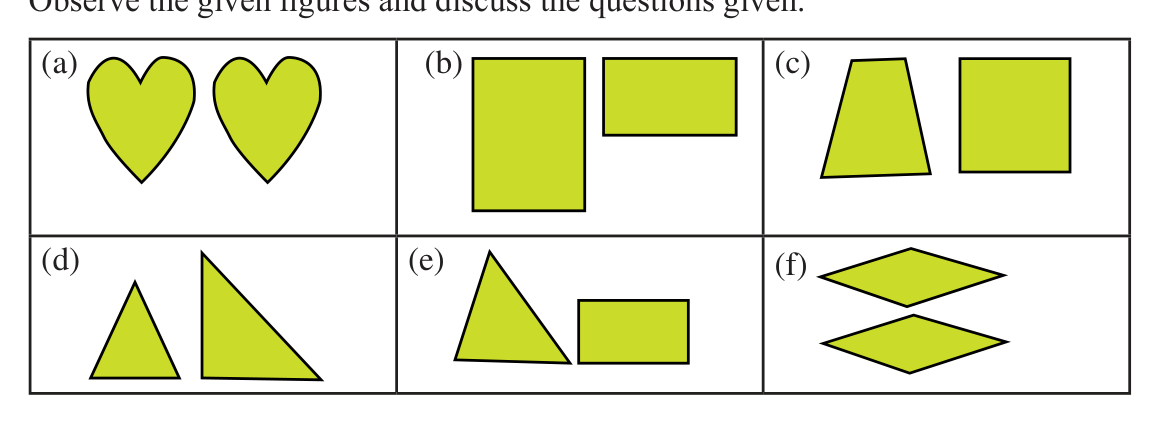
Study each pair and think about four questions.
- (a) Do the two figures match when one is laid over the other? The two hearts in (a) and the two rhombuses in (f) do. In (b), (c), (d) and (e) the shapes are different, so they do not.
- (b) Is the area of the pair equal? A pair that matches always has equal area. A pair that does not match may or may not have equal area, and only measuring can tell.
- (c) Which pairs are congruent? Pairs (a) and (f) are congruent. The other four pairs are not.
- (d) Are all figures with equal area congruent? No. Equal area tells us only that two figures cover the same amount of surface. It tells us nothing about their shapes.
A pair of rectangles makes point (d) clear. A rectangle 2 cm wide and 6 cm long has area \( 2 \times 6 = 12 \text{ cm}^2 \). A rectangle 4 cm wide and 3 cm long has area \( 4 \times 3 = 12 \text{ cm}^2 \). The areas are equal, but one rectangle is long and thin and the other is almost square, so neither fits on the other.
Congruent figures always have equal area, but figures with equal area need not be congruent. The parallelograms in this lesson are exactly such figures: different in shape, equal in area.
Standing on the Same Base and Lying between the Same Parallel Lines
Many figures in geometry are drawn between a pair of parallel lines. To compare their areas we need two exact ideas: what it means for figures to stand on the same base, and what it means for them to lie between the same parallel lines.
Standing on the same base: two figures stand on the same base when a side of one is exactly the same line segment as a side of the other. That shared side is their common base.
Lying between the same parallel lines: two figures lie between the same parallel lines when the base of each lies on one line and the side or vertex opposite that base lies on a second line parallel to the first.
The three figures below put these ideas to the test. In each one, matching arrow marks on two lines show that those lines are parallel.
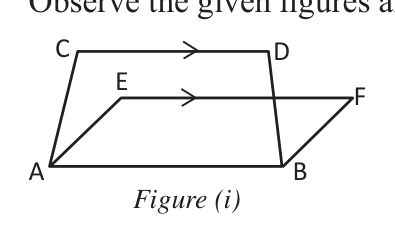
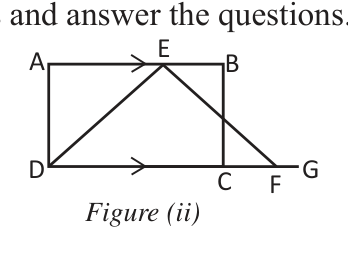
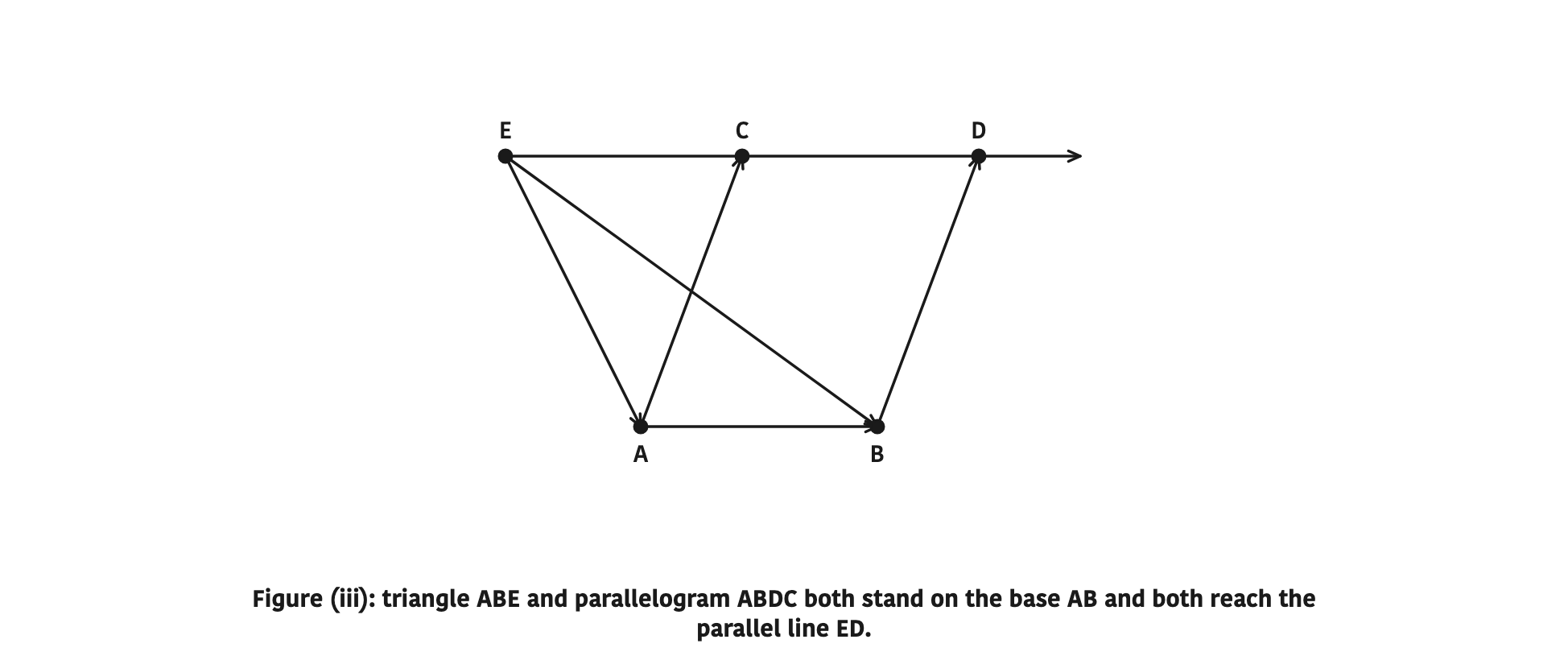
Now check each figure against both conditions.
- In figure (i), ABDC and ABFE stand on the same base AB but lie between different parallel lines. ABDC reaches up to the line CD, while ABFE reaches only the lower line EF.
- In figure (ii), rectangle ABCD and triangle DEF lie between the same parallel lines AB and DG, but they stand on different bases, DC and DF.
- In figure (iii), triangle ABE and parallelogram ABDC stand on the same base AB and lie between the same parallel lines AB and ED. Both conditions hold.
Only figure (iii) meets both conditions at once. The result in this lesson is about figures of that kind, so both conditions must be checked before it is used.
The Height between Two Parallel Lines
The height of a parallelogram is the perpendicular distance from its base to the opposite side. It is measured at right angles to the base, never along a slanting side. When the base lies on one line and the opposite side lies on a parallel line, the height is simply the distance between those two lines.
Height of a parallelogram: the perpendicular distance between its base and the side opposite the base.
\[ A = b \times h \]
Here \( A \) is the area, \( b \) is the base and \( h \) is the height. Parallel lines stay the same distance apart all along their length, so every perpendicular drawn from one to the other has the same length. That is why every figure standing between the same two parallel lines has the same height.
Same parallel lines means same height. Same base together with same height means the same value of base × height.
The slanting side of a parallelogram is not its height. A slanting side is always longer than the perpendicular between the parallel lines, so multiplying the base by it gives an area that is too large.
Measuring Two Parallelograms on One Base
Take two parallelograms, ABCD and ABEF, drawn on the same base AB between the parallel lines AB and FC. The base AB is 7 cm. A perpendicular DG is drawn from D to AB, and DG is 3 cm. What is the area of each, and how are the two areas related?
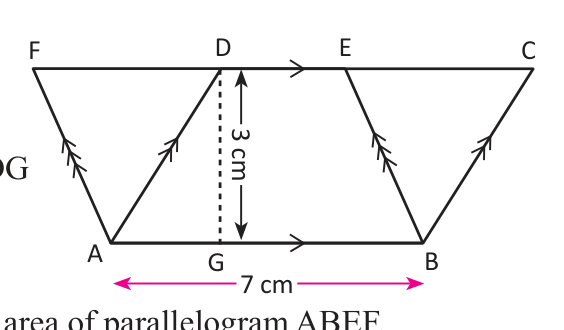
Step 1: The area of parallelogram ABCD is base × height, with base AB and height DG:
\[ \text{Area of } ABCD = AB \times DG \]
Step 2: Putting in AB = 7 cm and DG = 3 cm:
\[ 7 \text{ cm} \times 3 \text{ cm} = 21 \text{ cm}^2 \]
Step 3: Parallelogram ABEF stands on the same base AB, and its side FE lies on the same line FC. The perpendicular distance from FC to AB is still DG, so its area is:
\[ \text{Area of } ABEF = AB \times DG \]
Step 4: Putting in the same values:
\[ 7 \text{ cm} \times 3 \text{ cm} = 21 \text{ cm}^2 \]
Step 5: Comparing the two results, both areas are \( 21 \text{ cm}^2 \). So the area of parallelogram ABCD equals the area of parallelogram ABEF.
The two parallelograms lean in opposite directions and do not look alike. Their slant never entered the calculation. Only the base and the distance between the lines did, and those were the same for both.
The areas of parallelograms standing on the same base and lying between the same parallel lines are equal. Here, area of parallelogram ABCD = area of parallelogram ABEF.
Theorem 1: Parallelograms on the Same Base and between the Same Parallels
One measurement is not a proof. Another pair of parallelograms, drawn with different lengths, might seem to behave differently. The theorem below shows that the result holds for every such pair.
Theorem 1: Parallelograms standing on the same base and lying between the same parallel lines are equal in area.
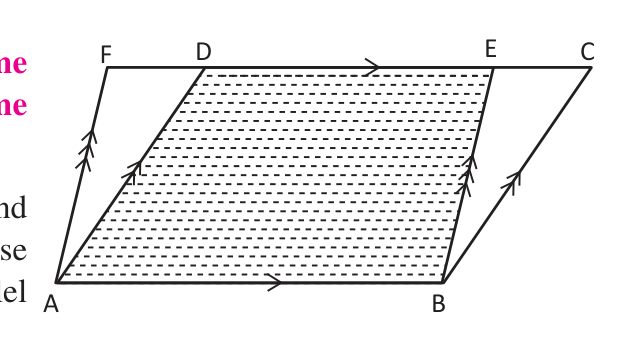
Given: parallelograms ABCD and ABEF stand on the same base AB and lie between the same parallel lines AB and FC.
To be proved: area of parallelogram ABCD = area of parallelogram ABEF.
The idea behind the proof comes from the shaded trapezium ABED, which lies inside both parallelograms. Parallelogram ABEF is this trapezium with triangle ADF added on the left. Parallelogram ABCD is the same trapezium with triangle BCE added on the right. So the whole question becomes: are triangles ADF and BCE equal in area? The proof answers it by showing that the two triangles are congruent.
A.A.S. axiom: if two angles and a side not included between them in one triangle are equal to the corresponding two angles and side of another triangle, the two triangles are congruent.
Whole part axiom: the whole is equal to the sum of its parts.
The proof is written as a table of statements, each with its reason.
| S.N. | Statements | Reasons |
| 1 (i) | In \( \triangle ADF \) and \( \triangle BCE \): \( \angle ADF = \angle BCE \) (A) | Corresponding angles, as \( AD \parallel BC \) |
| 1 (ii) | \( \angle AFD = \angle BEC \) (A) | Corresponding angles, as \( AF \parallel BE \) |
| 1 (iii) | \( AD = BC \) (S) | Opposite sides of parallelogram ABCD |
| 2 | \( \triangle ADF \cong \triangle BCE \) | By the A.A.S. axiom |
| 3 | Area of \( \triangle ADF \) = area of \( \triangle BCE \) | Congruent triangles are equal in area |
| 4 | Area of \( \triangle ADF \) + area of trapezium ABED = area of \( \triangle BCE \) + area of trapezium ABED | Adding the same trapezium to both sides |
| 5 | Area of parallelogram ABEF = area of parallelogram ABCD | From statement 4, by the whole part axiom |
Statement 5 is where the whole part axiom does its work. Triangle ADF and trapezium ABED together make the whole of parallelogram ABEF, and triangle BCE and trapezium ABED together make the whole of parallelogram ABCD. So parallelograms standing on the same base and lying between the same parallel lines are equal in area. Proved.
In statement 1, each pair of angles needs its own pair of parallel lines. \( \angle ADF = \angle BCE \) uses \( AD \parallel BC \), and \( \angle AFD = \angle BEC \) uses \( AF \parallel BE \). Writing only 'corresponding angles' without naming the parallel lines leaves the reason incomplete.
Example 1: A Parallelogram and a Rectangle on the Same Base
In the figure, \( AB \parallel XY \). ABPQ is a rectangle and ABCD is a parallelogram. Prove that the area of parallelogram ABCD = area of rectangle ABPQ.
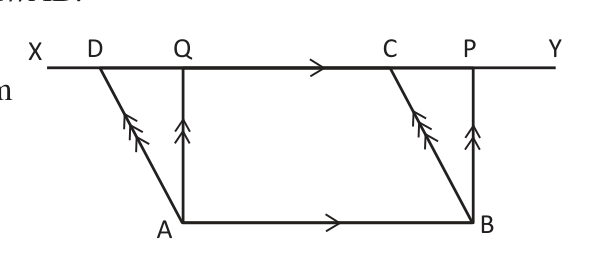
Solution: parallelogram ABCD and rectangle ABPQ stand on the same base AB and lie between the same parallel lines AB and XY. Every angle of a rectangle is a right angle, so AQ is perpendicular to AB. That makes AQ the height of the parallelogram as well.
To be proved: area of parallelogram ABCD = area of rectangle ABPQ.
| S.N. | Statements | Reasons |
| 1 | Area of parallelogram ABCD = \( AB \times AQ \) | Area of parallelogram = base × height |
| 2 | Area of rectangle ABPQ = \( AB \times AQ \) | Area of rectangle = length × breadth |
| 3 | Area of parallelogram ABCD = area of rectangle ABPQ | From statements 1 and 2 |
A rectangle is a parallelogram whose angles are all right angles, so Theorem 1 gives the same result at once. The example is still worth knowing, because it explains why the area of any parallelogram is base × height: the parallelogram can be swapped for a rectangle on the same base between the same parallels, and a rectangle's area is length × breadth.
The full lesson is waiting for you
The notes are free to read in full. A free account opens the rest of the practice, and tracks your progress and confidence score for every subject. Presentations and videos need approval from Learn Yeti.