Work and Leisure: Four Ideas to Argue With
Work is the effort we make to earn a living, and leisure is the free time left over when the work is done. People have argued for thousands of years about how the two should be balanced. Four short quotations open this unit, and each one takes a side. Read them slowly and decide whether you agree, because the whole unit keeps returning to this question.
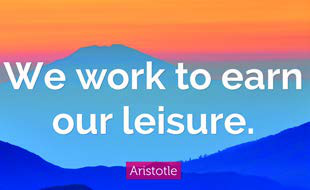


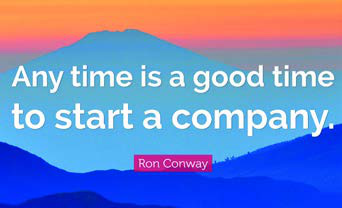
Aristotle says we work to earn our leisure. In his view, rest only has value when it has been paid for by effort. Thomas Fuller says all things are difficult before they are easy, which means the pain of learning is temporary and quitting early wastes it. Frank Ocean tells us to work hard in silence and let success be our noise, a warning against boasting before achieving. Ron Conway says any time is a good time to start a company, which is really a claim that waiting for a perfect moment is just another form of idleness. Keep these four voices in your head as you read the story that follows, because the story tests whether they are true.
The Ant and the Grasshopper
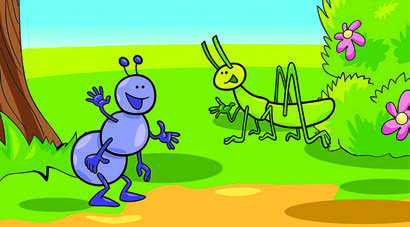
A fable is a short story, usually with animals as characters, that teaches a moral lesson about how people should behave.
The reading passage is a short story by W. Somerset Maugham. Its narrator begins by remembering a fable by La Fontaine that he was made to learn by heart as a small boy. In the fable, the ant spends a laborious summer gathering its winter store, while the grasshopper sits on a blade of grass singing to the sun. When winter comes, the ant is comfortably provided for, but the grasshopper's larder is empty. He begs the ant for a little food, and the ant gives her classic answer: what were you doing in the summer time? The grasshopper says he sang all day and all night. Then go and dance, replies the ant. The fable was devised to teach the young a useful lesson: in an imperfect world, industry is rewarded and giddiness is punished.
The moral of the fable is that hard work in good times brings security in bad times, while careless idleness brings ruin. Maugham retells it in real life to ask an uncomfortable question: is the world really that fair?
George and Tom: The Fable in Real Life
The narrator remembers this fable when he sees George Ramsay lunching alone in a restaurant, staring into space with an expression of deep gloom, as though the burden of the whole world sat on his shoulders. The narrator guesses at once what is wrong: George's unfortunate brother Tom has been causing trouble again. Every family, he supposes, has a black sheep, and Tom has been a sore trial to George for twenty years.
Tom had begun life decently enough. He went into business, married, and had two children. The Ramsays were perfectly respectable people, and everyone expected Tom to have a useful and honourable career. But one day, without warning, he announced that he did not like work and was not suited for marriage. He wanted to enjoy himself. He would listen to no expostulations. He left his wife and his office, and spent two happy years in the capitals of Europe. When his money was gone, he borrowed. He was charming and unscrupulous, so his friends found it almost impossible to refuse him a loan. He said that money spent on necessities was boring; the amusing money was the money spent on luxuries. For that money he depended on his brother George.
George was a serious, respectable man, a lawyer, and he did not fall for Tom's charm easily. Yet once or twice he believed Tom's promises of amendment and gave him considerable sums so that he could make a fresh start. Tom spent the money on a motor car and some very nice jewellery. When George finally realised that his brother would never settle down and washed his hands of him, Tom, without a qualm, began to blackmail him. It was not pleasant for a respectable lawyer to find his brother shaking cocktails behind a bar or driving a taxi outside his club. Tom claimed these were perfectly decent occupations, but hinted that for a couple of hundred pounds he would give them up for the honour of the family. George paid.
The worst episode came when Tom nearly went to prison. He had cheated a man named Cronshaw, and this time the matter was dishonest, which George understood to mean illegal. If Tom were prosecuted he would assuredly be convicted, and George could not allow his only brother to go to gaol. Cronshaw seemed vindictive. He was determined to take the matter to court and said Tom was a scoundrel who should be punished. It cost George an infinite deal of trouble and five hundred pounds to settle the affair. Then came the sting: the moment they cashed the cheque, Tom and Cronshaw went off to Monte Carlo together and spent a happy month there. The whole quarrel had been a trick played on George. The narrator has never seen George in such a rage.
George is the ant of the story and Tom is the grasshopper. George works, saves and behaves; Tom idles, spends and cheats. Yet in Maugham's telling it is the grasshopper who keeps enjoying himself at the ant's expense. The story does not cancel the fable's moral; it makes us feel how bitter it is when life refuses to follow it.
Silent Letters
A silent letter is a letter that appears in the spelling of a word but is not pronounced when the word is spoken. In qualm, the letter l is written but never heard.
English spelling keeps letters that speech dropped centuries ago, so you cannot always trust your eyes when you pronounce a word. The word qualm from the story is one example: it is pronounced as if it were spelled kwam. The table below shows the words from this unit with their silent letters. Say each word aloud and notice which letter your mouth skips.
| Silent letter | Words |
| b | doubt |
| p | pneumonia, receipt, pseudo |
| l | chalk |
| g | feign, resign, gnaw |
| t | bouquet, buffet |
| gh | light, neighbour |
| k and gh | knight, knave (silent k) |
| h | heir, archeology |
| n | solemn |
| s | island |
| w | wriggle |
| u | built |
Do not pronounce the silent letter just because you can see it. Island is pronounced eye-land, never is-land, and receipt is pronounced ri-seet, never ri-seept. When you meet a new word, check its pronunciation in a dictionary instead of sounding out every letter.
Have and Get: Getting Things Done
We do many things ourselves, but for some jobs we pay or ask another person: a barber cuts our hair, a mechanic repairs our bicycle, a tailor sews our clothes. English has a special structure for this, called the causative. Instead of saying the barber cut my hair, we usually say I had my hair cut, because what matters is the job and the person it was done for, not the worker.
The causative with have or get follows the pattern: subject + have/get + object + past participle. It means the subject arranges for someone else to do the action. Example: I got my bicycle repaired at A to Z Repair Centre.

Notice the shape of both answers. Indu does not take the photograph herself and Sandesh does not wash the car himself. The verb have or get is followed by the thing, and then by a past participle: have a photograph taken, get a car washed, have a hair cut done at a salon, get shoes mended, have dresses sewn, get eyes checked, have teeth scaled. You can build the same conversation about any service: a veterinary's, where you have a sick pet treated; a mechanic's, where you get a motorbike serviced; a dry cleaner's, where you have a coat dry cleaned; a translator's, where you get a document translated; a fortune teller's, where you have your fortune told; and a beautician's, where you get your hair styled.
When you name the person who does the job instead of the job itself, the pattern changes. Get takes a to-infinitive: I got my landlord to fix the broken windowpane. Have takes a bare infinitive: Rita had Ankit wash her clothes, and Smith had Jacque fetch a pail of water. The meaning is still causative, but now the doer stands in the sentence.
Make: Forcing and Causing
Make + person + bare infinitive means to force or cause someone to do something. Example: My mum always makes me clean my room on Saturdays. In the passive, make takes a to-infinitive: Kumari was made to turn on the television.
Make is stronger than have or get. It carries the idea of pressure or compulsion. The teacher made every one of us write an essay yesterday, whether we wanted to or not. A funny film made us all laugh, which is causing rather than forcing, but the grammar is the same. Watch the little words carefully. After make in an active sentence there is no to: he never makes us do heavy work. But turn the sentence passive and to appears: we were made to remember all the theorems. This one detail decides most exam questions on the causative.
Students often write I cut my hair yesterday when they mean the barber did it. That sentence claims you held the scissors yourself. Write I had my hair cut yesterday, or I got my hair cut yesterday. And never put a to-infinitive after have or make in an active sentence: had Ankit wash, made us laugh, but got me to dance.
Describing a Bar Chart
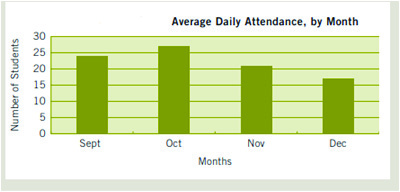
A bar chart shows amounts as bars so that the eye can compare them at a glance. This one records the average daily attendance of students, month by month, from September to December. Attendance stands at about 24 students in September, climbs to a peak of about 27 in October, drops to about 21 in November, and falls further to about 17 in December. To turn a chart into a paragraph, you need verbs that describe trends: whether the numbers are going up, going down, or staying the same.
| Upward trend | Downward trend | Stable trend |
| climb | drop | steady |
| go up | go down | maintain |
| grow | decrease | remain |
| increase | decline | constant |
| jump | fall | |
| rise | plummet | |
| rocket | plunge |
A good chart description follows a fixed order. First name the chart and its subject: the chart shows the average daily attendance of students by month. Then report the figures with trend verbs: according to the chart, attendance rises from September to October, reaching its peak at around 27 students. Then compare: while October records the highest attendance, December records the lowest, at about 17. Useful connectors are the chart shows or illustrates or represents, according to the chart, while and on the other hand, likewise, and overall. Finish with the overall picture: overall, attendance declines steadily after October.
Leisure: A Poem by W. H. Davies

After a story about a man who refused to work, the unit gives us a poem about people who never stop working. W. H. Davies asks what our life is worth if it is so full of care, meaning worry and busyness, that we have no time to stand and stare. Sheep and cows can stand beneath the boughs of a tree and gaze for as long as they like. We rush past woods without seeing the squirrels hide their nuts in the grass. We never notice that a sunlit stream is full of sparkling points of light, like a sky full of stars in broad daylight. The poet then imagines Beauty as a dancing woman: we have no time to turn at her glance, no time to watch her feet dance, and no time to wait for the smile that begins in her eyes to reach and enrich her mouth. His conclusion repeats his opening like a verdict: a poor life this, if full of care, we have no time to stand and stare.
WHAT is this life if, full of care,We have no time to stand and stare?No time to stand beneath the boughs,And stare as long as sheep and cows:No time to see, when woods we pass,Where squirrels hide their nuts in grass:No time to see, in broad daylight,Streams full of stars, like skies at night:No time to turn at Beauty's glance,And watch her feet, how they can dance:No time to wait till her mouth can,Enrich that smile her eyes began?A poor life this if, full of care,We have no time to stand and stare.
The poem and the story pull in opposite directions on purpose. Maugham shows the danger of all leisure and no work; Davies shows the poverty of all work and no leisure. The unit's real lesson sits between them: a good life needs both.
Listening: A Call to the Garage
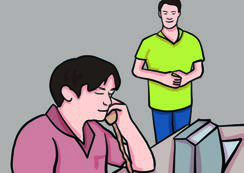
The listening task plays a telephone conversation between a lady and a garage. Before the audio starts, look at the picture and predict: who might the man on the telephone be talking to, and what about? Thinking about the unit title, Work and Leisure, and the picture of a workshop desk, a sensible guess is that a customer is arranging to have some work done. Prediction is not cheating; it is the first listening skill, because a listener who expects certain words hears them more easily.
While the audio plays, you fill blanks with exact words and phrases. The blanks tell you precisely what to catch: the name of the lady, what her car needs, the day she wants the car back, what would make the service take longer, what the garage she visited last time did about money, what fixing the brake pads will not do to the customer, and what the mechanic has that lets him return the car quickly. On the second listening you answer fuller questions: what the lady wants to get done, when she last had her car checked, when the mechanic has a free slot, how long a full service normally takes, why she suspects a serious problem, and what is wrong with the rear brake light. Notice how many of these are causative ideas: she wants to get her car serviced, to have it checked, to have the brake light repaired. Grammar and listening are testing the same skill here.
- Before listening, read every blank and every question, and underline the kind of answer each one needs: a name, a day, a time, a reason or a price.
- During the first listening, catch the short facts: names, days, times and amounts. Write them immediately, in the blank they belong to.
- During the second listening, check your first answers and listen for reasons: why the service might take longer, why the lady is worried.
- After listening, read your completed sentences aloud. An answer that breaks the grammar of its sentence is almost always wrong.
The final speaking task moves the same situation to a mobile phone service centre. Imagine your phone screen is cracked. What would you ask the receptionist or the engineer? Useful questions follow the unit's own grammar: Can I have my phone repaired here? How much will it cost to get the screen replaced? How long will the repair take? Is my data safe while the phone is being repaired? When can I collect it?
The Passive Voice
A sentence is in the active voice when the subject does the action: he delivers the letters. It is in the passive voice when the subject receives the action: the letters are delivered. The passive is formed with the verb be in the right tense plus the past participle of the main verb.
We choose the passive when the doer of the action is unknown, unimportant, or obvious, and the thing done matters more. Nobody asks which postman delivers the letters; what matters is that the letters are delivered. To change a sentence into the passive, move the object to the front, put be into the tense of the original verb, and add the past participle. If the doer still matters, add it at the end with by. The table below is the heart of this section; the past participle never changes, and only the form of be carries the tense.
| Verb tense | Active voice | Passive voice |
| Present Simple | He delivers the letters. | The letters are delivered. |
| Past Simple | He delivered the letters. | The letters were delivered. |
| Future Simple | He will deliver the letters. | The letters will be delivered. |
| Present Continuous | He is delivering the letters. | The letters are being delivered. |
| Past Continuous | He was delivering the letters. | The letters were being delivered. |
| Going to | He is going to deliver the letters. | The letters are going to be delivered. |
| Present Perfect | He has delivered the letters. | The letters have been delivered. |
| Past Perfect | He had delivered the letters. | The letters had been delivered. |
| Infinitive | He has to deliver the letters. | The letters have to be delivered. |
| Modals | He must deliver the letters. | The letters must be delivered. |
Some verbs, such as give, send, show, teach, pay and buy, take two objects: a person and a thing. John gave Elizabeth that beautiful ring has both Elizabeth and the ring as objects, so it allows two passives. Either the person leads, which English usually prefers: Elizabeth was given that beautiful ring by John. Or the thing leads: that beautiful ring was given to Elizabeth by John. The same choice appears in the exercises: he was sent a parcel by the mail-order company, the minister has been given the letters, the tourists were shown the sights of Pokhara, our students are taught English and French, and she is paid an excellent salary.
Do not drop the being in continuous passives or the been in perfect passives. Someone is helping her must become she is being helped, not she is helped, which changes the tense. Her students have sent her flowers must become she has been sent flowers, not she has sent flowers, which reverses who did what.
Writing an Essay on Work and Leisure
The final writing task asks for an essay of about 200 words on Work and Leisure, built around four prompts: differences, similarities, benefits and balance. Treat the prompts as a ready-made plan. Open by defining the two terms in your own words. In the second paragraph give the differences: work is duty, done for money or need, often tiring; leisure is choice, done for pleasure, refreshing. Then find the similarities, which is the surprising paragraph that earns marks: both fill our time, both can be done well or badly, and a hobby pursued seriously can feel like work while work we love can feel like leisure. Next state the benefits of each: work gives income, skill, discipline and self-respect; leisure gives rest, health, imagination and friendship. Close with balance: too much of either ruins a life, as the grasshopper's idle summer and the poet's careworn workers both show. Quoting Aristotle's line that we work to earn our leisure makes a strong final sentence.
Project Work: A Survey in Your Locality
The unit ends with real data work. Design and conduct a survey in your locality, visiting at least ten families. For each family, record how many members are working, how many are jobless, and how many are retired. Add up the three totals, convert each into a fraction of the whole, and draw the result as a pie chart, where a bigger slice means a bigger group. Then display the chart in class and describe it aloud using the trend and chart language from this unit: the chart shows the employment status of people in my locality; according to the chart, most people surveyed are working; while a quarter are retired, only a small share are jobless. The project joins the whole unit together: you do the work of a surveyor, and you describe the result like the bar chart you studied.
The full lesson is waiting for you
The notes are free to read in full. A free account opens the rest of the practice, and tracks your progress and confidence score for every subject. Presentations and videos need approval from Learn Yeti.