The Story of Human Evolution
Human beings did not appear on Earth suddenly. Over millions of years, our ancestors changed slowly, generation after generation, until they became the modern humans we are today. Scientists call this slow change evolution. The picture below shows five important stages in that long journey, from an early ape-like ancestor to modern humans.
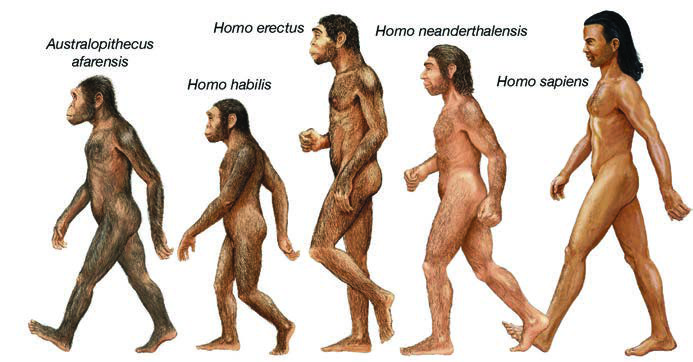
- Australopithecus afarensis: one of our earliest known ancestors. It lived in Africa more than three million years ago and could walk on two legs, though it still looked very ape-like.
- Homo habilis: the name means 'handy man', because this ancestor was among the first to make simple stone tools.
- Homo erectus: the 'upright man'. It walked fully upright, learned to use fire, and was the first human ancestor to spread out of Africa.
- Homo neanderthalensis: the Neanderthals were strong and heavily built, and survived in the cold lands of Europe and Asia.
- Homo sapiens: the 'wise man'. This is us, modern human beings, with language, art, farming and cities.
When you talk about this picture in class, describe what changes from left to right: the posture becomes straighter, the arms become shorter, the head changes shape, and body hair reduces. Evolution prepared humans for the next great story, the building of civilisations. This unit visits two of those stories: the Maya Empire of Central America, and the long history of money.
The Maya Empire
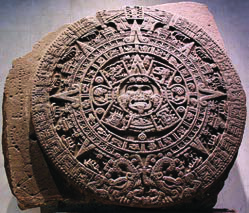
The carved stone wheel in the picture below is a calendar, and it was developed by the people of ancient Mesoamerica. The Maya were master calendar-makers. Their empire, centered in the tropical lowlands of what is now Guatemala, reached the peak of its power and influence around the sixth century AD. The Maya excelled at agriculture, pottery, hieroglyph writing, calendar-making and mathematics, and they left behind an astonishing amount of impressive architecture and symbolic artwork. Yet most of their great stone cities were abandoned by 900 AD, and nobody knows exactly why.
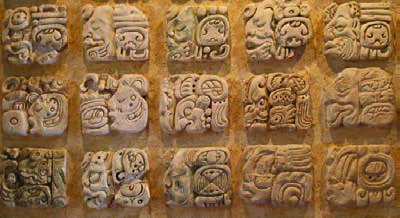
A hieroglyph is a picture that represents a word, syllable or sound. The Maya wrote with hieroglyphs, carving them on stone monuments and temple walls.
Where the Maya Lived
The Maya civilisation was one of the most dominant indigenous societies of Mesoamerica, the region that is present-day Mexico and Central America. Unlike other scattered indigenous populations of the region, the Maya were centered in one geographical block. It covered all of the Yucatan Peninsula and modern-day Guatemala, Belize and parts of the Mexican states of Tabasco and Chiapas, and the western part of Honduras and El Salvador. Because they were concentrated in one area, the Maya remained relatively secure from invasion by other Mesoamerican peoples.
Within that block, the Maya lived in three separate sub-areas, each with its own environment and culture.
| Sub-area | Where it lay |
| Northern Maya lowlands | On the Yucatan Peninsula |
| Southern lowlands | In the Peten district of northern Guatemala and adjacent portions of Mexico, Belize and western Honduras |
| Southern Maya highlands | In the mountainous region of southern Guatemala |
Most famously, the Maya of the southern lowland region reached their peak during the Classic Period of Maya civilisation, from 250 AD to 900 AD. There they built the great stone cities and monuments that have fascinated explorers and scholars ever since.
The First Farmers and the Rise of Cities
The earliest Maya settlements date to around 1800 BC. The earliest Maya were agricultural people who grew crops such as corn, beans, squash and cassava. About 300 BC, Maya farmers began to expand their presence in both the highland and lowland regions. The Middle Pre-classic Period also saw the rise of the first major Mesoamerican civilisation, the Olmecs. Like other Mesoamerican peoples, the Maya derived a number of religious and cultural traits from the Olmec, as well as their number system and their famous calendar. In addition to agriculture, the Pre-classic Maya also displayed more advanced cultural traits like pyramid-building, city construction and the inscribing of stone monuments.
The Classic Period: A Golden Age
The Classic Period, which began around 250 AD, was the golden age of the Maya Empire. Classic Maya civilisation grew to some 40 cities, and each city held a population of between 5,000 and 50,000 people. At its peak, the Maya population may have reached 2,000,000. Excavations of Maya sites have unearthed plazas, palaces, temples and pyramids, as well as courts for playing the ball games that were ritually and politically significant to Maya culture. The cities were surrounded and supported by a large population of farmers.
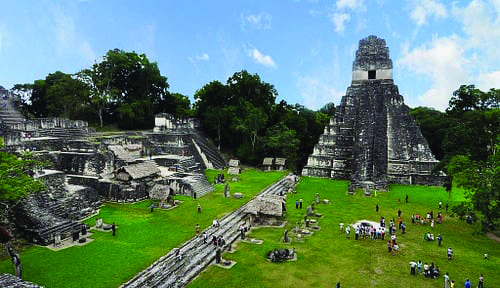
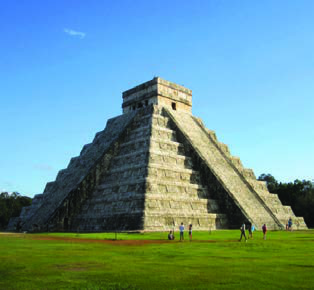
The Maya were deeply religious. They worshipped various gods related to nature, including the gods of the Sun, the Moon, rain and corn. At the top of Maya society were the kings, who claimed to be related to the gods and followed a hereditary succession. They were thought to serve as mediators between the gods and the people on earth, and they performed the elaborate religious ceremonies and rituals so important to Maya culture. The Classic Maya built many of their temples and palaces in a stepped pyramid shape, decorating them with elaborate reliefs and inscriptions. These structures earned the Maya their reputation as the great artists of Mesoamerica.
Guided by their religious ritual, the Maya also made significant advances in mathematics and astronomy, including the use of the zero and the development of a complex calendar system based on 365 days. Early researchers concluded that the Maya were a peaceful society of priests and scribes. Later evidence told another story: a thorough examination of the artwork and inscriptions on their temple walls showed a less peaceful side of Maya culture, including war between rival Mayan city-states and the importance of torture and human sacrifice to their religious ritual.
The Mysterious Collapse
From the late eighth through the end of the ninth century, something unknown happened that shook the Maya civilisation to its foundations. One by one, the classic cities in the southern lowlands were abandoned, and by 900 AD, Maya civilisation in that region had collapsed. The reason for this mysterious decline is unknown, though scholars have developed several competing theories.
- Environmental exhaustion: some believe that by the ninth century the Maya had exhausted the environment around them to the point that it could no longer sustain a very large population.
- Constant warfare: other scholars argue that endless fighting among competing city-states broke down the complicated military, family and trade alliances between them, along with the traditional system of dynastic power. As the stature of the holy lords diminished, their complex traditions of rituals and ceremonies dissolved into chaos.
- Catastrophic drought: finally, an extremely long and intense period of drought may have wiped out the Classic Maya civilisation. Drought would have hit cities like Tikal especially hard, because rainwater there was necessary for drinking as well as for crop irrigation.
All three of these factors may have played a part in the downfall of the Maya in the southern lowlands. This is one reason historians study the past so carefully: a civilisation that seemed unshakeable can still fall, and understanding why helps us protect our own.
Word Stress
In every English word of more than one syllable, one syllable is said more strongly than the others. That strong syllable carries the stress, and dictionaries mark it with a small raised mark before it. Say these words from the reading aloud and press hardest on the marked syllable.
- succe'ssion, with the stress on the second syllable: suc CE ssion
- exca'vation, with the stress on the third syllable: ex ca VA tion
- in'scription, with the stress on the second syllable: in SCRIP tion
- concen'tration, with the stress on the third syllable: con cen TRA tion
- ex'cel, with the stress on the second syllable: ex CEL
- 'architecture, with the stress on the first syllable: AR chi tec ture
- 'cultural, with the stress on the first syllable: CUL tur al
- ex'hausted, with the stress on the second syllable: ex HAUS ted
Words ending in -tion almost always carry their stress on the syllable just before -tion. Test it: succession, excavation, inscription, concentration. It works every time.
Talking About the Past: used to
Look at these two views of the same village, taken about ten years apart. In the earlier picture there are terraced fields, scattered houses and bare tracks. In the later one there are rows of new buildings, a pond and paved paths. English has a special structure for exactly this kind of comparison: used to.
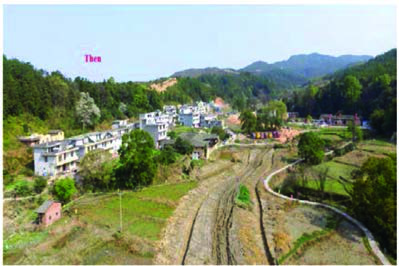
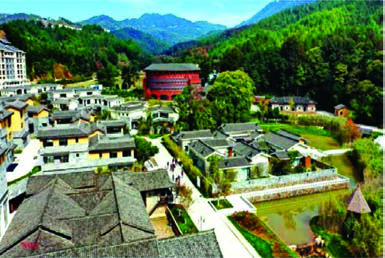
Used to + base verb describes a habit or a state that was true in the past but is not true now. There used to be a field in front of the village, but now it is filled with houses. The negative is didn't use to, and never used to is an even stronger negative. The question form is Did you use to ...?
Practise with the two pictures. The village used to have terraced fields; now it has rows of houses. People didn't use to have paved roads; now they walk on stone paths. There never used to be a pond; now there is one at the edge of the village.
After did or didn't, write use to, not used to. 'Did you use to play football?' and 'I didn't use to like tea' are correct. 'Did you used to play?' is a very common mistake, because the two forms sound the same when spoken.
The same structure works for people. Samita described her life five years ago and her life today, and the two descriptions hardly match.
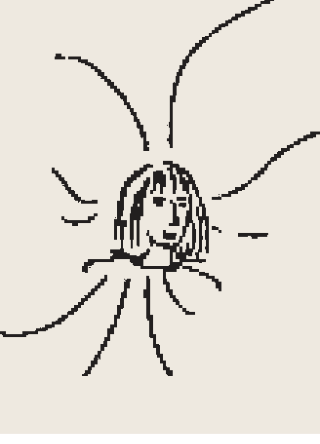
Five years ago Samita said: I travel a lot. I play the piano. I'm very lazy. I don't like cheese. I've got a dog. I'm a hotel receptionist. I've got lots of friends. I never read newspapers. I don't drink tea. I go to a lot of parties. Today she says: I eat a lot of cheese now. I work very hard these days. I work in a bookshop now. I don't know many people these days. I don't go away much these days. My dog died two years ago. I read a newspaper every day now. I haven't been to a party for ages. I haven't played the piano for years. Tea's great! I like it now.
- She used to travel a lot, but she doesn't go away much these days.
- She used to play the piano, but she hasn't played it for years.
- She didn't use to like cheese, but she eats a lot of cheese now.
- She used to have a dog, but it died two years ago.
- She never used to read newspapers, but she reads one every day now.
- She didn't use to drink tea, but she likes it now.
- She used to go to a lot of parties, but she hasn't been to one for ages.
Telling a Story from Pictures
A set of pictures can hold a whole story, and putting them in order is the first step of telling it. The six pictures below show two pairs of goats and one narrow bridge over a river. Study them, decide the order in which things must have happened, and then narrate the story aloud in past tense.
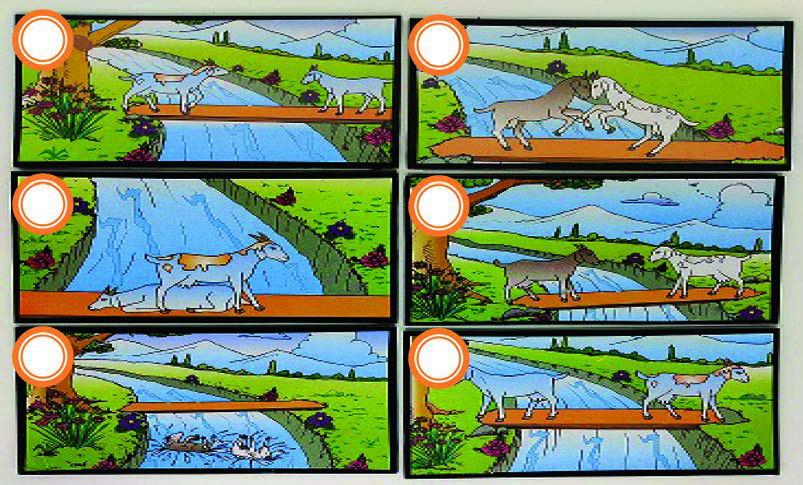
The story runs like this. Two goats approached the narrow bridge from opposite banks. They met in the middle, and neither was willing to step back. They lowered their horns and fought, and both fell into the river below. Later, two other goats met on the same bridge. One of them calmly lay down, the other stepped gently over it, and both crossed safely. When you narrate, use sequence words such as first, then, after that, at last, and keep every verb in the past tense. End with the lesson the pictures teach: a little give and take succeeds where stubbornness fails.
The History of Money
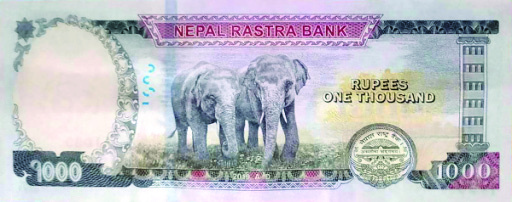
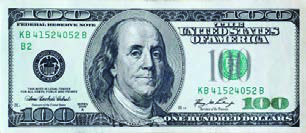
The notes and coins below are currencies: a one-thousand-rupee note issued by Nepal Rastra Bank and a one-hundred-dollar bill of the United States. Imagine a world without them. To get rice, you would have to find someone who had rice and also happened to want exactly what you could offer. Money solves that problem, and its story is as old as human civilisation itself. Money is basically a means of exchange; coins and notes are just items of exchange. But money was not always in the form it has today, and it is still developing.
Barter is a system of direct exchange of one product for another, without money. Before money was invented, barter was the basis of early commerce.
After barter, both livestock, particularly cattle, and plant products such as grain came to be used as money in many different societies at different periods. Cattle are probably the oldest of all forms of money, since the domestication of animals tended to precede the cultivation of crops. The earliest evidence of banking is found in Mesopotamia between 3000 and 2000 BCE, when temples were used to store grain and other valuables used in trade.
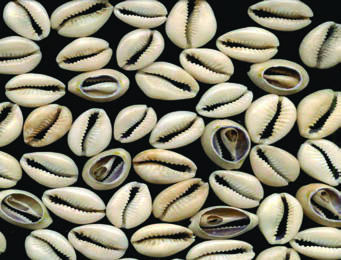
Some of the earliest currencies were objects from nature. A notable example is cowrie shells, first used as money about 1200 BCE. Though they may seem a random choice, the shells had real advantages: they were similar in size, small, and durable. The mollusks that produce them live in the coastal waters of the Indian and Pacific Oceans, yet trade spread the shells so far that even some European countries accepted them as currency. Shells in the form of wampum were used as money by Native Americans. Another currency from nature was whale teeth, used by Fijians, and the people of Yap Island carved huge disks of limestone that eventually became currency and remained a part of the island's culture.
From Metal Coins to Digital Money
The use of metal for money can be traced back to Babylon before 2000 BCE, but standardised and certified coinage may not have existed until the 7th century BCE. According to many historians, it was during this time that the kingdom of Lydia, in present-day Turkey, issued the first regulated coins. They appeared during the reign of King Alyattes, who ruled from 610 to 560 BCE, and were made of electrum, a natural mixture of gold and silver. Crudely shaped like beans, these coins featured the royal symbol, a lion. Alyattes' son, Croesus, reformed the kingdom's currency by introducing silver coins and gold coins, and soon such currency began appearing elsewhere.
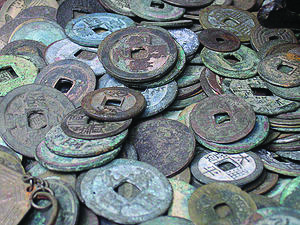
About the 6th century BCE, leather and animal hide began to be fashioned into currency. Early ancient Rome reportedly used this type of money, and it was also found in Carthage, in what is now France, and in Russia, which is believed to have used leather money into Peter the Great's reign. The Chinese emperor Wudi, who ruled from 141 to 87 BCE, created currency out of skins from his personal collection of white stags, fringed and decorated with elaborate designs. Although no longer used, leather money may have left a lasting legacy.
Given that paper is widely believed to have originated in China, it is fitting that the same country introduced paper currency. This innovation is widely thought to have occurred during the reign of Emperor Zhenzong, from 997 to 1022 CE. The notes were made from the bark of mulberry trees, so in a sense money really did grow on trees. By the late 18th and early 19th centuries, paper money had spread to other parts of the world. The bulk of it, however, was not money in the traditional sense but promissory notes: promises to pay specified amounts of gold or silver, which were key in the development of banks.
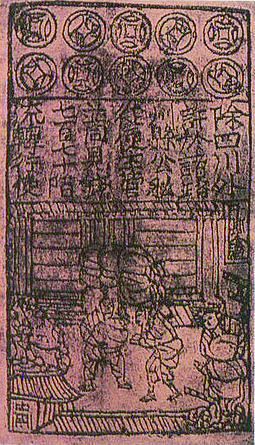
Fiat money is currency issued on the order of a sovereign government which, unlike gold and silver coins, has no intrinsic value. Its value rests only on the government's order and people's trust.
Fiat money brought a problem. Countries could issue such money at will, and some did, potentially making the currency worthless. This became such a problem that in 1821 the United Kingdom, then the leader in international finance, introduced the gold standard. In this monetary system, the standard unit of currency is kept at the value of a fixed quantity of gold, which increases confidence in international trade by preventing governments from excessively issuing currency. Eventually other countries, including Germany, France and the United States, adopted the gold standard too.
The system had drawbacks of its own. Notably, it limited a country's ability to isolate its economy from depression or inflation in the rest of the world. After the Great Depression, which lasted from 1929 to 1939, countries began to rethink the gold standard, and by the 1970s gold was no longer being tied to currency. The 21st century has given rise to novel forms of money, including digital payment and virtual currency such as bitcoin. Are paper notes and coins going to disappear soon? Nobody knows, but the history of money suggests it will keep changing form.
Listening: A Memory of Childhood
The listening task for this unit is a recording in which a speaker looks back on his early childhood: the house he grew up in, the garden around it, the trees, and how different his feelings were then. Before you press play, answer the warm-up questions from your own life: write any three most memorable things about your early childhood days, and say whether you wish you could be a young child again, and why.
Then read the printed tasks carefully before listening, because they tell you exactly what to catch. The sentence-completion items ask about the house where the speaker did something, how the Sun used to come at the window in the morning, when it used to wake him, the colour of the roses, who set the laburnum tree and on what occasion, and what the boy felt he was close to. The multiple-choice items ask where the robin built its nest, which tree is still living, how the speaker felt while swinging, which flower he does not mention, what his spirit is like now, what he thought about the fir treetops, and how he feels remembering his boyhood.
- Read every question and blank first, and predict what kind of word fits: a verb, a colour, a time word, a name of a tree.
- Listen the first time without writing, just following the speaker's memories in order.
- Listen the second time with your pencil ready, and fill each blank the moment you hear its answer.
- Write only what you actually hear, not what you expect. A question about a flower that is NOT mentioned needs you to tick off the ones that are.
- After listening, recall your own most favourite childhood memory and describe it to your friends, using used to for the habits of those days.
Three Past Tenses
English has more than one way to talk about the past, and this unit brings three of them together. Study these sentences: While I was studying, Karen phoned me three times. They were playing football when the storm started. While she was working in India, she began to learn Hindi. I had finished the shopping when I met Manoj. When we got to the party, most people had already left. It was the best movie I'd ever seen. He had already read the book, so I gave it to his sister. She had known him since they were children. In 2005, I was living in Biratnagar. She called me yesterday.
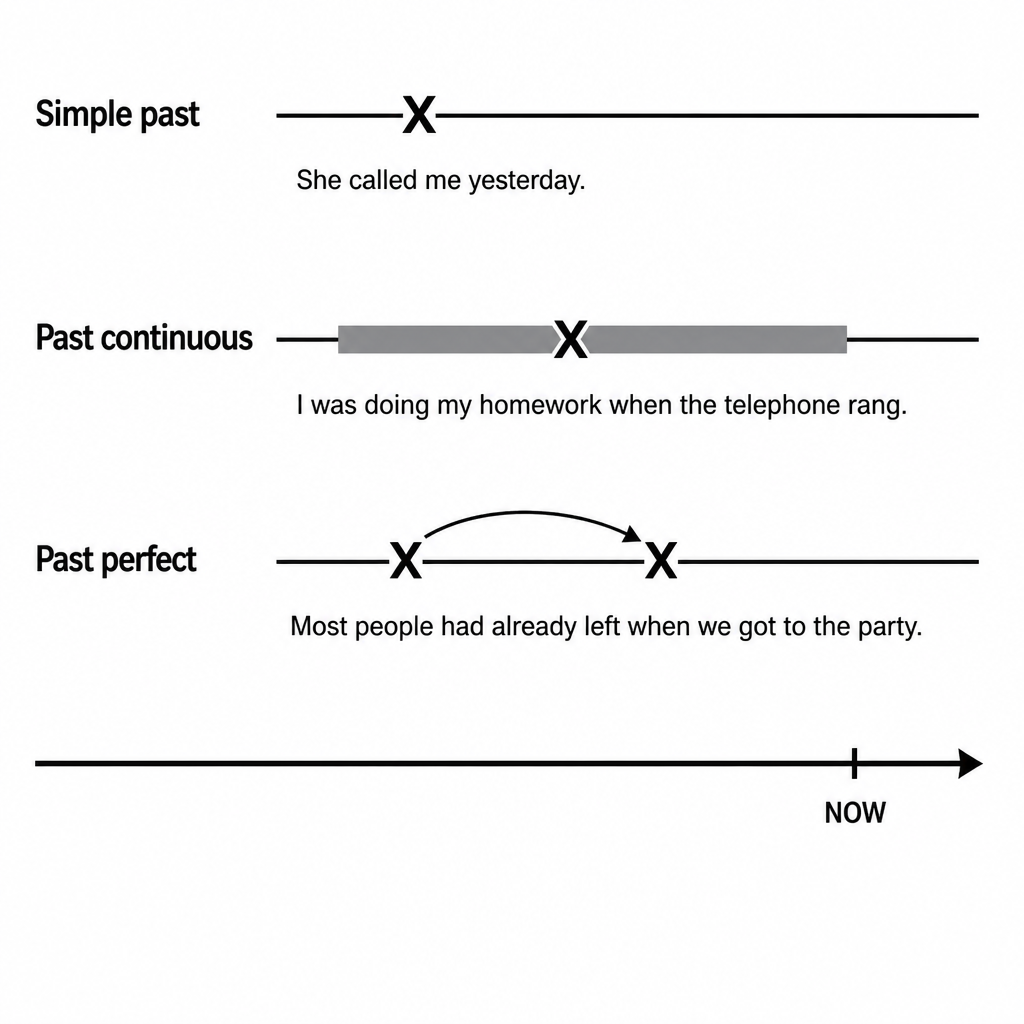
The simple past describes a completed action at a definite time in the past: She called me yesterday. Form: verb + ed, or the irregular second form.
The past continuous describes a longer action that was in progress at a past moment, often interrupted by a shorter simple-past action: They were playing football when the storm started. Form: was or were + verb-ing.
The past perfect describes an action that was already complete before another past action or time: When we got to the party, most people had already left. Form: had + past participle.
| Tense | Use | Example |
| Simple past | A finished action at a known past time | She called me yesterday. |
| Past continuous | A longer action in progress, often interrupted | I was doing my homework when the telephone rang. |
| Past perfect | The earlier of two past actions | He had already read the book, so I gave it to his sister. |
Do not use the past continuous for the short interrupting action. The long background action takes was or were + verb-ing, and the interruption takes the simple past: I was cooking a meal when the earthquake occurred, never I cooked a meal when the earthquake was occurring.
Giving a Story a Title
A good title is short, points at the heart of the story, and makes a reader want to know more. It can name the main characters, or it can name the lesson. Read this fable and try titling it yourself before reading on.
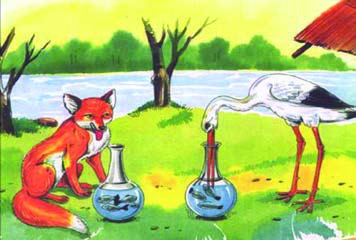
A fox in a forest planned to have fun with a stork, whose appearance he always laughed at. He invited the stork to dine, then served soup in a very shallow dish. The stork could only wet the tip of his bill and could not drink a single drop, while the fox lapped it up easily and made a great show of his enjoyment. The hungry stork was displeased, but he was calm-tempered and saw no good in flying into a rage. Instead, he invited the fox to dine with him in turn, and served a delicious-smelling fish dinner in a tall jar with a very narrow neck. The stork ate easily with his long bill; the fox could only lick the outside of the jar and sniff. When the fox lost his temper, the stork said calmly, 'Do not play tricks on your neighbours unless you can stand the same treatment yourself.' Suitable titles for this story include 'The Fox and the Stork', 'Tit for Tat', or 'A Trick Repaid'. Each one either names the characters or names the lesson.
The unit also asks you to develop full stories from bare outlines, such as a defeated king who watches a spider fail six times and succeed on the seventh, or two friends who meet a bear and discover which of them is a true friend. Turning an outline into a story is a skill you can follow step by step.
- Read the whole outline first, so you know where the story ends before you begin.
- Turn each fragment of the outline into one or two full sentences in the past tense.
- Add details the outline leaves out: names, places, feelings and a line or two of speech.
- Connect the sentences with time words such as once, one day, then, at last.
- End with the moral in a single clear sentence, and give the finished story a title.
Writing an Essay: The Importance of History
Do students need to learn history? The essay task of this unit asks you to argue that they do. An essay has three parts. The introduction says what the essay is about and states your view in one or two sentences. The body gives your reasons, one paragraph for each. The conclusion sums up and leaves the reader with a final thought. For this topic, strong body points include: history explains how our present world was made, from villages that turned into towns to money that turned from shells into apps; history teaches us from the successes and failures of others, such as the rise and mysterious fall of the Maya Empire; history gives us identity, because our language, festivals and nation all have roots in the past; and history trains judgement, because weighing evidence about the past is practice for weighing evidence today. A memorable conclusion might note that a person who knows no history is like a traveller with no memory of the road behind them.
Project Work: Your Family's Past
History is not only about empires; every family carries its own. For the project, ask your parents, grandparents, other family members or friends about your ancestors. Note down the main points and share them with your friends. Good questions to ask: Where did our family live three generations ago? What work did they do? How did they travel, cook and light their homes? What did things use to cost? Which stories about them are still told? Write the answers as notes, not full sentences, then organise them by generation before presenting. You will find yourself naturally using used to, because almost everything they describe has changed.
The Semicolon
A semicolon (;) separates two independent clauses that are not joined by a conjunction, and it separates elements in a series when those elements already contain commas.
Use it first between two complete sentences that belong together: The first group planted the saplings; the second group watered them. Each half could stand alone, and the semicolon holds them together without adding and or but. Use it second inside a list whose items already contain commas: On our tour we visited Kathmandu, Nepal; Pokhara, Nepal; and Darjeeling, India. Without the semicolons, the reader could not tell where one item ends and the next begins.
A semicolon joins two complete sentences. If one side cannot stand alone as a sentence, use a comma instead. 'Although it rained; we played' is wrong, because 'although it rained' is not a complete sentence.
The full lesson is waiting for you
The notes are free to read in full. A free account opens the rest of the practice, and tracks your progress and confidence score for every subject. Presentations and videos need approval from Learn Yeti.