What Area Means
Area is the amount of flat space a surface covers. Put an exercise book down on a table and the patch of table it hides is its area. What is being measured here is space and not length, so area is always written in square units such as square centimetres, square metres or square feet.
Area: the amount of flat surface a shape covers. It is measured in square units.
The simplest way to find an area is to draw the shape on squared paper and count the small squares inside it. Try counting the squares covered by each of the shapes below.
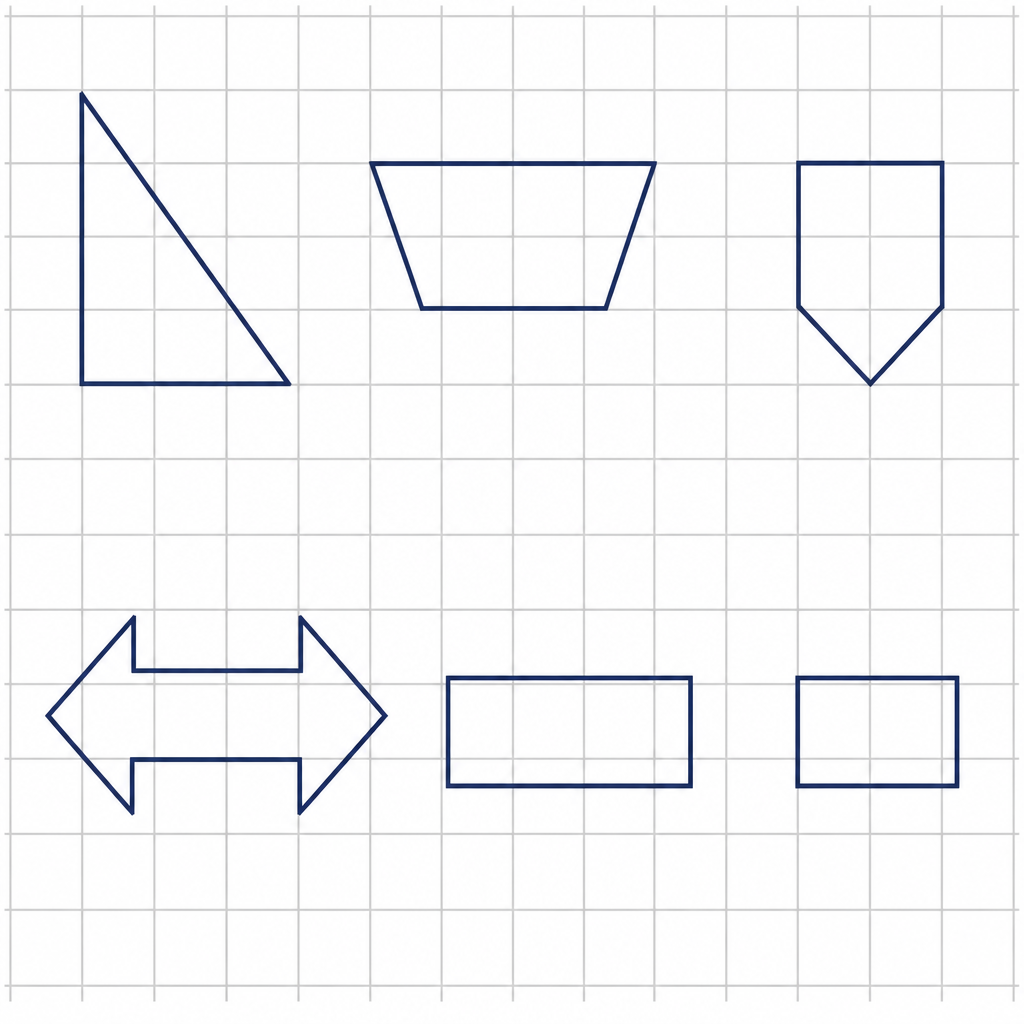
Counting squares works while the edges follow the grid lines. As soon as an edge runs at a slant you are left guessing at halves and quarters, and the answer stops being reliable. That is why each shape gets a formula of its own. The distance all the way round the outside of a shape is its perimeter. Perimeter is a length and area is a square measure, so the two are never written in the same units.
Perimeter: the total distance all the way round a shape, found by adding the lengths of all its sides.
The Area of a Right Angled Triangle
Take a rectangular sheet of paper with length l and breadth b. Its area is \( l \times b \). Now fold it along one diagonal and cut. The two pieces sit exactly on top of one another, which means the rectangle has been split into two identical right angled triangles.
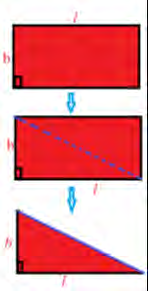
So the area of the rectangle is twice the area of one right angled triangle, which makes one triangle exactly half the rectangle:
\[ A = \frac{1}{2} \times l \times b \]
In a right angled triangle the two sides that make the right angle are the base b and the perpendicular p. Written with those letters the rule is:
\[ A = \frac{1}{2} \times b \times p \]
In a right isosceles triangle the perpendicular and the base are equal, so \( p = b \). That gives a shorter rule for this one triangle:
\[ A = \frac{p^2}{2} \quad \text{or} \quad A = \frac{b^2}{2} \]
The Area of Any Triangle
Now take a triangle with no right angle. Draw a rectangle of base b and height h and draw inside it a triangle with the same base and the same height. Drop a perpendicular from the top vertex to the base and the triangle is split in two. Cut off the two spare corners of the rectangle and lay them over the triangle, and they cover it exactly.
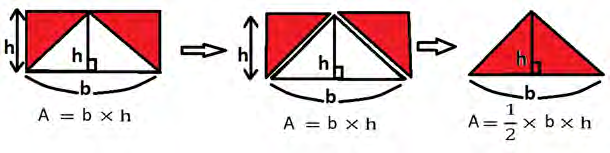
So the rectangle is twice the triangle, and the rule for every triangle follows:
\[ A = \frac{1}{2} \times b \times h \]
Here h is the length of the perpendicular from the vertex down to the base line, not the length of a sloping side. In a very flat triangle that perpendicular can even land outside the base itself, and the rule still holds.
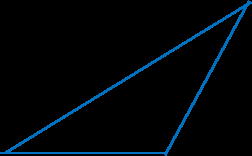
Do not put a sloping side into the formula as the height. The height is only the perpendicular, the line that meets the base at a right angle. Look for the little right angle mark and take that line.
Take a triangle with base 6 units and height 5 units as an example. The perpendicular splits it into two right angled triangles whose bases are 4 units and 2 units.
Step 1: The area of the first right angled triangle is:
\[ \frac{1}{2} \times 4 \times 5 = 10 \]
Step 2: The area of the second right angled triangle is:
\[ \frac{1}{2} \times 2 \times 5 = 5 \]
Step 3: Adding the two pieces gives the whole area in square units:
\[ 10 + 5 = 15 \]
Using the formula directly gives \( \frac{1}{2} \times 6 \times 5 = 15 \) as well, and that is half of the 6 by 5 rectangle whose area is 30 square units.
The Area of an Equilateral Triangle
In an equilateral triangle ABC all three sides are equal, say each of length a. Drop a perpendicular AD from the vertex A to the base BC. In an equilateral triangle the line that halves the top angle also cuts the base into two equal parts, so D is the midpoint of BC. The height is not given, so it has to be found first using the Pythagoras theorem.
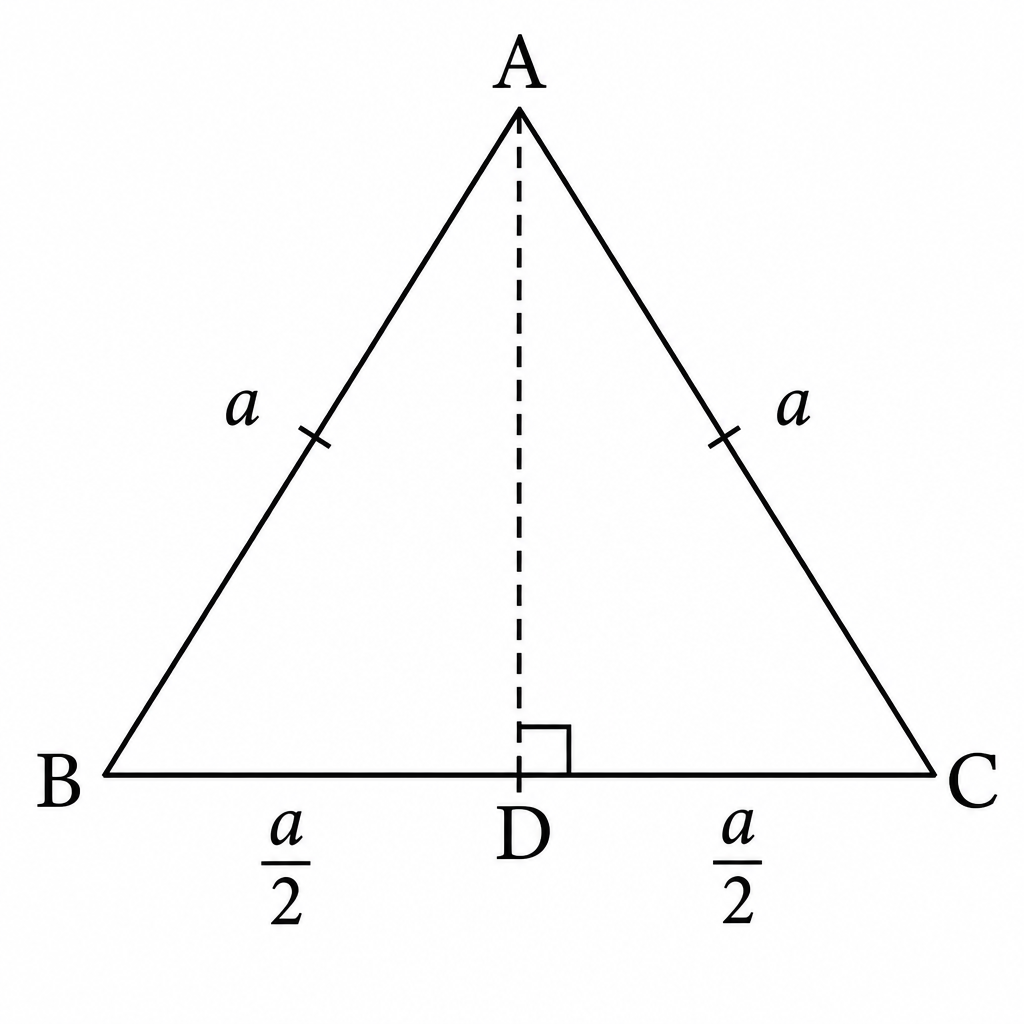
Step 1: AD cuts the base into two equal parts, so:
\[ BD = DC = \frac{a}{2} \]
Step 2: Applying the Pythagoras theorem in the right angled triangle ADC gives:
\[ AD^2 = AC^2 - CD^2 \]
Step 3: Substituting AC = a and \( CD = \frac{a}{2} \) gives:
\[ AD^2 = a^2 - \frac{a^2}{4} = \frac{3a^2}{4} \]
Step 4: Taking the square root gives the height:
\[ AD = \frac{\sqrt{3}}{2}a \]
Step 5: Putting base a and this height into the triangle rule gives:
\[ A = \frac{1}{2} \times a \times \frac{\sqrt{3}}{2}a \]
Step 6: Simplifying gives the area of an equilateral triangle:
\[ A = \frac{\sqrt{3}}{4}a^2 \]
For an equilateral triangle one side is enough to find the area, because the height itself is built out of that side.
The Area of an Isosceles Triangle
In an isosceles triangle ABC two sides are equal. Let AB = AC = a and let the base BC = b. The perpendicular AD drawn from A to BC again cuts the base into two equal halves.
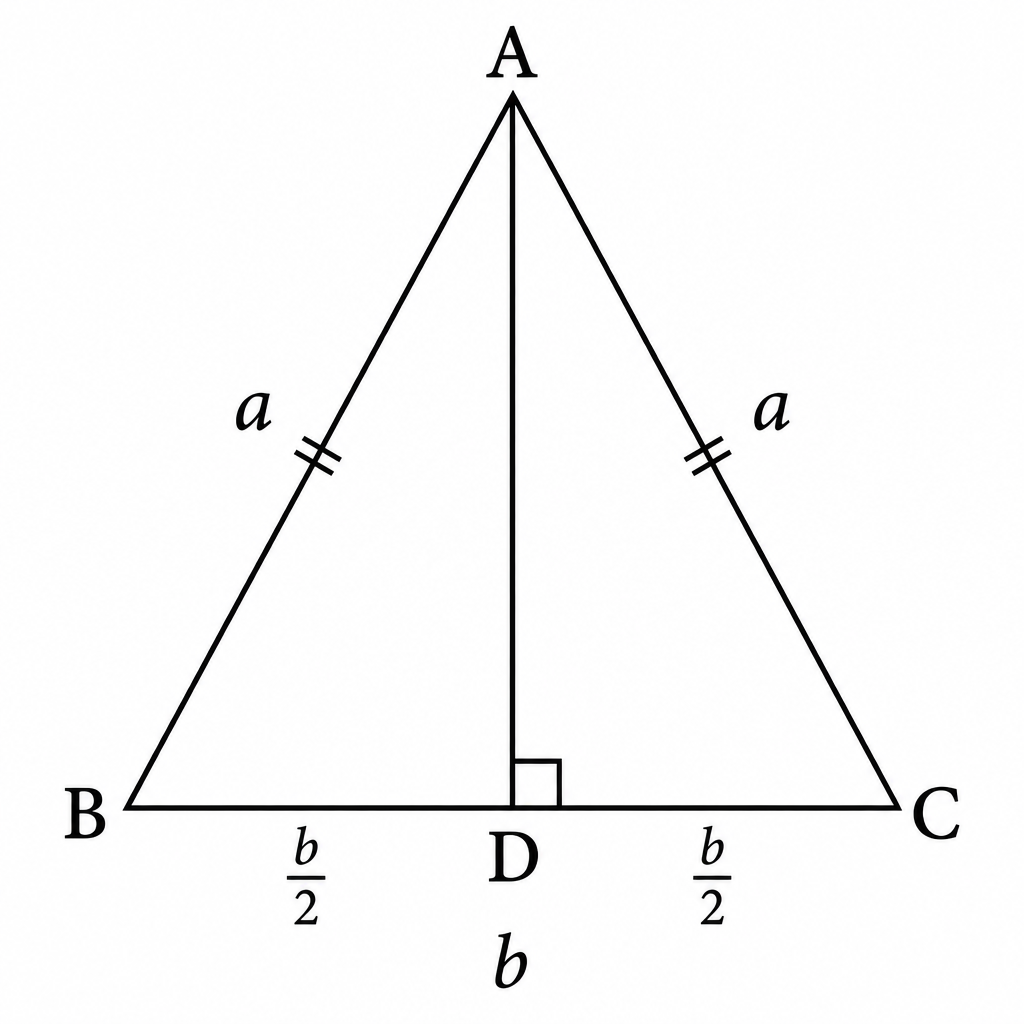
Step 1: The perpendicular halves the base, so:
\[ BD = DC = \frac{b}{2} \]
Step 2: The Pythagoras theorem in the right angled triangle ADC gives:
\[ AD^2 = a^2 - \frac{b^2}{4} = \frac{4a^2 - b^2}{4} \]
Step 3: Taking the square root gives the height:
\[ AD = \frac{\sqrt{4a^2 - b^2}}{2} \]
Step 4: Putting base b and this height into the area rule gives:
\[ A = \frac{1}{2} \times b \times \frac{\sqrt{4a^2 - b^2}}{2} \]
Step 5: Simplifying gives the area of an isosceles triangle:
\[ A = \frac{b\sqrt{4a^2 - b^2}}{4} \]
The Area of a Parallelogram
Make a parallelogram of base b and height h out of cardboard. Cut straight down from the right hand top vertex so that the cut is perpendicular to the base. A right angled triangle comes away. Slide that triangle across to the left hand end and it fits exactly, turning the parallelogram into a rectangle.
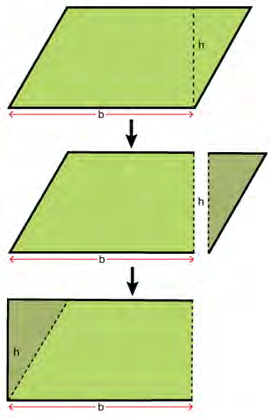
The new rectangle has length b and breadth h, and cutting and sliding cannot change how much surface there is. So:
\[ A = b \times h \]
Once again h is the perpendicular distance from one base to the parallel side opposite it, not the length of the slanting side.

The Area of a Rhombus
A rhombus ABCD has four equal sides, and its two diagonals AC and BD cross each other at right angles. Draw the diagonal BD and the rhombus splits into triangle ABD and triangle CBD. The diagonals meet at O, so both AO and CO are perpendicular to BD.
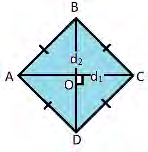
Step 1: Adding the areas of the two triangles gives:
\[ A = \frac{1}{2} BD \times AO + \frac{1}{2} BD \times CO \]
Step 2: Taking the common factor BD outside gives:
\[ A = \frac{1}{2} \times BD \times (AO + CO) \]
Step 3: AO and CO together make the whole diagonal AC, so:
\[ A = \frac{1}{2} \times BD \times AC \]
Step 4: Calling the diagonals \( d_1 \) and \( d_2 \), the area of a rhombus is:
\[ A = \frac{1}{2} \times d_1 \times d_2 \]
The diagonals of a kite also cross at right angles, so the very same rule gives the area of a kite.
The Area of a Trapezium
A trapezium is a quadrilateral with exactly one pair of parallel sides. In the trapezium ABCD the sides AB = a and DC = b are parallel and the perpendicular distance between them is h. Draw the diagonal AC and the trapezium splits into two triangles, each of height h.
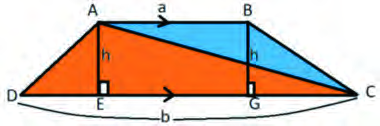
Step 1: Adding the areas of the two triangles gives:
\[ A = \frac{1}{2} \times b \times h + \frac{1}{2} \times a \times h \]
Step 2: Taking the common factor outside gives the area of a trapezium:
\[ A = \frac{1}{2} \times h \times (a + b) \]
The area of a trapezium is half the height multiplied by the sum of the two parallel sides. The slanting sides play no part in this rule.
The Area of Any Quadrilateral
Take a quadrilateral ABCD with no parallel sides at all. Draw one diagonal BD = d, then drop a perpendicular onto that diagonal from each of the other two vertices A and C. Call those perpendiculars \( h_1 \) and \( h_2 \).
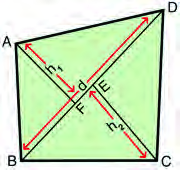
Step 1: Adding the areas of the two triangles the diagonal has made gives:
\[ A = \frac{1}{2} \times d \times h_1 + \frac{1}{2} \times d \times h_2 \]
Step 2: Taking the common factor outside gives the area of the quadrilateral:
\[ A = \frac{1}{2} \times d \times (h_1 + h_2) \]
In words, the area of a quadrilateral is half the diagonal multiplied by the sum of the perpendiculars drawn onto that diagonal.
All the Area Formulas in One Place
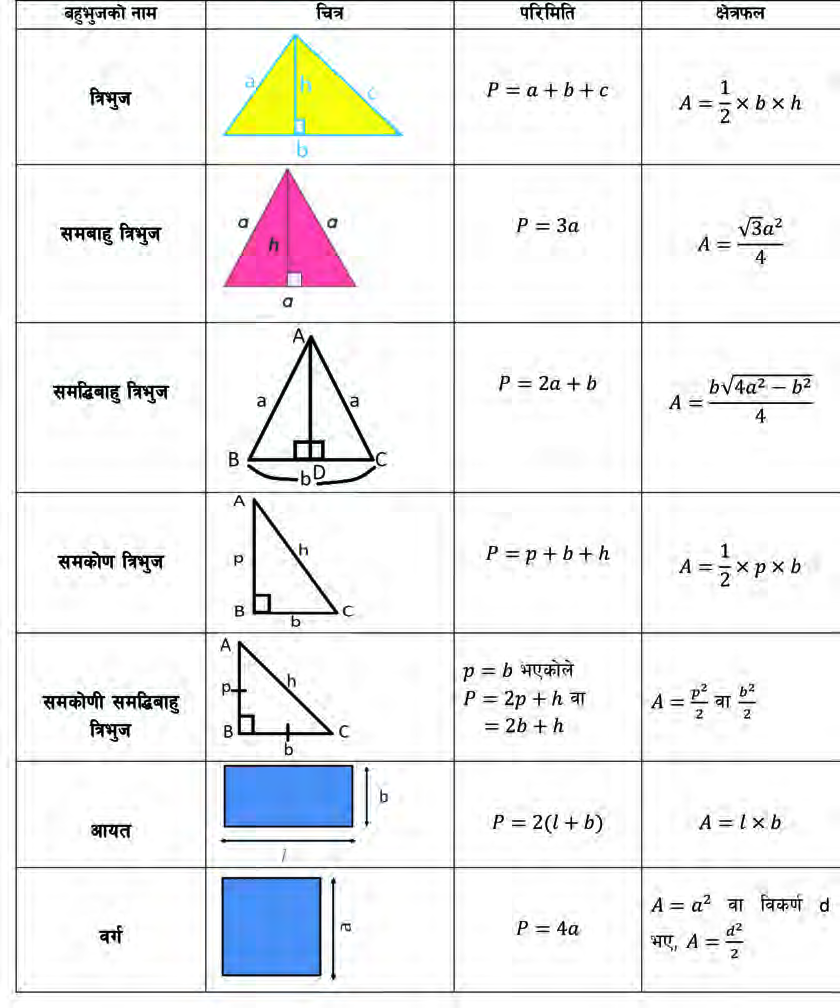
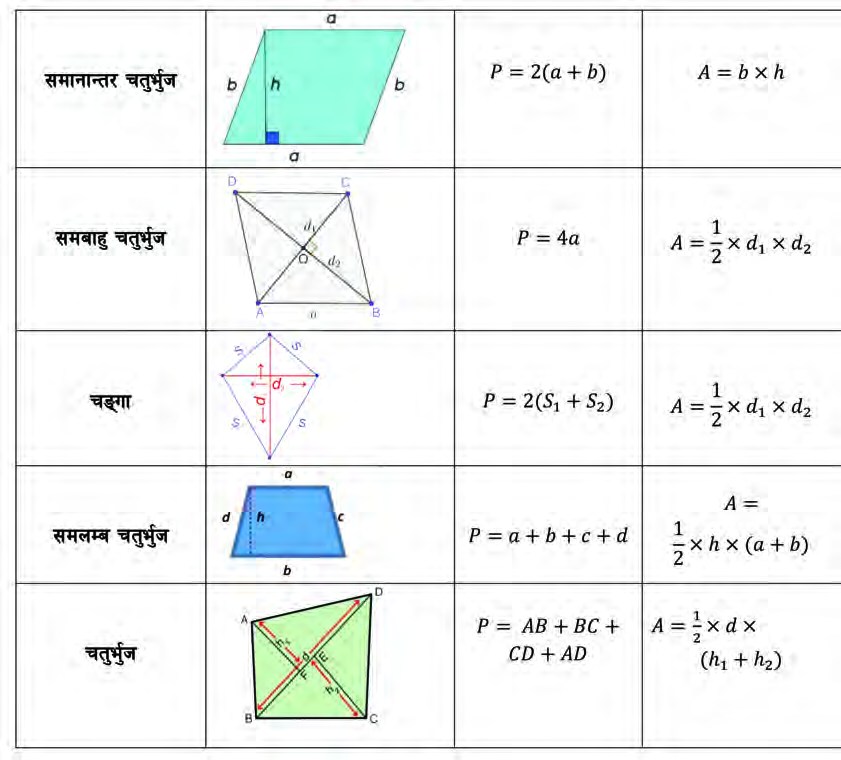
Every perimeter and area rule built so far is collected in the table below. In it a, b, c and d stand for sides, h for height, p for the perpendicular, and \( d_1 \) and \( d_2 \) for the two diagonals.
| Shape | Perimeter (P) | Area (A) |
| Triangle | \( P = a+b+c \) | \( A = \frac{1}{2}bh \) |
| Equilateral triangle | \( P = 3a \) | \( A = \frac{\sqrt{3}}{4}a^2 \) |
| Isosceles triangle | \( P = 2a+b \) | \( A = \frac{b\sqrt{4a^2-b^2}}{4} \) |
| Right angled triangle | \( P = p+b+h \) | \( A = \frac{1}{2}pb \) |
| Right isosceles triangle | \( P = 2b+h \) | \( A = \frac{b^2}{2} \) |
| Rectangle | \( P = 2(l+b) \) | \( A = l \times b \) |
| Square | \( P = 4a \) | \( A = a^2 \) |
| Parallelogram | \( P = 2(a+b) \) | \( A = b \times h \) |
| Rhombus | \( P = 4a \) | \( A = \frac{1}{2}d_1 d_2 \) |
| Kite | \( P = 2(S_1+S_2) \) | \( A = \frac{1}{2}d_1 d_2 \) |
| Trapezium | \( P = a+b+c+d \) | \( A = \frac{1}{2}h(a+b) \) |
| Quadrilateral | \( P = AB+BC+CD+AD \) | \( A = \frac{1}{2}d(h_1+h_2) \) |
When only the diagonal d of a square is known, the area can be found without first working out the side:
\[ A = \frac{d^2}{2} \]
Choosing the Right Formula
The first job in an area question is to name the shape, and the second is to see which measurements have been given. Only then is the formula chosen. The three shapes below are worked in exactly that order.
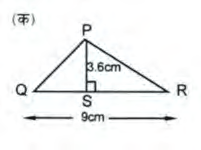
Step 1: This is a triangle with base b = QR = 9 cm and height h = PS = 3.6 cm. Writing the triangle rule:
\[ A = \frac{1}{2} \times b \times h \]
Step 2: Substituting the two measurements gives:
\[ A = \frac{1}{2} \times 9 \times 3.6 \]
Step 3: Working the arithmetic out gives the area:
\[ A = 16.2 \ \text{cm}^2 \]
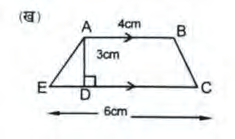
Step 1: This is a trapezium. The parallel sides are a = AB = 4 cm and b = CE = 6 cm, and the height is h = AD = 3 cm. Writing the rule:
\[ A = \frac{1}{2} \times h \times (a + b) \]
Step 2: Substituting the measurements gives:
\[ A = \frac{1}{2} \times 3 \times (4 + 6) \]
Step 3: Doing the addition inside the bracket first gives:
\[ A = \frac{1}{2} \times 3 \times 10 = 15 \ \text{cm}^2 \]
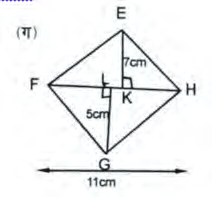
Step 1: This is a general quadrilateral. The diagonal is d = FH = 11 cm and the perpendiculars are \( h_1 = 7 \) cm and \( h_2 = 5 \) cm. Writing the rule:
\[ A = \frac{1}{2} \times d \times (h_1 + h_2) \]
Step 2: Substituting and adding inside the bracket gives:
\[ A = \frac{1}{2} \times 11 \times 12 = 66 \ \text{cm}^2 \]
Never leave the square unit off the answer. Writing 16.2 on its own is an incomplete answer; 16.2 square centimetres is the whole of it. If the measurements come in different units, change them all to one unit before you start.
Areas That Are Added Together
Many shapes have no formula of their own, because they are two or more simple shapes joined together. Break such a shape into pieces you recognise, find each area on its own, and then add them up.
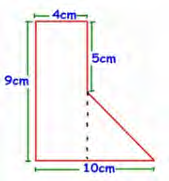
Step 1: The shape is a rectangle with a right angled triangle attached. The rectangle is 9 cm long and 4 cm wide, so:
\[ A_1 = 9 \times 4 = 36 \ \text{cm}^2 \]
Step 2: The base of the triangle is the full width less the width of the rectangle:
\[ b = 10 - 4 = 6 \ \text{cm} \]
Step 3: The perpendicular of the triangle is the full height less the 5 cm on the right hand side:
\[ p = 9 - 5 = 4 \ \text{cm} \]
Step 4: The area of the right angled triangle is then:
\[ A_2 = \frac{1}{2} \times 4 \times 6 = 12 \ \text{cm}^2 \]
Step 5: Adding the two pieces gives the area of the whole shape:
\[ A = 36 + 12 = 48 \ \text{cm}^2 \]
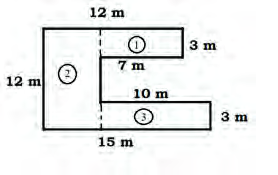
Step 1: This shape is made of three rectangles. The first is 7 m long and 3 m wide, so:
\[ A_1 = 7 \times 3 = 21 \ \text{m}^2 \]
Step 2: The second rectangle is 12 m long, and its width comes from taking 10 m away from the 15 m along the bottom:
\[ b_2 = 15 - 10 = 5 \ \text{m} \]
Step 3: The area of the second rectangle is then:
\[ A_2 = 12 \times 5 = 60 \ \text{m}^2 \]
Step 4: The third rectangle is 10 m long and 3 m wide:
\[ A_3 = 10 \times 3 = 30 \ \text{m}^2 \]
Step 5: Adding all three gives the area of the whole shape:
\[ A = 21 + 60 + 30 = 111 \ \text{m}^2 \]
Areas That Are Taken Away
When a small shape is cut out of, or marked off inside, a larger one, the area left over is found by subtracting. Work out the whole area of the larger shape first, then take away the area of the smaller shape inside it.
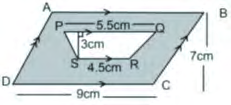
Step 1: The outer shape ABCD is a parallelogram with base 9 cm and height 7 cm:
\[ A_1 = 9 \times 7 = 63 \ \text{cm}^2 \]
Step 2: The inner shape PQRS is a trapezium whose parallel sides are SR = 4.5 cm and PQ = 5.5 cm and whose height is 3 cm:
\[ A_2 = \frac{1}{2} \times 3 \times (4.5 + 5.5) \]
Step 3: Adding inside the bracket and working it out gives:
\[ A_2 = \frac{1}{2} \times 3 \times 10 = 15 \ \text{cm}^2 \]
Step 4: Taking the smaller area from the larger gives the shaded area:
\[ A = 63 - 15 = 48 \ \text{cm}^2 \]
The same method works on problems about land. A rectangular field is 240 ft long and 180 ft wide, and a square pond of side 16 ft sits in the middle of it. The area of the field outside the pond is found like this.
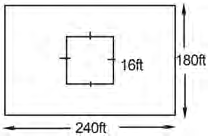
Step 1: The area of the rectangular field is:
\[ A_1 = 240 \times 180 = 43200 \ \text{ft}^2 \]
Step 2: The area of the square pond is:
\[ A_2 = 16^2 = 256 \ \text{ft}^2 \]
Step 3: Taking the pond away from the field leaves:
\[ A = 43200 - 256 = 42944 \ \text{ft}^2 \]
Working Backwards from a Known Area
Sometimes the area is given and a side or a height has to be found. Then the unknown is left inside the formula, which becomes an equation to solve. Suppose an equilateral triangle has area \( 16\sqrt{3} \) square centimetres and its side x is wanted.
Step 1: Writing down the rule for the area of an equilateral triangle:
\[ A = \frac{\sqrt{3}}{4}a^2 \]
Step 2: Putting the given area in and calling the side x makes an equation:
\[ 16\sqrt{3} = \frac{\sqrt{3}}{4}x^2 \]
Step 3: Dividing both sides by \( \sqrt{3} \) and multiplying by 4 gives:
\[ x^2 = 64 \]
Step 4: Taking the square root gives the side:
\[ x = 8 \ \text{cm} \]
When a length is what you are solving for, the answer comes out in units of length, not square units. Here the answer is 8 cm, not 8 square centimetres.
The Circumference of a Circle and π
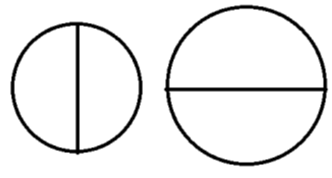
The length of the line all the way round a circle is called the circumference. The distance from the centre out to that line is the radius r, and a line right across the circle through the centre is the diameter d. The diameter is twice the radius, so \( d = 2r \).
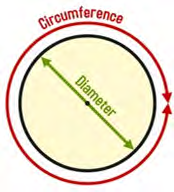
Cut out circles of several different sizes and roll each one along a ruler for exactly one turn, and you have measured its circumference. Divide each circumference by its own diameter and the same number appears every single time. That fixed ratio is written as the Greek letter \( \pi \).
π: the ratio of the circumference of any circle to its diameter. Its approximate value is \( \frac{22}{7} \) or 3.14.
\[ \pi = \frac{C}{d} \]
Turning that relationship round gives the rule for the circumference, and putting \( d = 2r \) in writes it in terms of the radius as well:
\[ C = \pi d = 2\pi r \]
Use whichever value the question gives you. When the radius or diameter is a multiple of 7 the fraction \( \frac{22}{7} \) makes the arithmetic easy; otherwise 3.14 is fine. Never mix the two values inside one calculation.
The Area of a Circle
Draw a circle of radius r on cardboard. Fold and divide it into as many equal parts as you can manage, then cut every part free. Lay the thin triangular pieces side by side, one pointing up and the next pointing down, and they form something very close to a parallelogram. The more pieces you cut, the more exactly it becomes one.
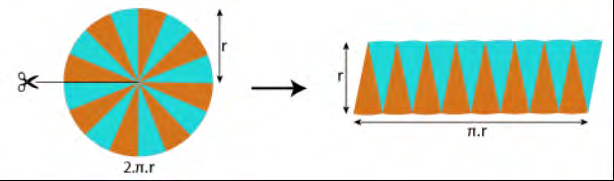
Step 1: The height of the parallelogram is the length of each piece, which is the radius:
\[ h = r \]
Step 2: Half the pieces point up and half point down, so the base is half of the whole circumference:
\[ b = \frac{2\pi r}{2} = \pi r \]
Step 3: Applying the parallelogram rule \( A = b \times h \) gives:
\[ A = \pi r \times r = \pi r^2 \]
Step 4: When only the diameter is known, putting \( r = \frac{d}{2} \) in gives:
\[ A = \frac{1}{4}\pi d^2 \]
Area of a circle: with radius r it is \( A = \pi r^2 \), and with diameter d it is \( A = \frac{1}{4}\pi d^2 \).
Circle Areas from Radius, Diameter and Circumference
In a circle question the route is chosen by looking at what has been given. A radius goes straight into the formula, a diameter uses the diameter form, and a circumference has to be turned into a radius first. All three cases are worked below with \( \pi = 3.14 \).
Step 1: The radius is given as r = 7 cm. Putting it into the formula gives:
\[ A = 3.14 \times 7 \times 7 = 153.86 \ \text{cm}^2 \]
Step 2: The diameter is given as d = 34 ft. Putting it into the diameter form gives:
\[ A = \frac{3.14 \times 34 \times 34}{4} = 907.46 \ \text{sq.ft} \]
Step 3: The circumference is given as C = 62.8 inch. The circumference rule gives the radius:
\[ r = \frac{62.8}{6.28} = 10 \ \text{inch} \]
Step 4: Now that radius goes into the area formula:
\[ A = 3.14 \times 10 \times 10 = 314 \ \text{sq.inch} \]
Finding the Radius When the Area Is Known
The lid of a cylindrical well has an area of 15400 square centimetres. The lid is a circle, so the same rule applies. Take \( \pi = \frac{22}{7} \). Find the radius of the lid, the length of steel needed to run right round it, and the cost at Rs. 250 per metre.
Step 1: Putting the given area into the area formula gives:
\[ 15400 = \frac{22}{7} \times r^2 \]
Step 2: Multiplying both sides by 7 and dividing by 22 gives:
\[ r^2 = \frac{15400 \times 7}{22} = 4900 \]
Step 3: Taking the square root gives the radius:
\[ r = 70 \ \text{cm} \]
Step 4: The distance round the lid is its circumference, so:
\[ C = 2 \times \frac{22}{7} \times 70 = 440 \ \text{cm} \]
Step 5: The price is per metre, so 440 cm is changed to 4.4 m. At Rs. 250 per metre the total cost is:
\[ 4.4 \times 250 = 1100 \]
So the radius of the lid is 70 cm, the steel needed is 4.4 m, and the total cost is Rs. 1100.
Shapes Made From a Square and a Circle
When a circle fits inside a square, the shaded part left around it is the square minus the circle. Take a square of side 12 cm holding a circle of radius 6 cm, with \( \pi = 3.14 \).
Step 1: The area of the square is:
\[ A_1 = 12 \times 12 = 144 \ \text{cm}^2 \]
Step 2: The area of the circle is:
\[ A_2 = 3.14 \times 6 \times 6 = 113.04 \ \text{cm}^2 \]
Step 3: Taking the circle away from the square leaves the shaded area:
\[ A = 144 - 113.04 = 30.96 \ \text{cm}^2 \]
Now take a square ABCD of side 14 cm with a quarter circle drawn in each of its four corners, leaving only the middle piece shaded. Here \( \pi = \frac{22}{7} \) is used.
Step 1: The area of the square is:
\[ A_1 = 14 \times 14 = 196 \ \text{cm}^2 \]
Step 2: Each quarter circle has a radius equal to half the side, so:
\[ r = \frac{14}{2} = 7 \ \text{cm} \]
Step 3: Four quarter circles together make one whole circle, so their total area is:
\[ A_2 = \frac{22}{7} \times 7 \times 7 = 154 \ \text{cm}^2 \]
Step 4: Taking those away from the square leaves the shaded middle:
\[ A = 196 - 154 = 42 \ \text{cm}^2 \]
The full lesson is waiting for you
The notes are free to read in full. A free account opens the rest of the practice, and tracks your progress and confidence score for every subject. Presentations and videos need approval from Learn Yeti.