Points, Axes and Ordered Pairs
To say exactly where a point sits on a flat surface we use two straight lines that cross each other. The horizontal line is the X-axis and the vertical line is the Y-axis. The place where they cross is called the origin, and its coordinates are (0, 0). When we write the coordinates of a point we always write the distance along the X-axis first and the distance along the Y-axis second. That is why (4, 1) and (1, 4) are two different points. For the first one you go 4 units right and then 1 unit up, and for the second you go 1 unit right and then 4 units up.
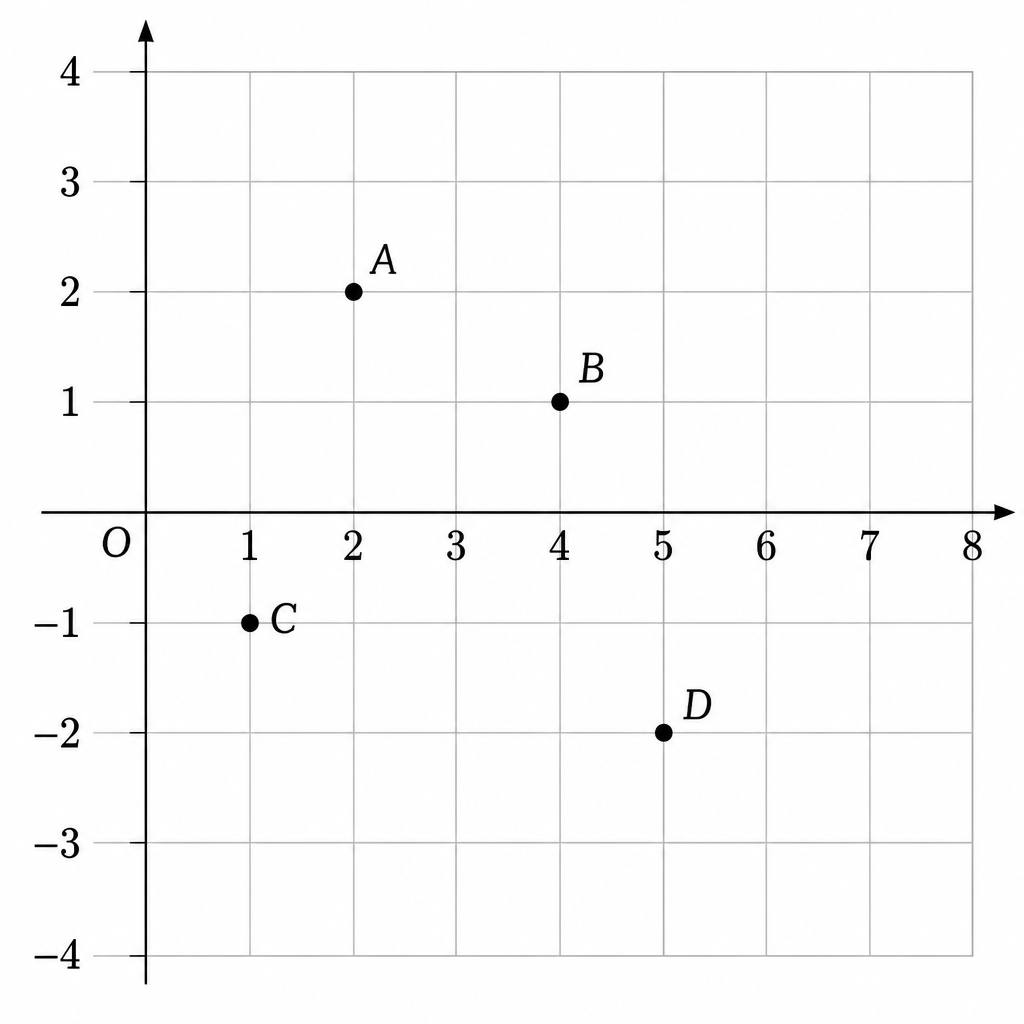
The signs of the two numbers tell you which side of the origin a point lies on. Those signs are the foundation of this whole lesson, because when we start flipping, sliding and turning shapes, it is the signs that show us what has changed.
- A point that is right of the origin and above it has both coordinates positive, such as (2, 2).
- A point that is left of the origin but above it has a negative first coordinate, such as (-3, 2).
- A point that is left of the origin and below it has both coordinates negative, such as (-3, -2).
- A point that is right of the origin but below it has a negative second coordinate, such as (5, -2).
We are now going to learn three ways of moving a shape around on that same plane. In all three the shape keeps its size and its form exactly as before. What changes is where it sits, or which way it faces.
Transformation: changing the position or the facing of a shape without changing its size or its form. Reflection, translation and rotation are the three kinds of transformation studied here.
Reflection in an Axis
When you stand in front of a mirror, your reflection appears exactly as far behind the glass as you are in front of it. A reflection in mathematics behaves in the same way. The line that acts as the mirror is called the axis of reflection. Every vertex of the original shape sits some distance from that line, and the matching vertex of the image sits the same distance away on the other side. In this lesson the mirror is always either the X-axis or the Y-axis.
Reflection: moving every point of a shape to the opposite side of a given line, keeping it the same distance from that line. The new shape produced is called the image.
Reflecting a Shape in the X-axis
Take the triangle ABC whose vertices are A(1, 2), B(2, 0) and C(3, 3), and reflect it in the X-axis. A is 2 units above the axis, so its image lands 2 units below it and becomes A'(1, -2). C is 3 units above, so C' is (3, -3). B is already sitting on the X-axis. Its distance from the mirror is zero, so after the reflection B' is still (2, 0).
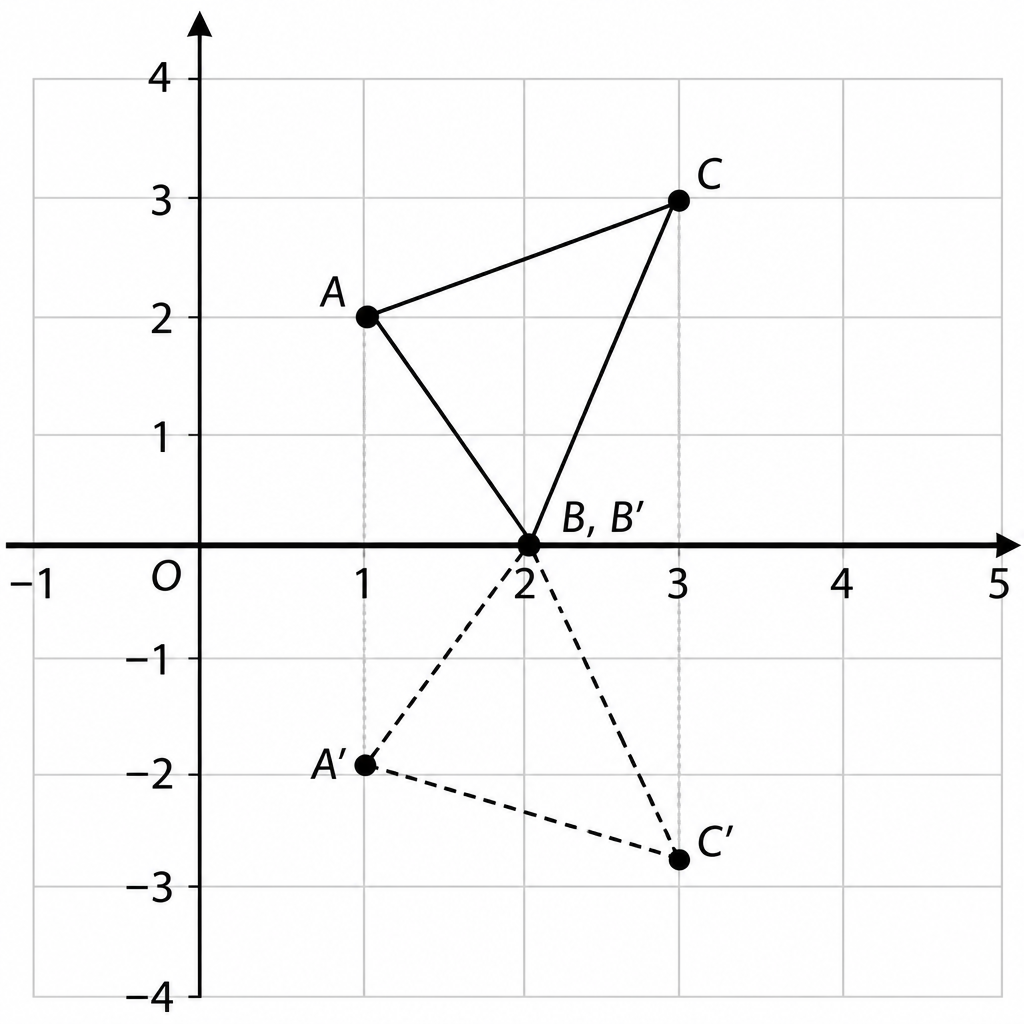
Reflecting in the X-axis keeps the x-coordinate the same and changes only the sign of the y-coordinate, so \( (x,\ y) \rightarrow (x,\ -y) \). A point already on the X-axis does not move at all.
Reflecting a Shape in the Y-axis
Now reflect the same triangle ABC in the Y-axis. This time the mirror stands upright, so the points move from right to left and not up or down. A(1, 2) is 1 unit to the right of the Y-axis, so its image lands 1 unit to the left and becomes A'(-1, 2). In the same way B(2, 0) gives B'(-2, 0) and C(3, 3) gives C'(-3, 3). The second coordinate of all three points stayed exactly as it was.
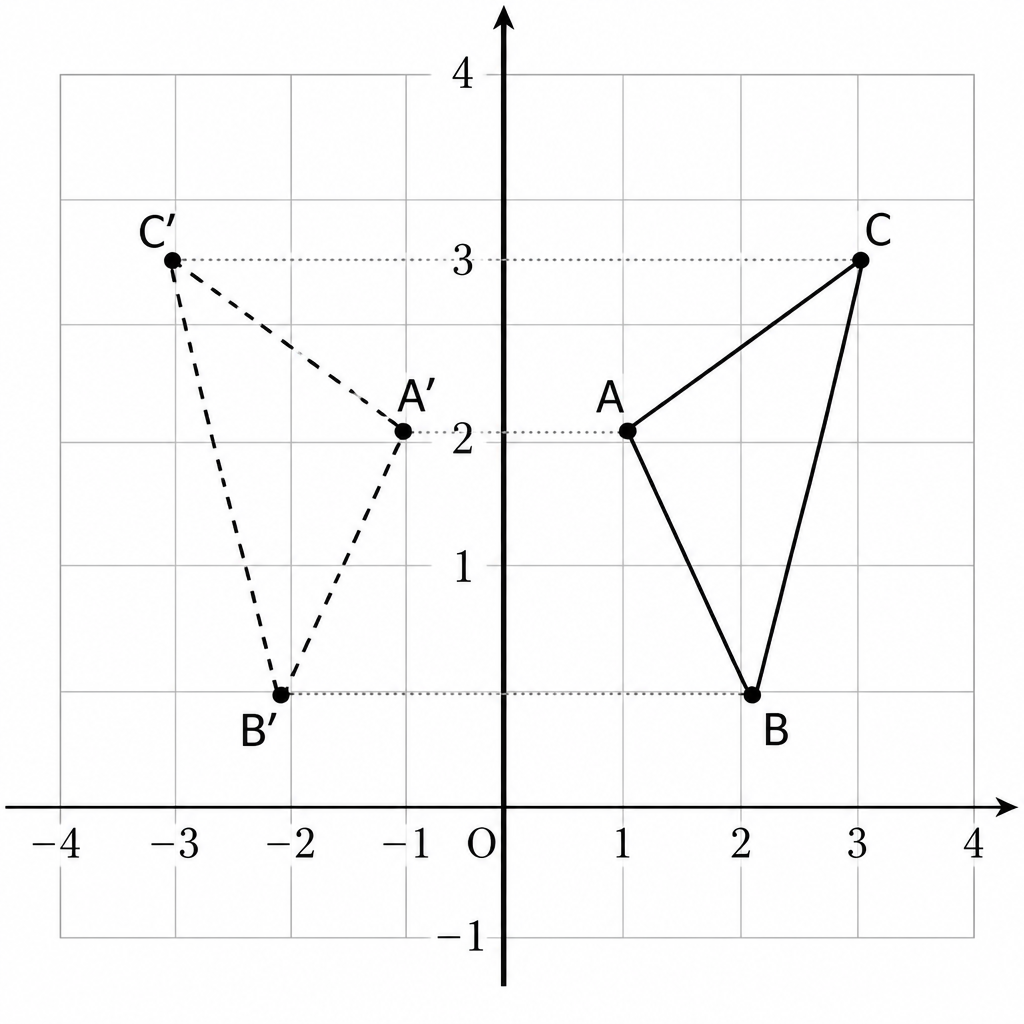
Reflecting in the Y-axis keeps the y-coordinate the same and changes only the sign of the x-coordinate, so \( (x,\ y) \rightarrow (-x,\ y) \). A point already on the Y-axis stays where it is.
Students very often change the wrong coordinate. The safe way to remember it is this: the axis you reflect in is the coordinate that does not change. Reflect in the X-axis and x stays; reflect in the Y-axis and y stays.
Worked Example: A Triangle Reflected in the Y-axis
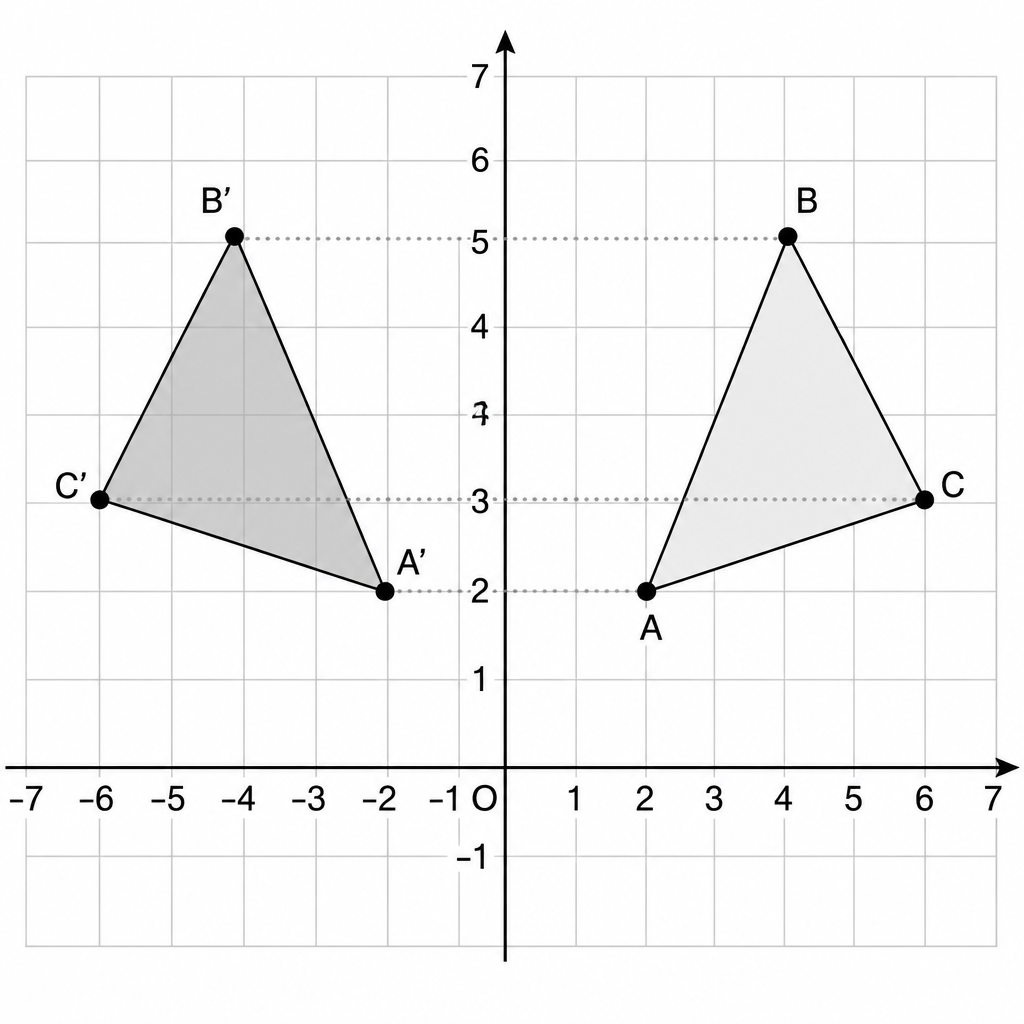
A(2, 2), B(4, 6) and C(6, 3) are the vertices of a triangle. Reflect it in the Y-axis and write down the coordinates of the image triangle A'B'C'.
Step 1: Write down the rule for a reflection in the Y-axis:
\[ (x,\ y) \rightarrow (-x,\ y) \]
Step 2: Apply the rule to A, so the x-coordinate changes sign and the y-coordinate is copied down:
\[ A(2,\ 2) \rightarrow A'(-2,\ 2) \]
Step 3: Apply the same rule to B:
\[ B(4,\ 6) \rightarrow B'(-4,\ 6) \]
Step 4: Apply the same rule to C:
\[ C(6,\ 3) \rightarrow C'(-6,\ 3) \]
So the image triangle has vertices A'(-2, 2), B'(-4, 6) and C'(-6, 3). The two triangles have sides of exactly the same length, but the order of A, B and C now runs the other way round in the image. That reversal is the same one you see when you raise your right hand in front of a mirror.
Translation: Sliding a Shape
Push a book across your desk without lifting it, without turning it and without flipping it, and you have translated it. In a translation every single point of the shape moves the same distance in the same direction. That is why a translation is never described by one number alone. You must say how far, and you must say which way.
Translation: moving a point or an object a fixed distance in a given direction. To describe a translation you must state both the amount of the move and its direction.
Take the point A(1, 2) and slide it 3 units right and 2 units up. It lands on A'(4, 4). A translation like this is written in short as (3, 2), where the first number is the sideways move and the second is the up and down move.
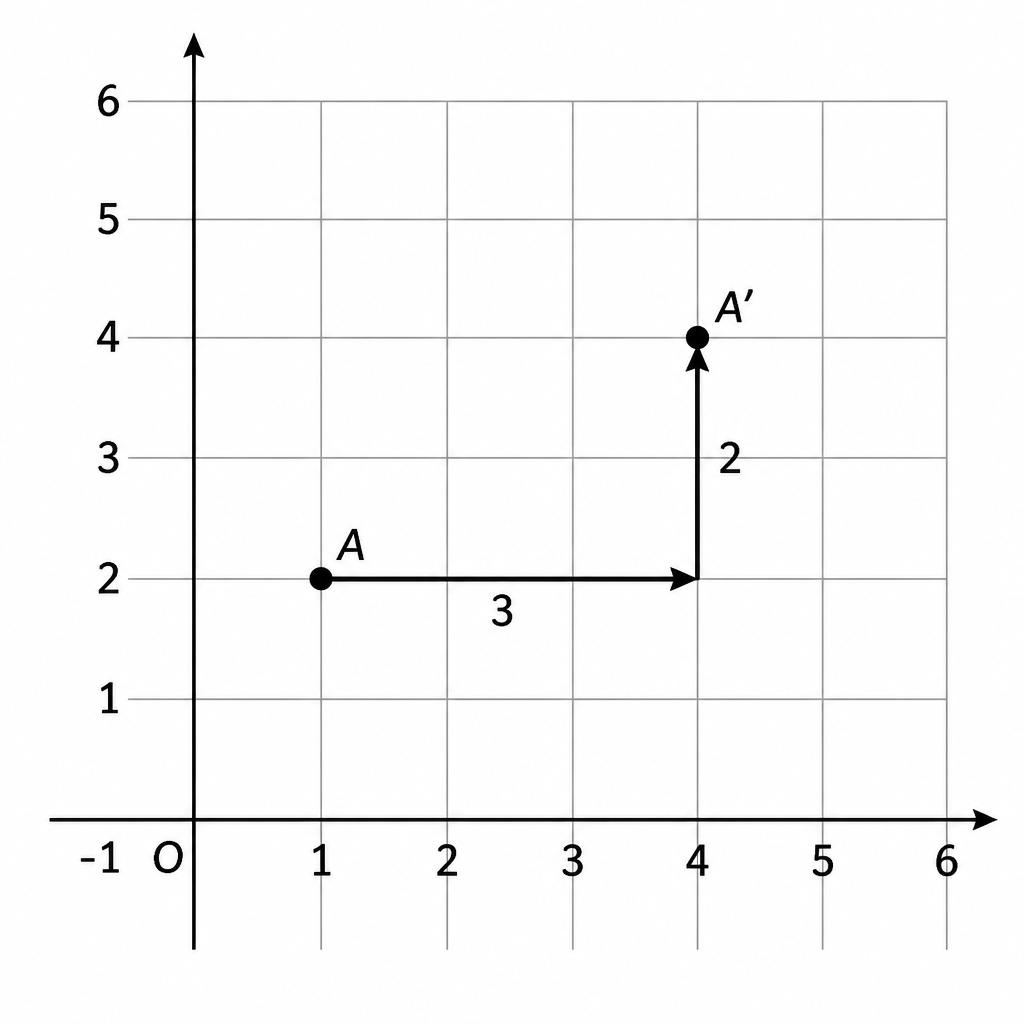
Getting the signs right is the heart of the whole method. Moving right is written with a plus, moving left with a minus, moving up with a plus and moving down with a minus.
| Direction | Sign | Example |
| Right | + | 4 units right is (4, 0) |
| Left | - | 3 units left is (-3, 0) |
| Up | + | 5 units up is (0, 5) |
| Down | - | 2 units down is (0, -2) |
Under the translation (a, b) every point follows \( (x,\ y) \rightarrow (x+a,\ y+b) \). The signs of a and b are what carry the direction.
Worked Example: Translating a Triangle
The triangle ABC has vertices A(4, 5), B(1, 3) and C(4, 3). Slide it 5 units right and 4 units up, and find the coordinates of the new triangle A'B'C'.
Step 1: Write the given translation as a pair of numbers:
\[ (5,\ 4) \]
Step 2: Both moves are positive, so the rule is to add 5 to every x and 4 to every y:
\[ (x,\ y) \rightarrow (x+5,\ y+4) \]
Step 3: Apply the rule to A. Since \( 4+5 = 9 \) and \( 5+4 = 9 \), this gives:
\[ A(4,\ 5) \rightarrow A'(9,\ 9) \]
Step 4: Apply the rule to B. Since \( 1+5 = 6 \) and \( 3+4 = 7 \), this gives:
\[ B(1,\ 3) \rightarrow B'(6,\ 7) \]
Step 5: Apply the rule to C. Since \( 4+5 = 9 \) and \( 3+4 = 7 \), this gives:
\[ C(4,\ 3) \rightarrow C'(9,\ 7) \]
Every one of the three vertices gained 5 on its x and 4 on its y. That sameness is the signature of a translation. If one vertex gains a different amount from the others, you know at once that a slip has been made.
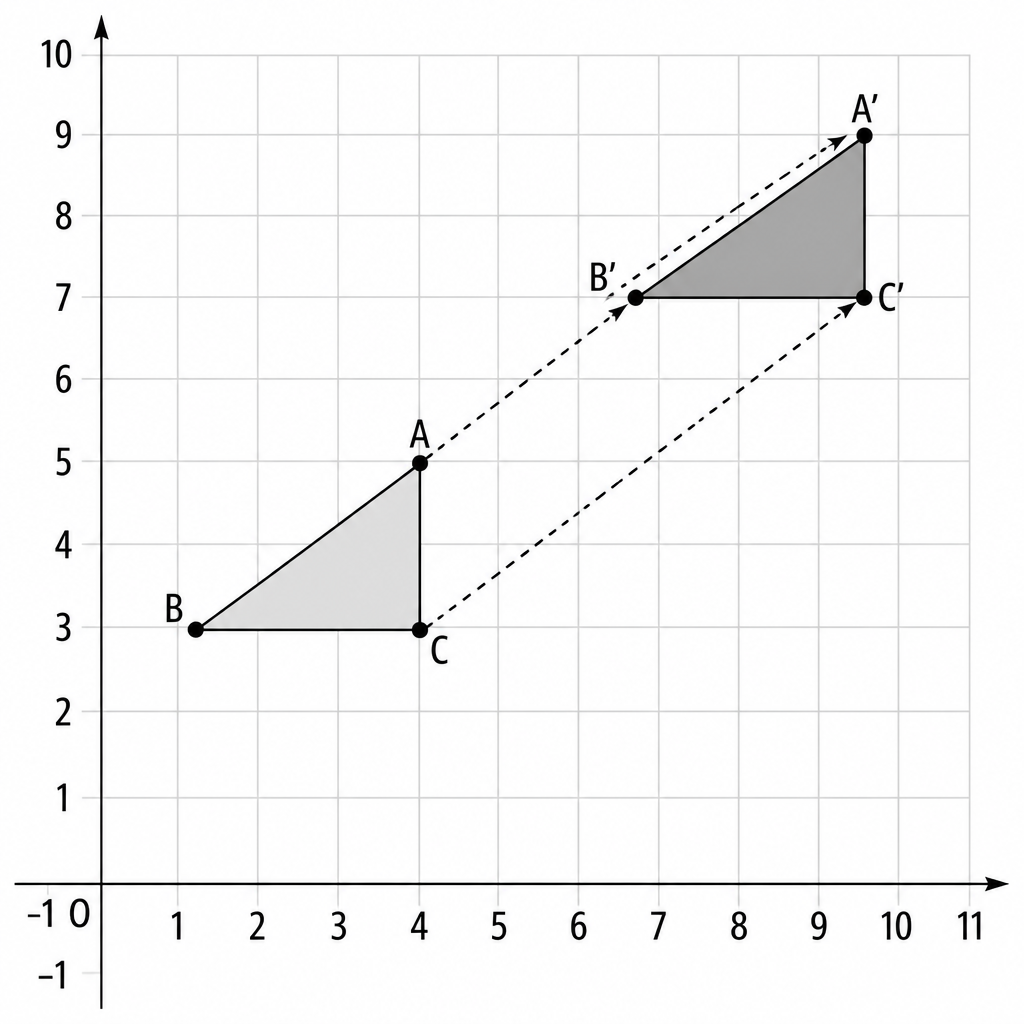
A translation never turns the shape and never flips it. Also, 3 units right and 2 units up is written (3, 2) and not (2, 3). The first number is always the sideways move and the second is always the vertical one.
Rotation: Turning About a Centre
The hands of a clock are pinned at one point and swing round that point. A rotation works in the same way: the shape turns about one fixed point, and that point itself does not move at all. In this lesson the fixed point is nearly always the origin O(0, 0).
Rotation: turning a shape through a given angle about a fixed point, which stays in place while everything else swings around it.
A rotation is not fully described until three separate things have been stated. Leave out any one of them and the turn cannot be carried out.
- The centre of rotation: the fixed point the shape turns about.
- The angle of rotation: how many degrees the shape turns, such as 45°, 90° or 180°.
- The direction of rotation: which way round the shape turns.
The direction is shown by a sign. Turning the way a clock's hands go is the negative direction, and turning against the clock is the positive direction. So +90° means a quarter turn anticlockwise, and -90° means a quarter turn clockwise.
For example, turn the point P(4, 6) through -90° about the origin and it arrives at P'(6, -4). The lengths OP and OP' are equal, and the angle POP' measures 90°.
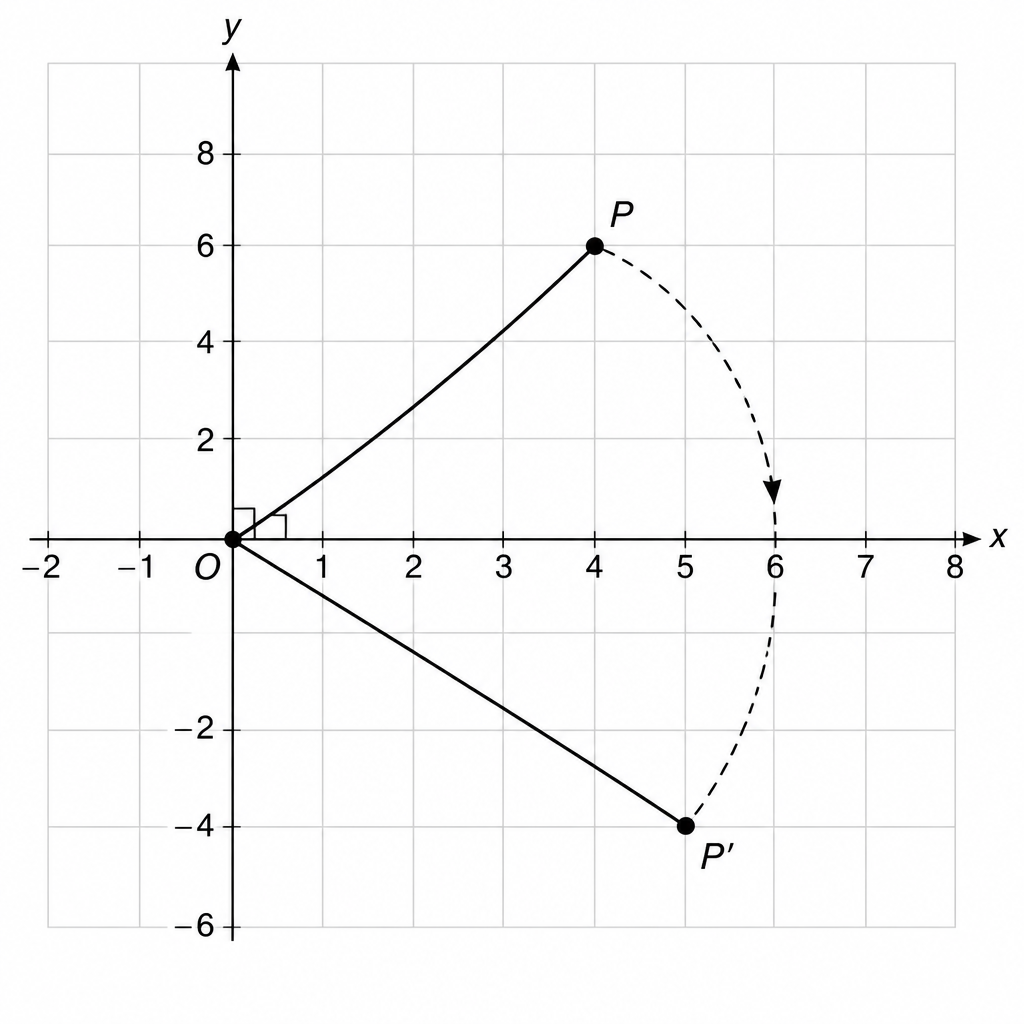
Quarter and Half Turns About the Origin
When the centre is the origin, the effect of a turn on the coordinates can be written as a short rule. These three rules are worth learning, but they stay in the memory far better if you first turn one point on a grid yourself and watch where it lands.
| Rotation | What it is | Rule |
| +90° | Quarter turn anticlockwise | \( (x,\ y) \rightarrow (-y,\ x) \) |
| -90° | Quarter turn clockwise | \( (x,\ y) \rightarrow (y,\ -x) \) |
| 180° | Half turn | \( (x,\ y) \rightarrow (-x,\ -y) \) |
In a quarter turn the two numbers swap places first, and only then does a sign go on. The +90° image of (5, 9) is (-9, 5), not (9, -5). Settle which number moves to the front before you worry about the minus sign.
Worked Example: Rotating a Triangle About the Origin
A triangle has vertices A(6, 6), B(4, 5) and C(6, 2). Rotate it about the origin through (a) 90° in the positive direction and (b) 180°.
Step 1: Write the rule for a rotation of +90° about the origin:
\[ (x,\ y) \rightarrow (-y,\ x) \]
Step 2: Apply the rule to A, so y = 6 moves to the front and turns negative while x = 6 goes to the back:
\[ A(6,\ 6) \rightarrow A'(-6,\ 6) \]
Step 3: Apply the same rule to B:
\[ B(4,\ 5) \rightarrow B'(-5,\ 4) \]
Step 4: Apply the same rule to C:
\[ C(6,\ 2) \rightarrow C'(-2,\ 6) \]
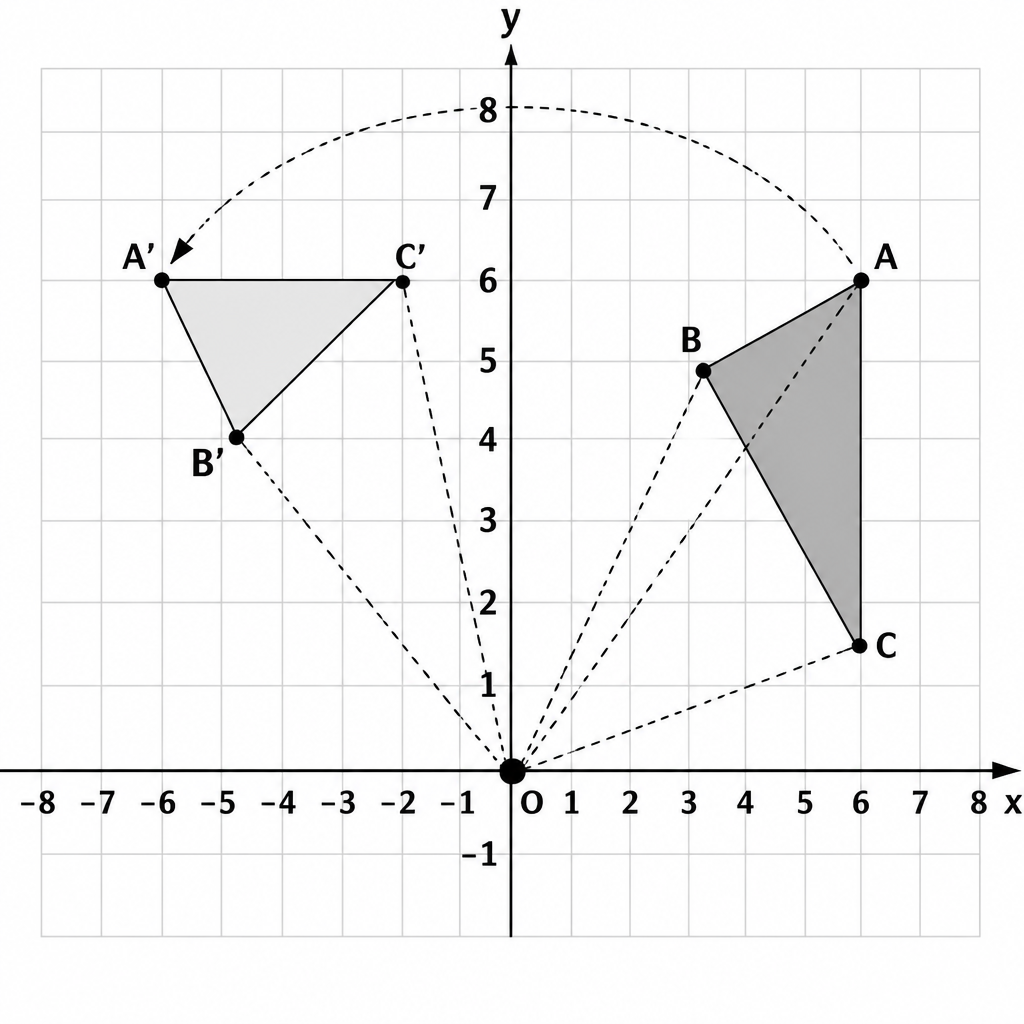
Step 5: For the second part apply the half turn rule, in which both coordinates change sign:
\[ (x,\ y) \rightarrow (-x,\ -y) \]
Step 6: Apply that rule to each vertex in turn. For A this gives:
\[ A(6,\ 6) \rightarrow A''(-6,\ -6) \]
Step 7: In the same way B and C give:
\[ B(4,\ 5) \rightarrow B''(-4,\ -5) \]
\[ C(6,\ 2) \rightarrow C''(-6,\ -2) \]
Comparing the Three Transformations
All three transformations leave the side lengths and the angles of the shape untouched, so the object and its image are always congruent. What differs is only where the image ends up and which way it faces.
| Transformation | What it does | Rule |
| Reflection in the X-axis | Flips it over | \( (x,\ y) \rightarrow (x,\ -y) \) |
| Reflection in the Y-axis | Flips it sideways | \( (x,\ y) \rightarrow (-x,\ y) \) |
| Translation (a, b) | Slides it | \( (x,\ y) \rightarrow (x+a,\ y+b) \) |
| Rotation of +90° | Turns it anticlockwise | \( (x,\ y) \rightarrow (-y,\ x) \) |
| Rotation of -90° | Turns it clockwise | \( (x,\ y) \rightarrow (y,\ -x) \) |
| Rotation of 180° | Turns it half way round | \( (x,\ y) \rightarrow (-x,\ -y) \) |
Before touching any question, ask one thing: has the shape been flipped, slid or turned? The answer to that tells you which of the rules to reach for.
The full lesson is waiting for you
The notes are free to read in full. A free account opens the rest of the practice, and tracks your progress and confidence score for every subject. Presentations and videos need approval from Learn Yeti.