Why Atomic Weight Was Not Enough
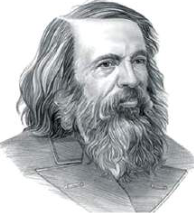
Scientists have found 118 elements so far, and each one has its own physical and chemical properties. Studying so many elements one by one is hard, so scientists arranged them in a table in which elements with similar properties sit in the same column. The Russian scientist Dmitri Mendeleev built such a table on the basis of the atomic weight of the elements. He believed that atomic weight was the fundamental property of an element.
Using atomic weight as the basis caused many complications. Some elements do not have just one atomic weight. Carbon is a clear example. Most carbon atoms have an atomic weight of 12, some have 13 and a few have 14. These three forms are written C-12, C-13 and C-14. All three are carbon, yet their atomic weights are different.
Isotopes: The forms of the same element having different atomic weights are called isotopes. Their atoms have the same number of protons but different numbers of neutrons.
| Isotope | Protons | Neutrons | Atomic weight |
| C-12 | 6 | 6 | 12 |
| C-13 | 6 | 7 | 13 |
| C-14 | 6 | 8 | 14 |
The number of protons in an atom of an element is always constant. Every carbon atom has 6 protons. The number of neutrons, however, can differ, and each extra neutron raises the atomic weight. This is how the isotopes of one element are formed.
Now think about a table built on atomic weight. If atomic weight really decided where an element belongs, then C-12, C-13 and C-14 should each have had a separate space. Mendeleev, however, allocated only one space for an element and gave no separate spaces to its isotopes. His periodic law also could not explain some other properties of the elements. After detailed study, scientists proved that atomic weight is not the fundamental property of elements, and they kept searching for a new law for the periodic table.
Isotopes differ in atomic weight, not in the number of protons. If the number of protons were different, the atom would be a different element altogether.
Moseley and the Modern Periodic Law
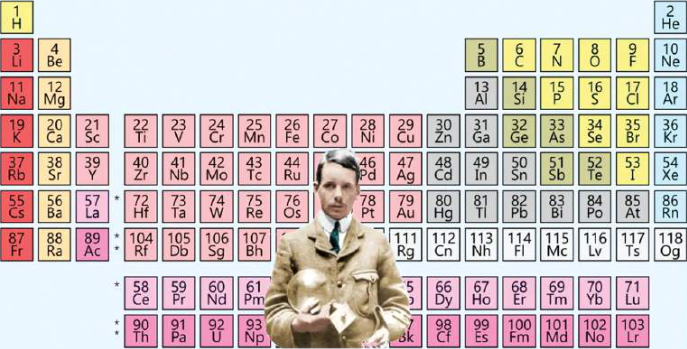
The answer came in 1913 AD from the English scientist Henry Moseley. He discovered that the properties of elements depend on atomic number rather than on atomic weight. The atomic number is the number of protons in the nucleus of an atom. On this basis he formulated the modern periodic law.
Modern periodic law: The physical and chemical properties of elements are the periodic function of their atomic number.
Periodic function means this: when the elements are placed in increasing order of atomic number, similar properties come back again and again at regular intervals. Lithium (3), sodium (11) and potassium (19) are all soft metals that react strongly with water, and their atomic numbers are 8 and then 8 apart. In the same way, fluorine (9) and chlorine (17) are non-metals with very similar properties. Just as Sunday returns every week, properties return along the list of elements.
Atomic number solves the isotope problem. C-12, C-13 and C-14 all have atomic number 6, so placing all three in one box is now exactly right.
The Long Form of the Periodic Table
A new periodic table was made on the basis of Moseley's periodic law. It is known as the modern periodic table or the long form of the periodic table. The elements are arranged in increasing order of their atomic number: hydrogen (1), helium (2), lithium (3) and so on up to oganesson (118). Here too, elements with similar properties are kept in the same vertical column.
Group: A vertical column of the periodic table is called a group. Elements in the same group have similar properties.
Period: A horizontal row of the periodic table is called a period. Along a period, the elements are kept in increasing order of their atomic number.
Each box of the table holds one element. The atomic number is written at the top of the box, the symbol in the middle and often the name below. For example, the box showing 30 and Zn is zinc. Once you know which period and which group an element is in, you can predict many of its properties.
Characteristics of the Modern Periodic Table
There are 7 periods in the modern periodic table, and the elements in the same period have the same number of shells. The main characteristics of the modern periodic table are:
- The elements are arranged in the increasing order of their atomic number.
- There are 7 periods and 18 groups.
- The table is divided into 18 groups according to the IUPAC system.
- Metals are placed on the left side, non-metals on the right side, and metalloids in between them.
- Group IA holds the alkali metals, group IIA the alkaline earth metals, groups IIIB to IIB the transition metals, group VIIA the halogens and group 0 (18) the noble gases.
- The 15 elements from lanthanum (atomic number 57) to lutetium (71) are the lanthanides, and the 15 elements from actinium (89) to lawrencium (103) are the actinides. They are kept separately below the main block.
- The elements of groups IIIB to VIIB, the three columns of group VIIIB, and groups IB and IIB, 10 columns altogether, are kept between the metals and the non-metals. These are called transition metals.
- The elements are classified into s, p, d and f blocks according to their electronic configuration based on subshells.
Periods: Seven Rows of Different Lengths
The seven periods do not hold the same number of elements. The first period has only hydrogen and helium, because the first shell holds only two electrons. The later periods become longer and longer. The sixth and seventh periods hold 32 elements each, because they include the lanthanides and the actinides.
| Period | Number of elements | Nature of period |
| First | 2 | Very short |
| Second | 8 | Short |
| Third | 8 | Short |
| Fourth | 18 | Long |
| Fifth | 18 | Long |
| Sixth | 32 | Very long |
| Seventh | 32 | Very long |
The period number tells you the number of shells. Sodium has the electronic configuration 2, 8, 1 and chlorine has 2, 8, 7. Both use three shells, K, L and M, so both are in the third period. Moving from left to right along a period, the number of shells stays the same while the electrons in the outermost shell increase one at a time.
Groups: Eighteen Columns and Their Names
The modern periodic table has 18 vertical columns. In the system of IUPAC, the International Union of Pure and Applied Chemistry, they are numbered 1 to 18 from left to right. The older system uses a Roman numeral with A or B. The columns at the two edges are the A groups and the columns in the middle are the B groups. Group VIIIB takes up not one column but three: 8, 9 and 10. Group 18 is also called group 0 or group VIIIA.
| IUPAC group | Old name | Element in period 4 |
| 1 | IA | K |
| 2 | IIA | Ca |
| 3 | IIIB | Sc |
| 4 | IVB | Ti |
| 5 | VB | V |
| 6 | VIB | Cr |
| 7 | VIIB | Mn |
| 8 | VIIIB | Fe |
| 9 | VIIIB | Co |
| 10 | VIIIB | Ni |
| 11 | IB | Cu |
| 12 | IIB | Zn |
| 13 | IIIA | Ga |
| 14 | IVA | Ge |
| 15 | VA | As |
| 16 | VIA | Se |
| 17 | VIIA | Br |
| 18 | 0 (VIIIA) | Kr |
VIIIA and VIIIB are not the same. VIIIA, which is group 18, holds the noble gases, while VIIIB is the three middle columns numbered 8, 9 and 10, where transition metals such as iron, cobalt and nickel sit.
Families of Elements in the Groups
Because the elements of one group behave alike, several groups are known by a family name. These are the ones to know:
- Group IA (1): alkali metals, such as lithium, sodium, potassium, rubidium, caesium and francium.
- Group IIA (2): alkaline earth metals, such as beryllium, magnesium, calcium, strontium, barium and radium.
- Groups IIIB to IIB (3 to 12): transition metals, such as iron, copper, zinc, silver and gold.
- Group VIIA (17): halogens, such as fluorine, chlorine, bromine and iodine.
- Group 0 (18): noble gases, also called inert gases, such as helium, neon, argon, krypton, xenon and radon.
Transition metals: The elements of the 10 columns from group IIIB to group IIB, kept between the metals on the left and the non-metals on the right, are called transition metals.
Members of a family resemble one another. Sodium and potassium are both stored under kerosene because both react at once with air and water. The noble gases, on the other hand, hardly react with other elements at all. So if you know how one member of a family behaves, you can predict how the others behave.
Where Metals, Non-metals and Metalloids Sit
In the modern periodic table the metals are on the left side and in the middle, the non-metals are on the right side, and the metalloids lie between the two. Metalloids are elements that show some properties of metals and some of non-metals. Boron, silicon, germanium, arsenic, antimony and tellurium are examples. They form a staircase that starts at boron and steps down to the right.
Hydrogen is the exception. It has one valence electron, so it is placed at the top of group IA, but it is a non-metal, not a metal. For this reason it is not counted among the alkali metals.
Lanthanides and Actinides
Lanthanides: The group of 15 elements from lanthanum (La), atomic number 57, to lutetium (Lu), atomic number 71, are called lanthanides.
Actinides: The group of 15 elements from actinium (Ac), atomic number 89, to lawrencium (Lr), atomic number 103, are called actinides.
The lanthanides belong to the sixth period and the actinides to the seventh. Lanthanum and actinium hold their places in group IIIB (3), and the other members are placed in two separate rows below the main table. If they were all kept in one row, the table would be 32 columns wide and hard to fit on a page. Placing them below keeps the table compact and easy to read, without breaking the order of atomic numbers: barium (56) is followed by lanthanum (57), and lutetium (71) is followed by hafnium (72).
The s, p, d and f Blocks
The electrons of an atom are arranged in shells, and a shell can be divided into subshells named s, p, d and f. The block of an element is named after the subshell that receives its last electron. How to write the configuration subshell by subshell is a lesson of its own. Here, what matters is where each block lies in the table:
- s-block: groups IA and IIA (1 and 2). Helium also belongs here, even though it is placed in group 18.
- p-block: groups IIIA to 0 (13 to 18).
- d-block: groups IIIB to IIB (3 to 12), which are the transition metals.
- f-block: the lanthanides and actinides kept separately below.
The width of each block matches how many electrons its subshell can hold: the s-block is 2 columns wide, the p-block 6 and the d-block 10.
Finding an Element's Place in the Table
For elements in the A groups, the atomic number is enough to find both the period and the group. Once the electrons are placed in the K, L, M and N shells, the number of shells used gives the period, and the number of valence electrons in the outermost shell gives the A group number.
Finding the group from valence electrons works only for elements of the A groups. It cannot be used for the transition metals, the lanthanides or the actinides.
Example 1: Find the position of the element with atomic number 11.
Step 1: Distributing the 11 electrons into the K, L and M shells:
\[ 11 = 2 + 8 + 1 \]
Step 2: Counting the shells. The electrons fill three shells, K, L and M, so the element is in period 3.
Step 3: Reading the valence electrons. The outermost shell holds 1 electron, so the element is in group IA (1). The element is sodium (Na), an alkali metal.
Example 2: Find the position of the element with atomic number 17.
Step 1: Distributing the 17 electrons into shells:
\[ 17 = 2 + 8 + 7 \]
Step 2: Counting the shells. Three shells are used, so the element is in period 3.
Step 3: Reading the valence electrons. The outermost shell holds 7 electrons, so the element is in group VIIA, which is group 17 in the 1 to 18 numbering. The element is chlorine (Cl), a halogen.
Example 3: Find the position of the element with atomic number 20.
Step 1: Distributing the 20 electrons into the K, L, M and N shells:
\[ 20 = 2 + 8 + 8 + 2 \]
Step 2: Counting the shells. Four shells are used, so the element is in period 4.
Step 3: Reading the valence electrons. The outermost shell holds 2 electrons, so the element is in group IIA (2). The element is calcium (Ca), an alkaline earth metal.
The full lesson is waiting for you
The notes are free to read in full. A free account opens the rest of the practice, and tracks your progress and confidence score for every subject. Presentations and videos need approval from Learn Yeti.