Why the position of an element matters
Every element has a fixed address in the modern periodic table. Its period is the horizontal row it sits in, and its group is the vertical column. This address is more than a label. The properties of an element depend on its group and its period, so once you know where an element sits, you can predict a great deal about how it will behave. That is exactly why the periodic table is so useful for studying elements: periods show their own patterns, and groups show theirs.
Four properties change in a regular way through the table: valency, atomic size, electropositivity and electronegativity, and chemical reactivity. All four patterns grow out of two simple facts about how atoms are built. Moving from left to right along a period, the number of shells stays the same, but each new element has one more proton in its nucleus and one more electron in its outer shell. Moving from top to bottom down a group, the number of valence electrons stays the same, but each new element has one more shell than the element above it.
Across a period: the same number of shells, but more protons and electrons. Down a group: the same number of valence electrons, but one more shell at each step. Every trend in this topic follows from these two facts.
Valence shell, valence electrons and valency
Valence shell: the outermost shell of an atom.
Valence electrons: the electrons present in the valence shell of an atom.
Valency: the combining capacity of an element. It is determined by the number of valence electrons, and it equals the number of electrons an atom loses, gains or shares to complete its valence shell.
An atom is most stable when its valence shell holds eight electrons, or two if its only shell is the first one. Atoms reach this state in whichever way is easier. An atom with one, two or three valence electrons gives them away, so its valency is 1, 2 or 3. An atom with four valence electrons usually shares them, so its valency is 4. An atom with five, six or seven valence electrons finds it easier to take in the three, two or one electrons it is missing, so its valency is 3, 2 or 1. An atom that already has eight valence electrons needs nothing, so its valency is 0.
- 1, 2 or 3 valence electrons: the valency equals the number of valence electrons.
- 4 valence electrons: the valency is 4.
- 5, 6 or 7 valence electrons: the valency is 8 minus the number of valence electrons.
- 8 valence electrons: the valency is 0.
How valency changes across a period and down a group
Across a period the number of shells does not change, but the electronic configuration does. Each step to the right adds one valence electron, so the number of valence electrons climbs from 1 in group IA to 8 in group 0. Because valency depends on the valence electrons, valency changes even within a single period. Moving from group IA to VIIA and then to group 0, the valencies are 1, 2, 3, 4, 3, 2, 1 and 0.
| Group | Valence electrons | Valency |
| IA | 1 | 1 |
| IIA | 2 | 2 |
| IIIA | 3 | 3 |
| IVA | 4 | 4 |
| VA | 5 | 3 |
| VIA | 6 | 2 |
| VIIA | 7 | 1 |
| 0 | 8 | 0 |
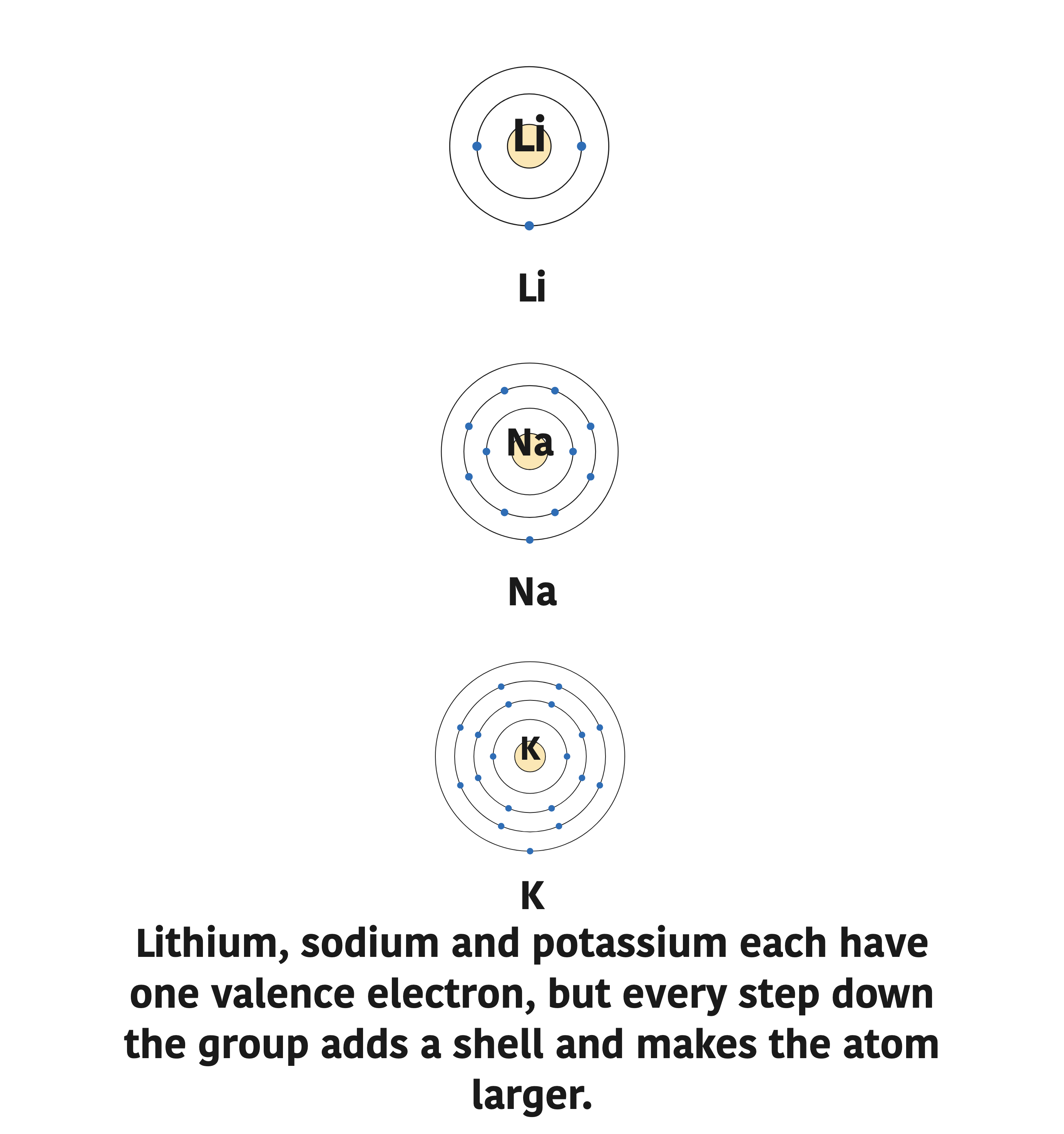
Down a group the story is different. Every element in a group has the same number of valence electrons, so all the elements of a group have the same valency. Lithium, sodium and potassium in group IA each have just one valence electron, even though each has a different number of shells:
- Lithium: \( 1s^2,\ 2s^1 \)
- Sodium: \( 1s^2,\ 2s^2\,2p^6,\ 3s^1 \)
- Potassium: \( 1s^2,\ 2s^2\,2p^6,\ 3s^2\,3p^6,\ 4s^1 \)
So the valency of the elements of group IA and VIIA is 1, the valency of the elements of group IIA and VIA is 2, and the elements of group IIIA and VA generally have a valency of 3.
Atomic size across a period
Atomic size decreases from left to right along a period, from group 1 to group 18. This surprises many students, because the atoms on the right have more electrons. Here is why it happens. As the atomic number increases, the number of protons and electrons increases, but the number of shells remains the same. So each extra electron is filled into the same outer shell. At the same time, each extra proton increases the positive charge of the nucleus. A more strongly charged nucleus attracts the electrons in the shell with more force and pulls the whole shell inward. As a result, the atom gets contracted.
More electrons does not always mean a bigger atom. Across a period the extra electrons go into a shell that already exists, and the growing pull of the nucleus makes the atom smaller.
Atomic size down a group
Atomic size is determined by the distance of the valence shell from the nucleus. Down a group, each element has one more shell than the element above it, so its valence shell sits farther from the nucleus. A lithium atom has K and L shells. A sodium atom has K, L and M shells. A potassium atom has K, L, M and N shells. So in group IA, sodium is larger than lithium, and potassium is larger than sodium. The number of protons also rises down a group, but the extra shell has the bigger effect, so atomic size increases from top to bottom of a group.
Electropositivity and electronegativity
Electropositivity: the property of an element to lose its valence electrons and form positive ions (cations).
Electronegativity: the property of an element to gain electrons in its valence shell to form negative ions (anions).
Metals tend to lose electrons, so electropositivity is also called metallic character. Nonmetals tend to gain electrons, so electronegativity is also called nonmetallic character. Both properties are controlled by atomic size, because size decides how firmly the nucleus holds its outer electrons.
Across a period, atomic size decreases. The valence electrons sit closer to a more strongly charged nucleus and are held more tightly, so the capacity to lose electrons decreases along the period, while the capacity to gain electrons increases. That means electropositivity, or metallic character, decreases from group 1 to group 18 of any period, and electronegativity, or nonmetallic character, increases. In the third period, sodium, magnesium, aluminium, silicon, phosphorus, sulphur and chlorine stand in increasing order of electronegativity, and the same list read backwards is their increasing order of electropositivity.
Down a group, atomic size increases. The valence electrons are farther from the nucleus and held loosely, so the tendency to lose them increases and electropositivity increases. Beryllium, magnesium and calcium in group IIA show this: their electropositivity increases in the order Be < Mg < Ca. For the same reason, an electron arriving from outside is attracted less strongly by a distant nucleus, so the capacity to gain electrons decreases, and electronegativity decreases down a group.
Chemical reactivity
Chemical reactivity tells how readily an element takes part in chemical reactions. A metal reacts by losing electrons, so the more easily it loses them, the more reactive it is. A nonmetal reacts by gaining electrons, so the more easily it gains them, the more reactive it is. This is why metals and nonmetals follow opposite trends.
Along a period, the chemical reactivity of metals decreases, while the chemical reactivity of nonmetals increases. The element at the extreme right of every period is the exception: it is an inert gas with a complete valence shell, so it does not react.
Down a group, the chemical reactivity of metals increases, because larger atoms lose their valence electrons more easily. The reactivity of the group IIA metals increases in the order Be < Mg < Ca, and in group IA potassium is more reactive than sodium. The chemical reactivity of nonmetals decreases down a group, because larger atoms gain electrons less easily. The reactivity of the nonmetals of group VIA is in the order O > S > Se, and among the halogens fluorine is the most reactive.
Down a group, reactivity goes up for metals but down for nonmetals. Before answering any reactivity question, first decide whether the element is a metal or a nonmetal.
The third period as an example
The third period runs from sodium to argon. Their atomic numbers, valence electrons and valencies are set out below.
| Atomic number | Element | Valence electrons | Valency |
| 11 | Na | 1 | 1 |
| 12 | Mg | 2 | 2 |
| 13 | Al | 3 | 3 |
| 14 | Si | 4 | 4 |
| 15 | P | 5 | 3 |
| 16 | S | 6 | 2 |
| 17 | Cl | 7 | 1 |
| 18 | Ar | 8 | 0 |
The atomic number increases from 11 to 18 across the period, and so do the numbers of protons and electrons. The number of shells stays at three, so every new electron is added to the same M shell. With each extra proton the attraction of the nucleus grows, the electrons are pulled closer, and the atoms contract. Sodium is therefore the largest atom in the period. Being the largest, it loses its single valence electron most easily, so sodium is the most electropositive element and the most reactive metal of the third period.
Argon is the smallest atom of the period, yet it is not the most electronegative. Argon is an inert gas. Its valence shell already holds eight electrons, so it gains none. That place goes to its neighbour. Chlorine needs just one electron to complete its octet and holds it strongly, so chlorine is the most electronegative element and the most reactive nonmetal of the third period.
All the trends at a glance
| Property | Left to right along a period | Top to bottom down a group |
| Number of shells | Stays the same | Increases by one |
| Valence electrons | Increase from 1 to 8 | Stay the same |
| Valency | 1, 2, 3, 4, 3, 2, 1, 0 | Stays the same |
| Atomic size | Decreases | Increases |
| Electropositivity (metallic character) | Decreases | Increases |
| Electronegativity (nonmetallic character) | Increases | Decreases |
| Reactivity of metals | Decreases | Increases |
| Reactivity of nonmetals | Increases | Decreases |
The most electropositive and most reactive metals sit at the bottom left of the table. The most electronegative and most reactive nonmetal, fluorine, sits at the top right, just before the inert gases.
The full lesson is waiting for you
The notes are free to read in full. A free account opens the rest of the practice, and tracks your progress and confidence score for every subject. Presentations and videos need approval from Learn Yeti.