Looking Up at the Night Sky
Go somewhere far from city lights on a clear night and look up. The sky is crowded with points of light. Some twinkle, some shine steadily, and now and then a bright streak flashes across and is gone. Photographs taken through large telescopes show much more: glowing clouds of gas, crowded clusters of stars, and faint smudges that are really huge families of stars very far away.
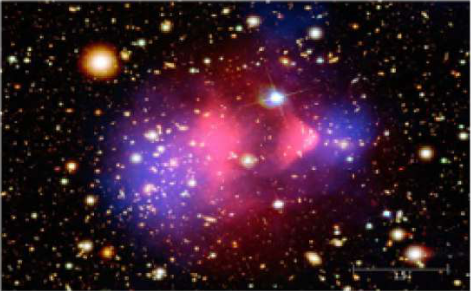
A sky like this raises some natural questions. What kinds of objects are out there? How do they stay where they are instead of falling or drifting away? How did all of it begin? And is anything out there standing still? Answering these questions is what the study of the universe is about.
Universe: The vast area around us, together with all the celestial bodies in it, is called the universe. The universe is the collective name of all celestial bodies.
The Earth, the Moon, the Sun, the other planets and every star we can see are all parts of the universe. We are not looking at it from outside. We live inside it, and the Earth is only a tiny part of it.
Celestial Bodies
Celestial body: Any natural object found in space, such as a star, a planet, a satellite or a comet, is called a celestial body. Celestial bodies are also called heavenly bodies.
Celestial bodies differ enormously. Some are extremely large and have a very large mass, like the Sun and the other stars. Others are very small, like a pebble of rock drifting through space, and their mass is small as well. They also differ in state. A star is a huge ball of hot, glowing gas, so it is in a gaseous state. The Moon, the rocky planets and the asteroids are in a solid state. Scientists sort celestial bodies into the kinds below.
| Kind | What it is | Example |
| Star | A huge ball of hot gas that makes its own heat and light | The Sun, the Pole Star |
| Planet | A large body that revolves around a star and shines only by reflecting the star's light | The Earth, Jupiter |
| Satellite | A body that revolves around a planet | The Moon, going round the Earth |
| Baby planet | A small, round body that revolves around the Sun like a planet but is too small to count as a full planet | Pluto |
| Asteroid | A small rocky body revolving around the Sun, found mostly in a belt between Mars and Jupiter | Vesta |
| Comet | A body of ice, dust and rock that grows a long glowing tail when it comes near the Sun | Halley's Comet |
| Meteor | A piece of rock from space that burns up as it rushes through the Earth's atmosphere, seen as a bright streak of light | A so-called shooting star |
| Meteorite | The part of a meteor that does not burn up completely and lands on the Earth's surface | Space rocks found in fields and deserts |
A meteor and a meteorite are not the same thing. The meteor is the streak of light we see while the rock is burning in the air. The meteorite is the leftover piece that actually lands on the ground. Most meteors burn up completely, so most of them never become meteorites.
Galaxies and the Milky Way
Stars are not spread evenly through the universe. They gather in enormous groups, and a single group can hold billions of stars along with gas and dust. The universe contains a huge number of these groups, separated from one another by unimaginably large distances.
Galaxy: A group of many stars forming one huge system is called a galaxy.
Milky Way: The galaxy in which our Solar System is located is called the Milky Way galaxy.
The Sun is just one ordinary star among the billions in the Milky Way. The Sun, together with the planets, satellites, asteroids and comets that go round it, forms the Solar System, and the whole Solar System lies inside the Milky Way, well away from its centre. On a very dark night a faint, pale band can be seen stretching across the sky. That band is the light of countless distant stars of our own galaxy, seen from inside it.
From small to large: the Earth is one planet of the Solar System, the Solar System lies inside the Milky Way galaxy, and the Milky Way is one of countless galaxies in the universe.
What Science Knows and What It Does Not Yet Know
The universe is such a huge region that even science has not yet been able to obtain concrete information about its size, its origin and how far it spreads. What scientists do have are careful observations and the theories built on them.
Astronomers at different times have put forward various theories about how the universe began. Among them, the Big Bang theory is considered the most reliable. According to this theory, all the celestial bodies in the universe are moving, and none of them is at rest. The study made by the astronomer Hubble of how these bodies move is an important part of this understanding.
These moving bodies are still pulling on one another through gravitational force. Depending on how that pull will affect their motion in the long run, different hypotheses have been proposed about the future of the universe: the open universe, the closed universe and the flat universe.
Importance of Gravitational Force in the Universe
Imagine one person standing at the North Pole and another at the South Pole, each throwing a ball straight up. On a globe the person at the South Pole seems to be hanging upside down, yet both balls fall back to the ground and neither flies off into space. This happens because the Earth pulls everything towards its centre. Wherever you stand on the Earth, down simply means towards the centre of the Earth.
The Earth is a planet, and it has mass. Anything that has mass pulls other objects towards itself, and this pull is called gravity. That is why the Earth has gravity. The Sun has mass, so the Sun has gravity. The Moon has mass, so the Moon has gravity too. The greater the mass, the stronger the pull, which is why the Sun, with its enormous mass, can hold on to planets that are extremely far away.
Mutual Attraction Between the Sun, the Earth and the Moon
The pull between two bodies never works in one direction only. The Sun attracts the Earth towards its centre, and at the same moment the Earth attracts the Sun towards its centre. In the same way, the Earth attracts the Moon towards its centre, and the Moon attracts the Earth towards its centre. An attraction in which each body pulls the other is called mutual attraction.
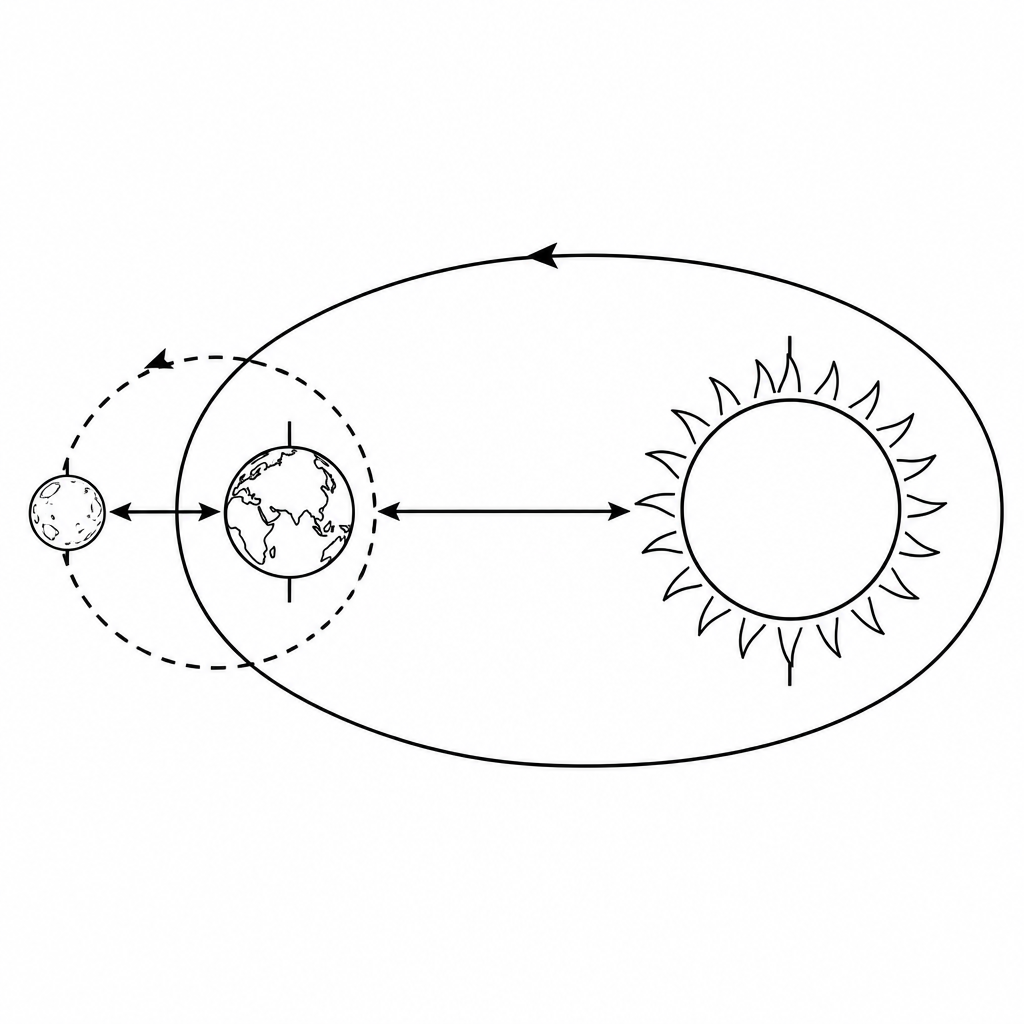
This is not special to the Sun, the Earth and the Moon. Between every pair of celestial bodies in space, near or far, there is the same mutual attraction. Every star, planet and satellite is pulling on every other one.
Gravitational force: The mutual force of attraction that exists among all celestial bodies in space, by which each body pulls the other towards its centre, is called gravitational force.
Do not think that only the Sun pulls the Earth while the Earth does nothing to the Sun. The pull acts on both bodies, and the two pulls are equal in size. The Sun hardly moves because its mass is far greater than the Earth's, not because the Earth has no pull.
How Gravity Keeps Bodies in Their Orbits
Orbit: The fixed path along which a celestial body revolves around another body is called its orbit.
Because of gravitational force, the Earth spins on its axis and revolves around the Sun in its orbit. The Moon revolves around the Earth. Every celestial body in the Solar System revolves around the Sun. Gravitational force is what keeps the planets lined up in their own orbits and keeps them going round the Sun.
If the Sun is pulling the Earth all the time, why does the Earth not fall into the Sun? Because the Earth is also moving very fast, sideways to the direction of the pull. The way these two work together can be followed in order.
- The Earth is moving very fast along its path.
- With no pull on it, it would carry straight on and leave the Sun far behind.
- The Sun's gravity pulls it towards the Sun's centre at every moment.
- This pull keeps bending the straight path, so the path becomes a curve.
- The curve closes on itself, and the Earth keeps going round and round in its orbit.
The Moon goes round the Earth for exactly the same reason. This also explains why planets and satellites do not crash into each other. Each planet moves in its own orbit at its own distance from the Sun, held there by the balance between its motion and the Sun's pull. The orbits do not run into one another, so the planets keep moving without ever meeting. The Sun, the Earth and the Moon all have gravity, yet their pulls and their motions are balanced in such a way that each body stays in its own place.
Without gravitational force there would be no orbits. The Moon would drift away from the Earth, the planets would fly off from the Sun, and the stars of a galaxy would scatter. Gravity is the force that holds the universe together as an ordered system.
The full lesson is waiting for you
The notes are free to read in full. A free account opens the rest of the practice, and tracks your progress and confidence score for every subject. Presentations and videos need approval from Learn Yeti.