How Scientists Study the Universe
On a clear night, away from city lights, the sky is full of stars. Looking up at it, people have always asked two big questions. How did the universe begin? What is the shape of the universe? At different times, scientists have tried to answer these questions through careful observation and research, and their work has grown into a whole branch of science.
Universe science: the branch of science that studies various facts about the universe, including the history and future of the universe.
Astrophysics: a branch of universe science that studies the origin, structure and future of the universe.
Astrophysicists cannot travel to distant stars, and they cannot repeat the birth of the universe in a laboratory. Instead they collect the light that reaches the Earth from far away, measure it with telescopes, and use physics and mathematics to work out what is happening out there. Everything in this topic was learnt in that way.
Our Place in the Milky Way
The Sun and its planets are not alone. They belong to a huge collection of stars called a galaxy. Our galaxy is a spiral galaxy named the Milky Way. Its diameter is about 100,000 light years, and our solar system lies at a distance of about 30,000 light years from its centre, out in one of the spiral arms. A light year is the distance light travels in one year, so even light, the fastest thing there is, needs 100,000 years to cross the Milky Way from one side to the other.
It is estimated mathematically that there are about 1.5 billion stars in the Milky Way galaxy alone. Yet the Milky Way is only one galaxy among a great many. When we speak of the universe, we mean all of these galaxies, everything in them, and the space between them.
The Big Bang Theory
Many theories about the origin of the universe have been proposed. Among them, the Big Bang theory is considered the most reliable. The theory is believed to have been born from an observation: all the galaxies, along with the Milky Way, are moving far away from each other with tremendous speed. If everything is rushing apart today, it must have been closer together in the past.
The Big Bang theory: the theory that the universe originated from the huge explosion of a single, extremely dense atom, and that all the celestial bodies in the universe came from this explosion.
According to this theory, in its first stage of existence the universe was in a very compressed state. It was in a very energetic state, no bigger than a small single atom. Before the explosion, the four fundamental forces existing in the universe are considered to have been unified as a single force. The four fundamental forces are:
- Gravitational force
- Electromagnetism
- Strong nuclear force
- Weak nuclear force
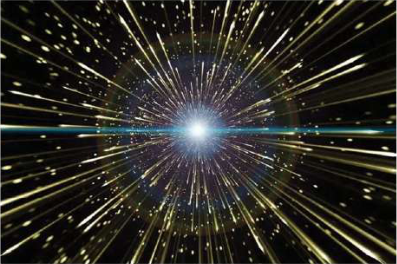
Because of excessive force and pressure, a huge explosion of that atom took place and the universe originated. Every star, planet and galaxy that exists today is believed to have come from that explosion.
A Universe That Keeps Growing
Think of a firecracker bursting. Its pieces fly away from the centre and away from each other. In the same way, after the huge explosion of that dense atom, all the celestial bodies have been moving far away from each other. So the size of the universe is increasing day by day.
The expansion of the universe is slow but continuous. At the same time, the speed of the celestial bodies is decreasing due to the force of gravity.
So two things happen together. The bodies keep moving apart, which makes the universe larger, and gravity keeps pulling them towards each other, which slows them down. You see a small version of this whenever you throw a ball upward. It keeps rising, but more and more slowly, because the Earth's gravity pulls on it.
Hubble's Study
The strongest evidence that galaxies are moving apart came from the American astronomer Edwin Hubble. In 1929 he tried to calculate the velocities of various galaxies using the 100-inch Hooker telescope on Mount Wilson. During his research he discovered that every galaxy is moving away from the other galaxies.
His measurements showed a clear pattern. The farther a galaxy is from the Earth, the smaller it appears, and the greater the velocity with which it moves away. Hubble plotted the velocity of each galaxy against its distance on a graph. The points did not fall at random. Taken together they rose along a straight line, with nearer galaxies moving away slowly and farther ones moving away fast.
Hubble's Law
The straight line on Hubble's graph can be written as a simple equation. It is known as Hubble's law.
\[ v = Hd \]
- \( v \) is the velocity with which the galaxies are moving away from each other.
- \( d \) is the distance between them.
- \( H \) is Hubble's constant.
Hubble's law: the velocity with which galaxies move away from each other equals Hubble's constant multiplied by the distance between them, written \( v = Hd \).
Hubble's constant: the constant \( H \) in Hubble's law. Its value is 73 km/s/Mpc, read as 73 kilometres per second per mega parsec.
The unit tells you what the number means. A parsec is a unit astronomers use for very large distances, and a mega parsec (Mpc) is one million parsecs. So a Hubble's constant of 73 km/s/Mpc means that if any two galaxies are at a distance of one mega parsec, they are separating from each other with a velocity of 73 km/s. Two galaxies twice as far apart, at two mega parsecs, separate twice as fast, at 146 km/s.
Multiply the distance between two galaxies by Hubble's constant and you get the velocity with which they are moving apart. Because the number you multiply by is fixed, the farther the galaxies are, the faster they are separating.
Using Hubble's Law
Example 1: A galaxy is 4 Mpc away from us. With what velocity is it moving away?
Step 1: Writing Hubble's law:
\[ v = Hd \]
Step 2: Putting in \( H = 73 \) km/s/Mpc and \( d = 4 \) Mpc:
\[ v = 73 \times 4 \]
Step 3: Multiplying the two numbers:
\[ v = 292\ \text{km/s} \]
So the galaxy is moving away at 292 km/s. Notice how the units work out. The Mpc in the distance cancels the per Mpc in the constant, leaving km/s, which is a unit of velocity.
Example 2: A galaxy is moving away from us at 511 km/s. How far away is it?
Step 1: Rearranging Hubble's law to make distance the subject, by dividing both sides by \( H \):
\[ d = \frac{v}{H} \]
Step 2: Putting in \( v = 511 \) km/s and \( H = 73 \) km/s/Mpc:
\[ d = \frac{511}{73} \]
Step 3: Dividing 511 by 73:
\[ d = 7\ \text{Mpc} \]
So the galaxy is 7 Mpc away. You can check it by working backwards, because \( 73 \times 7 = 511 \).
Hubble's constant is given per mega parsec, so the distance must be in mega parsecs before you multiply. Putting in a distance in light years or any other unit gives a wrong answer. The answer is a velocity, so it must be written with km/s.
How Hubble's Study Supports the Big Bang
Blow a little air into a balloon and mark a few dots on it with sign pens. As you blow in more air, every dot moves away from every other dot. No dot is at the centre, because the whole surface is stretching. Two dots that start far apart also separate by more than two dots that start close together.
The universe behaves in the same way. The dots are like the galaxies, and the stretching rubber is like the space of the universe. Just as every dot moves away from the others as the balloon grows, the area occupied by the entire universe is increasing and the galaxies are moving away from each other.
Now run the story backwards. If the galaxies are moving apart today, they must have been closer to each other in the past. Go back far enough, and they must all have been at the same point a very long time ago. That single starting point is exactly what the Big Bang theory describes. This is how Hubble's study helps to confirm the Big Bang theory.
Galaxies are moving apart today. So they were closer in the past, and long ago they were all at one point. This chain of reasoning is what links Hubble's study to the Big Bang theory.
The full lesson is waiting for you
The notes are free to read in full. A free account opens the rest of the practice, and tracks your progress and confidence score for every subject. Presentations and videos need approval from Learn Yeti.