How Science Studies Nature
Science does not understand the world by guessing. Scientific study brings together scientific facts, theories, models, experiments and physical situations. It studies the objects of nature in a planned and organized way. Each phenomenon is investigated logically, following the scientific method, and the investigation rests on empirical evidence. Empirical evidence is evidence that can be observed or measured. Science accepts a claim because it has been seen and measured, not because someone important said it.
Nothing in nature happens without a reason. Rain falls because water vapour rises and cools. A ball rolls because something pushed it. Behind every event or phenomenon there are factors that bring it about, and these are called causative factors. Some act on the event directly. Others act indirectly, through something else. Science gives such factors a special name.
Variable: A causative factor, characteristic or trait that has a direct or indirect relationship with an event or a phenomenon is known as a variable.
Curiosity Helps Us Predict
When we see a phenomenon or a change, we want to know three things: why it happens, which factors are involved, and how those factors have affected it. This curiosity is useful. Its answers help us predict the result of an action correctly, before we even do it.
Suppose a potted plant in the garden has wilted, its leaves hanging soft and limp. We want to know why. Is it lack of water? Has it stood in bright sun all afternoon? Or is there some other reason? To find out, we test the possibilities one at a time. We move the plant into the shade and see what happens, or we water it and see what happens.
The knowledge and experience we gain this way stay with us. Next time, we can easily guess what will happen to the plant if we forget to water it, or leave it in the sun on a hot day. Then we can take the necessary steps in time to save it. Knowledge that grows out of curiosity becomes the power to predict.
Cause and Effect
For each incident or change, there is always a cause and an effect. In the wilted plant, either the lack of water or the excessive heat of the sun is the causative factor. The wilting is the effect.
Cause: The causative factor that makes an event or a change happen is its cause.
Effect: The result or change that the cause produces is its effect.
The effect depends on the cause. When the stem of a plant holds enough water, it is stiff and stands upright. As the water is lost, the stem goes soft and bends. So the rigidity of a plant's stem depends on the amount of water in it.
Knowing that one thing affects another is not enough for a correct estimate, though. How big or small a quantity is, is called its magnitude. To estimate correctly, we must know the relationship between the magnitude of the causative factor and the magnitude of the effect. A little less water makes the leaves droop a little. Much less water makes the whole plant collapse. Finding out how much the effect grows when the cause grows is the real work of science.
This relationship is established through experiments. In an experiment the cause is changed by a known amount and the change in the effect is measured. The task of a scientist is to set up relationships between various physical quantities and, in the end, to find out how nature works.
Change the cause by a known amount, measure how much the effect changes, and write down the relationship between them. That is what scientific research does.
Testing Cause and Effect with a Catapult
A small catapult made from a rubber band shows a cause and its effect in numbers. A piece of paper about 2 cm long and 2 cm wide is rolled into a cylinder and folded in the middle. This paper bullet is a projectile, an object that is launched forward and then flies on by itself. The rubber band is hooked over two fingers of one hand, usually the thumb and forefinger. The paper bullet is held between the two strands of the band, and the band is pulled back.
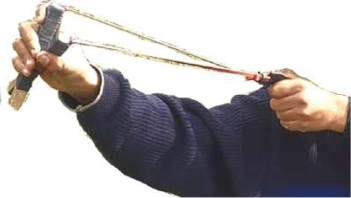
While the band is pulled back, the distance from the fingers to the paper bullet is called the extension of the rubber band. First the extension is set to 4 cm, the bullet is released, and the distance it flies is measured with a measuring tape. The same is then done with extensions of 6 cm, 8 cm and 10 cm. Each extension and the distance it produced are written in a table.
Never aim the paper bullet at anyone's face or eyes. Launch it only towards an empty space, and check that nobody is standing in its path before you let go.
Only one thing is changed on purpose each time, and that is the extension. Everything else stays the same: the same rubber band, the same size of paper bullet, the same hand. This way, any change in the distance travelled can be put down to the change in the extension and to nothing else.
One group's readings might look like this:
| Extension of rubber band (cm) | Distance travelled by the paper bullet (cm) |
| 4 | 60 |
| 6 | 90 |
| 8 | 120 |
| 10 | 150 |
The more the band was stretched, the farther the bullet flew. The extension is the cause and the distance travelled by the bullet is the effect. Real readings may not be quite this neat, because the hand moves slightly differently at every launch. The pattern is the same, though: as the extension grows, the distance grows.
What Is a Variable?
Scientific research involves changing the magnitude of one physical quantity and observing how this change brings changes in another physical quantity. In the catapult, we studied how the extension of the rubber band affects the distance travelled by the paper bullet. The extension and the distance are both physical quantities, and each had a different magnitude in every trial. Such physical quantities are called variables, because their value or magnitude varies each time.
Variables of an experiment: The elements (physical quantities) that change or may change in an experiment are called the variables of that experiment or research.
In the catapult experiment, the extension of the rubber band and the distance covered by the paper bullet are the variables. They are not the only ones. The thickness of the rubber band could also have been changed in that experiment, and so could the size of the paper bullet. Because these can change, they are also variables of the research, even though this time we chose to keep them the same.
- Extension of the rubber band: changed on purpose to 4, 6, 8 and 10 cm.
- Distance travelled by the paper bullet: measured every time.
- Thickness of the rubber band: could have been changed, kept the same this time.
- Size of the paper bullet: could have been changed, kept the same this time.
Do not think that only the quantities that did change are variables. A quantity that could change is a variable too, even when it is kept the same in one particular trial.
Writing a Relationship with Symbols
Writing "the extension of the rubber band" and "the distance travelled by the paper bullet" again and again is slow. So each variable has a name and is represented by a symbol for ease of writing. The relation between variables is then expressed as a mathematical formula. If the extension of the rubber band is denoted by \( e \) and the distance travelled by the paper bullet is denoted by \( x \), the relation between them is:
\[ x \propto e \]
The sign \( \propto \) is read "is proportional to". So \( x \propto e \) says that the distance travelled by the paper bullet is proportional to the extension of the rubber band. When \( e \) increases, \( x \) increases in the same ratio: if \( e \) doubles, \( x \) doubles too. In the table of readings, the extension went from 4 cm to 8 cm and the distance went from 60 cm to 120 cm. Both doubled.
Proportional sign: The sign \( \propto \) shows that when one variable increases, the other increases in the same ratio. \( x \propto e \) is read "\( x \) is proportional to \( e \)".
\( \propto \) is not the same as \( = \). \( x \propto e \) does not say the distance equals the extension: an extension of 4 cm gave a distance of 60 cm, not 4 cm. It only says the two grow together in the same ratio.
The full lesson is waiting for you
The notes are free to read in full. A free account opens the rest of the practice, and tracks your progress and confidence score for every subject. Presentations and videos need approval from Learn Yeti.