Things That Change in an Experiment
Scientists rarely just watch. Most research works by changing the size of one physical quantity on purpose and then observing how a second physical quantity responds. Anything in an experiment that changes, or could be changed, is called a variable, because its value varies from one trial to the next. Each variable has a name and is usually given a short symbol, so that the relation between variables can be written as a mathematical formula.
Variable: a physical quantity in an experiment or research whose value changes, or may be changed, from one trial to another.
Not every variable plays the same part. Some are changed by the experimenter, some change as a result, and some have to be held fixed so that they do not spoil the result. Variables are therefore usually sorted into three types: the independent variable, the dependent variable and the controlled variable.
The Rubber Band and Paper Bullet Experiment
One simple experiment shows all three types clearly. A rubber band is fixed to a catapult, and a small folded piece of paper is used as a bullet. The band is pulled back by a measured amount and released, and the distance the paper bullet travels is measured.
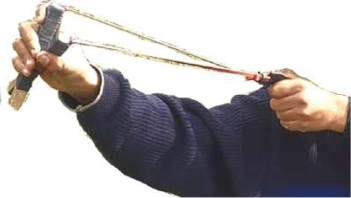
The band is stretched by 4 cm first, then by 6 cm, 8 cm and 10 cm. Each time, the distance travelled by the bullet is written in a table like this one:
| S.N. | Extension of rubber band (cm) | Distance travelled by the paper bullet (cm) |
| 1. | 4 | |
| 2. | 6 | |
| 3. | 8 | |
| 4. | 10 |
If the stretch is written as e and the distance as x, the results show that the distance grows as the stretch grows. This is written \( x \propto e \) and read as 'x is directly proportional to e'. The experiment also contains two quantities that could have been changed but were not: the thickness of the rubber band and the size of the paper bullet. These are variables too, and they matter just as much as the other two.
Independent Variable
In every experiment the researcher changes one variable by a chosen amount and measures the change this brings in another variable. The change made by the experimenter is called the causative factor, and the change that follows in the other variable is called the effect.
In the catapult experiment, the stretched band throws the bullet. The extension of the band is the causative factor and the distance travelled by the bullet is the effect. Nobody tells the experimenter how far to stretch the band. They are free to choose 4 cm, 7 cm or 10 cm. A variable that the experimenter can set freely in this way is called the independent variable.
Independent variable: the variable that the researcher deliberately changes or manipulates in an experiment or research. It is the causative factor whose effect is being studied.
The causative factors in an experiment are its independent variables. When studying how a plant grows, the amount of fertilizer, the amount of sunlight and the amount of water can each be the independent variable. The experimenter picks just one of them, varies it, and watches what happens to the plant.
Dependent Variable
Before letting go of the band, the experimenter cannot say exactly how far the bullet will fly. That distance is not something they choose. It depends on how far the band was stretched, and it can only be found by measuring it after the launch. A variable like this is called the dependent variable.
Dependent variable: the variable whose value depends on the value of another variable, so that the experimenter cannot predict or determine its value directly. Its value is found by observing or measuring it.
In the catapult experiment, the distance covered by the paper bullet is the dependent variable. In the same way, when observing the effect of sunlight on the growth and development of a plant, the amount of sunlight is the independent variable and the height or growth of the plant is the dependent variable. There is a quick test for the dependent variable: ask yourself 'which quantity am I waiting to find out?' The answer is the dependent variable.
Independent variable: what I change. Dependent variable: what I observe. Controlled variable: what I keep the same.
Controlled Variable
Many experiments involve more than two variables, and each of them can influence the result. Suppose the first trial uses a thin rubber band, and the second uses a thick band with a bigger stretch as well. If the bullet flies further, nobody can say whether the extra stretch or the thicker band caused it. It becomes hard to draw a conclusion, and any conclusion drawn may not be valid or reliable.
So every variable other than the chosen independent and dependent variables is kept under control from the first trial to the last. This makes the finding of the experiment valid, reliable and accurate. The variables held in check throughout the experiment in this way are called controlled variables.
Controlled variable: a variable that is kept the same throughout an experiment or research so that it does not affect the result.
In the catapult experiment, the same rubber band of the same thickness and paper bullets of the same size are used every time. If a different band were used in each trial, the result would not be valid. So the thickness of the rubber band and the size of the paper bullet are the controlled variables of this experiment.
When observing the effect of light on plant growth, all the plants should be the same size at the start. The air, water and manure given to them should also be kept equal throughout the experiment. So the initial size of the plants and the air, water and manure supplied to them are the controlled variables here.
When studying how the surface area of limestone affects the rate of its chemical reaction with an acid, the acid used each time should have the same concentration, and the quantity and weight of limestone should also be kept the same. In this experiment the surface area is the independent variable, the rate of reaction is the dependent variable, and the concentration of the acid and the quantity and weight of the limestone are the controlled variables.
Keeping a variable steady does not happen by luck. It needs special arrangements while the experiment is being designed, such as taking all the limestone from one bag, or watering every pot with the same measuring cup.
A controlled variable is not a variable that does not matter. It is kept the same precisely because it would change the result if it were allowed to vary. Leaving it out of the plan is how an experiment ends up giving a wrong conclusion.
The Three Variables Side by Side
Setting out the variables of the three experiments in one table makes their roles easy to tell apart. Every row has exactly one independent variable and one dependent variable, but there can be more than one controlled variable.
| Experiment | Independent variable | Dependent variable | Controlled variables |
| Catapult and paper bullet | Extension of rubber band | Distance travelled by paper bullet | Thickness of rubber band, size of paper bullet |
| Sunlight and plant growth | Amount of sunlight | Height or growth of plant | Initial size of plants, air, water, manure |
| Limestone and acid | Surface area of limestone | Rate of reaction | Concentration of acid, quantity and weight of limestone |
More Examples of Variables
The same three types of variable turn up in every piece of research, in the laboratory and in daily life. The table below shows the variables of four more investigations.
| Subject of research | Independent variable (what I can change) | Dependent variable (what I observe) | Controlled variable (what I keep the same) |
| Relation of a rotating knob of a tap and the rate of flow of the water | Magnitude of rotation of knob (in degree) | Amount of the water flow per minute (in litre) | Water pressure |
| Relation of electricity and magnetism in a solenoid | Amount of electric current (in ampere) | Number of pins attracted by the electromagnet | Number of turns in the solenoid, size of the pin |
| Effect of heat on the solubility of sugar | Temperature of water (in degree celsius) | Amount of completely dissolved sugar in water (in grams) | Amount of water (always 100 grams) |
| The immediate effect of physical exercise on the heartbeat | Duration of physical exercise (in minutes) | Number of heartbeats | Type of physical exercise, the interval between the end of exercise and the count of heartbeats |
Look at the tap. The further the knob is turned, the more water flows out each minute. But if the water pressure in the pipe changed during the experiment, the flow would change even with the knob held still, so the pressure must stay the same. In the sugar investigation the water is always 100 grams, because more water would dissolve more sugar whatever the temperature. In the exercise investigation, the longer someone waits after exercising before counting, the more the heart settles down, so that waiting time is also kept the same every time.
Notice that every measured quantity in the table carries its unit: degree, litre, ampere, degree celsius, grams, minutes. A number without its unit means nothing, so a variable is always written with the unit it is measured in.
Rules for Handling Variables
Five points need attention whenever variables are handled. The first three apply while the experiment is being planned:
- There should be only one independent variable in research or an experiment.
- There should be only one dependent variable in research or an experiment.
- Except for the specified independent and dependent variables, all other variables should be controlled.
The reason behind all three is the same. When only one cause is changed and only one effect is measured, any change in the result can be traced with confidence to that one cause. The other two rules are about how the variables are written, in an equation and on a graph.
Variables in an Equation
When the relation between variables is written as an equation, the dependent variable is usually written on the left side and the independent variable on the right side. For this reason the independent variable is sometimes called the right variable and the dependent variable the left variable.
Right variable and left variable: the independent variable, written on the right side of an equation, is called the right variable, and the dependent variable, written on the left side, is called the left variable.
When we study how the distance covered by a moving object varies with time, the equation of their relationship is:
\[ s = vt \]
Here the distance travelled, s, is the dependent variable, so it sits on the left. The time, t, is the independent variable, so it sits on the right. The speed, v, is kept the same while the distance is measured at different times, so speed is the controlled variable. The catapult result \( x \propto e \) follows the same pattern: the dependent distance x on the left and the independent stretch e on the right.
Variables on a Graph
When the relationship between variables is plotted on a graph, the dependent variable is always plotted on the y-axis, the vertical line, and the independent variable on the x-axis, the horizontal line. That is why the dependent variable is sometimes called the vertical variable or the y-variable, and the independent variable the horizontal variable or the x-variable.
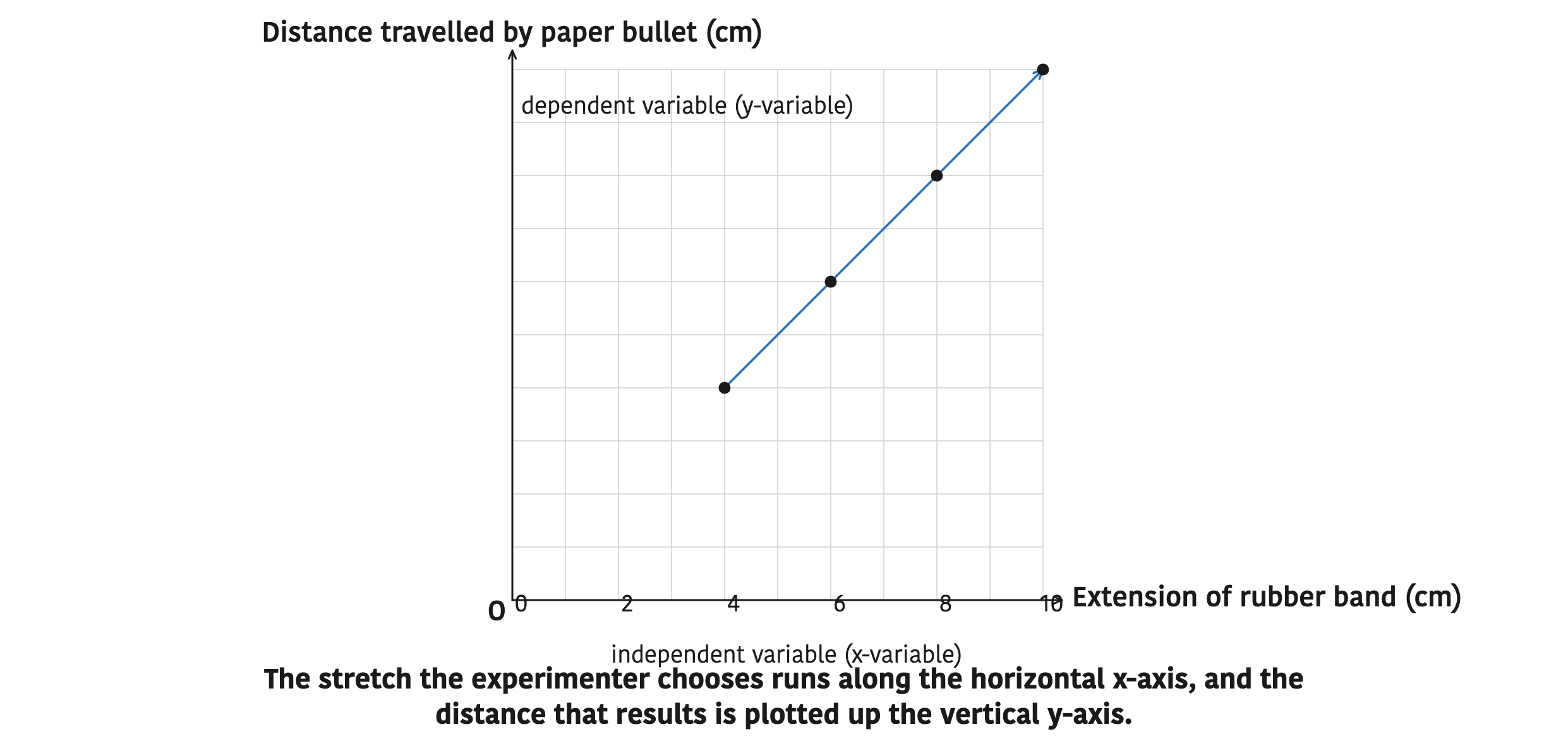
A graph always shows how a change in the independent variable brings a change in the dependent variable. Read it from left to right: as you move along the x-axis to a bigger stretch, the line climbs to a longer distance.
x-variable and y-variable: the independent variable, plotted on the horizontal x-axis, is called the x-variable or horizontal variable, and the dependent variable, plotted on the vertical y-axis, is called the y-variable or vertical variable.
| Where it is written | Independent variable | Dependent variable |
| In an equation | Right side (right variable) | Left side (left variable) |
| On a graph | x-axis, horizontal line (x-variable) | y-axis, vertical line (y-variable) |
The full lesson is waiting for you
The notes are free to read in full. A free account opens the rest of the practice, and tracks your progress and confidence score for every subject. Presentations and videos need approval from Learn Yeti.