Terms and Common Ratio of a Geometric Sequence
A geometric sequence is a list of numbers in which each term after the first is found by multiplying the term before it by the same fixed number. That fixed number is called the common ratio and is written \( r \). In the sequence 2, 6, 18, 54, ... every term is 3 times the one before it, so the common ratio is 3. To find \( r \) in any geometric sequence, divide a term by the term just before it: \( \frac{6}{2} = \frac{18}{6} = \frac{54}{18} = 3 \). The answer is the same whichever pair of neighbouring terms you choose, and that is exactly what makes the sequence geometric.
When the first term is called \( a \), the terms follow a clear pattern. The first term is \( a \), the second is \( a \) multiplied by \( r \) once, the third is \( a \) multiplied by \( r \) twice, and so on. The power of \( r \) is always one less than the position of the term.
| Position | Term | Example (\( a = 2 \), \( r = 3 \)) |
| 1st | \( a \) | 2 |
| 2nd | \( ar \) | 6 |
| 3rd | \( ar^2 \) | 18 |
| 4th | \( ar^3 \) | 54 |
| nth | \( ar^{n-1} \) | \( 2 \times 3^{n-1} \) |
This pattern gives the formula for the nth term of a geometric sequence. It is the main tool for everything that follows:
\[ t_n = ar^{n-1} \]
Here \( a \) is the first term, \( r \) is the common ratio, \( n \) is the position of the term, and \( t_n \) is the term standing in that position. For example, the fifth term of a sequence is \( t_5 = ar^4 \), because the power is one less than 5.
Finding a Missing Term Between Two Terms
Suppose the numbers 3, m, 27 are three terms in a row of a geometric sequence, and the middle term \( m \) is unknown. We cannot see the common ratio directly, but we know one thing for certain: the ratio stays the same all along the sequence. So the first term divided by the second must equal the second term divided by the third. That single fact is enough to find \( m \).
Step 1: Setting the two ratios equal:
\[ \frac{3}{m} = \frac{m}{27} \]
Step 2: Cross multiplying, which is allowed because the two fractions are equal:
\[ m^2 = 3 \times 27 \]
Step 3: Taking the square root of both sides to get \( m \) on its own:
\[ m = \sqrt{3 \times 27} = \sqrt{81} = 9 \]
So the missing term is 9. To check, divide each term by the one before it: \( 9 \div 3 = 3 \) and \( 27 \div 9 = 3 \). Both ratios are 3, so 3, 9, 27 really is a geometric sequence. Look closely at Step 3. The middle term came out as the square root of the first term multiplied by the third term. This is true for any three terms in a row of a geometric sequence:
\[ t_2 = \sqrt{t_1 \times t_3} \]
What Geometric Means Are
Geometric means: The terms lying between the first term and the last term of a geometric sequence are called geometric means.
Look at the sequence 2, 8, 32, 128, 512. Its first term is 2 and its last term is 512. The three numbers standing between them, 8, 32 and 128, are the geometric means between 2 and 512. In the same way, 9 is the geometric mean between 3 and 27, because 9 is the only term standing between them in 3, 9, 27.
A question that asks you to find, or insert, geometric means between two numbers is asking you to fill the gap between them with the right number of terms, so that the whole row, from the first number to the last, becomes a geometric sequence. The two given numbers always stay at the two ends. There are two situations, and each has its own method:
- (a) When only one geometric mean is needed between two terms, it is the square root of their product.
- (b) When two or more geometric means are needed, they are calculated using the first term and the common ratio. The common ratio is found by taking the last term as the nth term.
One Geometric Mean Between Two Numbers
Let \( a \) and \( b \) be two numbers and let \( m \) be the single geometric mean between them. Then \( a \), \( m \), \( b \) are three terms in a row of a geometric sequence, so the ratio from \( a \) to \( m \) equals the ratio from \( m \) to \( b \), that is \( \frac{m}{a} = \frac{b}{m} \). Cross multiplying gives \( m^2 = ab \), and taking the square root gives the rule:
\[ m = \sqrt{ab} \]
Geometric mean of two numbers: The single geometric mean between two numbers \( a \) and \( b \) is the square root of their product, \( m = \sqrt{ab} \).
Example 1: Find a geometric mean between the two numbers 2 and 32.
If \( m \) is the geometric mean between 2 and 32, then 2, m, 32 are in geometric sequence. Here the first term is \( a = 2 \), the third term is \( t_3 = 32 \), and the mean \( m \) is the second term.
Step 1: Using the rule for a single geometric mean:
\[ m = \sqrt{a \times t_3} = \sqrt{2 \times 32} \]
Step 2: Multiplying the two numbers under the root:
\[ m = \sqrt{64} \]
Step 3: Taking the square root:
\[ m = 8 \]
Hence the geometric mean between 2 and 32 is 8. The sequence 2, 8, 32 has a common ratio of 4, since \( 8 \div 2 = 4 \) and \( 32 \div 8 = 4 \), which confirms the answer.
Do not add the two numbers and halve them. That gives \( \frac{2 + 32}{2} = 17 \), and 2, 17, 32 has no common ratio, because \( 17 \div 2 \) is not equal to \( 32 \div 17 \). A geometric mean comes from multiplying the numbers and taking the square root.
Two or More Geometric Means
When two or more means are needed, the square root rule is no longer enough, because each unknown term does not sit between two known neighbours. Instead we find the common ratio first. Once \( a \) and \( r \) are known, every term of the sequence can be written down.
The key is counting the terms. If \( m \) geometric means are placed between two numbers, the full sequence holds the two given numbers as well as the \( m \) means. So the total number of terms is:
\[ n = m + 2 \]
The last given number is therefore the nth term, and the formula \( t_n = ar^{n-1} \) turns it into an equation with \( r \) as the only unknown. The method runs in this order:
- Write down the first term \( a \) and the number of means \( m \).
- Find the total number of terms, \( n = m + 2 \).
- Take the last given number as \( t_n \) and write \( t_n = ar^{n-1} \).
- Solve this equation to find the common ratio \( r \).
- Find the means one by one: \( ar \), \( ar^2 \), \( ar^3 \), and so on.
Now take the sequence 2, \( m_1 \), \( m_2 \), \( m_3 \), 512, ... in which the three terms between 2 and 512 are unknown. The first term is \( a = 2 \), the number of means is 3, and the last term is 512.
Step 1: Counting the total number of terms:
\[ n = m + 2 = 3 + 2 = 5 \]
Step 2: Writing the last term, 512, as the fifth term in \( t_n = ar^{n-1} \) with \( a = 2 \):
\[ 512 = 2r^{5-1} \]
Step 3: Simplifying the power:
\[ 512 = 2r^4 \]
Step 4: Dividing both sides by 2:
\[ 256 = r^4 \]
Step 5: Writing 256 as a fourth power, since \( 4 \times 4 \times 4 \times 4 = 256 \):
\[ 4^4 = r^4 \]
Step 6: Comparing the bases, because the powers are equal:
\[ r = 4 \]
Step 7: Finding the first mean, which is the second term:
\[ m_1 = ar = 2 \times 4 = 8 \]
Step 8: Finding the second mean, which is the third term:
\[ m_2 = ar^2 = 2 \times 4^2 = 32 \]
Step 9: Finding the third mean, which is the fourth term:
\[ m_3 = ar^3 = 2 \times 4^3 = 128 \]
So the complete sequence is 2, 8, 32, 128, 512, and the three geometric means between 2 and 512 are 8, 32 and 128.
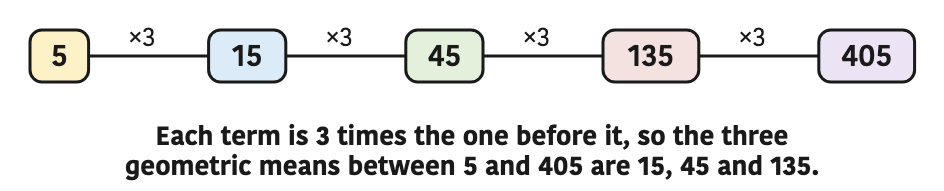
Example 2: Find 3 geometric means between the two numbers 5 and 405.
Let \( m_1 \), \( m_2 \), \( m_3 \) be the 3 geometric means between 5 and 405. Then 5, \( m_1 \), \( m_2 \), \( m_3 \), 405 are in geometric sequence, with first term \( a = 5 \), number of means 3, and last term 405.
Step 1: Counting the total number of terms:
\[ n = 3 + 2 = 5 \]
Step 2: Putting \( t_5 = 405 \) into the nth term formula:
\[ 405 = 5r^{5-1} \]
Step 3: Simplifying the power:
\[ 405 = 5r^4 \]
Step 4: Dividing both sides by 5:
\[ 81 = r^4 \]
Step 5: Writing 81 as a fourth power, since \( 3 \times 3 \times 3 \times 3 = 81 \):
\[ 3^4 = r^4 \]
Step 6: Comparing the bases:
\[ r = 3 \]
Step 7: Finding the first mean, which is the second term:
\[ m_1 = ar = 5 \times 3 = 15 \]
Step 8: Finding the second mean, which is the third term:
\[ m_2 = ar^2 = 5 \times 3^2 = 45 \]
Step 9: Finding the third mean, which is the fourth term:
\[ m_3 = ar^3 = 5 \times 3^3 = 135 \]
Hence the 3 geometric means between 5 and 405 are 15, 45 and 135.
Example 3: Insert 2 geometric means between 3 and 81.
When the number of means changes, the power of \( r \) changes too, so this time a cube appears instead of a fourth power. Here \( a = 3 \), the number of means is 2, and the last term is 81.
Step 1: Counting the total number of terms:
\[ n = 2 + 2 = 4 \]
Step 2: Writing 81 as the fourth term in the formula:
\[ 81 = 3r^{4-1} = 3r^3 \]
Step 3: Dividing both sides by 3:
\[ 27 = r^3 \]
Step 4: Writing 27 as a cube, since \( 3 \times 3 \times 3 = 27 \):
\[ 3^3 = r^3 \]
Step 5: Comparing the bases:
\[ r = 3 \]
Step 6: Finding the first mean:
\[ m_1 = ar = 3 \times 3 = 9 \]
Step 7: Finding the second mean:
\[ m_2 = ar^2 = 3 \times 3^2 = 27 \]
The sequence becomes 3, 9, 27, 81, so the two geometric means are 9 and 27.
The total number of terms is the number of means plus 2, not the number of means itself. With 3 means, the last number is the 5th term, so the equation uses \( r^4 \). Writing \( 405 = 5r^3 \) instead gives a wrong common ratio and wrong means.
Checking Your Means
A set of geometric means is easy to check, and checking catches almost every slip. First, count: the number of terms you have found between the two given numbers must equal the number of means asked for. Second, divide each term by the term before it. Every one of these divisions must give the same common ratio, and multiplying the last mean by that ratio must land exactly on the last given number.
In Example 2 the full row is 5, 15, 45, 135, 405. Dividing along the row gives \( 15 \div 5 = 3 \), \( 45 \div 15 = 3 \), \( 135 \div 45 = 3 \) and \( 405 \div 135 = 3 \). All four ratios are 3, and multiplying the last mean by the ratio gives \( 135 \times 3 = 405 \), which is the last given number. The answer is correct.
One mean: multiply the two numbers and take the square root. Several means: count the terms, find \( r \) from the last term, then keep multiplying by \( r \) starting from the first term.
The full lesson is waiting for you
The notes are free to read in full. A free account opens the rest of the practice, and tracks your progress and confidence score for every subject. Presentations and videos need approval from Learn Yeti.