Arithmetic Sequences and the General Term
A sequence is a list of numbers written in order by a rule. Look at 2, 4, 6, 8, ... and 1, 3, 5, 7, .... In both of them you reach the next term by adding the same number every time, and here that number is 2. Now look at 1, 4, 16, 64, ... and 2, 6, 18, 54, .... Here you reach the next term by multiplying by the same number: 4 in the first one and 3 in the second. The first kind is called an arithmetic sequence and the second kind a geometric sequence. Some lists, such as 5, 11, 8, 14, ..., are neither, because the jumps go up by 6 and then down by 3. In this topic we work only with arithmetic sequences.
Arithmetic sequence: a sequence in which every term after the first is obtained by adding the same fixed number to the term before it.
Common difference: the fixed number added each time in an arithmetic sequence, written \( d \). Subtract any term from the term just after it to find it: \( d = t_2 - t_1 = t_3 - t_2 \).
Once the first term \( a \) and the common difference \( d \) are known, every term can be built from those two numbers. The second term is \( a + d \), the third is \( a + 2d \) and the fourth is \( a + 3d \). By the time you reach the \( n \)th term, \( d \) has been added \( (n - 1) \) times. So the general term is:
\[ t_n = a + (n - 1)d \]
In 2, 4, 6, 8, ... we have \( a = 2 \) and \( d = 2 \). So the sixth term is \( t_6 = 2 + 5 \times 2 = 12 \) and the eighth term is \( t_8 = 2 + 7 \times 2 = 16 \). Joining the terms with plus signs instead of commas turns the sequence into a series: \( 2 + 4 + 6 + 8 + \dots \).
Every question in this topic is solved with two tools: the gap between neighbouring terms never changes, and the general term formula \( t_n = a + (n - 1)d \).
One Missing Term Between Two Terms
Suppose 3, m, 7 are in arithmetic sequence and m is unknown. How do we find m? The common difference never changes, so the jump from 3 up to m must be equal to the jump from m up to 7. That single fact is enough.
Step 1: Writing the two differences as equal:
\[ m - 3 = 7 - m \]
Step 2: Adding \( m \) and 3 to both sides, so the terms with \( m \) are on the left and the numbers on the right:
\[ m + m = 7 + 3 \]
Step 3: Since \( 2m = 10 \), dividing both sides by 2:
\[ m = \frac{7 + 3}{2} = 5 \]
Check: 3, 5, 7 goes up by 2 each time, so it really is an arithmetic sequence. Now look at Step 3 again. The answer came from adding the two outer terms and halving the total. In other words, the middle term is the average of its two neighbours.
In an arithmetic sequence, the term standing exactly between two terms is their average.
Arithmetic Means
Arithmetic means: the terms lying between the first and the last terms of an arithmetic sequence are called arithmetic means.
In 3, 5, 7 there is one arithmetic mean, and it is 5. In 3, 7, 11, 15, 19 there are three arithmetic means: 7, 11 and 15. The first and last terms are the ones given in the question; every term between them is a mean. When there is exactly one mean \( m \) between \( a \) and \( b \), it is their average:
\[ m = \frac{a + b}{2} \]
There are two ways of finding arithmetic means:
- (a) One arithmetic mean between two terms is found by taking the average of the two terms.
- (b) When there is more than one arithmetic mean between two terms, find the common difference \( d \) first and build each mean from it.
The letter m is used in two ways in this topic. When there is only one mean, m is the mean itself. When there are several means, m is the number of means, and the means themselves are called \( m_1, m_2, m_3 \) and so on. Read the question to see which one is meant.
The Same Term Found with the Common Difference
The average only works for a single mean. The second method works for any number of means, so it is worth watching it on the easy case first. In 3, m, 7 the first term is \( a = 3 \), 7 is the third term and m is the second term.
Step 1: Writing the third term with the general term formula:
\[ t_3 = a + 2d \]
Step 2: Putting in \( a = 3 \) and \( t_3 = 7 \):
\[ 7 = 3 + 2d \]
Step 3: Subtracting 3 from both sides:
\[ 2d = 4 \]
Step 4: Dividing both sides by 2 to get the common difference:
\[ d = 2 \]
Step 5: The mean is the second term, so adding \( d \) to \( a \):
\[ m = t_2 = a + d = 3 + 2 = 5 \]
Both methods give 5, as they must, because both describe the same sequence 3, 5, 7.
Several Means Between Two Terms
Now suppose three terms are missing: 3, x, y, z, 19. The average of 3 and 19 is 11, and that is the middle term y, but the average alone cannot give x and z. So we use the common difference. The key job is to count how many terms there are altogether. The three means and the two given terms make 5 terms, so 19 is the fifth term.
Total number of terms: when m arithmetic means are placed between two given terms, the total number of terms is \( n = m + 2 \). The 2 counts the first and the last terms.
\[ n = m + 2 \]
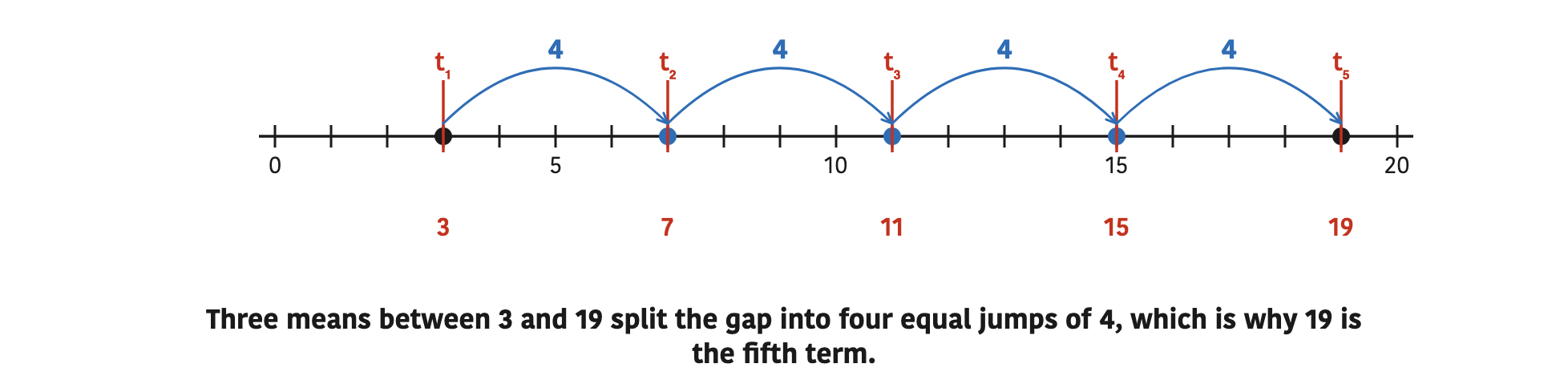
Step 1: Counting the terms, since there are three means:
\[ n = 3 + 2 = 5 \]
Step 2: Writing the fifth term with the general term formula:
\[ t_5 = a + (5 - 1)d \]
Step 3: Putting in \( a = 3 \) and \( t_5 = 19 \):
\[ 19 = 3 + 4d \]
Step 4: Subtracting 3 from both sides:
\[ 4d = 16 \]
Step 5: Dividing both sides by 4:
\[ d = 4 \]
Step 6: Building each mean by adding \( d \) to \( a \) once, twice and three times:
\[ x = t_2 = a + d = 3 + 4 = 7 \]
\[ y = t_3 = a + 2d = 3 + 2 \times 4 = 11 \]
\[ z = t_4 = a + 3d = 3 + 3 \times 4 = 15 \]
The sequence is 3, 7, 11, 15, 19. The middle mean, 11, is indeed the average of 3 and 19, so the two methods agree.
Worked Example 1: One Arithmetic Mean Between 7 and 17
Question: Find an arithmetic mean between 7 and 17. Let the mean be m. Then 7, m, 17 are in arithmetic sequence, with first term \( a = 7 \) and third term \( t_3 = 17 \).
Method 1, using the average. Step 1: The formula for a single mean:
\[ m = \frac{a + b}{2} \]
Step 2: Putting in \( a = 7 \) and \( b = 17 \) and working it out:
\[ m = \frac{7 + 17}{2} = \frac{24}{2} = 12 \]
Method 2, using the common difference. Step 1: Putting the values into the third term \( t_3 = a + 2d \):
\[ 17 = 7 + 2d \]
Step 2: Subtracting 7 from both sides:
\[ 2d = 17 - 7 = 10 \]
Step 3: Dividing both sides by 2:
\[ d = 5 \]
Step 4: Finding the second term, which is the mean:
\[ m = t_2 = a + d = 7 + 5 = 12 \]
So the arithmetic mean between 7 and 17 is 12. Check: 7, 12, 17 rises by 5 at each step.
Worked Example 2: Three Arithmetic Means Between 3 and 23
Question: Find three arithmetic means between 3 and 23. Call the means \( m_1, m_2, m_3 \). The sequence is 3, \( m_1 \), \( m_2 \), \( m_3 \), 23, with first term \( a = 3 \) and number of means \( m = 3 \).
Step 1: Counting the total number of terms:
\[ n = m + 2 = 3 + 2 = 5 \]
Step 2: So 23 is the fifth term. Writing it with the general term formula:
\[ t_5 = a + (5 - 1)d \]
Step 3: Putting in \( t_5 = 23 \) and \( a = 3 \):
\[ 23 = 3 + 4d \]
Step 4: Subtracting 3 from both sides:
\[ 4d = 20 \]
Step 5: Dividing both sides by 4:
\[ d = \frac{20}{4} = 5 \]
Step 6: Building the means by adding \( d \) to \( a \) once, twice and three times:
\[ m_1 = a + d = 3 + 5 = 8 \]
\[ m_2 = a + 2d = 3 + 2 \times 5 = 13 \]
\[ m_3 = a + 3d = 3 + 3 \times 5 = 18 \]
So the three arithmetic means between 3 and 23 are 8, 13 and 18. Adding \( d \) once more to the last mean gives \( 18 + 5 = 23 \), which is the last term, and that confirms the answer.
Worked Example 3: Seven Arithmetic Means Between 3 and 43
Question: Find seven arithmetic means between 3 and 43. The sequence is 3, \( m_1 \), \( m_2 \), \( m_3 \), \( m_4 \), \( m_5 \), \( m_6 \), \( m_7 \), 43, with \( a = 3 \) and number of means \( m = 7 \).
Step 1: Counting the total number of terms:
\[ n = 7 + 2 = 9 \]
Step 2: So 43 is the ninth term. Writing it with the formula:
\[ t_9 = a + (9 - 1)d \]
Step 3: Putting in \( t_9 = 43 \) and \( a = 3 \):
\[ 43 = 3 + 8d \]
Step 4: Subtracting 3 from both sides:
\[ 8d = 40 \]
Step 5: Dividing both sides by 8:
\[ d = 5 \]
Step 6: Starting from the first term and adding 5 each time, the seven means are worked out in the table:
| Mean | Term | Working | Value |
| \( m_1 \) | second term | \( a + d = 3 + 5 \) | 8 |
| \( m_2 \) | third term | \( a + 2d = 3 + 2 \times 5 \) | 13 |
| \( m_3 \) | fourth term | \( a + 3d = 3 + 3 \times 5 \) | 18 |
| \( m_4 \) | fifth term | \( a + 4d = 3 + 4 \times 5 \) | 23 |
| \( m_5 \) | sixth term | \( a + 5d = 3 + 5 \times 5 \) | 28 |
| \( m_6 \) | seventh term | \( a + 6d = 3 + 6 \times 5 \) | 33 |
| \( m_7 \) | eighth term | \( a + 7d = 3 + 7 \times 5 \) | 38 |
So the seven arithmetic means are 8, 13, 18, 23, 28, 33 and 38. The final check: \( 38 + 5 = 43 \), which is the last given term.
Do not treat the last given term as if its position were the number of means. With 7 means, 43 is the ninth term, not the seventh or the eighth. Writing \( 43 = 3 + 6d \) or \( 43 = 3 + 7d \) gives the wrong common difference, and every mean built from it is wrong. Always count \( n = m + 2 \) first.
Means in a Decreasing Sequence
The common difference can also be negative. When the first term is bigger than the last, the sequence goes down. Question: Insert four arithmetic means between 20 and 5. Here \( a = 20 \) and \( m = 4 \).
Step 1: Counting the total number of terms:
\[ n = 4 + 2 = 6 \]
Step 2: So 5 is the sixth term. Putting the values into \( t_6 = a + 5d \):
\[ 5 = 20 + 5d \]
Step 3: Subtracting 20 from both sides:
\[ 5d = -15 \]
Step 4: Dividing both sides by 5:
\[ d = -3 \]
Step 5: Building the means by adding \( -3 \) each time, which means taking away 3:
\[ m_1 = a + d = 20 - 3 = 17 \]
\[ m_2 = a + 2d = 20 - 6 = 14 \]
\[ m_3 = a + 3d = 20 - 9 = 11 \]
\[ m_4 = a + 4d = 20 - 12 = 8 \]
The means are 17, 14, 11 and 8. Then \( 8 - 3 = 5 \) brings us to the last term, so the answer checks.
Choosing the Method
After reading a question, first see how many means are asked for. That tells you the total number of terms and which term the last given number is. The table puts the cases of this topic side by side.
| Number of means (m) | Total terms (n = m + 2) | Last given term is | Method |
| 1 | 3 | \( t_3 \) | Average, or find d |
| 3 | 5 | \( t_5 \) | Find d first |
| 4 | 6 | \( t_6 \) | Find d first |
| 7 | 9 | \( t_9 \) | Find d first |
Count, find d, build: \( n = m + 2 \) tells you which term the last one is, the general term formula gives d, and the means are \( a + d, a + 2d, a + 3d, \dots \)
The full lesson is waiting for you
The notes are free to read in full. A free account opens the rest of the practice, and tracks your progress and confidence score for every subject. Presentations and videos need approval from Learn Yeti.