Nepal's Population Across the Census Years
Nepal counted its people for the first time in 1968 B.S. (1911 A.D.). Since then a census, a count of every person living in the country, has been held roughly once every ten years. The chart below shows the total population found at each census, measured in lakhs. One lakh is 1,00,000, so a bar marked 56 stands for 56,00,000 people.
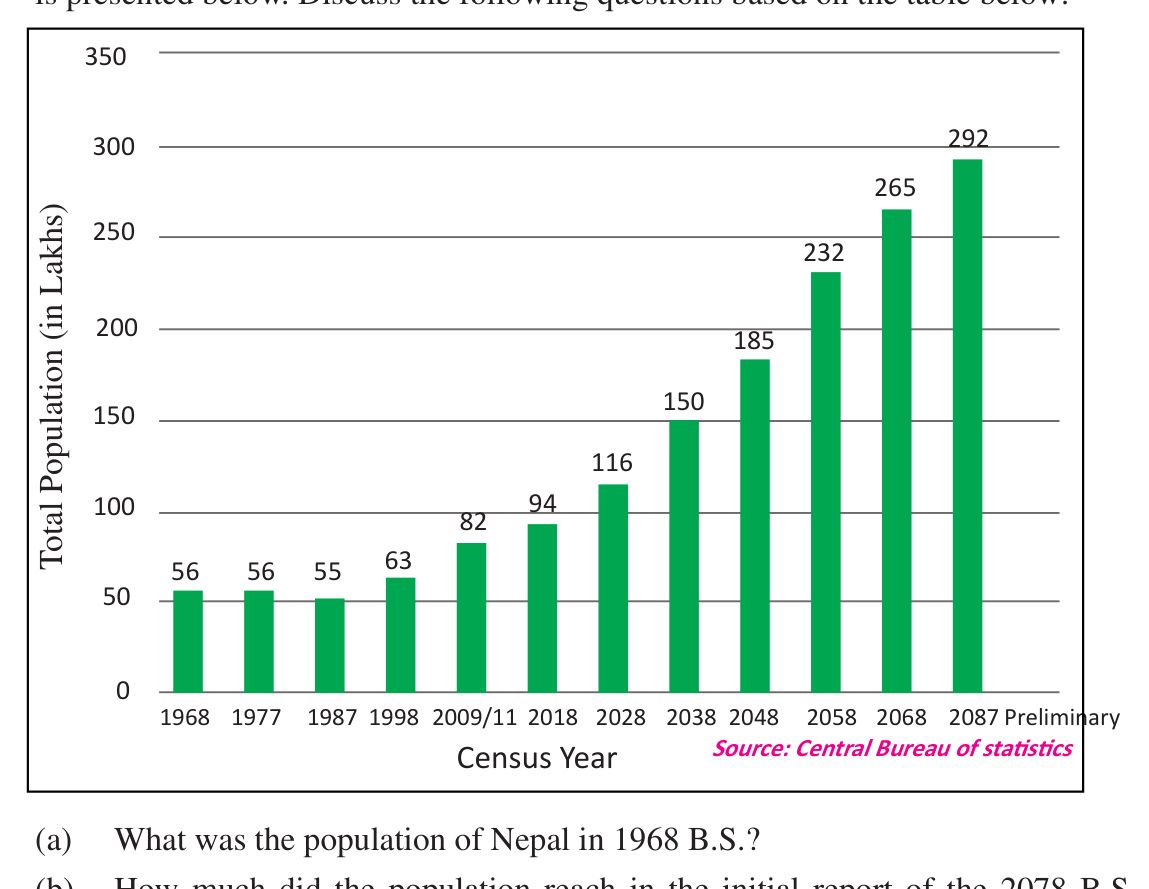
Reading the bars from left to right, the population was 56 lakh in 1968 B.S. and had reached 292 lakh by the preliminary count of 2078 B.S. It stayed the same between 1968 and 1977, and it fell only once, from 56 lakh to 55 lakh between 1977 and 1987. After that it rose at every census, and the rises generally became larger. The table lists every change.
| Census year (B.S.) | Population (lakh) | Change from the previous census |
| 1968 | 56 | First census |
| 1977 | 56 | No change |
| 1987 | 55 | Fell by 1 lakh |
| 1998 | 63 | Rose by 8 lakh |
| 2009/11 | 82 | Rose by 19 lakh |
| 2018 | 94 | Rose by 12 lakh |
| 2028 | 116 | Rose by 22 lakh |
| 2038 | 150 | Rose by 34 lakh |
| 2048 | 185 | Rose by 35 lakh |
| 2058 | 232 | Rose by 47 lakh |
| 2068 | 265 | Rose by 33 lakh |
| 2078 (preliminary) | 292 | Rose by 27 lakh |
Change as a Percentage
A rise of 27 lakh tells us little until we compare it with the population it started from. So a change is usually written as a percentage of the earlier value: divide the change by the earlier value and multiply by 100. Here is the change from 2068 B.S. to 2078 B.S.
Step 1: Subtracting the 2068 population from the 2078 population, in lakhs:
\[ 292 - 265 = 27 \]
Step 2: Dividing the increase by the 2068 population and multiplying by 100:
\[ \frac{27}{265} \times 100\% \approx 10.19\% \]
So in those ten years the population grew by about 10.19%. In the same way, the fall from 56 lakh to 55 lakh between 1977 and 1987 was \( \frac{1}{56} \times 100\% \approx 1.79\% \).
Growth of this kind is all around us. The price of rice and cooking oil goes up every year, land in a town becomes dearer, a school admits more students, money in a bank earns interest, bacteria in curd multiply every hour and a young plant grows taller every month. In each case a quantity keeps increasing at some rate, and the rest of this topic shows how to calculate where it will end up.
Growth That Builds on Itself
Suppose the population of a municipality was 25,000 at the 2078 B.S. census and it increases by 2% every year. To find the population in 2079 B.S. and in 2080 B.S., we can work one year at a time.
Step 1: For 2079 B.S., adding 2% of 25,000 to 25,000:
\[ \begin{aligned} &25000 + 25000 \times \frac{2}{100} \\ &= 25000 + 500 = 25500 \end{aligned} \]
Step 2: For 2080 B.S., taking 2% of 25,500, the population at the start of that year, and adding it:
\[ \begin{aligned} &25500 + 25500 \times \frac{2}{100} \\ &= 25500 + 510 = 26010 \end{aligned} \]
Look at the two increases. The first year added 500 people, but the second year added 510. The extra 10 appear because the 500 newcomers of the first year also grew by 2% in the second year. Each year the same rate is applied to a bigger number than before, so the growth builds on itself.
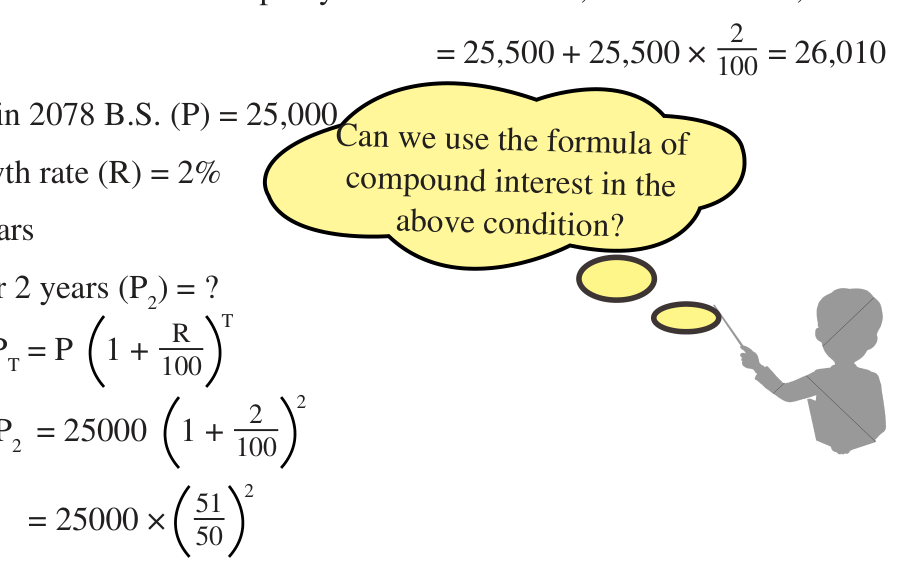
In compound interest the interest of each year is added to the principal, and the next year's interest is calculated on the new total. Population growth behaves in the same way, so the compound interest formula applies. Taking P = 25,000, R = 2 and T = 2:
Step 1: Writing the compound interest formula for the population after T years:
\[ P_T = P\left(1 + \frac{R}{100}\right)^T \]
Step 2: Putting in P = 25,000, R = 2 and T = 2:
\[ P_2 = 25000\left(1 + \frac{2}{100}\right)^2 \]
Step 3: Adding inside the bracket, since \( 1 + \frac{2}{100} = \frac{102}{100} = \frac{51}{50} \):
\[ P_2 = 25000 \times \left(\frac{51}{50}\right)^2 \]
Step 4: Squaring the fraction and multiplying:
\[ P_2 = 25000 \times \frac{2601}{2500} = 26010 \]
The formula gives 26,010 in one line, the same number we found year by year. For 10 or 20 years the year by year method becomes long, but the formula stays one line.
The Formulas for Growth
Population growth rate: when nothing from outside affects it, the population of a place increases each year by a fixed percentage of its size. That percentage is the population growth rate.
Growth population: the population a place reaches after increasing at its growth rate for some years. Problems about growth population are solved in the same way as compound interest problems.
If P is the population of the initial year and it grows at R% every year, the population after T years is:
\[ P_T = P\left(1 + \frac{R}{100}\right)^T \]
Sometimes only the number of people added is asked for. That is the final population minus the initial one, \( P_T - P \). Taking P out as a common factor gives the formula for the increased population after T years:
\[ P_T - P = P\left[\left(1 + \frac{R}{100}\right)^T - 1\right] \]
- P is the population (or price) of the initial year.
- R is the growth rate per year, in percent.
- T is the time, in years.
- \( P_T \) is the population (or price) after T years.
The letters are the same ones used in compound interest. Only their meaning changes with the situation.
| Letter | In compound interest | In growth |
| P | Principal | Initial population or initial price |
| R | Rate of interest per year | Growth rate per year |
| T | Time | Time |
| \( P_T \) | Compound amount after T years | Population or price after T years |
The same formula works for anything that grows by a fixed percentage of its current value: prices under inflation, bacteria that grow every hour, a plant that grows every month. The time T is counted in the same unit as the rate. A rate per hour needs T in hours, and a rate per month needs T in months.
Do not use \( P\left(1 + \frac{RT}{100}\right) \) for growth. That takes every year's increase from the first number only, like simple interest. A population or a price grows on its new value each year, so the power T is needed.
When the Rate Changes from Year to Year
Growth is not always steady. A district may grow by 5% one year, 6% the next and 4% the year after. Then each year gets its own bracket, and the brackets are multiplied together:
\[ \begin{aligned} P_T = P &\left(1+\frac{R_1}{100}\right)\left(1+\frac{R_2}{100}\right) \\ &\times \left(1+\frac{R_3}{100}\right) \cdots \left(1+\frac{R_T}{100}\right) \end{aligned} \]
Here \( R_1, R_2, R_3, \ldots, R_T \) are the growth rates of the first year, the second year, the third year and so on up to the T-th year. If every rate equals R, all the brackets are the same, and their product is \( \left(1+\frac{R}{100}\right)^T \). That is the ordinary formula again.
Migration and Deaths
The growth rate describes how a population changes on its own. In a real place, people also arrive from elsewhere, leave for other places, and sometimes die in accidents or disasters. These numbers are given separately from the rate, so they are handled separately.
Migration: people moving from one place to live in another. Those who move in (in-migration) increase the population of a place, and those who move out (out-migration) decrease it.
- Add the people who migrate in.
- Subtract the people who migrate out.
- Subtract the deaths that are given separately, such as deaths in a disaster.
The order of the work matters. First grow the population up to the year in which people arrive, leave or die. Then adjust it by adding or subtracting those people. Finally grow the new number for the years that remain.
Deaths and people who leave always reduce the population. A common slip is to add every number given in the question. Only the people who arrive are added.
Example 1: Finding the Population After Some Years
The population of a town in 2078 B.S. was 80,000. If the population grows by 3% every year, what will it be in 2081 B.S.?
Here the initial population P = 80,000, the rate R = 3% per year, and the time T = 2081 minus 2078, which is 3 years.
Step 1: Writing the growth formula:
\[ P_T = P\left(1+\frac{R}{100}\right)^T \]
Step 2: Putting in P = 80,000, R = 3 and T = 3:
\[ P_3 = 80000\left(1+\frac{3}{100}\right)^3 \]
Step 3: Adding inside the bracket, since \( 1 + \frac{3}{100} = 1.03 \):
\[ P_3 = 80000 \times (1.03)^3 \]
Step 4: Working out the cube, \( (1.03)^3 = 1.092727 \), and multiplying:
\[ P_3 = 80000 \times 1.092727 = 87418.16 \]
People are counted in whole numbers, so the population in 2081 B.S. will be about 87,418.
Example 2: Finding the Increase in Price
Inflation rate: the percentage by which prices rise in a year.
Two years ago a 25 kg sack of jeera masino rice cost Rs. 1,300. If the inflation rate was 5% per year, by how much has the price increased now?
Here P = Rs. 1,300, R = 5% per year and T = 2 years. Only the increase is asked, so the increase formula is used.
Step 1: Writing the formula for the increase:
\[ P_T - P = P\left[\left(1+\frac{R}{100}\right)^T - 1\right] \]
Step 2: Putting in P = 1300, R = 5 and T = 2, and adding inside the small bracket:
\[ = 1300\left[\left(\frac{105}{100}\right)^2 - 1\right] \]
Step 3: Squaring, since \( (1.05)^2 = 1.1025 \), and subtracting 1:
\[ = 1300 \times 0.1025 \]
Step 4: Multiplying:
\[ = 133.25 \]
So the price of the sack has increased by Rs. 133.25. As a check, the new price is \( 1300 \times 1.1025 = 1433.25 \), and 1433.25 minus 1300 is indeed 133.25.
Example 3: Finding the Rate of Growth
The price of a photocopy machine rose from Rs. 1,00,000 to Rs. 1,21,000 in 2 years. Find the yearly rate of increase.
Here P = Rs. 1,00,000, \( P_T \) = Rs. 1,21,000, T = 2 years, and R is unknown.
Step 1: Putting the known values into the growth formula:
\[ 121000 = 100000\left(1+\frac{R}{100}\right)^2 \]
Step 2: Dividing both sides by 100000, so that the bracket stands alone:
\[ \frac{121000}{100000} = \left(1+\frac{R}{100}\right)^2 \]
Step 3: Simplifying the fraction to \( \frac{121}{100} \) and writing it as a square, because \( 121 = 11^2 \) and \( 100 = 10^2 \):
\[ \left(\frac{11}{10}\right)^2 = \left(1+\frac{R}{100}\right)^2 \]
Step 4: Both sides are squares of positive numbers with the same index, so their bases are equal:
\[ \frac{11}{10} = 1+\frac{R}{100} \]
Step 5: Subtracting 1 from both sides:
\[ \frac{R}{100} = \frac{11}{10} - 1 = \frac{1}{10} \]
Step 6: Multiplying both sides by 100:
\[ R = \frac{1}{10} \times 100 = 10 \]
The price rose by 10% per year. Check: 10% of 1,00,000 makes 1,10,000 after one year, and 10% of 1,10,000 makes 1,21,000 after two.
Example 4: Finding the Time
A basic school has 500 students now. If the number of students increases by 20% every year, in how many years will it reach 864?
Here P = 500, R = 20% per year, \( P_T \) = 864, and T is unknown. When T is the unknown, the idea is to write both sides as powers of the same base.
Step 1: Putting the known values into the growth formula:
\[ 864 = 500\left(1+\frac{20}{100}\right)^T \]
Step 2: Dividing both sides by 500 and adding inside the bracket:
\[ \frac{864}{500} = \left(\frac{120}{100}\right)^T \]
Step 3: Reducing both fractions to lowest terms:
\[ \frac{216}{125} = \left(\frac{6}{5}\right)^T \]
Step 4: Writing the left side as a power, because \( 216 = 6^3 \) and \( 125 = 5^3 \):
\[ \left(\frac{6}{5}\right)^3 = \left(\frac{6}{5}\right)^T \]
Step 5: The bases are the same, so the indices are equal:
\[ T = 3 \]
The school will have 864 students after 3 years. Check: 500 becomes 600, then 720, then 864.
Example 5: Finding the Value Some Years Ago
The price of a plot of land is now Rs. 7,98,600 per aana. If the price has been rising by 10% every year, what was the price per ropani 3 years ago? (1 ropani = 16 aana)
Here the price now is the final value, \( P_T \) = Rs. 7,98,600 per aana, with R = 10% and T = 3 years. The price 3 years ago is the initial value P, which is unknown.
Step 1: Putting the known values into the growth formula:
\[ 798600 = P\left(1+\frac{10}{100}\right)^3 \]
Step 2: Working out the bracket, since \( (1.1)^3 = 1.331 \):
\[ 798600 = P \times 1.331 \]
Step 3: Dividing both sides by 1.331 to find P, the price per aana 3 years ago:
\[ P = \frac{798600}{1.331} = 600000 \]
Step 4: Converting to a price per ropani by multiplying by 16, because 1 ropani is 16 aana:
\[ 16 \times 600000 = 9600000 \]
Three years ago the land cost Rs. 6,00,000 per aana, which is Rs. 96,00,000 per ropani.
Example 6: A Different Rate Each Year
In 2076 B.S., 50,000 students from a district appeared in the SEE. Over the next 3 years the number increased by 5%, 6% and 4% in turn. How many students will appear in the SEE in 2079 B.S.?
Here P = 50,000, T = 3 years, \( R_1 = 5\% \), \( R_2 = 6\% \) and \( R_3 = 4\% \).
Step 1: Putting the values into the formula for different rates, one bracket for each year:
\[ \begin{aligned} P_3 = 50000 &\left(1+\frac{5}{100}\right)\left(1+\frac{6}{100}\right) \\ &\times \left(1+\frac{4}{100}\right) \end{aligned} \]
Step 2: Adding inside each bracket:
\[ P_3 = 50000 \times 1.05 \times 1.06 \times 1.04 \]
Step 3: Multiplying by the first year's factor:
\[ 50000 \times 1.05 = 52500 \]
Step 4: Multiplying by the second year's factor:
\[ 52500 \times 1.06 = 55650 \]
Step 5: Multiplying by the third year's factor:
\[ 55650 \times 1.04 = 57876 \]
So 57,876 students will appear in the SEE in 2079 B.S.
Example 7: Growth with Migration and Deaths
The population of a municipality in 2078 B.S. was 1,00,000. In 2079 B.S., 8,000 people migrated there from other places and 500 died in various accidents. If the population grows by 2% every year, what will it be in 2081 B.S.?
The 8,000 newcomers and the 500 deaths in 2079 are not part of the 2% rate, so the work is done in two parts: grow to 2079, adjust, then grow to 2081.
Part I, from 2078 B.S. to 2079 B.S.: here P = 1,00,000, R = 2 and T = 1.
Step 1: Growing the population for one year:
\[ P_1 = 100000\left(1+\frac{2}{100}\right)^1 = 102000 \]
Step 2: Adding the 8,000 who arrived and subtracting the 500 who died:
\[ 102000 + 8000 - 500 = 109500 \]
Part II, from 2079 B.S. to 2081 B.S.: the new starting population is P = 1,09,500, with R = 2 and T = 2.
Step 3: Putting these values into the growth formula:
\[ P_2 = 109500\left(1+\frac{2}{100}\right)^2 \]
Step 4: Squaring the bracket, since \( (1.02)^2 = 1.0404 \), and multiplying:
\[ P_2 = 109500 \times 1.0404 = 113923.8 \]
Rounding to whole people, the population of the municipality in 2081 B.S. will be 1,13,924.
Choosing the Right Formula
Every growth problem is the same formula with a different letter missing. Decide first what is asked, then use the matching method.
| What is asked | What to do |
| Population or price after T years | Use \( P_T = P\left(1+\frac{R}{100}\right)^T \) |
| Only the increase | Use \( P\left[\left(1+\frac{R}{100}\right)^T - 1\right] \) |
| The rate R | Divide \( P_T \) by P, write it as a power with index T, compare the bases |
| The time T | Divide \( P_T \) by P, write it as a power of \( 1+\frac{R}{100} \), compare the indices |
| The initial value P | Divide \( P_T \) by \( \left(1+\frac{R}{100}\right)^T \) |
| Different rates each year | Multiply one bracket for each year |
| Migration or deaths | Grow, add or subtract the people, then grow again |
From the beginning of 2075 to the end of 2077 is 3 years, because 2075, 2076 and 2077 are each counted in full. From the 2078 census to the 2080 census is 2 years. Read the words beginning and end carefully before writing T.
The full lesson is waiting for you
The notes are free to read in full. A free account opens the rest of the practice, and tracks your progress and confidence score for every subject. Presentations and videos need approval from Learn Yeti.