Why Things Lose Value
A new tractor, a new cupboard and a new photocopy machine have one thing in common. From the day they are bought, their value starts to fall. Suppose a farmer buys a tractor for Rs. 5,50,000 and sells it two years later for Rs. 3,60,000. The price has fallen by Rs. 1,90,000. Nobody has cheated anybody. Two years of ploughing have worn out its parts, so no buyer will pay the price of a new tractor for it.
The same thing happens in a second-hand shop, where a cupboard can be bought for Rs. 15,000 less than a new one of the same kind. An office photocopy machine bought for Rs. 2,10,000 may be worth only Rs. 1,00,000 after some years of printing. Every machine is built to work for a certain period. The more it is used, the less efficiently it works, and the less it is worth.
Depreciation: the fall in the value of an item over time, at a certain rate, because it is used and worn.
Compound depreciation: depreciation in which the value falls at a fixed rate every year, and each year's fall is calculated on the value at the start of that year.
In compound interest, interest joins the principal and makes the next year's interest larger. Compound depreciation works the other way round. After the first year's fall, the second year's fall is taken from the smaller value that is left, so the amount lost each year is a little less than the year before.
The Symbols of Depreciation
Every depreciation problem is built from four quantities. Before starting any calculation, write down what the question gives you using these symbols.
- \( V_0 \): the initial value, the price at the start
- \( R \): the rate of depreciation per year, as a percentage
- \( T \): the time, in years
- \( V_T \): the value after T years
Rate of depreciation: the percentage by which the value falls in one year, written R% per annum (p.a.).
Building the Formula Year by Year
The formula is easier to trust once you have built it yourself, one year at a time. In the first year the value falls by R% of the starting value \( V_0 \).
Step 1: The value after 1 year is the starting value minus R% of it:
\[ V_1 = V_0 - V_0 \times \frac{R}{100} \]
Step 2: Taking \( V_0 \) out as a common factor:
\[ V_1 = V_0\left(1 - \frac{R}{100}\right) \]
Step 3: The second year's fall is R% of \( V_1 \), the value left after the first year, not of \( V_0 \). So the value after 2 years is:
\[ V_2 = V_1 - V_1 \times \frac{R}{100} \]
Step 4: Taking \( V_1 \) out as a common factor:
\[ V_2 = V_1\left(1 - \frac{R}{100}\right) \]
Step 5: Putting in the value of \( V_1 \) from Step 2, the same bracket is multiplied twice:
\[ V_2 = V_0\left(1 - \frac{R}{100}\right)^2 \]
Step 6: The third year works the same way and multiplies by the same bracket once more:
\[ V_3 = V_0\left(1 - \frac{R}{100}\right)^3 \]
Each year adds one to the power, and the power always equals the number of years gone by. So the value after T years is:
\[ V_T = V_0\left(1 - \frac{R}{100}\right)^T \]
One year of depreciation means multiplying the value by \( \left(1 - \frac{R}{100}\right) \). A 10% depreciation, for example, multiplies the value by 0.9. For T years, that same multiplier is used T times.
How Much Value Is Lost
Sometimes a question asks not for the value that is left but for the amount that has been lost. That amount is the difference between the starting value and the value after T years.
Amount depreciated: the starting value minus the value after T years, that is \( V_0 - V_T \).
Step 1: The amount depreciated is:
\[ V_0 - V_T \]
Step 2: Putting in the formula for \( V_T \):
\[ = V_0 - V_0\left(1 - \frac{R}{100}\right)^T \]
Step 3: Taking \( V_0 \) out as a common factor:
\[ = V_0\left[1 - \left(1 - \frac{R}{100}\right)^T\right] \]
Read carefully whether the question wants the value after depreciation, \( V_T \), or the amount depreciated, \( V_0 - V_T \). "How much has it depreciated" asks for the difference. "What is it worth now" asks for \( V_T \) itself.
When the Rate Changes Every Year
In real life a value does not always fall at the same rate each year. A new motorbike, for example, loses a lot in its first year and less in later years. If the rates for the first, second, third and so on up to the T th year are \( R_1\% \), \( R_2\% \), \( R_3\% \), ..., \( R_T\% \), then each year multiplies the value by its own multiplier:
\[ \begin{aligned} V_T = V_0 &\left(1 - \frac{R_1}{100}\right)\left(1 - \frac{R_2}{100}\right) \\ &\times \cdots \times \left(1 - \frac{R_T}{100}\right) \end{aligned} \]
When all the rates are equal, every bracket is the same and this formula becomes \( V_0\left(1 - \frac{R}{100}\right)^T \) again.
Do not add different rates together and treat them as one fall, and do not take their average either. Depreciation of 10%, 15% and 20% is not a single 45% fall, and it is not 15% for three years. Write each year's bracket separately and multiply.
Growth and Depreciation Side by Side
The formulas for growth and depreciation look almost the same. The only difference is the sign inside the bracket: growth adds, because the value rises, and depreciation subtracts, because the value falls.
| Feature | Growth | Depreciation |
| Value each year | rises | falls |
| Multiplier each year | \( 1 + \frac{R}{100} \) | \( 1 - \frac{R}{100} \) |
| Multiplier at 10% | 1.1 | 0.9 |
| Amount changing each year | gets larger | gets smaller |
Growth adds and depreciation subtracts. After depreciation the answer must always be smaller than the starting value, which is a quick check on your working.
Example 1: Finding the Present Value
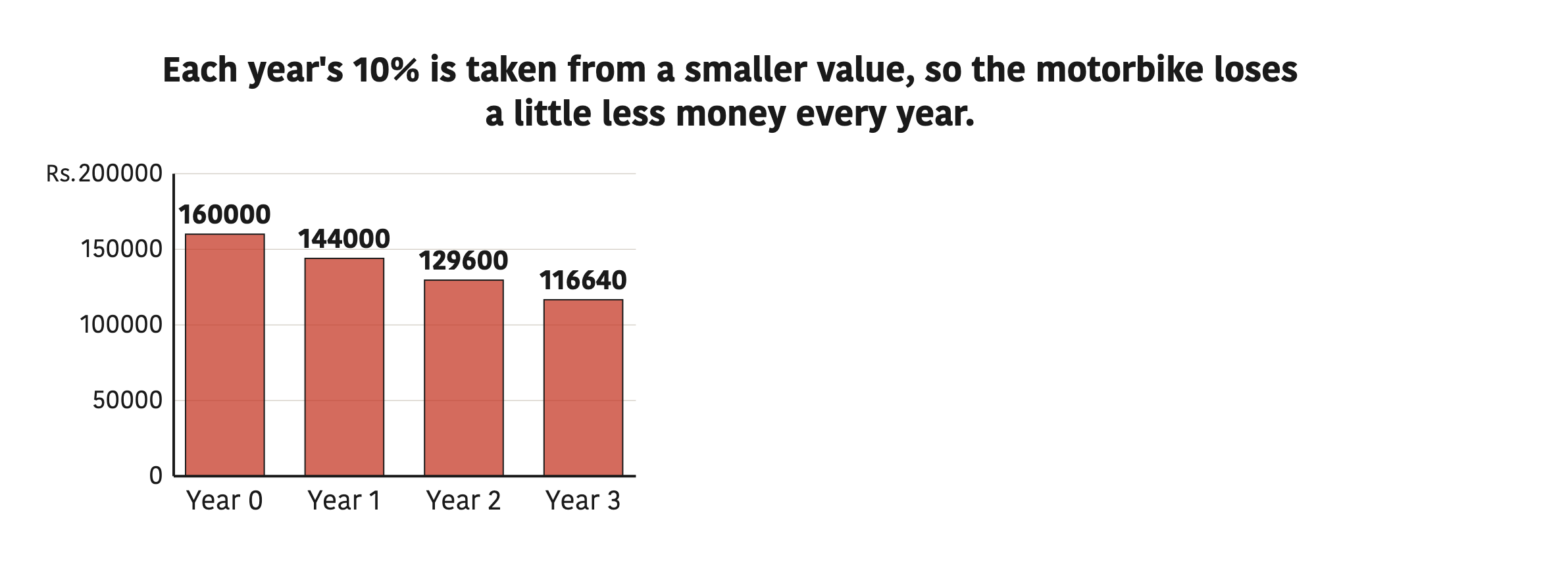
A motorbike is bought for Rs. 1,60,000. Its value depreciates at 10% per annum. What will it be worth after 3 years, and by how much will its value have fallen?
Here \( V_0 = \text{Rs. } 1{,}60{,}000 \), \( R = 10\% \), \( T = 3 \) years, and \( V_T \) is to be found.
Step 1: Writing the formula for the value after T years:
\[ V_T = V_0\left(1 - \frac{R}{100}\right)^T \]
Step 2: Putting in \( V_0 = 1{,}60{,}000 \), \( R = 10 \) and \( T = 3 \):
\[ V_3 = 1{,}60{,}000\left(1 - \frac{10}{100}\right)^3 \]
Step 3: Simplifying the bracket, since \( 1 - \frac{10}{100} = \frac{90}{100} = 0.9 \):
\[ V_3 = 1{,}60{,}000 \times (0.9)^3 \]
Step 4: Cubing 0.9 gives 0.729, and multiplying:
\[ V_3 = 1{,}60{,}000 \times 0.729 = 1{,}16{,}640 \]
Step 5: Subtracting the new value from the starting value to find the amount depreciated:
\[ V_0 - V_3 = 1{,}60{,}000 - 1{,}16{,}640 = 43{,}360 \]
So after 3 years the motorbike is worth Rs. 1,16,640, and its value has fallen by Rs. 43,360. Year by year, it loses Rs. 16,000 in the first year, Rs. 14,400 in the second and Rs. 12,960 in the third. Each year's 10% is taken from a smaller value, so each loss is smaller. The three losses add up to Rs. 43,360, the same answer.
Example 2: Finding the Rate of Depreciation
Sunita bought a computer for Rs. 50,000 for her studies. After 2 years of use its value had fallen by Rs. 18,000. What is the yearly rate of depreciation?
Here \( V_0 = \text{Rs. } 50{,}000 \), \( T = 2 \) years, the amount depreciated is Rs. 18,000, and \( R \) is to be found. The formula needs \( V_T \), not the amount lost, so that comes first.
Step 1: Finding the value after 2 years:
\[ V_2 = 50{,}000 - 18{,}000 = 32{,}000 \]
Step 2: Putting the values into the formula:
\[ 32{,}000 = 50{,}000\left(1 - \frac{R}{100}\right)^2 \]
Step 3: Dividing both sides by 50,000 and simplifying the fraction:
\[ \frac{16}{25} = \left(1 - \frac{R}{100}\right)^2 \]
Step 4: Writing \( \frac{16}{25} \) as a square:
\[ \left(\frac{4}{5}\right)^2 = \left(1 - \frac{R}{100}\right)^2 \]
Step 5: The powers are equal, so the bases are equal:
\[ \frac{4}{5} = 1 - \frac{R}{100} \]
Step 6: Moving \( \frac{R}{100} \) to one side:
\[ \frac{R}{100} = 1 - \frac{4}{5} = \frac{1}{5} \]
Step 7: Multiplying both sides by 100:
\[ R = \frac{1}{5} \times 100 = 20 \]
So the computer depreciates at 20% per annum. Checking: \( 50{,}000 \times 0.8 \times 0.8 = 32{,}000 \), which matches.
Example 3: Finding the Time
A tractor is worth Rs. 5,00,000 now. If its value falls by 20% every year, after how many years will it be worth Rs. 2,56,000?
Here \( V_0 = \text{Rs. } 5{,}00{,}000 \), \( R = 20\% \), \( V_T = \text{Rs. } 2{,}56{,}000 \), and \( T \) is to be found. Because T sits in the power, both sides are written as powers of the same base and the powers are compared.
Step 1: Putting the values into the formula:
\[ 2{,}56{,}000 = 5{,}00{,}000\left(1 - \frac{20}{100}\right)^T \]
Step 2: Dividing both sides by 5,00,000:
\[ \frac{256000}{500000} = \left(\frac{80}{100}\right)^T \]
Step 3: Simplifying the fractions on both sides:
\[ \frac{64}{125} = \left(\frac{4}{5}\right)^T \]
Step 4: Since \( 64 = 4^3 \) and \( 125 = 5^3 \), writing the left side as a power of \( \frac{4}{5} \):
\[ \left(\frac{4}{5}\right)^3 = \left(\frac{4}{5}\right)^T \]
Step 5: The bases are equal, so the powers are equal:
\[ T = 3 \]
So the tractor will be worth Rs. 2,56,000 after 3 years.
Example 4: Finding the Original Price
Rajesh sold his mobile phone for Rs. 21,675 after using it for 2 years. If its value depreciates at 15% per annum, how much did he pay for it?
Here \( V_T = \text{Rs. } 21{,}675 \), \( R = 15\% \), \( T = 2 \) years, and \( V_0 \) is to be found.
Step 1: Putting the values into the formula:
\[ 21{,}675 = V_0\left(1 - \frac{15}{100}\right)^2 \]
Step 2: Simplifying the bracket and squaring it, since \( (0.85)^2 = 0.7225 \):
\[ 21{,}675 = V_0 \times 0.7225 \]
Step 3: Dividing both sides by 0.7225:
\[ V_0 = \frac{21675}{0.7225} = 30{,}000 \]
So Rajesh paid Rs. 30,000 for the phone. Adding 15% back twice to the selling price would not give this answer, because the 15% was taken from the larger, earlier values. Dividing through the formula is the correct method.
Example 5: Different Rates in Different Years
A printing machine is worth Rs. 2,00,000 now. Its value falls by 10% in the first year, 15% in the second year and 20% in the third year. What will it be worth after 3 years?
Step 1: Writing the formula for three different rates:
\[ V_3 = V_0\left(1 - \frac{R_1}{100}\right)\left(1 - \frac{R_2}{100}\right)\left(1 - \frac{R_3}{100}\right) \]
Step 2: Putting in the values, with each bracket turned into a decimal:
\[ V_3 = 2{,}00{,}000 \times 0.90 \times 0.85 \times 0.80 \]
Step 3: Multiplying the three multipliers, since \( 0.90 \times 0.85 = 0.765 \) and \( 0.765 \times 0.80 = 0.612 \):
\[ V_3 = 2{,}00{,}000 \times 0.612 = 1{,}22{,}400 \]
So the machine will be worth Rs. 1,22,400 after 3 years. Using the average rate of 15% for all three years would give Rs. 1,22,825, which is wrong.
Example 6: Profit or Loss After Selling
A businessman bought a mini truck for Rs. 25,00,000. In 2 years of running it he earned Rs. 4,50,000. The truck depreciates at 12% per annum, and he sold it after 2 years. Did he make a profit or a loss, and how much?
The truck brought him money in two ways: the income from running it, and the price he sold it for. Both are added together before comparing with what he invested.
Step 1: Putting the values into the formula for the truck's value after 2 years:
\[ V_2 = 25{,}00{,}000\left(1 - \frac{12}{100}\right)^2 \]
Step 2: Multiplying, since \( (0.88)^2 = 0.7744 \):
\[ V_2 = 25{,}00{,}000 \times 0.7744 = 19{,}36{,}000 \]
Step 3: Adding the selling price and the income to find the total received:
\[ 19{,}36{,}000 + 4{,}50{,}000 = 23{,}86{,}000 \]
Step 4: The total received is less than the investment, so subtracting it from the investment:
\[ 25{,}00{,}000 - 23{,}86{,}000 = 1{,}14{,}000 \]
So the businessman made a loss of Rs. 1,14,000. Had the total received been more than the investment, the difference would have been a profit.
Do not leave out the income when working out profit or loss. Comparing only the depreciated value with the investment would show a loss of Rs. 5,64,000 here, which is wrong.
Example 7: Depreciation of Share Prices
The share price of a hydropower company fell by 10% every year for 2 years in a row. Gita sold all her shares now for Rs. 40,500. She had bought them 2 years ago at Rs. 100 per share. How many shares did she have?
First the total value 2 years ago, \( V_0 \), is found. Then it is divided by the price of one share.
Step 1: Putting the values into the formula:
\[ 40{,}500 = V_0\left(1 - \frac{10}{100}\right)^2 \]
Step 2: Squaring the bracket, since \( \left(\frac{90}{100}\right)^2 = \frac{81}{100} \):
\[ 40{,}500 = V_0 \times \frac{81}{100} \]
Step 3: Multiplying both sides by \( \frac{100}{81} \) to find \( V_0 \):
\[ V_0 = \frac{40500 \times 100}{81} = 50{,}000 \]
Step 4: Dividing the total value by the price of one share:
\[ \frac{50{,}000}{100} = 500 \]
So Gita had 500 shares. The number of shares never changed. Only the price of each share fell.
Example 8: Values of Two Successive Years
At a certain yearly rate of depreciation, an article will be worth Rs. 72,900 after 2 years and Rs. 65,610 after 3 years. Find the rate and the original price.
The value after 3 years is the value after 2 years multiplied once more by \( \left(1 - \frac{R}{100}\right) \). So dividing the later value by the earlier one gives the multiplier for one year.
Step 1: Dividing \( V_3 \) by \( V_2 \):
\[ \frac{65{,}610}{72{,}900} = 1 - \frac{R}{100} \]
Step 2: Changing the fraction to a decimal:
\[ 0.9 = 1 - \frac{R}{100} \]
Step 3: Solving for R:
\[ \frac{R}{100} = 0.1, \quad R = 10 \]
Step 4: Using the value after 2 years in the formula to find the original price:
\[ 72{,}900 = V_0 \times (0.9)^2 = V_0 \times 0.81 \]
Step 5: Dividing both sides by 0.81:
\[ V_0 = \frac{72900}{0.81} = 90{,}000 \]
So the rate of depreciation is 10% per annum and the original price was Rs. 90,000.
The full lesson is waiting for you
The notes are free to read in full. A free account opens the rest of the practice, and tracks your progress and confidence score for every subject. Presentations and videos need approval from Learn Yeti.