What Drill Is
At a school assembly, on a national day, or at the opening of a sports meet, you have seen students moving with the same step. Every foot lifts at the same moment, every arm swings together, and when one person at the front calls out, the whole group stops, turns or moves on. That group activity is drill.
Drill: Drill is a group activity, repeated again and again, in which people stand in lines or rows and move on a signal, following the orders of a commander.
The person who gives the orders in drill is called the commander. Every movement is done with discipline on the commander's order: nobody moves at a time of their own choosing or in their own way. In the past, drill was done mainly by the police, the army and scout children, who were trained to move their bodies in a disciplined way during festivals and celebrations. Today drill is practised by many groups and in schools as well. Schools use it at morning assembly, and at ceremonies it is performed as a march past.
Why Drill Is Done
Drill is done in a group, and that makes it enjoyable. Moving in step with friends feels livelier than exercising alone. Along with the fun, drill builds these qualities in a person:
- It helps the body grow and develop.
- It builds the skill of working with others in the same rhythm.
- Discipline.
- Obedience, the habit of following orders.
- Control over one's emotions.
- Patience.
- Tolerance.
- The ability to lead.
Differences between individuals make no difference in drill. Tall or short, quick or slow, everyone hears the same command and does the same movement. So every member of the group can take part on equal terms.
In drill the whole team should look like one body. If one person's step is out of time, that is the step everyone notices.
The Three Parts of Drill: Instruction, Command and Action
Drill works through three parts: instruction, command and action. They always come in this order.
Instruction: Instruction is the information about what to do in a task and how to do it.
Command: A command is the signal or spoken order given to the group, after the instruction, to carry out the activity.
Action: Action is the activity the group performs according to the instruction and the command.
Here is the order at work. Before the drill starts, the commander tells the team: "When I say 'Right turn', turn 90° to your right on your right heel and the ball of your left foot." That is the instruction. Then the commander calls out loudly: "Right turn!" That is the command. Finally, the whole team turns right together. That is the action. If the command comes before the team understands the instruction, the team is confused. If someone moves before the command, the rhythm breaks.
A commander can lead a group through many movements using different instructions and commands. Each command is explained below, one at a time.
(a) Attention
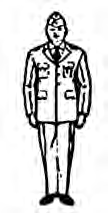
Every drill activity starts from the attention position, and after most other commands the team comes back to it. It is the base position of drill. In attention, the body is held like this:
- The feet form a V: the toes point outward so that there is an angle of about 30° to 40° between the two feet.
- The knees are straight and the chest is held out.
- Both arms hang straight down from the shoulders and are pressed against the sides of the body.
- The hands are loosely closed into fists.
- The chin is slightly lowered.
- The eyes look straight ahead, as if at something more than 500 metres away.
(b) Stand at Ease
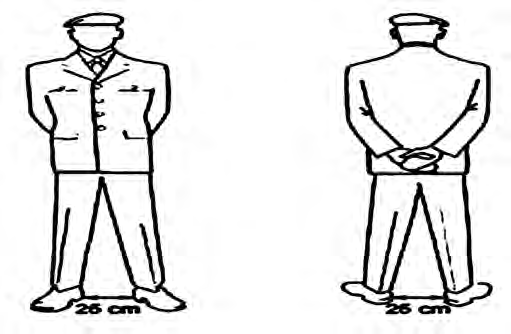
Stand at ease is a little more relaxed than attention, but the team is still in line and still alert. When the command comes, the feet and hands move like this:
- The right foot stays where it is.
- The left leg is lifted from the front, with the knee raised high.
- The left foot is set down 25 to 30 cm away, to the left.
- Both hands go behind the back, and the four fingers of the right hand are laid over the four fingers of the left hand, not counting the thumbs.
- The left thumb holds the four fingers of the right hand in place.
- Last, the right thumb is placed on top and grips the fingers.
Standing this way spreads the body's weight equally over both feet, so the body is better balanced.
(c) Mark Time
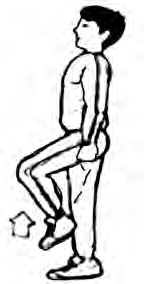
In mark time the feet march but the team does not move forward. It is marching on the spot. After the command:
- Starting from attention, the left foot is lifted from the front and put back down on the ground.
- Once the left foot is down, the right foot is lifted from the front and put down.
- When the right foot is down, the left foot is lifted again.
- This carries on, to a count of one, two, one, two or to the beat of a drum, until the command to halt is given.
The halt command must be given while the players have their right foot raised. The team then stops on the count of check, one, two, and ends with both feet together at attention. The full way of stopping is given under Group Halt below.
(d) Forward March
Before a programme begins at a ceremony, each group of participants performs a march past in perfect uniformity. To set the team moving, the commander gives the order to go forward. This command is Forward March.
As soon as the command comes, everyone steps off together, first with the left foot and then with the right. Because the whole group does this, every member's rhythm and movement must be the same. If even one person starts with the right foot, the rhythm of the entire line is spoiled.
(e) Quick March
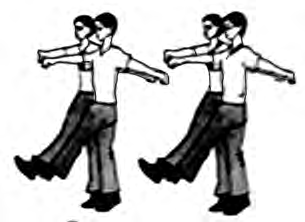
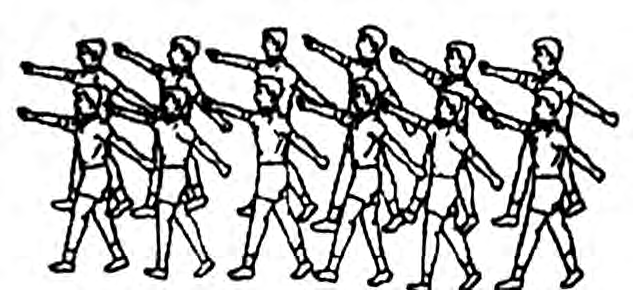
This command is given to make a group that is already moving forward march briskly. In quick march, arms and legs move in opposite pairs:
- First the left foot and the right arm go forward.
- Then the right foot and the left arm go forward.
- The elbow must not bend, and the arm swings up straight in front, level with the shoulder.
- The knee must not bend either.
- The foot lands on the heel only.
(f) Eyes Right
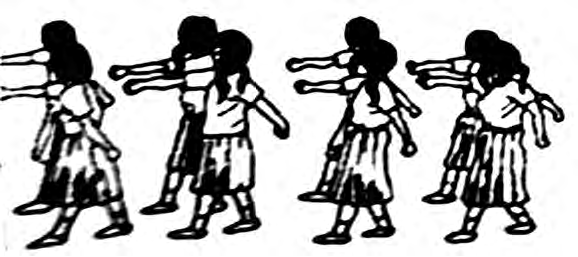
At a ceremony, while the team is marching forward, this command is used to honour and salute the invited guests on the stage. Eyes right is given only when the guests are on the team's right side. After the command, the members, the team leader and the flag bearer each do something different:
- Team members turn their heads to the right and keep marching forward, swinging both arms forward and back.
- The team leader keeps the left arm still, pressed against the body, and salutes with the right hand.
- The flag bearer tilts the flag to the right, turns the head to the right and marches on.
(g) Eyes Left
Eyes left is the mirror of eyes right. While the team marches forward, this command is given to honour and salute invited guests on the stage when they are on the team's left side. After the command, everyone turns the head to the left and marches on, swinging both arms forward and back. The team leader keeps the left arm still, pressed against the body. The flag bearer tilts the flag to the left, turns the head to the left and marches on.
The eyes go to the side where the guests are. Eyes right is given only if the guests are on the right, and eyes left only if they are on the left. Turning the head just because the team has reached the stage, without checking which side the guests are on, is wrong.
(h) Eyes Straight
After the team has saluted the guests on the stage with eyes right or eyes left, the team leader gives the command eyes straight. From the point where the command is given, the members turn their heads back to face straight ahead, one after another, and keep marching. With eyes straight, the team returns to the way it was marching before.
(i) Salute
Salute: To salute is to greet a person of higher rank than oneself.
A salute is given to honour a distinguished person or group. It is also used when receiving a prize or a certificate. To salute:
- Step one pace forward.
- Stand at attention and raise the heels of both feet.
- Bring the right hand to the side of the forehead, with all five fingers pressed together.
(j) Group Halt
Group halt is the command that stops a team that is marking time. It is given at the moment the players' right foot is raised. The team then stops like this:
- Check: saying 'check', the players put the right foot down.
- One: the left foot is put down.
- Two: the right foot is put down and the team stands still.
This feels awkward at first, but with practice the team learns to stop together on check, one, two. The same method is used to stop a team that is marching forward.
(k) Right Turn
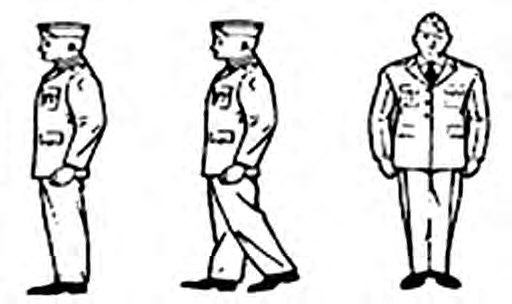
Right turn is done from the attention position. On the team leader's command:
- Start: stand at attention.
- Count one: turn 90° to the right, pivoting on the right heel and the ball of the left foot.
- Count two: bring the left foot, which is now behind, up to join the right foot.
(l) Left Turn
Left turn is also done from attention. It is the exact opposite of right turn. On the team leader's command:
- Start: stand at attention.
- Count one: turn 90° to the left, pivoting on the left heel and the ball of the right foot.
- Count two: bring the right foot, which is now behind, up to join the left foot.
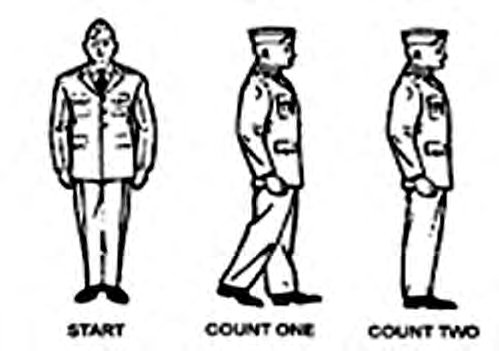
In a right turn you pivot on the right heel and bring the left foot in. In a left turn you pivot on the left heel and bring the right foot in. The heel on the side you are turning towards is always the pivot.
(m) Fall Out
Fall out: Fall out is the command a commander gives to let the team rest for a short time in the middle of a drill.
Fall out does not mean the drill is over. After a while the drill starts again. When the commander gives the fall out command to a team standing at attention:
- The team turns right together.
- It moves one pace to the right.
- It walks a few paces forward to the place where it will rest.
(n) Dismiss
Dismiss: Dismiss is the last stage of drill. Only when the commander gives this command is the drill formally declared over.
The commander gives the dismiss command while the team is at attention. Then:
- The team turns right together.
- It steps one pace forward.
- It salutes.
- Then the line breaks up and each member leaves for where they are going.
Do not mix up fall out and dismiss. Fall out is a short rest, and the drill starts again after it. Dismiss is the end of the drill, and only dismiss has a salute before the line breaks up.
(o) How to Receive a Prize or Certificate
At school and at many ceremonies, students and players who win first, second or third place, or a consolation place, in sports and cultural competitions are given prizes. Receiving a prize or certificate in a polite, proper way shows good manners and adds dignity to the programme. When your name is called to receive a prize:
- Rise from your seat and walk to the stage.
- Salute and greet the chief guest seated on the stage.
- Bend forward a little, hold out both hands and receive the prize or certificate.
- After receiving it, bow to the chief guest again and salute or greet them with joined palms.
- Move the left foot one pace back and bring the right foot to join it.
- Turn fully around to face the audience and greet everyone.
- Return to your seat.
The Commands at a Glance
| Command | When it is given | What the body does |
| Attention | At the start of every activity | Body upright, arms at the sides, feet in a V of 30° to 40° |
| Stand at ease | After attention | Left foot 25 to 30 cm to the left, hands joined behind |
| Mark time | From attention | Left, right steps on the spot |
| Forward march | To begin a march past | Everyone steps off together with the left foot |
| Quick march | While already moving forward | Left foot with right arm, elbows and knees straight |
| Eyes right | When guests are on the right | Heads right, leader salutes with the right hand |
| Eyes left | When guests are on the left | Heads left, leader's left arm held still |
| Eyes straight | After the salute to guests | Heads face straight ahead again |
| Salute | To honour someone and when receiving a prize | One pace forward, right hand beside the forehead |
| Group halt | While the right foot is raised | Stop on check, one, two |
| Right turn | From attention | Turn 90° right on the right heel, join the left foot |
| Left turn | From attention | Turn 90° left on the left heel, join the right foot |
| Fall out | For a rest in the middle of drill | Turn right, one pace right, then to the resting place |
| Dismiss | At the end of drill | Turn right, one pace forward, salute, then break the line |
The full lesson is waiting for you
The notes are free to read in full. A free account opens the rest of the practice, and tracks your progress and confidence score for every subject. Presentations and videos need approval from Learn Yeti.