What Diabetes Is
Diabetes mellitus is the full medical name of the illness most people simply call diabetes. In Nepal it is also known as the sugar disease. Our blood always carries some dissolved sugar, and that sugar is glucose. The cells of the body use glucose to get the energy for walking, reading, playing and thinking, so having glucose in the blood is a good thing. The trouble begins when there is far more of it than the body needs, and it stays that way for a long time.
Diabetes mellitus: the condition in which, because of changes in the chemical reactions of the body, the amount of sugar in the blood stays higher than normal for a long time.
Look closely at the words 'for a long time' in that definition. After a festival meal full of sweets, or a cup of very sugary tea, anyone's blood sugar rises for a while. A healthy body brings it back to normal within a few hours. A body with diabetes cannot do this, so its blood sugar stays high for days, months and years.
How Insulin Keeps Blood Sugar in Balance
Foods such as rice, chapati, potatoes, beaten rice and sugar are rich in carbohydrate. During digestion this carbohydrate is turned into glucose, which passes into the blood. Managing that glucose is the job of a hormone. An organ called the pancreas, which lies behind the stomach, produces a hormone called insulin. Insulin changes glucose into glycogen. In this way the amount of sugar in the blood is kept within its normal limit.
Pancreas: the organ lying behind the stomach whose ductless glands produce the hormone insulin.
Insulin: the hormone produced by the pancreas that changes glucose, made from the carbohydrate in our food, into glycogen, and so keeps blood sugar under control.
Followed in order, the path from a meal to normal blood sugar looks like this:
- We eat food that contains carbohydrate.
- After digestion, the carbohydrate becomes glucose and enters the blood.
- The pancreas produces insulin.
- Insulin changes the glucose into glycogen.
- The amount of sugar in the blood stays normal.
When Insulin Falls Short
If this process goes wrong, or the pancreas makes too little insulin, glucose cannot be changed into glycogen. It keeps building up in the blood, and the amount of glucose rises in both the blood and the urine. This is diabetes. Without enough insulin the body cannot use the glucose in its blood, so the glucose is passed out of the body in urine. As a result the body grows weak, the person becomes thin, and they feel hungry again and again.
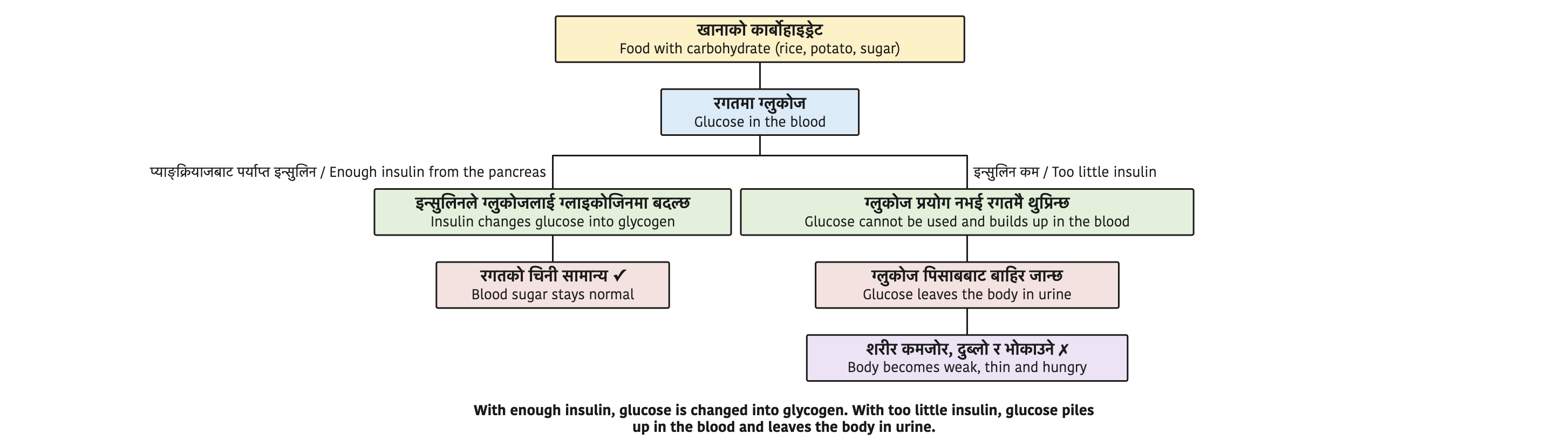
This can seem strange: the blood is full of sugar, yet the body is starving. Picture a family storeroom packed with grain, but locked, with the key lost. There is plenty of food, and still the family goes hungry. Insulin is that key. Without it the body cannot use its own glucose, and the glucose is wasted.
In diabetes the problem is not a shortage of sugar but a shortage of insulin. There is plenty of sugar in the blood; the body simply cannot use it.
Who Gets Diabetes, and at What Age
Diabetes does not come from a single cause; it arises in several ways. For some people it is hereditary: if parents or grandparents have had it, their children are more likely to get it too. The other big reason is the way a person lives. When someone lives in comfort without physical work or exercise, eats carelessly, spends the day idle and keeps putting on weight, diabetes can set in.
Diabetes mainly attacks people over 40. Nowadays, however, a disorderly lifestyle, too little exercise and food with little nourishment have made it appear in people younger than 40 as well. Habits such as sitting for hours in front of a phone or television, riding everywhere instead of walking, and filling up on instant noodles, crisps and bottled sweet drinks are spreading in villages as well as in cities.
Diabetes is not only an old person's disease. Younger people with unhealthy habits can get it too, and those habits often begin in the teenage years.
Causes of Diabetes
The causes of diabetes are easiest to understand in three groups: personal, environmental, and social and economic.
- Personal causes: the disease develops when the ductless glands in the pancreas cannot produce enough insulin. Obesity, too little physical activity, an inactive life and an unhealthy lifestyle also cause it.
- Environmental causes: daily stress, a polluted environment, a diet heavy in oily, sugary and packaged market food, smoking and drinking alcohol, and the use of pesticides can also lead to the disease.
- Social and economic causes: low wages and poverty, urbanisation, lack of a balanced diet, the habit of eating fatty, oily and very sweet food, and social and cultural customs in which people do little physical activity or exercise.
A ductless gland has no tube to carry away what it makes; it sends its hormone straight into the blood. If these glands in the pancreas make too little insulin, glucose builds up in the blood exactly as described above.
It may seem odd that both poverty and rich, oily food appear on the list. A family on low wages often buys food that is cheap but low in nourishment, and missing out on a balanced diet also raises the risk of diabetes. So diabetes is not only a disease of the well off. Urbanisation plays its part too, by pushing people towards a life with less walking and less physical work.
Symptoms of Diabetes
A person with diabetes may show these symptoms:
- Feeling more hungry and thirsty than usual
- Needing to pass urine often
- Wounds and boils that are slow to heal
- Feeling weak
- Constipation
- Fainting
- Headache
- Getting angry quickly
- Losing weight for no obvious reason
- Loss of sexual desire
Several of these follow directly from what happens inside the body. Because the body cannot use its glucose, the glucose leaves in urine, so the person passes urine often, and losing that water makes them thirsty. Because the body gets no energy from its sugar, the person feels weak, keeps feeling hungry, and loses weight unusually even while eating.
A wound that takes a long time to heal is another sign of diabetes. If someone shows these symptoms for many days, the sensible step is to have their blood sugar checked at the nearest health centre.
Preventing Diabetes
Many causes of diabetes are tied to our own habits, so by changing those habits we can protect ourselves to a large extent. These are the measures to follow:
- Eat healthy food
- Exercise regularly
- Keep body weight normal
- Do not use tobacco products or alcohol
- Keep blood pressure and blood sugar under control
- Do not eat too much carbohydrate-rich food
- Avoid very oily and sweet food
- Eat plenty of green vegetables
- Drink plenty of water
- Pay special attention to cleanliness
- Do not take on needless worry
Matching each measure to the cause it works against shows why these measures help:
| Cause | Measure that works against it |
| Obesity | Keep body weight normal |
| Too little physical activity, an inactive life | Exercise regularly |
| Oily, sugary and packaged market food | Eat healthy food and plenty of green vegetables |
| Smoking and drinking alcohol | Do not use tobacco products or alcohol |
| Daily stress | Do not take on needless worry |
These measures are not hard to fit into daily life. You can walk or cycle to school, play or run for half an hour in the evening, drink water instead of bottled sweet drinks, and snack on fruit, roasted chickpeas or maize rather than instant noodles. Putting a little less rice and a little more green vegetables on your plate also makes a real difference.
We cannot change what we inherit, but food, exercise and habits are in our own hands. A healthy lifestyle is the strongest protection against diabetes.
The full lesson is waiting for you
The notes are free to read in full. A free account opens the rest of the practice, and tracks your progress and confidence score for every subject. Presentations and videos need approval from Learn Yeti.