Menstruation: Natural and a Matter of Pride
Girls and women of reproductive age menstruate roughly once a month. Menstruation is a normal, natural and regular process of the body. It is not something to be ashamed of. It is a matter of pride.
When a girl starts to menstruate, it shows that her body is healthy and that she has become capable of reproduction. So when a daughter has her first period, it is a moment for the family to be glad, not worried or embarrassed. A woman can take it as good news about her own body: it tells her she is able to have children one day.
Even so, many people in our society still hold myths and wrong ideas about menstruation. Because of them, a menstruating girl may be kept out of the kitchen, stopped from touching a water tap, or made to sleep outside the house. Myths like these get in the way of menstrual hygiene management, and in the end they harm the health of girls and women.
Myths, Misconceptions and Superstition
Three words come up again and again in this lesson, and they mean slightly different things.
Myth: a false belief that people accept as true because they have heard it or received it through tradition, without checking whether it is real.
Misconception: a wrong understanding of something, an idea that does not match the facts.
Superstition: a belief held blindly, without any reason or evidence behind it.
Removing a myth: the work of clearing away a false belief and putting a correct understanding in its place.
Most myths about menstruation were not made up by anyone alive today. They have been handed down from grandmother to mother to daughter for generations, and because nobody questioned them, they started to feel like facts. The first step in removing a myth is to ask a simple question: what is the evidence for this?
Common Myths and Misconceptions about Menstruation
These beliefs about menstruation are still found in many communities in Nepal:
- The superstition that a girl or woman becomes impure while she is menstruating.
- The misconception that she must not eat milk, curd, ghee, fish or meat during her period.
- The belief that her brothers and father must not see or touch her during this time.
- The belief that she must not sleep in her usual place or bed, and must sleep alone and apart.
- The belief that she must not attend any religious event or take part in worship.
- The practice of chhaupadi, still followed in some districts of Karnali and Sudurpaschim provinces, in which a menstruating girl or woman is kept apart in a hut outside the house.
- The belief that she must not touch plants, green vegetables, water sources, taps or cooking pots.
These seven are not the only ones. Many other myths are found in our communities. In some homes a menstruating girl is told not to look in a mirror; in others she is told that pickle will spoil if she touches it. All of them share one thing: none of them has any evidence behind it.
Myth and Fact Side by Side
Setting each myth beside the fact shows clearly why it is wrong:
| Myth | Fact |
| A girl or woman becomes impure during her period. | Menstruation is a normal, regular process. It does not make anyone impure. |
| She must not eat milk, curd, ghee, fish or meat. | Food does not affect menstruation in any harmful way. Her body needs nourishing food during her period just as on any other day. |
| Her father and brothers must not see or touch her. | Seeing or touching a menstruating daughter or sister does no harm to anyone. |
| She must sleep alone, apart, or outside. | Sleeping in her own clean, warm and safe bed is what keeps her healthy. |
| Plants, water sources or pots are spoiled if she touches them. | Her touch does not wilt a plant, pollute water or make a pot unclean. |
The Practice of Chhaupadi
Chhaupadi: the practice of not letting girls and women stay in the house during menstruation, and keeping them apart in a hut outside it.
Chhau hut: a small hut outside the house where a menstruating girl or woman is made to stay apart from the family.
Chhaupadi is still practised in some districts of Karnali and Sudurpaschim provinces. Under it, a girl or woman is not allowed to stay in the family home for as long as her period lasts. She is sent to a chhau hut outside the house, where she sleeps, eats and spends her days away from the rest of the family.
A chhau hut is usually low, cramped and dark, built of stone, mud or straw. It has no clean bed, no clean water and no safe way to shut the door. A girl kept there faces cold in winter, smoke if she lights a fire to keep warm, and danger from wild animals, snakes and people who may harm her. So chhaupadi is not just a mistaken belief. It is a practice that puts the lives of girls and women at risk.
How These Myths Cause Harm
Myths do not stay inside people's heads. They change how a menstruating girl or woman is treated every day, and that treatment has real effects:
- Menstrual hygiene becomes harder to manage. If she cannot touch a tap or a water source, she cannot wash herself properly or clean her pads.
- Her health suffers. Being denied nourishing food can leave her weak, and staying in a cold, dirty place raises the risk of infection and illness.
- She begins to feel shame, fear and low self-worth, and may start to see a natural process of her own body as something bad.
- Her safety is at risk. Alone in a chhau hut, she is exposed to animals, snakes, cold and violence.
In this way, wrong ideas about menstruation keep damaging the health of women. Removing them is a job for all of us, each from our own place in the family and community.
Efforts Needed to Remove the Myths
Individuals, families, schools, communities and the government all have a part to play. These are the efforts needed:
- We must first accept for ourselves, and then help everyone in society understand, that no girl or woman is impure because she menstruates. It is a normal, regular process and a sign that she is reproductively healthy.
- Awareness programmes about menstruation must be run regularly in schools and communities, not just once.
- The government itself must run campaigns to remove misconceptions about menstruation.
- Adolescent friendly services, where boys and girls can ask questions and get help without fear, must be run in every community.
- The law made against chhaupadi must be enforced effectively.
- Sexual and reproductive health education must reach communities in a way that actually works.
- Menstrual Hygiene Day must be marked in schools and communities with awareness activities.
A law alone does not remove a myth. Change lasts only when family members themselves understand that menstruation is not impure and start treating girls accordingly.
Government and Legal Efforts So Far
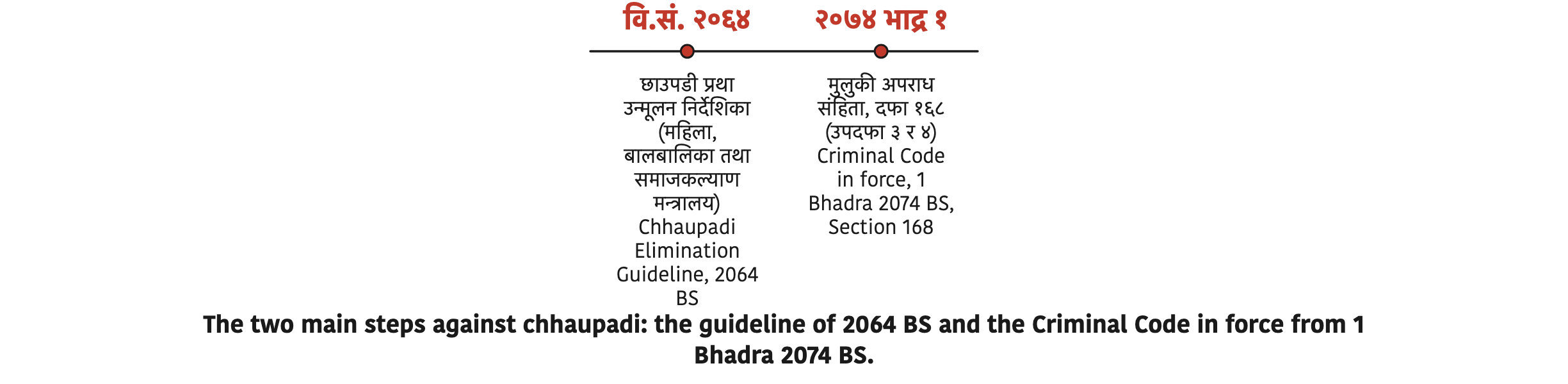
To remove these myths and make dignified menstrual hygiene management possible, the Government of Nepal has made policies at different times and has been putting them into practice. Non-governmental organisations have also been working on this for a long time. Two steps stand out.
First, in 2064 BS the Ministry of Women, Children and Social Welfare approved and put into effect the Chhaupadi Elimination Guideline. This gave government bodies a clear basis for working to end the practice.
Second, the Criminal Code of Nepal, in force from 1 Bhadra 2074 BS, made it illegal to keep a woman who is menstruating or has recently given birth in a chhau hut. From then on, chhaupadi was no longer just a harmful custom. It became a crime that can be punished. Two subsections of Section 168 of this law deal with it:
| Section 168 | What it says |
| Subsection 3 | A woman who is menstruating or has recently given birth must not be kept in chhaupadi, and no discrimination, untouchability or inhuman treatment of any similar kind may be done to her or caused to be done. |
| Subsection 4 | A person who discriminates in this way can be punished with up to three months in prison, or a fine of three thousand rupees, or both. |
Do not mix up subsections 3 and 4. Subsection 3 says what must not be done; subsection 4 gives the punishment for doing it. The law protects women who have recently given birth as well as women who are menstruating.
Making a law is a big step, but a myth does not disappear just because a law exists. That is why government and non-governmental bodies are still working both to reduce wrong beliefs and practices around menstruation and to see that these laws are actually carried out. The rest of us have to keep doing everything we can as well.
What Each of Us Can Do
Removing these myths is not only the government's job. As students, we can start in our own homes and neighbourhoods:
- Talk about menstruation openly, without embarrassment, and share correct information with friends.
- Never tease or look down on a friend or sister because she is menstruating.
- Politely explain the difference between myth and fact to parents and grandparents at home.
- If you learn that someone is being kept in a chhau hut, tell a teacher, the local ward office or the police.
- Take an active part in awareness programmes at school and in Menstrual Hygiene Day activities.
Boys have just as big a part to play. When brothers and fathers themselves understand that nothing happens if they see or touch a menstruating girl, the myth inside the home falls away fastest.
The full lesson is waiting for you
The notes are free to read in full. A free account opens the rest of the practice, and tracks your progress and confidence score for every subject. Presentations and videos need approval from Learn Yeti.