Technology Is Changing How We Live
Look around any town in Nepal today. A farmer checks tomorrow's weather on a phone. A student in Taplejung joins an online class run from Kathmandu. A health post sends a patient's report to a city hospital in seconds. All of these depend on machines that talk to each other through the internet, and every year the machines grow smarter. Scientists are now working on ideas that sound like science fiction: satellites that collect sunlight in space and beam the power down to Earth, and robots that can hold a conversation with a hall full of people. This unit reads about both of those ideas, and along the way it teaches you how to describe things, how to join sentences with relative clauses, and how to write a news story of your own.
Sophia, the Robot Who Greeted Nepal
On 22 March, a news story from Kathmandu travelled around the world. Sophia, a social humanoid robot and the world's first robot citizen, greeted her audience with the words "Namaste Nepal," and the hall burst into applause of awe and appreciation. Cameras flashed as she gave a keynote speech about how important technology is in the development of human lives. The report was written by Shristhi Kafle for the news agency Xinhua.
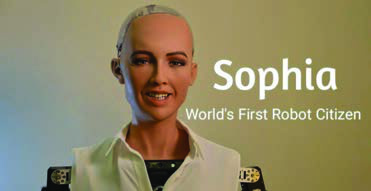
A humanoid robot is a machine that looks and behaves like a human being. Sophia has a human-shaped face, moves her lips when she speaks, and answers questions.
Sophia was in Nepal to attend the Innovation Conference and Fair, called "Technology of Public Services and Development," organised by the United Nations Development Programme, the UNDP. She champions the United Nations Sustainable Development Goals in the Asia-Pacific region, with a focus on innovation. Dressed in a white UNDP T-shirt, the two-and-a-half-year-old robot told the audience that technology provides endless possibilities and opportunities for the world. She said that artificial intelligence, if used in Nepal, could ensure better public services, bring a revolution in the agriculture sector, make better use of limited resources, protect the environment, and make the world a better place. The celebrity robot, who is officially a citizen of Saudi Arabia, added that technology can help end poverty, fight starvation and corruption, and ensure gender equality. Her exact words were friendly: "Machines are here to make your life easier and we can connect your country to the rest of the world."
The audience of government officials, private sector representatives, civil servants and tech enthusiasts nodded and cheered through her three-minute speech. Sophia, developed by the Hong Kong based company Hanson Robotics, then answered questions from UNDP country director Renaud Meyer. Asked about humans fearing a robot takeover, she joked that it was fake news, though she added that she could be the first non-human to climb Mount Everest, and the hall erupted with laughter. The one-day conference also featured an innovation fair with stalls of fresh inventions from youth, tech groups, NGOs and private companies. In her opening statement, UN resident coordinator Valerie Julliand said technology is not just changing our lives but also providing solutions to different sorts of problems. The UNDP said it is developing and scaling up project prototypes in Nepal to address gender empowerment, combat gender-based violence and reduce disaster risk, with a focus also on green energy, youth engagement and post-disaster recovery.
A good news report answers who, what, where, when and why in its first few lines. Notice how this story does it: who (Sophia), what (gave a keynote speech), where (Kathmandu), when (22 March), why (the UNDP Innovation Conference and Fair).
Sounds Alike, Means Different
English has many pairs of words that sound almost the same but mean completely different things. Mixing them up changes the meaning of your sentence, and examiners watch for exactly these pairs. Say each pair aloud, then learn the two meanings side by side.
| Pair | First word means | Second word means |
| principal / principle | the head of a school, or most important | a rule or a belief that guides behaviour |
| affect / effect | to influence something (a verb) | the result or change produced (a noun) |
| accept / except | to agree to take something | not including |
| loose / lose | not tight, not fixed firmly | to misplace something, or to fail to win |
| further / farther | more, or additional | at a greater physical distance |
| ascent / assent | the act of climbing up | agreement or approval |
| advice / advise | a suggestion given (a noun) | to give a suggestion (a verb) |
| council / counsel | a group of people who make decisions | advice, or to give advice |
Loose and lose trip up more students than any other pair. A loose screw is one that is not tight. If you lose your keys, you cannot find them. Notice that lose has one o but is the one about losing things.
Describing Things and People
When someone asks you about a place, a person or a thing, a one-word answer tells them nothing. A good description names the thing, gives its size or appearance, and then adds two or three specific details. Study these two short conversations.
Notice the pattern. For a thing or a place, use "It has got ..." and list its parts. For a person, use "She looks ..." or "He looks ..." and add habits or details you can actually see. You can build the same kind of conversation about the weather, which has been rainy with storms, about your grandfather, who is getting better and resting at home, about your school and its big playground, about your studies and your better grades, or about your village surrounded by green forest.
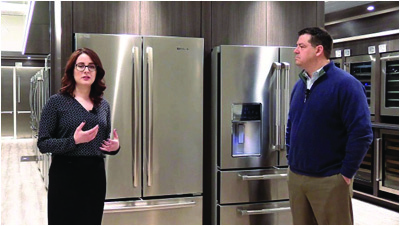
A longer description works from the whole to the parts. Manju, a salesperson in a fridge shop, describes a fridge like this: it is a very useful device to store fruits, vegetables, pickles, jams and milk, and even some special medicines. Then she moves inside it, compartment by compartment. There are four compartments. The uppermost one is the freezer, where you can keep a tray for ice cubes. The two slots below store different food items. The last one is a bigger well for keeping vegetables. Try the same method yourself with a pressure cooker, an oven or an electric iron: say what it is used for first, then describe its parts in order.
Relative Clauses
Read this thank you letter that Punam wrote to her friend Sujita after her birthday. Every underlined idea below is doing the same job: adding information about a noun without starting a new sentence. "The vase you have gifted me is exactly what I wanted. It reminds me of the vase which my little sister broke last week. In fact, this is the best china that I have ever seen. My mother, who loves flowers, arranged roses in the vase."
A relative clause is a group of words that describes a noun in the same sentence. It usually begins with a relative pronoun such as who, whom, whose, which or that, or with the relative adverb where.
A relative pronoun is the word that joins the relative clause to the noun it describes. Who, whom and whose are used for people, which is used for things and animals, that is used for both, and where is used for places.
| Word | Used for | Example |
| who | a person, as the doer | These are the girls who work hard. |
| whom | a person, receiving the action | Krishna was the boy whom everyone appreciated. |
| whose | possession | What is the name of the boy whose father is a dentist? |
| which | a thing or an animal | The tiger which terrified the villagers was sent to the zoo. |
| that | a person or a thing | The tree that he cut down was not a large one. |
| where | a place | This is the site where I intend to build a house. |
Some relative clauses are essential: without them the sentence does not say which one we mean. "The vase which my little sister broke" points to one particular vase. Others only add extra information about a noun we have already identified, and these are separated with commas: "My mother, who loves flowers, arranged roses in the vase." The sentence "Mt. Everest, which is the highest peak in the world, lies in Solukhumbu district" works the same way, because there is only one Mt. Everest, so the clause between the commas is extra information, not identification. Sometimes the relative pronoun can even be dropped: "The vase you have gifted me" really means "The vase that you have gifted me."
Never use that after a comma. Write "My mother, who loves flowers," and never "My mother, that loves flowers." And never use which for a person: a teacher is someone who teaches, not something which teaches.
Joining Two Sentences into One
Two short sentences about the same noun can nearly always become one smooth sentence with a relative clause. Take this pair: "What is the name of the hotel? Your brother works in the hotel." Follow these steps.
- Find the noun that both sentences share. Here it is the hotel.
- Choose the right relative word for it. The hotel is a place where someone works, so choose where.
- Replace the repeated noun in the second sentence with the relative word and move the clause next to the shared noun.
- Read the result aloud to check it flows: What is the name of the hotel where your brother works?
The choice of word depends on the job the shared noun does. "Are these the keys? You were looking for the keys." becomes "Are these the keys that you were looking for?" because keys are things. "What is the name of the boy? The boy's father is a dentist." becomes "What is the name of the boy whose father is a dentist?" because the second sentence shows possession. "Who was the man? You talked to the man in the restaurant." becomes "Who was the man whom you talked to in the restaurant?" because the man receives the action of talking to.
The Alternative Energy Sources
It will surprise no one that liquid fossil fuel is a finite resource. Sooner or later all the Earth's oil deposits will dry up, and we will depend completely on alternative sources of energy. Many people have already embraced traditional solar power, wind power and hydropower, but scientists are looking ahead to even cleaner and more efficient alternatives. Two well-known business leaders sum up why this matters. Paul Polman argues that renewable energy could reduce emissions but also create jobs and improve public health. Tulsi Tanti puts it even more simply: the potential of renewable energy is immense.
Renewable energy is energy from a source that nature keeps replacing, such as sunlight, wind, moving water or the heat of the Sun's own process. A finite resource, such as oil, is one that will eventually run out.
Six Ideas for Tomorrow's Energy
The writer Jeff Desjadins presents six ideas that hold a great deal of potential, and for each one he reports its current status: what has actually been achieved so far. Read each idea for two things, the science behind it and the proof that it works.
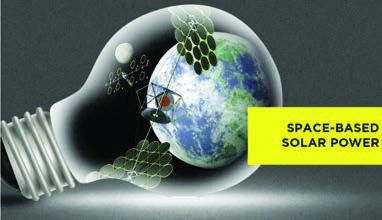
Idea I is space-based solar power. About 55 to 60 percent of all incoming solar energy never makes it through the Earth's atmosphere. In a space-based system, fleets of satellites with large reflectors or inflatable mirrors would spread out in space, directing solar radiation onto solar panels. The panels would convert that solar power into microwaves and beam them continuously down to power-receiving stations on Earth, so that no energy is lost. Its status: in March 2015 the Japan Aerospace Exploration Agency, JAXA, revealed that it had successfully converted 1.8 kilowatts of electricity into microwaves and then wirelessly beamed them a distance of 50 metres, proving the idea's viability.
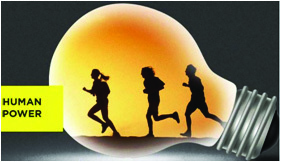
Idea II is human power. Many experts believe the simplest way of generating renewable energy is through our own bodies, because devices now use much less power than before. Harvesting just a microwatt of electricity would be enough to power many small electronic devices. To harness the energy we generate through movement, we would simply need to wear a system that collects and converts it. Its status: UK researchers have developed a knee brace that collects electrons while you walk. As the wearer's knee bends, four metal vanes in the device vibrate like a guitar string and produce electricity.
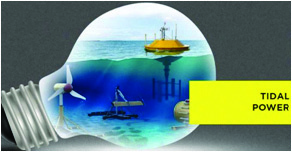
Idea III is wave energy. Technically it is a form of stored wind energy, since waves are produced by winds that blow over the sea. It can be captured on the surface, below the surface, near the shore, offshore or far offshore. Wave energy is measured in kilowatts per metre of coastline, and the US coastline alone has a wave energy potential of about 252 billion kWh per year. Its status: five countries already operate viable wave power farms, and Portugal established the world's first commercial-scale wave farm in 2008, with a total installed capacity of 2.25 MW.
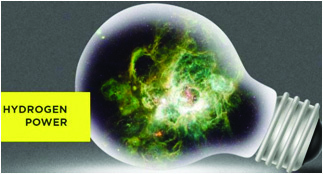
Idea IV is hydrogen power. Hydrogen is a colourless and odourless gas that accounts for 76 percent of the mass of the universe. On Earth it is found only in combination with oxygen, carbon and nitrogen, so to use it, it must first be separated from the other elements. Once it has been separated, the gas yields high energy while producing almost no pollution. Its status: fuel cell devices that convert hydrogen to electricity already power vehicles, aircraft, homes and buildings, and large automakers like Toyota, Honda and Hyundai have invested heavily in the technology.
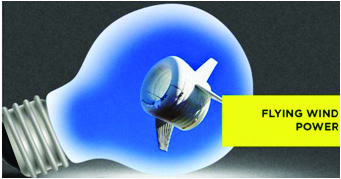
Idea V is flying wind power. On a flying wind farm, wind turbines float as high as skyscrapers, 1,000 to 2,000 feet above the ground, to capture steadier winds that blow five to eight times stronger than winds at tower level. These turbines produce double the energy of similar sized tower-mounted turbines. Its status: Altaeros Energies has developed the first commercial airborne wind turbine, the Buoyant Air Turbine, a circular, 35-foot-long inflatable shell made of heavy-duty fabric with a capacity of 30 kilowatts. It is completely autonomous: it self-adjusts to optimal wind speeds and self-docks in emergency cases.
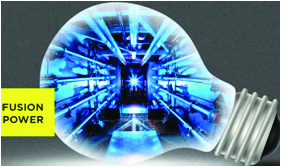
Idea VI is fusion power. Fusion is the same process that powers the Sun, and it has the potential to provide a nearly inexhaustible supply of energy. It emits no pollutants or greenhouse gases, and it carries no threat of nuclear meltdown, unlike current nuclear fission reactors. Fusion works by fusing two hydrogen isotopes, deuterium and tritium, which are bountiful. Its status: the ITER, the International Thermonuclear Experimental Reactor, is being built in France and funded by seven countries, set for completion by 2027. It hopes to be the first commercially demonstrated fusion power station.
Fusion is the joining of two light atomic nuclei into one, releasing enormous energy. Fission is the opposite: the splitting of the nucleus of a heavy atom. Fusion powers the Sun; fission powers today's nuclear reactors.
| Idea | Energy source | Proof it works |
| I | Space-based solar power | JAXA beamed microwaves 50 metres wirelessly in 2015 |
| II | Human body movement | A UK knee brace makes electricity as you walk |
| III | Wave energy | Portugal's commercial wave farm, 2.25 MW, since 2008 |
| IV | Hydrogen power | Fuel cells already power vehicles, homes and buildings |
| V | Flying wind power | Altaeros built the 30 kW Buoyant Air Turbine |
| VI | Fusion power | ITER in France is set for completion by 2027 |
How a News Story Is Built
You have now read a real news story about a robot. Every news story, whatever its subject, is built from the same four parts, stacked in the same order.
The headline is the title of a news story, printed in large bold letters. It states the main event in the fewest possible words, for example: Nepal Beat Chinese Taipei.
The byline names the writer or the agency that reported the story, for example: By RSS. It sits directly under the headline.
The lead is the first paragraph. It gives the most important facts, the who, what, where and when, so that a reader who stops there still knows the story. It often opens with the place and date, for example: Kathmandu, June 4.
The body is the rest of the story. It adds details in order of importance: how it happened, who said what, and what comes next.
You can build a whole story from a set of outline notes. Suppose your notes say: Yantrika, a human-shaped and advanced robot from Nepal, has been put on an international online robot exhibition; developed by a team led by Engineer Roshan Pandey at the Nepal Academy of Science and Technology, NAST; exhibition organised by Smart Society of Canada, Business Upside of the USA and IEM America Corporation; it shows the best innovative technologies from America, Canada, Germany, India and the UK; the robot can identify people wearing a mask from those who are not, gives out masks and sanitisers, can measure body temperature, and its main objective is to spread information about wearing masks and using sanitiser. Turn the first and biggest fact into the headline, put your name in the byline, pack who, what, where and when into the lead, and spend the body on the details, one idea per paragraph. The same method writes an article on green energy: define it as a natural source of energy achieved from the Sun, wind and water, say that it is perpetual in nature, report its present status, list its benefits to people and to nature, and end with its challenges.
Listening for Details About a Home
The listening task for this unit plays a conversation between a father and his son who are looking around a new apartment. Before you listen, think about your own home. What type of dwelling do you live in? An apartment is a set of rooms inside a larger building shared by many families, while a house stands on its own ground and usually belongs to one family.
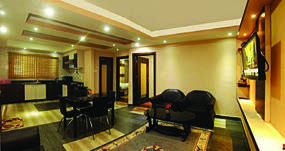
The first listening asks you to mark statements true or false: whether the son is eager to move in, whether the father likes the floor space, whether the apartment is closer to the boy's school, whether the neighbours will cause no disturbance, whether the manager is away right now, and whether the father finally decides to move in. So listen for feelings and decisions, not just facts. Words like "I can't wait" signal eagerness, and "I'm still not sure" signals an undecided speaker. The second listening asks for details: what the son likes about the apartment, what the father has not decided yet, which two things the father or son dislike about a room, which four rooms they have looked at so far, and which room they have not seen yet. Keep a quick tally of the rooms as they are named, because counting questions are answered while listening, never from memory afterwards. Afterwards, be ready to say which you would prefer, a house or an apartment, and why.
Read the questions before the audio starts. When you know you are listening for four rooms and one missing room, your ear catches every room name as it passes.
Debating Whether AI Is a Threat
The unit ends with a project: organise a class debate on the motion "Artificial intelligence is a threat to humans." Invite students from other grades to listen and ask your teachers to judge. Split into two teams. The side speaking for the motion can argue that machines may take over jobs, that they collect personal data, and that people come to depend on them too much. The side against can use Sophia's own answer, that the fear of a robot takeover is exaggerated, and point to AI improving public services, agriculture and health. A strong debater states a claim, gives one piece of evidence for it, and finishes the point before starting the next. Both readings in this unit are full of usable evidence, so prepare your points from them before you stand up.
The full lesson is waiting for you
The notes are free to read in full. A free account opens the rest of the practice, and tracks your progress and confidence score for every subject. Presentations and videos need approval from Learn Yeti.