One World, Many Customs
Every community on Earth has its own way of doing things. In Nepal, a devotee carries tall decorated poles through the streets of an old town while crowds follow. In a Buddhist monastery, hundreds of monks in saffron robes chant together. In Spain, a matador in bright silk faces a charging bull while thousands watch from the stands. In Japan, a host prepares tea with slow, exact movements while guests kneel silently on straw mats. Each of these scenes looks completely normal to the people inside it, and completely surprising to a visitor seeing it for the first time. That difference between the insider's view and the outsider's view is what this whole unit is about.
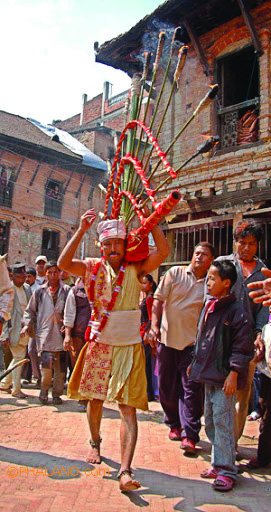
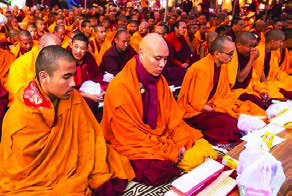
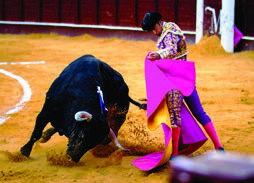
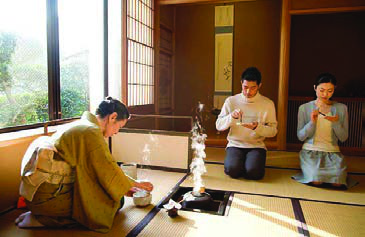
A custom is a way of behaving or doing something that a particular community has followed for a long time, such as greeting elders in a fixed way or celebrating a festival on a fixed date.
Culture is the whole way of life of a group of people. It includes their language, food, dress, beliefs, art, rituals, attitudes and behaviour, all passed from one generation to the next.
Before judging a custom as strange, it helps to ask what it means to the people who practise it. The first reading of this unit tests that idea in the hardest possible place: a funeral custom that sounds shocking when described in one sentence, but which makes deep sense once you understand the belief behind it.
Sky Burials: Saying Farewell in Tibet
Sky burials are the traditional custom in Tibetan Buddhism for saying farewell to the dead. To put it bluntly, the dead body is cut into pieces and fed to waiting vultures. These days outsiders are mostly forbidden from witnessing the ritual. The writer Matthew Carney had heard about sky burials with a mixture of horror and fascination, and while travelling with his family he decided at least to look at the place where they happen.
The family arrived at a very isolated, traditional Tibetan Buddhist monastery near Tagong in North Eastern Sichuan. They had been told that foreigners were not allowed to experience the secret ritual anyway, so they only expected to see the site. Their driver pointed them to the top of the mountain where the burials take place. The spot was surrounded by a sea of Tibetan prayer flags, and they could just make out a kind of stone slab. As they hiked up, they heard Tibetan nuns chanting.
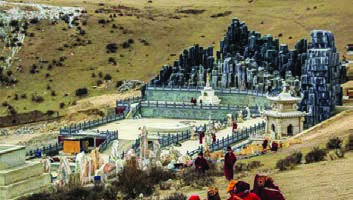
Then the writer turned and saw about one hundred vultures sitting on the hill, waiting, and what looked like a body bag resting on the stone slab. The family had stumbled into the start of an actual sky burial. Through a translation app he asked a Tibetan man standing nearby what was happening. "Flesh eating birds," the man replied. When the writer asked if they could stay, the answer was yes, but on the side and with no photos.
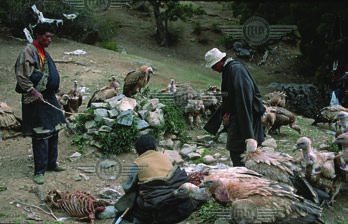
The parents now had to make quick decisions about their children. Their six year old son was given the iPad to play computer games. He was thrilled, and for once his parents were happy to hand it over, because he was too young to see the ritual. The eleven year old son and thirteen year old daughter were treated differently. The writer's wife Catherine sat them down, told them straight what was about to happen, explained the cultural and religious context, and gave them the choice to stay or go. To their credit, they stayed.
What Happens at a Sky Burial
The Rogyapa is the body breaker, the person who performs the sky burial by cutting up the body and preparing it for the vultures.
When the bag was taken off, the corpse of what looked like a middle aged woman was revealed. The Rogyapa stormed up the side of the mountain, dressed in a thick, dark scarlet coloured coat with a black hood. With a butcher knife in hand, he wasted no time in carving up the body. The writer found it gruesome and only just stopped himself from throwing up, yet his children seemed to take it in their stride.
The vultures grew impatient and started to jump towards the flesh. The body breaker gave the signal, and the Tibetans holding the birds back let them through. The vultures swarmed in a frenzy, jumping on top of each other and tearing at the flesh. It took at most fifteen minutes for the entire corpse to be gone, with only the bones left behind.
The body breaker then gathered up the human bones and began to pulverise them with a mallet, grinding them into powder. He mixed the powder with yak butter and barley flour. In one last gesture, he walked into the middle of the vultures and threw the mixture high into the air. And with that, he was gone. There was absolutely nothing left of the body.
Why the Vultures Matter
For Tibetans, every part of this ritual carries meaning. It is considered a bad omen if the vultures do not eat the body, or even if small bits are left over. The birds are not scavengers in Tibetan eyes at all.
Dakinis is the Tibetan name for the vultures at a sky burial. They are seen as being like angels who take the soul into the heavens to await reincarnation and the next life.

Tibetans consider the body a mere vessel for the soul. Once the soul has left, the body is only a container, so giving it to the birds is an act of generosity, not of disrespect. At the end of the ritual, a peace and calmness seemed to descend over the scene, and everyone seemed happy that it had been fulfilled. The writer's older children, surprisingly, were fine. They seemed to understand what they had seen: an ancient culture giving a meaning to lives. The writer felt like a proud dad that day, proud of their maturity and intelligence. As for the six year old, he was none the wiser. He had been deeply engrossed in his iPad, playing Minecraft the whole time.
A custom that looks horrifying from the outside can carry deep meaning on the inside. The sky burial treats the body as an empty vessel and returns it to nature, while the soul travels on. Understanding the belief changes how you see the practice.
Saying Contracted Forms
English speakers rarely say "is not" or "cannot" in ordinary talk. They squeeze the two words into one contracted form, and the apostrophe marks the letters that have been dropped: is not becomes isn't, cannot becomes can't. A contracted form is said as a single word, in one smooth beat, with the stress on the first part. Practise saying each of these aloud.
| Full form | Contracted form | How it sounds |
| are not | aren't | one beat, like AHRNT |
| is not | isn't | IZ-unt |
| was not | wasn't | WOZ-unt |
| were not | weren't | one beat, like WURNT |
| have not | haven't | HAV-unt |
| has not | hasn't | HAZ-unt |
| had not | hadn't | HAD-unt |
| do not | don't | one beat, rhymes with won't |
| does not | doesn't | DUZ-unt |
| did not | didn't | DID-unt |
| cannot | can't | one beat, like KAHNT |
| could not | couldn't | KOOD-unt |
| must not | mustn't | MUSS-unt, the first t is silent |
| will not | won't | one beat, rhymes with don't |
Won't is the short form of will not, not of want, and its vowel changes: will becomes won't. In mustn't, the first t is silent, so it is said MUSS-unt, never MUST-nt.
Asking for Permission
When you want to do something that involves another person, you ask for permission first. English gives you a ladder of expressions, from casual to very polite. With friends, Can I is enough. May I and Could I sound more careful, and are right for teachers, elders and strangers. Is it OK if I, Do you mind if I and Do you think I could are the most polite of all, because they leave the listener completely free to refuse.
- May I go out, please?
- Can I bring my doggie to the party?
- Could I taste that hot spicy dish?
- Do you think I could have a look at your photo album?
- Do you mind if I use your protractor for a while?
- Is it OK if I ask you something on Ecology?
- May I sit here for a while?
The reply matters just as much as the request. To agree, you can say Sure, Yes, please do, Of course, go ahead, No problem, or Please feel free. To refuse politely, English speakers soften the blow: Well, I'd rather you didn't. A flat No, you can't is grammatical but sounds harsh, so keep it for situations that really demand firmness.
| Situation | You ask | They reply |
| Sore throat, need a doctor | I have a sore throat. May I go to see a doctor? | Sure. |
| Headache, want to go home | I have a bad headache. Could I go home? | Yes, please do. |
| Blister on foot, need the clinic | I have a blister on my foot. Can I visit the clinic? | Sure, go ahead. |
| Want the news on the radio | May I turn on the radio for the news? | Of course, go ahead. |
| Want photos with a camera | Is it OK if I take some photos with your camera? | No problem. |
| Want to phone a friend | Do you think I could use the telephone to chat with my friend? | Please feel free. |
| Toilet is not so dirty | Do you mind if I use this toilet? | Well, I'd rather you didn't. |
| Want a day off on a very busy day | May I take a day off tomorrow? | No. You can't. |
Do you mind if I sit here? asks whether the person objects. So Not at all means yes, you may sit, and Yes, I do mind is a refusal. Answering Yes when you mean to allow it says the opposite of what you intend.
Yes/No Questions and Short Answers
A yes/no question is a question that can be answered with yes or no. It always begins with an auxiliary verb such as is, are, was, were, do, does, did, has, have, will, can or may.
If the statement already contains a helping verb, a form of be, have, will or a modal, you make the question by moving that helper in front of the subject. It is raining becomes Is it raining? The meeting will be held next Tuesday becomes Will the meeting be held next Tuesday? Your brother has gone to sleep becomes Has your brother gone to sleep?
If the statement has only a main verb, borrow do, does or did. Use does for he, she and it in the present, do for the others, and did for the past. The main verb then returns to its base form. Harish plays football becomes Does Harish play football? Ramesh went to the market yesterday becomes Did Ramesh go to the market yesterday?
- It is Tuesday today. Question: Is it Tuesday today?
- Anita is learning English. Question: Is Anita learning English?
- Januka works at the supermarket. Question: Does Januka work at the supermarket?
- Tanka switched off the computer. Question: Did Tanka switch off the computer?
- There will be a food party. Question: Will there be a food party?
After did, the main verb goes back to its base form. Did Ramesh go to the market? is correct. Did Ramesh went to the market? is wrong, because did already carries the past tense.
A yes/no question is normally answered with a short answer that repeats the same helper: Are you busy today? Yes, I am. Is it raining? No, it isn't. But real conversation also allows natural answers that respond to the speaker's intention. If someone offers, Can I carry your bags?, the polite refusal is It's all right, thanks, not a bare No, you can't. If someone asks with concern, Is it too hot in here for you?, the friendly answer is No, I'm fine, thanks.
Surprising Customs Around the World
One thing that sets humans apart from other members of the animal kingdom is our propensity, our natural desire, to build customs and traditions around everything from beauty rituals to death customs. Humans love doing this so much that the world has been enriched with thousands of different cultures since the dawn of civilization. An important aspect of almost any culture is its code of etiquette and its sense of identity. The second reading of this unit collects four customs that astonish outsiders.
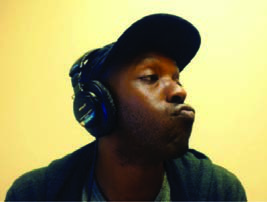
Pointing with lips. Hand gestures vary across cultures, but few customs extend that variety to the mouth. In Nicaragua, it is common to point with the lips instead of the thumb or index finger that most of the world uses. It all starts by puckering up, squeezing the lips together and pushing them forward. The lip point is typically used in conversation to indicate something that is happening nearby.
Tipping. The United States has an unusual tipping culture. Unlike many countries where people do not tip at all, or tip only small amounts when the food was particularly good, tipping is rather mandatory at most American restaurants. Patrons, the customers, are expected to leave between 10 to 20 percent of the bill in tips, and there are further rules for tipping bartenders, delivery people and other service personnel. Some criticise the practice as irrational, but there is no doubt that it gives waiters and waitresses an incentive to provide better service.

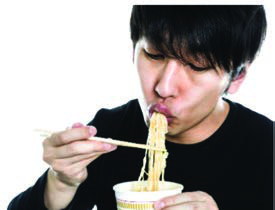
Slurping. Most societies have rules about table etiquette, and in Western cultures eating noisily is considered rude. In Japan, making slurping sounds while eating noodles has an entirely different meaning. Westerners twirl their noodles on a spoon before putting them in the mouth, while the Japanese simply slurp them up without contorting them first, which is naturally noisier. Slurping in Japan signals that you are really enjoying the food, and some scientists even argue that slurping invites air onto the palate and actually enhances the noodles' flavour.
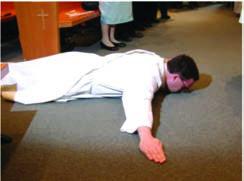
Kneeling or lying prostrate as greeting. For the Yoruba people, an ethnic group that largely resides in Nigeria, greeting rituals are taken very seriously, especially towards elders. When an adult approaches, Yoruba youths are expected to drop to their knees in greeting. More specifically, women kneel, and men typically lie prostrate, stretched flat on the ground, face down. These gestures show respect and deference for the elders of the community, and this custom distinguishes the Yoruba from other ethnic groups in Nigeria, including the Bini and the Kalabari.
| Custom | Where | What it means |
| Pointing with the lips | Nicaragua | Shows where something nearby is, instead of using a finger |
| Tipping 10 to 20 percent | United States | Expected payment that rewards good service |
| Slurping noodles | Japan | Shows you are really enjoying the food |
| Kneeling or lying prostrate | Yoruba people of Nigeria | Respect and deference for elders |
Listening for Marriage Traditions
Weddings collect a community's customs in one place. In a Nepali wedding you may see a procession dancing to drum beats through the village, the bride's hands and feet darkened with henna patterns, and vermilion powder passed along a white cloth. Look at these three moments and ask yourself which traditions you recognise and how marriage is celebrated in your own community.
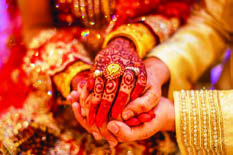
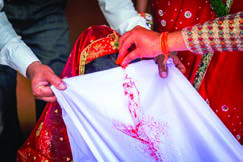
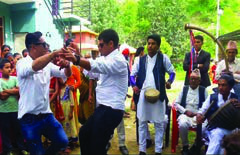
The listening task plays an audio about marriage traditions in four countries: China, India, Ghana and Cuba. On the first listening, your job is to match four traditions to their countries: jumping over the broom, dancing covered with money, painting the hands and feet, and changing wardrobes. Listen for each country's name and the tradition described next to it. On the second listening, you fill six blanks with words and phrases from a given box: profitable, custom, Jewish, cocktail dress, evil spirits, lucky colour and henna paste. The sentences tell you what to listen for: what kind of wedding tradition breaking a glass is, what jumping over the broom sweeps away, what dancing covered with money is considered, what decorates a bride's hands and feet in India, why Chinese brides wear red first, and what the third wardrobe of a Chinese bride is.
Before the audio plays, read every blank and predict what kind of word fits it: a nationality, a reason, an object, a colour. Then listen for the sentence around each answer. You will usually hear the idea explained rather than the exact word read out, so listen for meaning, not just for matching sounds.
Reporting Yes/No Questions
Direct speech gives the speaker's exact words inside quotation marks: Rahul said to me, "Did you watch the cricket match on TV last night?"
Indirect speech, also called reported speech, gives the meaning of the words without quoting them: Rahul asked me if I had watched the cricket match on TV the night before.
A yes/no question is reported with the verb asked followed by if or whether. The quotation marks and the question mark disappear, the words return to statement order, the tense usually moves one step back, and pronouns and time words shift to the reporter's point of view. Here is the full method on one example, "Are you coming home with me?" he said.
- Change the reporting verb: he said becomes he asked, and said to always becomes asked.
- Join the two parts with if or whether in place of the quotation marks.
- Put the words back into statement order: are you coming becomes you were coming, with the subject before the verb.
- Move the tense one step back: am/is/are coming becomes was/were coming, did watch becomes had watched, will becomes would, can becomes could.
- Adjust pronouns and time words to the reporter's view: you becomes I or he or she, me becomes him or her, last night becomes the night before.
- Drop the question mark, because the reported sentence is a statement: He asked if I was going home with him.
| In direct speech | In indirect speech |
| said to me | asked me |
| quotation marks and question mark | if or whether, no question mark |
| present simple: do you come | past simple: whether I came |
| past simple: did you watch | past perfect: if I had watched |
| present perfect: have you seen | past perfect: if I had seen |
| will, can, may | would, could, might |
| last night, tomorrow, here | the night before, the next day, there |
Never keep the question order or the question mark inside the reported sentence. He asked did I watch the match? is wrong on both counts. Write He asked if I had watched the match, with statement order and a full stop. Note also that when the reporting verb is in the present, as in Usha says, the tense does not move back: Usha asks if I can solve the problem.
Writing an Essay About Culture
This unit sets two essays. The first is a short essay titled Our Culture Our Pride, where you explain what your culture is and why it deserves pride. The second asks you to pick any one unique custom of Nepal and write about it following a given outline. The outline is a ready made skeleton: deal with each point in turn and the essay organises itself.
- Introduction: name the custom and the place it belongs to, in two or three sentences.
- Time to celebrate: say when it happens, on which date, season or occasion.
- Historical and cultural values: explain where it came from and what beliefs it carries.
- Community observing it: name the community, caste or region that practises it.
- Activities of celebration: describe what people actually do, step by step.
- Your opinions: say what you think of the custom, honestly and respectfully.
- Conclusion: close with why the custom matters and whether it should be preserved.
Before writing, it helps to know which kind of essay you are producing. There are four main types, classified by the writer's overall goal: does the writer want to tell about a personal experience, describe something, explain an issue, or convince the reader to accept a viewpoint?
Narrative essay: tells a story about a real life experience, usually in the first person. The writer makes the story as vivid as possible and builds towards a conclusion or a personal statement.
Descriptive essay: paints a picture in the reader's mind with words. The writer describes a person, place, object or memory, showing rather than telling, through colourful words and sensory details that appeal to the reader's emotions.
Expository essay: an informative piece that presents a balanced analysis of a topic using facts, statistics and examples. It includes comparison and contrast essays, cause and effect essays, and how to or process essays.
Persuasive essay: aims to convince the reader to accept the writer's point of view or recommendation, building a case with facts, logic, examples, expert opinion and sound reasoning, while presenting all sides of the argument clearly.
An essay on a custom is mostly descriptive and expository: you describe what the celebration looks like and explain when, why and by whom it is observed. The opinions section adds a light persuasive touch.
The Elements of a Culture
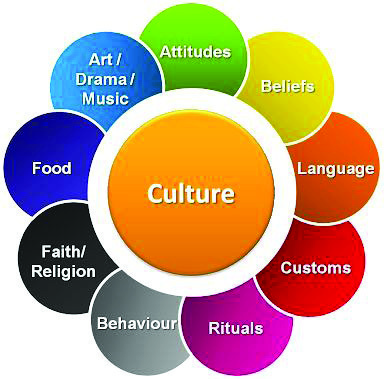
Culture is not one thing but a bundle of connected elements: attitudes, beliefs, language, customs, rituals, behaviour, faith and religion, food, and art including drama and music. Take any one culture of Nepal and you can fill in every petal. For Newar culture, the language petal holds Nepal Bhasa, the food petal holds yomari and samay baji, the rituals petal holds ceremonies such as Ihi, and the art petal holds paubha painting and the Lakhey dance. The project of this unit asks you to do exactly this: choose a culture, design a similar picture with its elements filled in, and explain it to your class.
- Choose one culture you know well, your own or a neighbour's.
- Draw a large circle in the middle and write the culture's name in it.
- Around it, draw one petal for each element: attitudes, beliefs, language, customs, rituals, behaviour, faith or religion, food, and art, drama and music.
- Fill each petal with one or two real examples from that culture.
- Present the chart to the class, explaining one petal at a time.
The full lesson is waiting for you
The notes are free to read in full. A free account opens the rest of the practice, and tracks your progress and confidence score for every subject. Presentations and videos need approval from Learn Yeti.