The Warming World Around Us
The Earth is slowly getting hotter, and the change is showing up everywhere: in the sea, on the mountains, and in our weather. When people burn coal, petrol and gas, cut down forests, and run factories that release smoke, gases such as carbon dioxide collect in the atmosphere. These gases trap the sun's heat the way glass traps heat inside a greenhouse, so the planet's average temperature rises. That rise is called global warming, and the long term shift in weather patterns it causes is called climate change.
Global warming is the gradual rise in the average temperature of the Earth's atmosphere, caused mainly by gases released when people burn fuels and destroy forests.
Climate change is the long term change in the Earth's weather patterns, such as hotter summers, unreliable rain, and stronger storms, that results from global warming.
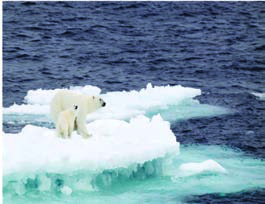
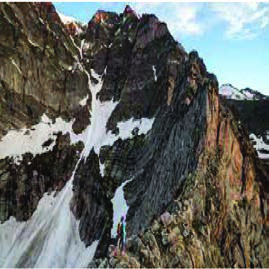
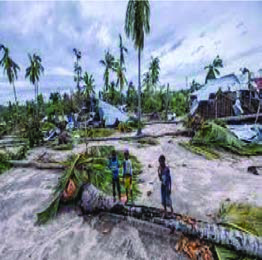
The three pictures show the chain clearly. The causes sit in human hands: smoke from vehicles and factories, forests cleared for timber and farmland, and rubbish that releases gas as it rots. The consequences fall on everyone: sea ice melts under polar bears, glaciers and mountain snow shrink, seas rise, and cyclones and floods strike harder and more often. Farmers face failed rains, and diseases spread to new places. Talking about these causes and consequences in English is the first skill of this unit, and every other skill in it, reading, speaking, listening and writing, circles back to this same theme.
A Movie Review: Chasing Ice
One powerful way to talk about climate change is through film, and one way to talk about film is the movie review. A review usually opens with a fact file, a small table of essential information, before the reviewer says a single word of opinion. Here is the fact file for the documentary this unit studies.
| Item | Information |
| Title | Chasing Ice |
| Genre | Documentary, Biography |
| Language | English |
| Director | Jeff Orlowski |
| Producers | Jerry Aronson, Paula Dupre Pesmen, Jeff Orlowski |
| Writer | Mark Monroe |
| Release date | Aug 10, 2016 |
| Runtime | 1h 14m |
| Produced by | Diamond Docs, Exposure |
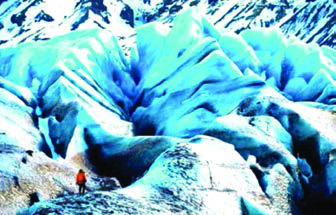
Chasing Ice traces the journey of environmental photographer James Balog as he tries to capture the erosion of Arctic glaciers in photographs and video. After Hurricane Sandy, the power and unpredictability of nature had become impossible to ignore, and Balog's film arrived just as weather and global warming became prevalent topics everywhere. To accomplish his goal, Balog started his own project and named it the Extreme Ice Survey. It began as a piece of work for National Geographic and grew into something much larger, an attempt to show glacial erosion to the whole world.
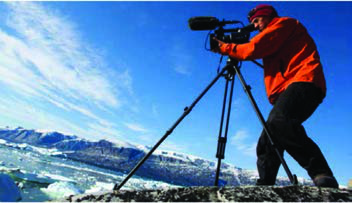
The survey began with a total of 25 cameras, monitored over the course of three years. The cameras were housed in protective units so the harsh Arctic weather could not destroy them, and Balog's team periodically downloaded the footage. He had photographed glaciers before, and he wanted to return to the same places to see how they had changed. He and his team set up cameras in Greenland, Iceland, Alaska and Montana's Glacier National Park. The result is time lapse footage of glaciers calving, that is, breaking apart into icebergs, which lets viewers see with their own eyes what is actually happening in these zones.
The reviewer, Andrea Seikaly, praises the film for several exact reasons. The documentary opens with striking and intense clips of natural disasters, and Balog begins by admitting his own initial skepticism about climate change, which makes him relatable and increases his credibility, because he ends up finding evidence for the very thing he once doubted. He refrains from overwhelming the audience with too many scientific details and makes the data easy to understand. The film also shows the extreme lengths his team, which included a glaciologist and a climatologist, went to: Balog cries out in disappointment when cameras fail, lowers himself into precarious holes and caves of ice for the best shot, and keeps ice hiking even when knee surgery threatens to stop him. The verdict is clear: Chasing Ice is a worthwhile documentary of intriguing theories and exquisite images. Even people reluctant to accept environmental theories will gain something, because the film makes viewers think critically about climate change and what it can mean for our future.
How a Movie Review Is Built
A movie review is a short piece of writing that gives the basic facts about a film, summarises what it shows without spoiling it, judges its strengths and weaknesses with evidence, and ends with a verdict telling readers whether it is worth watching.
- A fact file: title, genre, language, director, producer, writer, release date and runtime, set out before the opinion begins.
- A summary: what the film is about and how it was made, told in the reviewer's own words.
- Strengths: what the film does well, always backed by an example from the film itself.
- Weaknesses or doubts: who might hesitate to watch it, and whether the film still rewards them.
- A verdict: one clear closing judgement, such as calling the film a worthwhile documentary.
A review is opinion built on evidence. Every time the reviewer praises Chasing Ice, she points to something in the film: the disaster clips, the confessed skepticism, the ice cave descents. When you write your own review of a favourite movie, follow the same rule: never state a judgement without showing the scene that proves it.
When you write a review of your own favourite movie, begin with the fact file table, then write one paragraph of summary, one or two paragraphs of judgement with examples, and a final verdict sentence. Keep the tense consistent: reviews describe films in the present, so write the film shows, not the film showed.
The Two Sounds of oo
The letters oo look the same in every word, but English gives them two different sounds. In book, the sound is short, written /ʊ/ in phonetic symbols: the lips round briefly and let go. In food, the sound is long, written /uː/: the lips stay rounded and the sound stretches. Spelling gives no reliable clue, since foot is short while food, one letter away, is long, so these words must be learnt by ear and by list.
| /ʊ/ short, as in book | /uː/ long, as in food |
| book | food |
| cook | moon |
| foot | noon |
| good | roof |
| look | room |
| hook | school |
| stood | soon |
| took | too |
| wood | zoo |
| wool | zoom |
Test yourself with the pair good food. Say it aloud: good is short and quick, food is long and stretched. If both come out the same, one of them is wrong.
Guessing with must, can't, may and might
We spend much of every day guessing from evidence: who a stranger is, why a friend looks upset, whether the neighbours are home. English grades these guesses by how sure the speaker feels, using the modal verbs must, can't, may and might. Read how two students use them.
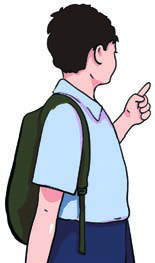
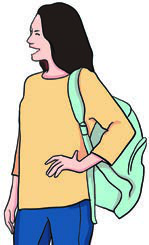
Must, used for deduction, means the speaker is almost certain something is true because the evidence points that way: Suman is not at home during office hours, so he must be in his office.
Can't, used for deduction, means the speaker is almost certain something is not true: their car is not at home, so they can't have returned.
May and might express possibility: the speaker thinks something is possible but is not sure. They may come tomorrow. Shishir might become a millionaire.
To make deductions about the past, add have and the past participle after the modal. She must have received good news explains a happy face now by pointing to something that already happened. They can't have returned denies a past event. He might have been burying something admits a past possibility. The pattern is always modal, then have, then the past participle, and it never changes for he or she.
The opposite of must in a deduction is can't, never mustn't. He must be a chef becomes He can't be a chef. Mustn't means something is not allowed, which is a completely different idea.
A Noisy Party
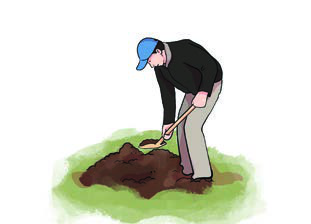
The dialogue A Noisy Party puts deduction language inside a comedy. At half past one in the morning, Ramila shakes her husband Ramesh awake: the people next door, the Dahals, are having another party, and the noise is waking the whole street. Ramila calls it disgusting and wants someone to call the police. Ramesh takes it more lightly, noting that the neighbours must be having a good time, and that they never invite him and his wife. Near three o'clock the guests finally leave, but then comes a crash: the Dahals are having a row, a noisy quarrel, and Ramesh is certain they are throwing pots and pans again. Ramila thinks it was a plate, or maybe the TV.
Just before dawn the story turns dark, or seems to. There is someone in the garden next door. Ramesh guesses it must be the milkman, but Ramila is certain it is not him, because it is far too early. Ramesh looks out and gets a shock.
Ramila's advice saves them from embarrassment. Asked directly, Mr Dahal explains everything: he has not been to bed at all, his wife knocked over the goldfish tank while they were clearing up after the party, the poor fish died, and he is simply burying them before his children wake up. The suspected murder is a funeral for goldfish. Notice how the whole comedy runs on the language of certainty: I'm sure, I'm certain, there is no doubt, it must be, he can't be, he might be. The couple sound completely confident at every step, and they are wrong at almost every step.
Must, can't and might report how sure the speaker feels, not what is actually true. Ramesh was certain about the pots and pans and certain about the spade, and reality embarrassed him both times. Strong language does not make a guess a fact.
Talking About the Future
English builds its future with will plus other pieces, and the piece you choose depends on the shape of the action. A single act or prediction takes the simple future. An action that will be going on across a stretch of future time takes the future continuous. An action that will already be finished before a future point takes the future perfect. The time expression in the sentence almost always tells you which one to use.
The simple future, will plus the base verb, states a future act, decision or prediction: I think our team will win the match.
The future continuous, will be plus the ing form, describes an action in progress at or across a future time: The workers will be building the building for the next two months.
The future perfect, will have plus the past participle, describes an action completed before a future point, usually marked with by or by the time: By 11 p.m. tonight, she will have prepared the report.
| Form | Signal words | Example |
| will + verb | tomorrow, today, next year, I think | The forecast says it will rain heavily today. |
| will be + verb-ing | till, until, for the next two months | Sandeep will be staying at ours till Monday. |
| will have + past participle | by, by the time, before | My uncle will have learned to talk in English by the time he finishes this course. |
The marker decides the tense, not the look of the sentence. By 11 p.m. tonight points forward, so the verb is will have prepared. But before her parents returned home contains a past verb, returned, so the sentence needs the past perfect, had finished, even in an exercise about the future. Always find the time word before you fill the gap.
Asking Questions Two Ways
A statement hides many possible questions inside it. They went to Spain last week can be asked about the time, the place or the people. To turn a statement into a wh-question, work through these moves.
- Find the piece of information the bracket asks about: in They went to Spain last week (When), the piece is last week.
- Choose the question word that matches it: when for time, where for place, what for things, why for reasons, how for manner, whom for people receiving the action, which for one out of several.
- Bring an auxiliary verb in front of the subject. If the sentence has none, add do, does or did and change the main verb to its base form: went becomes did they go.
- Put the question word first and drop the information it replaces: When did they go to Spain?
So Mr Chaudhari lives in Pokhara (Where) becomes Where does Mr Chaudhari live? and The Smiths sold the house where they had lived for five years (Which) becomes Which house did the Smiths sell? The wh-word does the pointing, and the auxiliary does the asking.
An indirect question, also called a reported question, retells someone's question inside a statement: the direct question Where are you from? becomes My new friend asked me where I was from.
- Keep the question word, but switch to statement word order: subject before verb, so where was the bank becomes where the bank was.
- Remove do, does and did completely: What does your father do? becomes Rohan enquired what my father did.
- Move the tense one step back when the reporting verb is past: are becomes was, have been doing becomes had been doing, will becomes would.
- Change pronouns and time words to fit the reporter's point of view: you becomes I, here becomes there, now becomes then.
- End with a full stop, not a question mark, because the whole sentence is a statement.
Do not carry the question order into the reported form. She asked me where was the nearest bank is wrong. She asked me where the nearest bank was is right. Inside a reported question, the verb goes back behind the subject.
Listening for the Weather
Weather words come in pairs: a noun for the thing and an adjective for the day it makes. Wind gives windy, cloud gives cloudy, rain gives rainy, sun gives sunny, snow gives snowy, and fog gives foggy. Notice the spelling changes: sun doubles its n before y, and each adjective simply describes what fills the sky. Match each picture with its adjective.
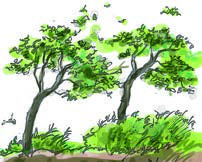
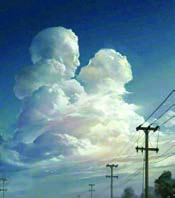
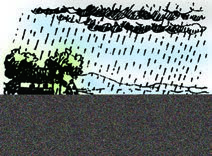
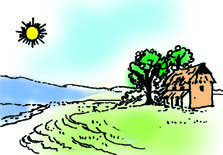
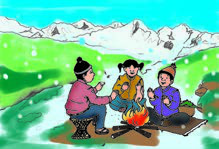
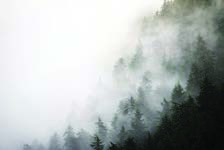
The second listening task plays an audio about how differently people treat the weather in two places, England and Dubai, and how global warming is involved. Your job is to match the beginnings of five sentences, about the people in England, the weather in England, the people in Dubai, the weather in Dubai, and global warming, with the correct endings from a list of six. One example is done: Different people think differently about the weather. Before the audio starts, read both columns and use grammar to narrow the choices. A singular subject like the weather or global warming needs a singular ending such as is very changeable or is changing weather patterns, while a plural subject like the people needs endings such as don't think about the weather much or are always concerned about the weather there. Predict your pairs, then listen to confirm or correct them, because only the audio can settle which country matches which attitude.
Writing a Notice
A notice is the shortest formal document a school produces, and every line of it earns its place. It appears on the noticeboard where hundreds of people will read it in a few seconds, so it must answer what, when, where and for whom without a wasted word.
A notice is a short formal announcement, displayed publicly, that gives complete information about one event or decision: what will happen, when, where, who it concerns, and who issued it.
- The name of the school or institution, centred at the top.
- The address, and below it the date of issue.
- The single word Notice as a title.
- A short body, often beginning This is to notify all the students that, stating the event, its dates and any instruction.
- The designation of the issuer at the bottom right, usually Head Teacher.
A vacation notice, for example, names the school and its address, gives the date it was issued, states the closing and reopening dates of the school and the reason, the summer vacation, and closes with the head teacher's designation. When you read any notice, train yourself to underline exactly these items: the dates, the event, and who it applies to. When you write one, check that a reader who knows nothing else could still act on it correctly.
A good notice passes the stranger test: someone who has heard nothing about the event can read it once and still know what is happening, when, where, and what they must do.
Linking Verbs
A linking verb connects the subject of a sentence with a word that gives information about the subject, such as a condition or relationship. It shows no action; it simply links the subject to the rest of the sentence.
In The ball is red, the verb is does nothing to the ball. It only connects the ball to its description, red. The common linking verbs are be in all its forms (is, are, was, were), become, seem, feel, sound, taste, look, smell, appear, remain, stay, prove and turn. Compare She tasted the soup, an action, with The soup tastes salty, a link: the same verb can act in one sentence and link in another. The test is simple: if the verb can be replaced by is or seems and the sentence still makes sense, it is working as a linking verb.
Project: Pictures That Persuade
The unit closes where it began, with images of a warming world, but this time you make them. In groups, prepare illustrations showing the impact of global warming on the environment: a shrinking glacier, a flooded village, a dried up spring, a storm hit farm. Display the illustrations on the classroom walls, walk around to study the other groups' work, and give each group feedback in English. This is the whole unit in one task: you are doing with drawings what James Balog did with twenty five cameras, turning evidence into images that make people think critically about climate change.
The full lesson is waiting for you
The notes are free to read in full. A free account opens the rest of the practice, and tracks your progress and confidence score for every subject. Presentations and videos need approval from Learn Yeti.